Bharat Milap Mandir sits on the Kamadgiri parikrama path, about 5 km from the main town area of Chitrakoot, set within a small clearing in the forested foothills below Kamadgiri. The Ramayana describes that after Shri Rama, Sita-mata, and Lakshmana left Ayodhya for the forest, the younger brother Bharata — who had refused to accept the throne — set out from Ayodhya with the royal household, the queen-mothers, and the people of the city, to find Rama and bring him back. He travelled long, crossed the Yamuna, took the blessings of the sage Bharadwaj at Prayag, and finally reached Chitrakoot. Tradition holds that here, at this very spot, the brothers met and embraced after their long separation.
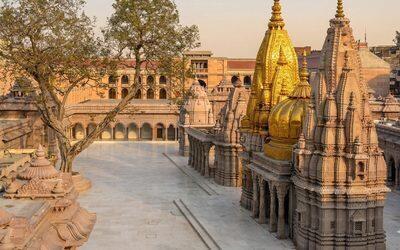
The shrine is not a grand temple. It is a small, stone-built mandir with a modest sanctum, a flagstone courtyard, and an old peepal tree at the edge of the compound. What draws pilgrims here is not architectural scale but bhav. To stand at Bharat Milap is to stand inside one of the most tender passages of the Ramayana — the moment when Bharata fell at his elder brother's feet and asked him to return, when Rama gently refused in order to keep his father's vow, and when Bharata received the charan-paduka (wooden sandals) to carry back to Ayodhya and place upon the throne in Rama's name.
The katha
The episode is known in the Ayodhya Kanda of the Valmiki Ramayana and is one of the most beloved passages of Tulsidas's Ramcharitmanas. After Dasharath's passing, Bharata refused to accept the kingdom that had been given to him through Kaikeyi's boon. He held that Rama was the rightful king, and that no rule could be just so long as Rama walked the forest as an exile. With Shatrughna at his side, the queen-mothers behind him, and the people of Ayodhya following, Bharata set out for Chitrakoot. The Ramayana describes that when the brothers finally saw each other, they wept and embraced; Lakshmana, who had first mistaken the approaching army for a hostile force, was the one to recognise Bharata's tilak from afar.
Bharata pleaded with Rama through the night and into the next day, urging him in the name of the kingdom, of dharma, and of their father's love. Rama refused gently but firmly, holding that a son's first duty is to honour his father's word. In the end Bharata accepted Rama's charan-paduka, returned to Ayodhya, and ruled from Nandigram for fourteen years not as king but as caretaker, placing the sandals upon the throne and considering himself only their servant. The shrine at Chitrakoot marks the ground where this exchange — the renunciation of two brothers, both for the sake of the other — took place.
Bharat Milap is held in Rama-bhakti tradition to embody one of the highest teachings of the Ramayana: that love between brothers, surrender to dharma, and the willingness to give up one's own claim for the sake of another are themselves a form of liberation. Devotees come here not so much to ask for boons as to absorb the bhav of the place — the bhav of bhratri-prem (brotherly love), of dharma-nishtha (steadfastness in duty), and of vairagya (the readiness to renounce). Many pilgrims stand quietly in the small courtyard and recite the Ayodhya Kanda chaupais from the Manas in a low voice. The local belief is that those who pray with sincerity at Bharat Milap receive harmony in their own families, healing of long-held quarrels between siblings, and the inward strength to forgive.
The shrine is also revered by sadhus and Ramayan-kathavachaks who pause here during their Chitrakoot yatra. Tulsidas himself is held to have meditated near this spot and composed parts of the relevant Manas chaupais by sitting under the surrounding trees.
చరిత్ర
Chitrakoot has been a continuously revered Ramayana-tirtha since the earliest layers of the epic tradition. The shrine at Bharat Milap is mentioned in regional sthala-puranas and in the oral traditions of Chitrakoot pandas and ashrams. The present stone mandir is the result of successive renovations across the medieval and modern periods. Bundela rulers of the 17th century are credited with rebuilding the sanctum in its current form; later patrons through the 18th and 19th centuries added the surrounding stone courtyard, the boundary walls, and the small dharamshala rooms for visiting sadhus. In the 20th century the path from Ram Ghat to Bharat Milap was paved, and the mandir was brought under the care of the Chitrakoot tirtha-trust along with local seva-samitis. The peepal tree at the edge of the compound is held by local tradition to be very old, and some pandas point to it as a silent witness from the time of the brothers themselves.
వాస్తుశిల్పం
The shrine is small and architecturally simple. A modest stone sanctum holds murtis of the four brothers — Shri Rama, Bharata, Lakshmana, and Shatrughna — shown in the moment of meeting, with Bharata bowing at Rama's feet. The sanctum opens onto a flagstone courtyard ringed by a low boundary wall. A single shikhara, plain and unadorned, rises above the sanctum. To one side stands the old peepal tree, its base wrapped in red cloth and surrounded by small offerings. A few sadhu-rooms and a one-room dharamshala line the back of the compound. There is no large mandapa, no elaborate stonework, no gilded shikhara — the deliberate simplicity is in keeping with the forest-bhav of Chitrakoot and the renunciate spirit of the episode the shrine commemorates.
ఆచారాలు & పూజలు
Daily worship at Bharat Milap is quiet and traditional. The pujari opens the sanctum before sunrise, bathes and dresses the murtis, and performs a simple shringar followed by morning aarti. Through the day pilgrims come, offer flowers and tulsi at the feet of the murtis, and many sit in the courtyard reciting chaupais from the Ayodhya Kanda of the Ramcharitmanas. Evening aarti is held at dusk; the courtyard is small enough that even a few dozen devotees fill it warmly.
The traditional Chitrakoot yatra-sequence places Bharat Milap between Ram Ghat and Kamadgiri: sunrise snan at Ram Ghat, walk up to Bharat Milap for darshan and a short Manas-paath, then continue to Kamadgiri for the parikrama. Many pilgrims also do a short charan-paduka darshan here, remembering Bharata's vow at Nandigram. Families seeking harmony at home often offer a small puja for bhratri-prem; those reconciling after long quarrels sometimes come together to bow at the sanctum.
పండుగలు & ఉత్సవాలు
| పండుగ | ఎప్పుడు | రద్దీ |
|---|---|---|
| Ram Navami | — | high |
| Bharat Milap day (Kartik) | — | very_high |
| Diwali Mela (Kartik Amavasya) | — | very_high |
| Hanuman Jayanti | — | high |
Ram Navami: The supreme Rama-bhakti day.
Bharat Milap day (Kartik): The day most directly tied to the episode this shrine commemorates.
Diwali Mela (Kartik Amavasya): The supreme Chitrakoot festival.
Hanuman Jayanti: Honours the Lord''s closest devotee.
Prepare for Your Visit
Practical guidance to help you plan your pilgrimage
| Pilgrim Guidance | How to reachBharat Milap Mandir lies on the Kamadgiri parikrama path, about 5 km from Ram Ghat and the central town area — most pilgrims reach the Kamadgiri base by auto-rickshaw and join the parikrama path on foot. The nearest railway station is Chitrakoot Dham Karwi (8 kilometres), well-connected to Jhansi, Prayagraj, and Lucknow. The nearest airports are Prayagraj (135 kilometres) and Khajuraho (175 kilometres). From the Kamadgiri base, follow the signed parikrama path past the small shrines; Bharat Milap is set back from the path in a small clearing. Auto-rickshaws and e-rickshaws from Karwi and Ram Ghat will drop pilgrims close to the Kamadgiri base; the walk to the mandir from there follows the parikrama path. PreparationThe mandir is small and the visit is quiet — a darshan of ten to twenty minutes is typical, longer if you wish to sit and read Manas chaupais. Carry tulsi or a few flowers if you wish to offer; otherwise simple folded hands are entirely sufficient. Many devotees pair the Bharat Milap darshan with the Kamadgiri parikrama (a five-kilometre walk around the sacred hill, taking two to three hours), so wear comfortable footwear and carry water if you plan to continue. Modest dress; cover shoulders and knees. Best time to visitOctober to March is most pleasant. Ram Navami (March–April) and Bharat Milap day during the Diwali Mela period bring special celebrations — kirtans, Manas-paath, and processions. Kartik Amavasya (the Diwali Mela at Chitrakoot) draws very large crowds across all Chitrakoot shrines; the Bharat Milap mandir is a quieter pause within that wider pilgrimage flow. |
ప్రదేశం
Satna, MP
యాత్రికుల ఫోటోలు
ఇంకా యాత్రికుల ఫోటోలు లేవు.
భక్తుల సవరణలు
ఇంకా సవరణలు లేవు.
సవరణల చరిత్ర
ఇంకా సవరణలు లేవు.
భరత్ మిలాప్ మందిరం, చిత్రకూటం సందర్శనను ప్లాన్ చేయండి
మీ ప్రయాణానికి ప్రత్యేక ప్రణాళిక, ధరలు పొందండి.
సిఫార్సు చేయబడింది
ఈ క్షేత్రానికి ప్యాకేజీలు
Pilgrim Notes
On-ground observations from fellow pilgrims
No pilgrim notes yet. Be the first to share on-ground observations!
Sign in to share a note.
Pilgrim Reviews
Be the first to share your experience at భరత్ మిలాప్ మందిరం, చిత్రకూటం.
Sign in to write a review.
సమీప పుణ్యక్షేత్రాలు
భరత్ మిలాప్ మందిరం, చిత్రకూటం దగ్గరున్న ఇతర పుణ్యక్షేత్రాలను చూడండి
MPలోని ఆలయాలు, తీర్థాలు, పుణ్యక్షేత్రాలను చూడండి
సమీపంలో చూడండిఈ యాత్రా మార్గాలలో భాగం
ఈ క్షేత్రం భాగమైన సంప్రదాయ యాత్రా మార్గాలలో నడవండి.