Surya Kund is the perennially boiling natural hot spring at Yamunotri Dham in Uttarkashi district, 3,293 metres above the sea on the western face of the Garhwal Himalaya. The kund lies a few steps below the Yamuna Devi temple — the source-shrine of the river Yamuna and one of the four sacred dhams of the Char Dham yatra. Its waters rise from the earth at approximately 88°C, so hot that they cook raw rice — and it is this very property that has given Surya Kund its singular place in the Yamunotri ritual tradition.
Tradition holds that the kund is a gift of Surya, the sun god, to his daughter Yamuna. When Yamuna chose to descend to the high Himalaya as a river of grace for mortals, her father — knowing the bitter cold of that altitude — placed a perennial warmth at her feet so that pilgrims and the goddess herself would never be without his presence. Every Yamunotri pilgrim today first approaches Surya Kund, ties a small cloth-bundle (potli) of raw rice and unpeeled potatoes, lowers it into the boiling water on a long cord, waits a few minutes, draws it out fully cooked, and carries it to the Yamuna Devi temple as the traditional Yamunotri prasad.
The Surya-Yamuna katha
The Puranic katha tells: Yamuna is the daughter of Surya by his consort Sanjna, and the sister of Yama, the lord of dharma. When the earth grew heavy with the karma of mortals, Yamuna agreed to descend as a river of liberation — a sister-stream to Ganga. She chose her source in the high snows of Kalinda Parvat (Bandarpunch range), at an altitude where the cold is unrelenting nine months of the year. Surya, watching his daughter take this difficult vow, sent his warmth into the earth beneath her shrine — so that wherever Yamuna sat, her father's heat would rise from below. Surya Kund is held to be the visible expression of that father-daughter bond: the gentle Yamuna held in the perennial warmth of her father, the sun. Adjacent to Surya Kund — slightly cooler, suitable for bathing — is Gauri Kund, named for Devi Parvati, completing the family-tirtha of Yamunotri.
Surya Kund is the focal ritual point of the entire Yamunotri yatra. To take Yamuna's darshan without first cooking the prasad at Surya Kund is held by long Garhwali tradition to be an incomplete pilgrimage; the rite is what binds the pilgrim to the deity, what makes the journey personal. The act of cooking-and-offering — preparing the goddess's prasad with one's own hands in her father's warmth — turns every Yamunotri pilgrim from a visitor into a participant in the lila. The Yamuna-bhakti tradition of north India holds Yamuna to be the mother of grace (karunamayi), the river who washes away the fear of Yama her brother; bathing in Yamuna at any point downstream is held to be sanctifying, but receiving her prasad from her source-kund is the supreme darshan. The high altitude, the bitter cold of the trek, the sudden warmth of the kund, the muslin bundle drawn boiling from the water — every element of the rite carries the bhav of a daughter held in her father's arms, and a pilgrim received into a family.
చరిత్ర
Surya Kund has been a pilgrim site for centuries; references to the Yamunotri shrine and its hot spring appear in medieval Garhwali tradition and in the accounts of pilgrims through the Char Dham route. The shrine itself was formally re-consecrated in the 19th century by Maharaja Pratap Shah of Tehri Garhwal, who built the present small temple of Yamuna Devi. The kund's stone-paved structure, with its containment wall and the cord-anchor for lowering rice-bundles, dates from the 19th-20th centuries; earlier the kund was an unwalled natural spring. The site has been damaged and rebuilt several times after floods and avalanches — most recently after the 2013 Uttarakhand cloudburst, which devastated much of the Yamunotri trail. The present stone-paved kund is a careful reconstruction faithful to the older pattern.
వాస్తుశిల్పం
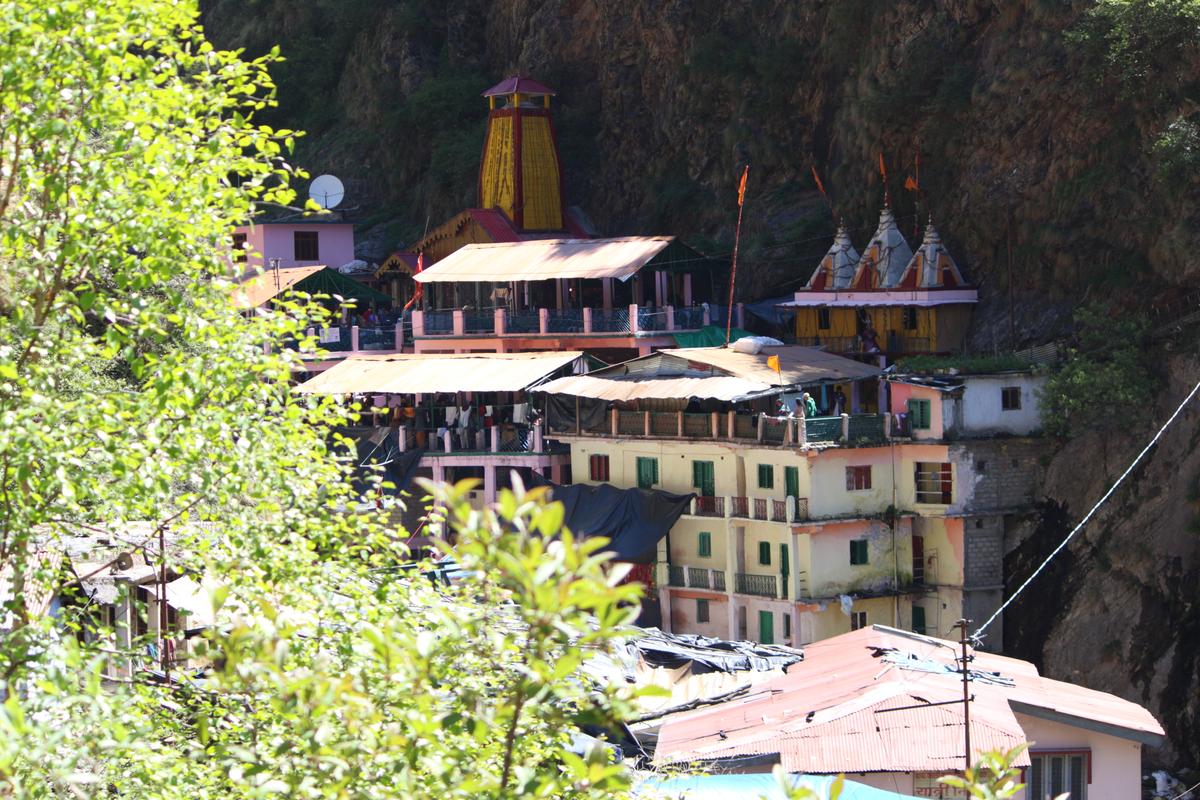
Surya Kund is a small stone-paved tank, roughly two metres across, walled on three sides with the natural spring rising at its centre. The water is held within carved stone — gray Himalayan granite — with a containment wall keeping the boiling spring contained for the cooking-ritual. A simple wooden cord-anchor at one edge allows pilgrims to lower their muslin cloth bundles (potlis) of rice and potatoes into the water and retrieve them safely. Just above the kund stands the small Yamuna Devi temple, a modest stone-and-wood Garhwali shrine with a low shikhara, weather-worn by the high-altitude climate. Adjacent to Surya Kund is Gauri Kund, slightly cooler, used for the ritual bath that the hotter Surya Kund cannot support. The whole tirtha-complex — Surya Kund, Gauri Kund, Yamuna Devi temple — is held within a small stone-walled compound on the steep slope below Kalinda Parvat.
ఆచారాలు & పూజలు
The principal ritual at Surya Kund is the cooking of the prasad. Pilgrims arrive at the kund with raw rice and small unpeeled potatoes — available at stalls along the Janki Chatti trek and at Yamunotri itself, often pre-bundled in a small muslin cloth (potli). The potli is tied to a long cord, lowered into the boiling kund water, left for a few minutes, and drawn out fully cooked. The pilgrim then carries the warm bundle a few steps up to the Yamuna Devi temple, offers it to the goddess as bhog, receives it back as prasad, and shares it with family.
Surya Kund itself is not for bathing — the water is far too hot. The adjacent Gauri Kund, fed by the same hot spring but tempered by mixing, is the bathing-kund. Pilgrims typically bathe in Gauri Kund first, then cook the prasad at Surya Kund, then take Yamuna-darshan at the temple — completing the three-fold ritual in that traditional sequence.
పండుగలు & ఉత్సవాలు
| పండుగ | ఎప్పుడు | రద్దీ |
|---|---|---|
| Akshaya Tritiya (Kapat Opening) | — | very_high |
| Yamuna Jayanti | — | high |
| Bhai Dooj (Kapat Closing) | — | very_high |
| Char Dham Yatra Season | — | high |
Akshaya Tritiya (Kapat Opening): The supreme opening-day of the Yamunotri yatra.
Yamuna Jayanti: The birth-day of Devi Yamuna.
Bhai Dooj (Kapat Closing): The closing-day of the Yamunotri yatra; the most sacred Yamuna-festival.
Char Dham Yatra Season: The Garhwali Himalayan yatra tradition.
Prepare for Your Visit
Practical guidance to help you plan your pilgrimage
| Pilgrim Guidance | How to reachYamunotri is reached via the 6 km uphill trek from Janki Chatti (the road head), which itself is a 5-6 hour drive from Dehradun via Barkot. The trek takes 3-5 hours on foot; ponies, dandis (palanquins), and porters are available at Janki Chatti. The trail climbs roughly 800 metres of altitude — moderately strenuous. Surya Kund sits at the trail's end, just below the Yamuna Devi temple. PreparationAltitude (3,293m) and cold are the principal concerns. Dress in layered woollens; weather changes rapidly even in summer. Carry a small muslin cloth or buy a pre-bundled potli of rice and potatoes at Janki Chatti or Yamunotri. Carry your own offering or buy one at the stalls. Avoid lowering hands directly into the kund — the water genuinely cooks. Use the provided cord and anchor. Best time to visitThe shrine is open only during the Yamunotri yatra season — typically from Akshaya Tritiya (late April or early May) to Bhai Dooj (late October or early November). The dham is closed in winter when snow makes the trek impassable. May-June and September-October are the most settled weather windows. Monsoon (July-August) brings landslides and trail risk. The first kapat-opening day and the last kapat-closing day draw very high crowds. |
ప్రదేశం
Uttarkashi, UK
యాత్రికుల ఫోటోలు
ఇంకా యాత్రికుల ఫోటోలు లేవు.
భక్తుల సవరణలు
ఇంకా సవరణలు లేవు.
సవరణల చరిత్ర
ఇంకా సవరణలు లేవు.
సూర్య కుండం, యమునోత్రి సందర్శనను ప్లాన్ చేయండి
మీ ప్రయాణానికి ప్రత్యేక ప్రణాళిక, ధరలు పొందండి.
సిఫార్సు చేయబడింది
ఈ క్షేత్రానికి ప్యాకేజీలు
Pilgrim Notes
On-ground observations from fellow pilgrims
No pilgrim notes yet. Be the first to share on-ground observations!
Sign in to share a note.
Pilgrim Reviews
Be the first to share your experience at సూర్య కుండం, యమునోత్రి.
Sign in to write a review.
సమీప పుణ్యక్షేత్రాలు
సూర్య కుండం, యమునోత్రి దగ్గరున్న ఇతర పుణ్యక్షేత్రాలను చూడండి
UKలోని ఆలయాలు, తీర్థాలు, పుణ్యక్షేత్రాలను చూడండి
సమీపంలో చూడండిఈ యాత్రా మార్గాలలో భాగం
ఈ క్షేత్రం భాగమైన సంప్రదాయ యాత్రా మార్గాలలో నడవండి.