Badrinath is the place where Hindu tradition sets the tapasya of Vishnu himself. Here the Lord is worshipped as Badrinarayan, called Badri Vishal by the pilgrims of the hills. The Shri Badarinath Kedarnath Temple Committee, which administers the shrine, describes the image in the sanctum as finely sculpted in black stone, seated in the meditative pose called padmasana, holding conch and chakra in two lifted arms with the other two rested in a yogic pose. This is not Vishnu in the splendour of Vaikuntha with consort and vahana. This is Vishnu withdrawn into meditation on a bare mountain, and that is the form the devotee comes here to see.
The temple stands in Chamoli district of Uttarakhand at an altitude of 3,133 metres, on the right bank of the Alaknanda, between the mountain ranges named for Nar and Narayan. Nine kilometres to the west rises Nilkantha, 6,596 metres, long called the Queen of the Garhwal, which stands over the valley through every hour of the pilgrim's day.
The name of the place comes from the badari, a wild berry of these slopes. Tradition tells that when the Lord sat in penance here with no shelter against sun and snow, Lakshmi took the form of a badari tree and stood over him; from that shelter come both the name Badrinarayan and the older name of the region, Badrika-ashram. The Bhagavata Purana speaks of Badrikashram as the place where the Personality of Godhead, in his incarnation as the sages Nara and Narayana, had been undergoing great penance since time immemorial. These twin sages, held in tradition to be an amsha-avatara of Vishnu and the sons of Dharma and Murti, are the presence the two mountain ranges are named for, and the Mahabharata identifies Arjuna with Nara and Krishna with Narayana. To stand before the sanctum is therefore to stand between them.
Badrinath belongs to several sacred orders at once. It is one of the four dhams of Uttarakhand, travelled together with Yamunotri, Gangotri and Kedarnath, and in the usual order of the yatra it is the last of them. It is counted among the 108 Divya Desams held sacred in Vaishnava tradition, which is why a Garhwali shrine above the snow line is sung in the Tamil devotional world of the far south. That binding of north and south is not only a matter of hymns. The Rawal, the head priest of Badrinath, is by long tradition a Nambudiri Brahmin from Kerala, and he is assisted by the Garhwali Dimri Brahmins of Dimmar village in Chamoli. In this one sanctum, Kerala and Garhwal serve the same Lord daily.
For roughly half the year no pilgrim reaches the temple. The kapat close in autumn, an Akhand Jyoti of ghee is lit to burn through the winter darkness, and the worship of Badri Vishal continues below the snow line at Yogadhyan Badri in Pandukeshwar, where the temple committee places the utsav-murti through the cold months; tradition also holds the Lord to be notionally present at the Narasimha temple in Jyotirmath until the doors open again. Devotees do not receive this as a seasonal timetable. They understand it as the Lord withdrawing into his own retreat when the mountain closes, and returning to receive his people when the passes open again.
Nor does the kshetra end at the temple steps. Below the shrine, between the temple and the Alaknanda, lie the hot waters of Tapt Kund, where pilgrims bathe before darshan. Half a kilometre away are Narad Kund and Brahma Kapal, where families offer shraddha for their ancestors on the river bank. Above and beyond are Charanpaduka with its rock bearing the footprints of the Lord, the Mata Murti temple, the Panch Shila and the five streams of the Panch Dhara, and the village of Mana with the Saraswati, the Vyas and Ganesh caves and the road onward to Vasudhara. A pilgrim who has time gives Badrinath more than a morning.
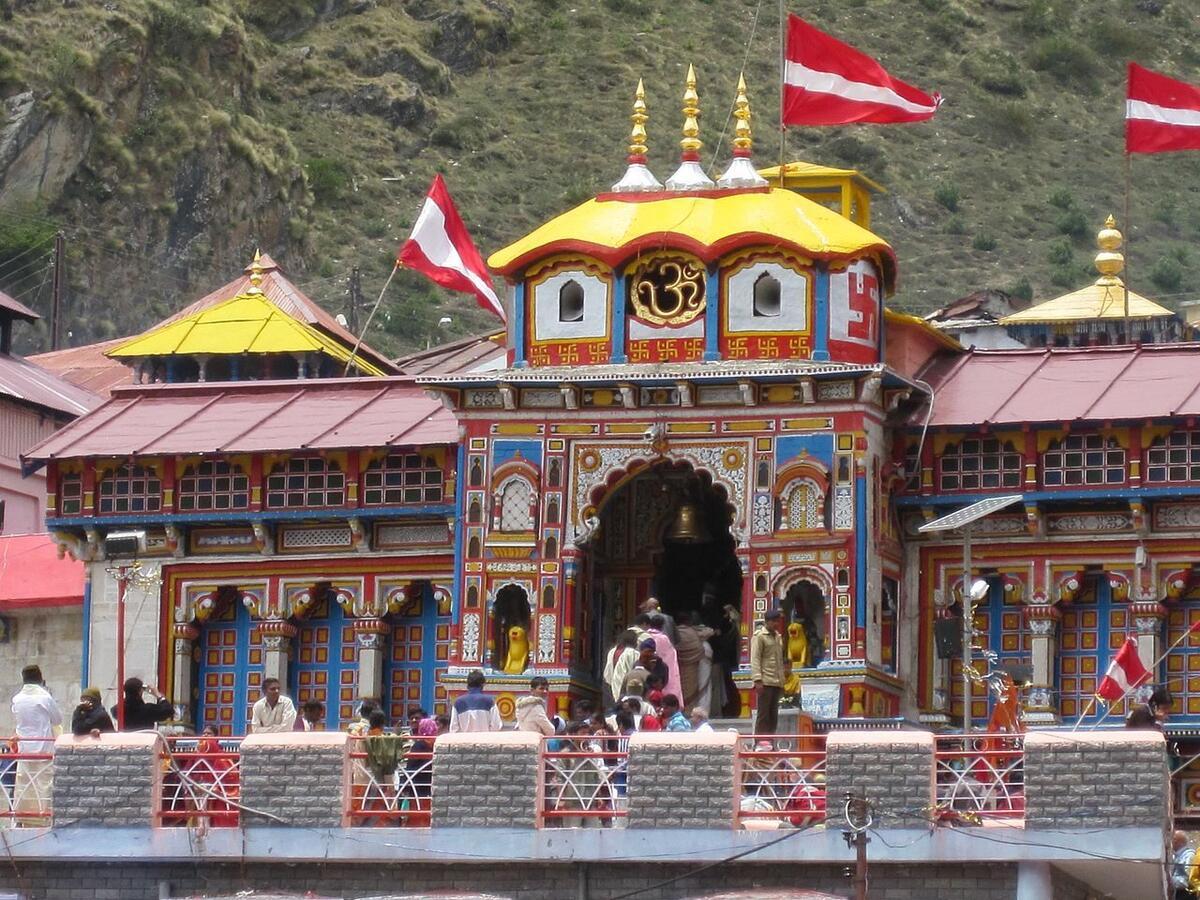
The devotional weight of Badrinath rests on a single idea: that the Lord who sustains the worlds is here found in penance. Elsewhere Vishnu is served as king and protector. At Badrinath he is seated in padmasana with his hands in a yogic pose, and the pilgrim who climbs to 3,133 metres to bow before that image is bowing before restraint rather than splendour. Devotees hold that this darshan settles something in a person that no amount of ordinary worship reaches.
Because the shrine belongs both to the Uttarakhand Char Dham and to the 108 Divya Desams of the Vaishnava tradition, two great streams of Hindu devotion meet in one sanctum. A family from the Garhwal hills and a family that has come up from the Tamil country stand in the same queue, addressing the same Lord by names their grandmothers used. For many pilgrims the Char Dham yatra is felt to be complete only when Badri Vishal has been seen, and it is common to keep the traditional order and take darshan of Baba Kedar before coming on to Badrinath.
Badrinath is also one of the great places where Hindus discharge their debt to the dead. On the bank of the Alaknanda at Brahma Kapal, pilgrims perform shraddha karma and offer oblations for departed ancestors with the help of the priests. Families carry that sankalp across the country to make it here, and many come to Badrinath for this reason before they come for anything else.
Katha and local belief
The katha of the badari tree is the first thing a child is told about this place. Vishnu, absorbed in tapasya on the open mountain, took no notice of the cold or the sun; Lakshmi, unwilling to see him unsheltered, became the berry tree that stood over him. Devotees draw a plain lesson from it: the Mother's care arrives where it is needed, without being asked, and often without being noticed.
The Bhagavata Purana places at Badrikashram the great penance of Nara and Narayana. Tradition tells that when the devas grew uneasy at the power of that austerity and sent celestial nymphs to break it, the sage Narayana placed a flower upon his thigh and from it sprang a nymph more beautiful than any of them, Urvashi, named from uru, the thigh. The katha is not told to celebrate a victory. It is told to show a tapasya so complete that temptation could not find a hold in it.
Around Badrinath the memory of the Pandavas lies close to the ground. At Mana, tradition points to the great rock lying across the Saraswati as the Bhim Pul, held to have been set there by Bhima, and to the cave where Ved Vyas is believed to have lived while composing the Vedas. Beyond Mana, at the Vasudhara falls, local belief holds that the falling water will not touch the body of one who has sinned, and pilgrims stand beneath the spray to see whether it will come to them.
The last of the kathas belongs to the temple's own history. Adi Shankaracharya, tradition says, recovered the image of Badrinarayan from the waters of Narad Kund and enshrined it here, and after him the Rawal has come from Kerala to serve a Himalayan shrine. Devotees read that arrangement as the acharya's own answer to those who imagine the sacred geography of the country to be divided.
History
Worship in this valley is older than any account of the building that now stands here. The Puranic literature knows Badrikashram as an ashram of penance long before it knows it as a temple, and the enduring historical thread at Badrinath is not construction but continuity: an image, a river bank, and an unbroken habit of return.
Of the shrine itself, the Shri Badarinath Kedarnath Temple Committee records that Adiguru Shankaracharya recovered the image from Narad Kund and re-enshrined it in the eighth century CE, at a time when the committee describes the acharya as working to restore the standing of Hindu practice in the Himalaya. Some reference accounts place the same act in the ninth century, and some hold that the image was recovered from the Tapt Kund rather than Narad Kund. What all versions agree on is the act: a lost murti restored to worship, and a line of daily service established that has not lapsed since.
The building was enlarged by the Garhwal kings in the seventeenth century. The Garhwal earthquake of 1803 damaged it severely, and it was largely rebuilt afterwards by the King of Jaipur. Avalanche, snow load and earth movement have required repair many times over, so that the fabric a pilgrim sees today is layered rather than ancient, while the worship inside it is the older thing.
The priestly arrangement has held through all of it. The Rawal is drawn from the Nambudiri Brahmins of Kerala, is expected to hold the degree of Acharya in Sanskrit, and by tradition remains a bachelor; the Garhwali Dimri Brahmins of Dimmar village in Chamoli assist in the daily service. The temple, together with Kedarnath and the associated shrines of the region, is administered by the Shri Badarinath Kedarnath Temple Committee, which publishes the puja and yatra arrangements each season.
Architecture
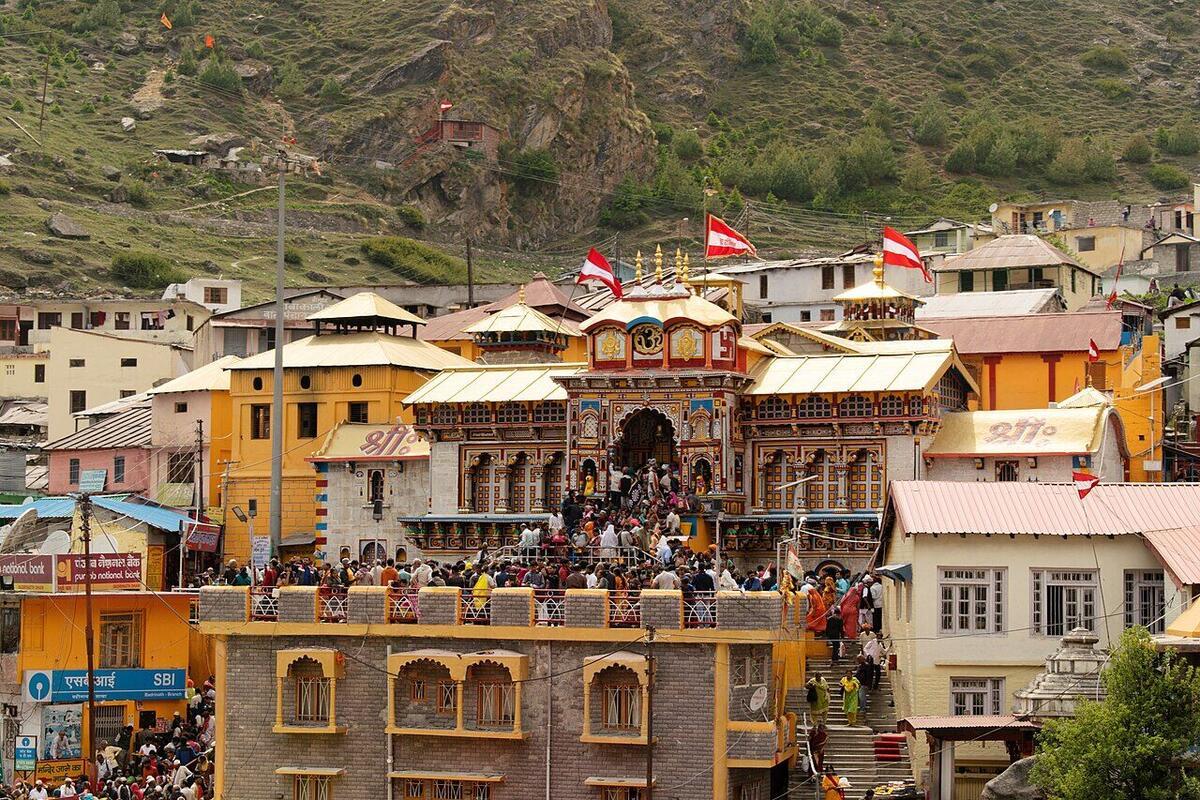
The face Badrinath turns to the pilgrim is unlike anything else on the Char Dham route. A broad stairway climbs to a tall arched gateway, the Singhdwar; above it the front of the temple is brightly painted, pierced with arched windows, and crowned by a conical roof about fifteen metres tall carrying a small cupola under a gilt gold covering. Against grey rock and snow, that painted front is one of the most recognisable forms in Hindu sacred architecture.
Within, the temple committee describes three parts. The garbha griha holds the sanctum; the darshan mandap is where the rituals are conducted; and the sabha mandap, a spacious pillared hall, is where pilgrims gather. The movement from the open stairway to the pillared hall to the small sanctum draws the pilgrim inward by stages, which is exactly what the darshan itself does.
The complex holds fifteen images. Besides Badri Narayan himself, there are Nar and Narayan, Kuber the lord of wealth, Narad, and Uddhava. The presence of Nar and Narayan inside the temple, and of the two mountain ranges bearing their names outside it, means the katha of the place is written both in stone and in the skyline.
Nothing here reaches for the scale of the great southern temple cities, and nothing needs to. The building is small, high, bright and repeatedly rebuilt, and its authority comes from the fact that it has been held to its place on this bank of the Alaknanda through earthquake and avalanche for as long as anyone can trace.
Rituals & Practices
Worship at Badrinath keeps the concentrated rhythm of a shrine open only half the year. The temple committee gives the morning Abhishek puja as roughly 4:30 AM to 6:30 AM. Ved path and Geeta path are listed from about 7:30 AM to noon and again from about 3:00 PM to 5:00 PM. The evening aarti begins around 6:00 PM in the summer season and the temple stays open until about 8:30 PM, while the Shayan aarti has no fixed starting time and depends on how the queue is moving. Timings shift with the season, the weather and the crowd, so confirm the current schedule with the temple committee before planning around a particular aarti.
Sankalp pujas here are booked rather than walked into. The temple committee requires prior registration for puja, path, aarti and bhog bookings, and the registration must be made from an Indian mobile number. Seats for each puja are limited and are released season by season, so book well before you travel rather than on arrival.
The pilgrim's own sequence at Badrinath is simple and old. Most bathe first in the hot waters of Tapt Kund, which lie between the temple and the Alaknanda, or at Narad Kund nearby, and go up to the sanctum afterwards. Those who have come with a sankalp for their ancestors go to Brahma Kapal on the river bank, where shraddha karma and oblations for the departed are performed with the help of the priests. Tulsi, flowers and the offerings usual to Vishnu worship are given at the shrine; sugar balls are the common prasad, and since May 2006 a Panchamrit prasad prepared locally and packed in local bamboo baskets has also been distributed.
When the kapat close for the winter, the Akhand Jyoti is lit with ghee to burn through the six dark months, and worship of Badri Vishal continues below at Yogadhyan Badri in Pandukeshwar, where the utsav-murti is kept, while tradition holds the Lord to be notionally present at the Narasimha temple in Jyotirmath until the doors open again.
Festivals & Celebrations
| Festival | When | Crowd |
|---|---|---|
| Kapat opening (start of the yatra season) | — | Very high |
| Badri Kedar Festival | — | High |
| Mata Murti ka Mela | — | Moderate to high |
| Shraddha at Brahma Kapal | — | Steady rather than peaked |
| Kapat closing and the Akhand Jyoti | — | High on the final darshan day |
Kapat opening (start of the yatra season): Devotees understand the opening as the Lord receiving his people again after his winter retreat. Badrinath customarily opens a day after Kedarnath, and many families keep that order in their yatra.
Badri Kedar Festival: It expresses the paired identity of the two great Garhwal dhams, the Vaishnava and the Shaiva, held by tradition as one pilgrimage rather than two.
Mata Murti ka Mela: Mata Murti is revered as the mother of Nar and Narayan, and the mela honours the maternal presence that tradition places at the origin of this kshetra.
Shraddha at Brahma Kapal: Badrinath is among the great sites where Hindus discharge the debt owed to the ancestors, and for many families this rite, rather than sightseeing, is the reason for the journey.
Kapat closing and the Akhand Jyoti: Worship of Badri Vishal continues below the snow line at Yogadhyan Badri in Pandukeshwar, where the utsav-murti is kept through the winter, while tradition holds the Lord to be notionally present at the Narasimha temple in Jyotirmath until the doors open again in spring.
Temple Details
| Timings | bhog: Kheer Bhog 7:30â8:30 AM; Pind Prasad available around 8:00 AM; Yatri Bhog (daily bhog of Shri Badarinath ji) distributed to pilgrims around 1:00 PM (BKTC) note: BKTC publishes puja/aarti timings, not a separate general-darshan timetable; plan around the 4:30 AM opening abhishek and the evening aarti sequence and confirm the day's queue status at the darshan slot-token counter season: Open only about six months a year â kapat opens late April / early May and closes for winter in November (BKTC: 'open for public views from April/May to November'); see closure_info day_paths: Ved Path and Geeta Path 7:30 AM â 12:00 noon and 3:00 PM â 6:00 PM (BKTC online booking schedule) shayan_aarti: Shayan Aarti with Geet Govind Path â no fixed start time; it begins only after all pilgrims in the queue have had darshan (BKTC) evening_aarti: Kapoor Aarti 6:00â6:10 PM, Chandi Aarti 6:15â6:30 PM, Swaran Aarti 6:30â6:45 PM, Astotari Puja 6:45â7:00 PM, Vishnu Sahasranam Path 7:00â7:20 PM, Vishnu Sahasranamawali 7:20â7:45 PM (BKTC booking schedule). BKTC terms: evening aarti starts around 6:00 PM in the summer season and runs till 8:30 PM excluding Shayan Aarti eclipse_closure: The temple is closed to pilgrims during solar and lunar eclipses; booked pujas are rescheduled (BKTC) morning_abhishek: Maha Abhishek / Abhishek puja 4:30 AM â 6:30 AM (BKTC online booking schedule; BKTC terms say Abhishek is performed every morning from 4:00 AM till 6:30 AM). Attending pilgrims must reach the temple gate 15â30 minutes earlier |
| Darshan Types | General darshan (free) Mandatory free Char Dham registration must be done first (registrationandtouristcare.uk.gov.in / the official Android-iOS app / offline counters). Carry the Yatra Registration Letter with QR code â it is verified at the Pandukeshwar check point â and collect a Dham darshan slot token at the queue token slot counter (Badrinath ISBT / BRO circle / Mana parking) for a smooth darshan (Tourist Care Uttarakhand). Attending puja / aarti (paid, BKTC online booking) Duration: Individual evening aartis run 10â25 minutes each; morning Abhishek 4:30â6:30 AM Book on badrinath-kedarnath.gov.in (BKTC: 'Registration must be from Indian Mobile Number'). Carry the puja receipt and a valid government photo ID (foreigners: passport and visa). Reach the temple gate 15â30 minutes early for morning Abhishek/Path/Aarti and show the receipt at the puja counter 15â20 minutes before evening aartis. If you cannot attend, the puja is performed in your name and gotra by the priests. Bookings are non-refundable and non-transferable (BKTC). |
| Pooja Services | Maha Abhishek Puja â 4:30â6:30 AM, â¹5,500 (attending)Abhishek Puja â 4:30â6:30 AM, â¹5,300 (attending)Entire Pujas of the Day â 4:00 AMâ8:00 PM, â¹15,000Srimad Bhagwat Saptah Path â â¹1,00,000Ved Path â 7:30 AMâ12 noon & 3â6 PM, â¹3,100Geeta Path â 7:30 AMâ12 noon & 3â6 PM, â¹3,100Kapoor Aarti â 6:00â6:10 PM, â¹501Chandi Aarti â 6:15â6:30 PM, â¹701Swaran Aarti â 6:30â6:45 PM, â¹901Astotari Puja â 6:45â7:00 PM, â¹701Vishnu Sahasranam Path â 7:00â7:20 PM, â¹1,001Vishnu Sahasranamawali â 7:20â7:45 PM, â¹1,001Shayan Aarti with Geet Govind Path â end of day (no fixed time), â¹5,001Pind Prasad (for pilgrims doing pind daan) â â¹101, available around 8:00 AMYatri Bhog â â¹101 and above; Kheer Bhog â â¹2,100 (7:30â8:30 AM); Parvi Khichdi Bhog â â¹1,001Akhand Jyoti â â¹2,100 (one day) / â¹6,000 (one year); Ghrit Kambal, Ghee for Deepak and Akhand Jyoti on closing day â â¹6,000 eachNitya Niyam Bhog â â¹15,000 (Shri Badarinath ji) / â¹10,000 (deities of subordinate temples)Atka Prasad by post â â¹501 (ordinary post) / â¹1,100 (registered post)Bandhan (10-year) pujas: Maha Bhog â¹45,000; Abhishek â¹51,000; Bal Bhog â¹10,000; Vishnu Sahasranam Path â¹10,000; Sahasranamawali â¹12,000; Astotari Path â¹5,100; Swaran Aarti â¹6,100; Chandi Aarti â¹5,100; Kapoor Aarti â¹3,000Special-occasion pujas: Nar Narayan Janmotsav (Shravan) â¹6,100; Shravani Rudrabhishek â¹15,000; Shri Krishna Janmashtami Utsav â¹15,000; Mata Murti Utsav (Vaman Dwadashi) â¹10,000; Deep Malika Utsav (Deepawali) â¹10,000All rates are BKTC's published online rates as of 2026-09-03 and may change; donations get 50% exemption under section 80G (Indian rupees only) |
| Management | Shri Badarinath Kedarnath Temple Committee (BKTC), Government of Uttarakhand — constituted under the Shri Badarinath and Shri Kedarnath Mandir Act, 1939 (BKTC: 'constituted as per 1939 Act'; Act name per Wikipedia). BKTC: the chief priests are Namboodiri Brahmins of the 'Malawar' (Malabar) region of South India, and the chief priest is known as Rawal Ji (Wikipedia: Nambudiri Brahmins from Kerala). |
| Entry Fee | Free entry · No darshan ticket is sold â BKTC charges only for optional pujas, aartis and bhog. Char Dham yatra registration is free ('there is no fee for registration for Char Dham' â Tourist Care Uttarakhand FAQ). |
Prepare for Your Visit
Practical guidance to help you plan your pilgrimage
| Rules & Restrictions |
|
| Best Time to Visit | May–June and September–October. BKTC's prose calls summer (May–June) 'ideal for all sight seeing and the holy Badarinath pilgrimage' and September 'an ideal month'; its attraction entries list 'May, Jun, Sep, Oct', while the Badrinath page header lists May–November as visiting months. BKTC describes monsoon (July to mid-September) as prone to rain, landslides and road blocks — check the Rishikesh–Badrinath road condition before starting — and winter (October to April) as sub-zero with snow; roads are typically blocked by snow January–April and the temple is closed. Carry woollens even in summer: BKTC's month guide gives May 11–22 °C, June 9–16 °C, September 11–14 °C, October 12–17 °C with cold nights. |
| How to Reach | by air: Jolly Grant Airport, Dehradun is the nearest airport â about 314 km (BKTC) / 317 km (Chamoli district) from Badrinath; taxis are available from the airport to Badrinath (BKTC). nearby: Mana village (last Indian village) 4.4 km; Ganesh Cave (Mana) 4.5 km; Bheem Pul 3 km; Mata Murti Temple 3 km; Charan Paduka 2.5 km; Vyas Cave 5 km; Narad Kund 0.5 km; Brahma Kapal 0.5 km per BKTC's distance list (its prose says 'around two kilometers'); Sheshnetra 0.23 km; Panch Dhara 1 km; Pandukeshwar / Yogdhyan Badri 22.6â23 km (BKTC). by road: Badrinath is on National Highway 58. Distances: Rishikesh 297â298 km, Haridwar 320â324 km, Dehradun 340 km, Delhi 530 km (Chamoli district / BKTC; Tourist Care Uttarakhand gives ~300 / ~320 / ~330 km). Buses to Haridwar, Rishikesh and Srinagar leave from ISBT Kashmiri Gate, Delhi; buses and taxis to Badrinath are available from Dehradun, Haridwar, Rishikesh, Pauri, Rudraprayag, Karnaprayag, Ukhimath, Srinagar, Chamoli and Joshimath (BKTC). Chamoli district: 'Local Transport Union Buses and State Transport buses operate between Badrinath and Rishikesh (297 km)'. by train: Rishikesh is the nearest railhead, about 295â298 km from Badrinath on NH58 (BKTC; Chamoli district says 297 km approx). Haridwar and Dehradun stations are the other options; buses and taxis onward from Rishikesh. from joshimath: Joshimath is around 45 km from Badrinath (BKTC); Jyotirmath/Joshimath's Shri Narsingh Temple is the winter seat of Badrinath's deities. from kedarnath: Kedarnath to Badrinath 247 km via GaurikundâGuptkashiâRudraprayagâChamoli (BKTC Route 1), or 229 km via UkhimathâChoptaâGopeshwarâChamoli (BKTC Route 2). Chamoli to Badrinath is 96 km. road route from rishikesh: Rishikesh â Devprayag (71 km) â Kirtinagar (30) â Srinagar (4) â Rudraprayag (34) â Gauchar (20) â Karnaprayag (12) â Nandprayag (20) â Chamoli (11) â Birahi (8) â Pipalkoti (9) â Garur Ganga (5) â Helang (15) â Joshimath (14) â Vishnuprayag (13) â Govindghat (8) â Pandukeshwar (3) â Hanumanchatti (10) â Badrinath (11); Haridwar adds 24 km (BKTC route table: Rishikesh 298 km, Haridwar 324 km). |
| Pilgrim Guidance | Reaching BadrinathBadrinath is reached entirely by road, and no trek is needed at the end of it: unlike Kedarnath, where the road stops at Gaurikund and a sixteen-kilometre climb follows, the highway runs into the temple town itself. The Uttarakhand government's yatra portal gives the main route as Dehradun to Rishikesh, then Devprayag, Rudraprayag, Karnaprayag, Nandaprayag, Joshimath and Badrinath. Road distances given on the same portal are roughly 300 km from Rishikesh, 320 km from Haridwar, 330 km from Dehradun, 230 km from Kedarnath, 300 km from Gangotri and 350 km from Yamunotri. The nearest railway station is Rishikesh, which the temple committee places 295 km away, and the nearest airport is Jolly Grant at Dehradun, about 314 km away. Charter helicopter services operate from Dehradun. The last stretch needs respect. The state portal itself describes the 45 km from Joshimath to Badrinath as scenic but landslide-prone, so check road conditions before you set out. During and just after the monsoon this road can close at short notice. Build slack into your plan rather than a tight connection, and treat any day lost to a blocked road as part of the yatra rather than a failure of it. Registration and the seasonRegistration is mandatory and free. The Uttarakhand government requires every pilgrim and vehicle to register before starting the journey to the Char Dham and Hemkund Sahib, through the official Tourist Care portal at registrationandtouristcare.uk.gov.in or the Tourist Care Uttarakhand mobile app. Download and carry the QR-coded Yatra Registration Letter and a valid personal ID. For Badrinath, verification points are located at the Badrinath ISBT, the BRO circle and the Mana parking area, and a queue token slot counter operates at the temple itself. The shrine is open from roughly late April or May until November. The opening date is fixed afresh each year and announced in advance; for 2026 the state yatra portal gives the kapat opening of Badrinath Dham as 23 April 2026, a day after Kedarnath, and many families keep that order. The closing falls on an auspicious day in October or November, traditionally on Bhai Dooj or after it, and is announced during the season rather than fixed in advance. Check the temple committee's published dates before booking travel, and do not rely on last year's dates. Preparing for the heightBadrinath sits at 3,133 metres and the surrounding sites are higher still, with Mana at about 3,200 metres. Anyone arriving from the plains should allow a night at a lower elevation such as Joshimath or Pandukeshwar rather than driving straight up and going for darshan the same evening. Carry proper woollens and a windproof layer whatever the calendar says, since the temperature drops sharply once the sun leaves the valley, and carry any regular medication with you rather than in checked baggage. Pilgrims with heart, lung or blood pressure conditions, and those travelling with elderly parents or small children, should take medical advice before the journey and pace the days gently. Allow more than a single morning if you can. The temple committee's own recommendation for the town is a stay of one day, but the committee gives Charanpaduka as 2.5 km from the temple, an uphill climb it puts at about an hour and a half, the Mata Murti temple is about 3 km off, Mana village is a little over four kilometres away, and the Vasudhara falls lie about 9 km from Badrinath with a trek of roughly three hours from Mana, usually accessible from the second week of May until October or November. These are walks at altitude, not strolls; start early, carry water, and turn back without regret if the body says so. |
| Weather | summer_may_june: Pleasant, moderately cold; May 11â22 °C, June 9â16 °C; light woollens recommended, colder at night (BKTC) winter_november_april: Sub-zero minimums, heavy snowfall, roads blocked; November 6â14 °C, January 1â8 °C; temple closed (BKTC) autumn_september_october: September 11â14 °C, sunny, an ideal month; October 12â17 °C, cold pleasant days, chance of snowfall late in the month (BKTC) monsoon_july_mid_september: Regular rain, temperature drops, landslides and road blocks possible; July 11â14 °C, August 12â16 °C (BKTC) |
| Pilgrim Tips |
|
Location
Chamoli, UK
Pilgrim photos
No pilgrim photos yet.
Official Links
Community corrections
No corrections yet.
Edit history
No revisions yet.
Plan Your Visit to Badrinath Temple
Get a custom itinerary and pricing for your trip.
Pilgrim Notes
On-ground observations from fellow pilgrims
No pilgrim notes yet. Be the first to share on-ground observations!
Sign in to share a note.
Pilgrim Reviews
15 reviews
Be the first to share your experience at Badrinath Temple.
Sign in to write a review.
Nearby sacred places
Discover other sacred places near Badrinath Temple
Explore temples, tirthas, and pilgrimage sites in UK
Explore nearbyPart of these circuits
Walk the traditional pilgrimage routes this destination belongs to.