Sarnath is the place where, in Buddhist tradition, the Dhammacakkappavattana took place — the "turning of the wheel of Dharma." Here, at the deer park known as Mrigadava or Isipatana, the Buddha is said to have delivered his first teaching after attaining enlightenment at Bodh Gaya, to the five ascetics who had formerly been his companions in austerity. Their acceptance of the teaching is held to be the founding of the first Sangha.
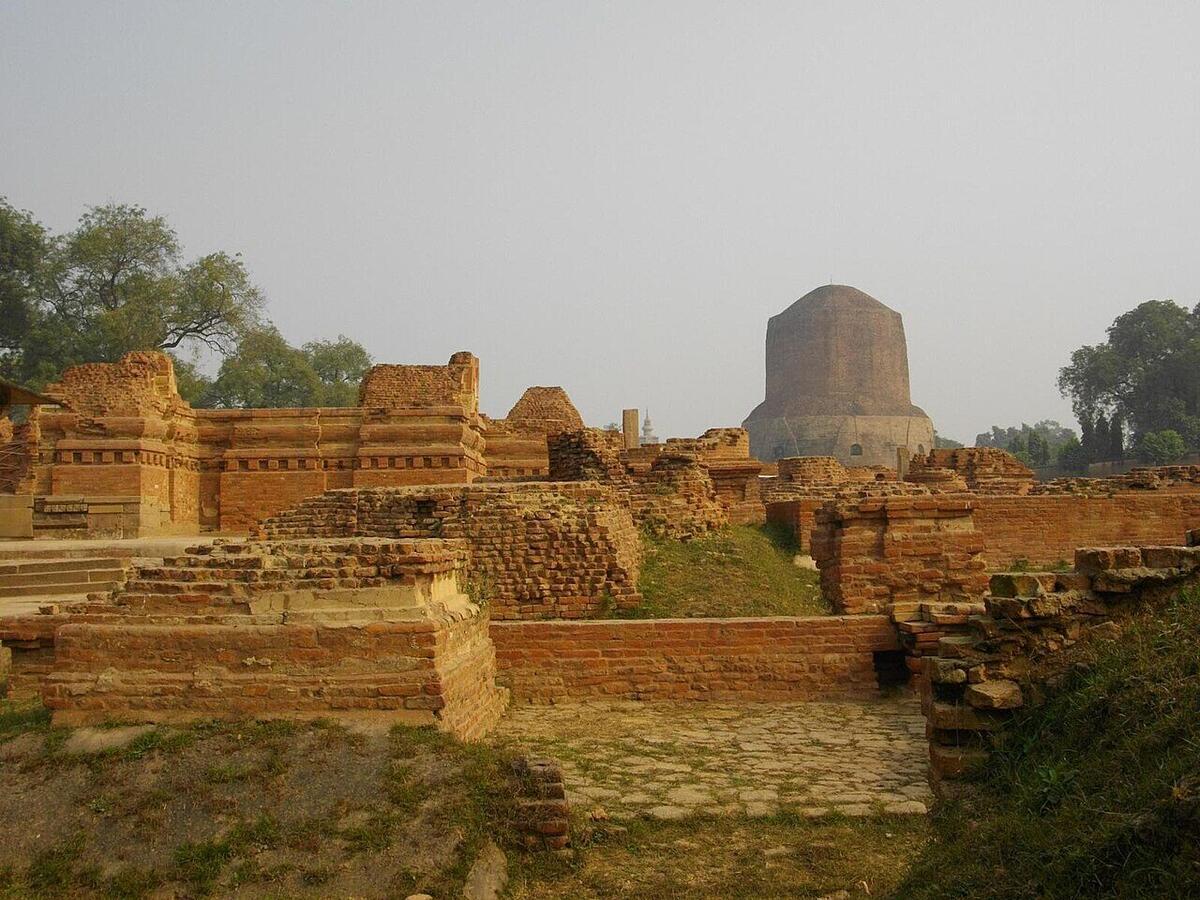
The site lies about ten kilometres north of Varanasi, within a compound that now combines archaeological ruins, modern viharas built by Buddhist communities from many countries, and the Sarnath Museum that houses the Ashokan Lion Capital. The central monument is the Dhamek Stupa — a cylindrical stupa 43 metres in height, marking, by tradition, the very spot of the first sermon.
Sarnath is counted among the four principal sites of Buddhist pilgrimage, alongside Lumbini (the Buddha's birth), Bodh Gaya (his enlightenment), and Kushinagar (his parinirvana). Pilgrims from Sri Lanka, Myanmar, Thailand, Tibet, Japan, Korea, and many other lands continue to come to Sarnath, and the site functions today as a quiet, reverent space of meditation and study.
The teaching delivered at Sarnath is the Dhammacakkappavattana Sutta — the discourse that is said to have set the wheel of Dharma in motion. In it, the Buddha laid out the Middle Way, the Four Noble Truths (the truth of suffering, its origin, its cessation, and the path to its cessation), and the Noble Eightfold Path. These teachings are regarded as the foundation upon which all later Buddhist schools rest.
Buddhist tradition holds that the first sermon was delivered to five ascetics — Kondanna, Vappa, Bhaddiya, Mahanama, and Assaji — who had earlier left the Bodhisattva when he abandoned severe austerity. At Sarnath, upon hearing the teaching, they became the first members of the Sangha. This moment is considered the founding of the Buddhist community.
The wider sacred significance
Sarnath is one of the four principal samvega-sthana — "places of noble urgency" — that the Buddha himself, according to the Mahaparinibbana Sutta, named as fit for pilgrimage:
- Lumbini — the place of his birth
- Bodh Gaya — the place of his enlightenment
- Sarnath — the place of the first sermon
- Kushinagar — the place of his parinirvana
Tradition holds that darshan of these four places brings particular merit to the Buddhist pilgrim, and many complete them in a single yatra. Sarnath, where the teaching first began, is often considered the site at which the Buddhist path becomes most visible as a continuing practice.
History
Sarnath's continuous recorded history begins with Emperor Ashoka in the 3rd century BCE. After embracing Buddhism, Ashoka built stupas, viharas, and a lion-crowned pillar at Sarnath. A fragment of the pillar still stands at the site; its Lion Capital, carved around 250 BCE, is now housed in the Sarnath Museum and was adopted in 1950 as the State Emblem of India.
Over the following centuries, Sarnath became one of the principal Buddhist monastic centres of the subcontinent. The Chinese pilgrim Xuanzang, travelling here in the seventh century, described thirty monasteries and around three thousand monks in residence. The great Dharmarajika Stupa rose at the site, and the deer park attracted pilgrims from across Asia.
The site suffered severe destruction during the invasions of the late 12th century; monasteries were broken, stupas were dismantled, and Sarnath fell into disuse. For several centuries the site lay buried under farmland and was largely forgotten. In 1835, the British archaeologist Alexander Cunningham began the excavations that uncovered the Dhamek Stupa, the Ashokan pillar, and much else; systematic archaeological work continued through the late 19th and 20th centuries.
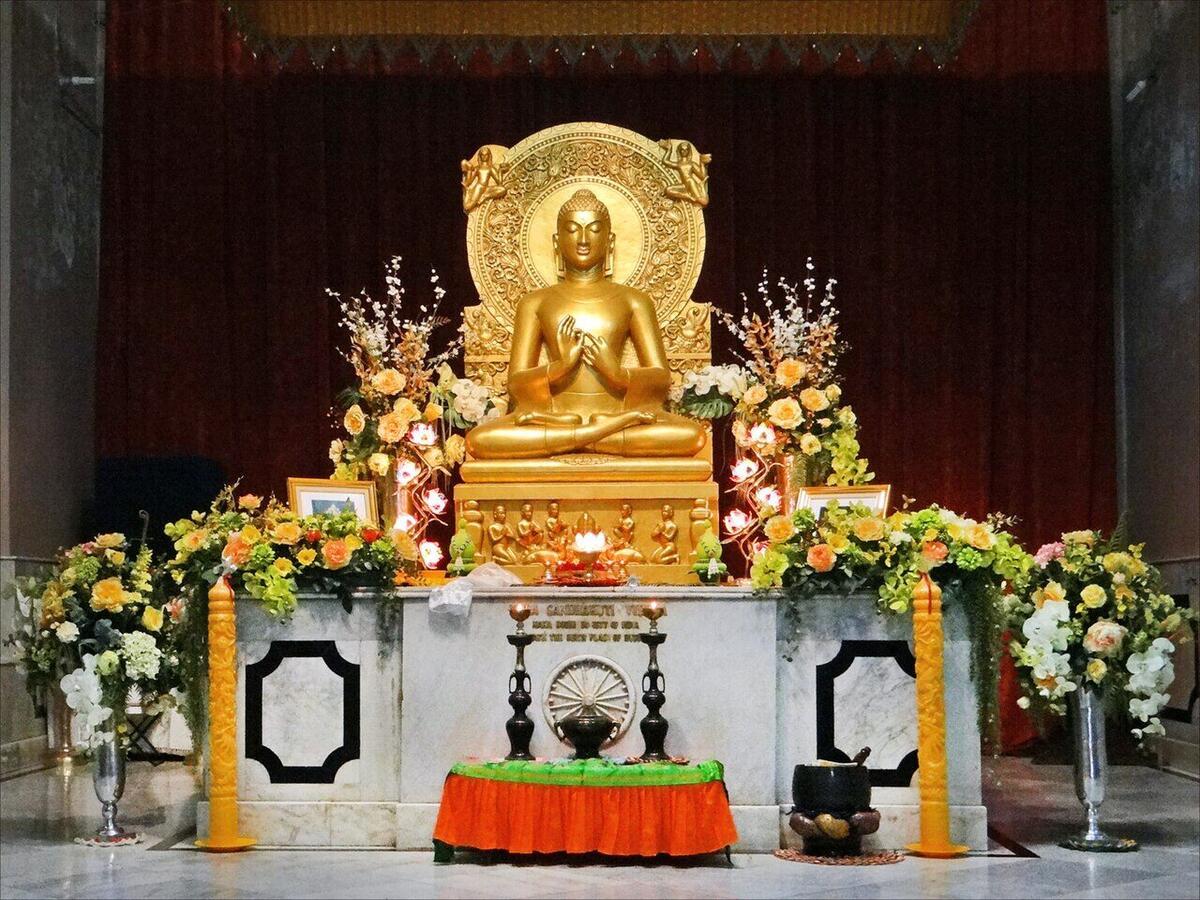
In 1931, the Mulagandhakuti Vihar was rebuilt near the original by Anagarika Dharmapala and the Mahabodhi Society, with interior frescoes by the Japanese artist Kosetsu Nosu. Through the twentieth century, Buddhist communities from Sri Lanka, Thailand, Myanmar, Japan, Korea, Tibet, and elsewhere have established modern monasteries and temples at Sarnath, restoring the site as a living centre of Buddhist practice.
Architecture
The main archaeological compound at Sarnath contains the principal monuments of the ancient site, preserved under the Archaeological Survey of India.
- Dhamek Stupa — a cylindrical stupa of brick and stone, 43 metres in height, marking by tradition the spot of the first sermon. The lower half carries carved Gupta-period ornamentation; the upper half is plainer brick.
- Dharmarajika Stupa (ruins) — the foundations of what was once one of the largest stupas of the subcontinent, dismantled in the medieval period. The relics once enshrined within it are dispersed.
- Ashokan pillar — a broken pillar of polished Chunar sandstone, 3rd century BCE, bearing Ashoka's edict to the monks of Sarnath. Its Lion Capital is preserved in the Sarnath Museum.
- Monastery foundations — extensive remains of the ancient viharas, covering several hectares.
Outside the archaeological compound stand the newer viharas built through the twentieth century:
- Mulagandhakuti Vihar (1931) — rebuilt by the Mahabodhi Society, with frescoes by Kosetsu Nosu depicting the life of the Buddha.
- Chaukhandi Stupa — where, by tradition, the Buddha met his five former companions. An octagonal Mughal-period tower was added on top in the sixteenth century.
- Modern viharas and temples of the Sri Lankan, Thai, Burmese, Tibetan, Japanese, Korean, and Chinese Buddhist communities — each in the architectural idiom of its tradition.
The Lion Capital itself, kept in the Sarnath Museum, is four lions seated back to back on an abacus, itself resting on a bell-shaped lotus. The sculpture is in polished Chunar sandstone and is considered one of the finest works of early Indian sculpture.
Rituals & Practices
Sarnath functions today as both a historical-archaeological site and a living centre of Buddhist practice. The observances carried here reflect the many Buddhist traditions now present.
- Pradakshina at the Dhamek Stupa. Pilgrims circumambulate the stupa clockwise, offering prayers, flowers, and sometimes draping cloth around its base.
- Meditation and sitting. Many pilgrims sit quietly in meditation within the archaeological compound, particularly near the Dhamek Stupa and the foundations of the monastery.
- Recitation of the Dhammacakkappavattana Sutta. Some Theravada pilgrim groups recite the first sermon aloud at the site. Mahayana and Vajrayana groups may chant sutras and mantras according to their own traditions.
- Puja at the modern viharas. Each of the country-specific viharas (Sri Lankan, Thai, Burmese, Japanese, Tibetan, and others) carries on its daily puja in its own tradition. Pilgrims are welcome to attend with respect.
The archaeological compound is open through daylight hours for a modest entry fee; the Sarnath Museum has its own schedule and is closed on Fridays.
Festivals & Celebrations
| Festival | When | Crowd |
|---|---|---|
| Dhamma Chakra Day (Asalha Puja) | — | Very high |
| Buddha Purnima | — | Very high |
| Magha Puja | — | Moderate |
| Kathina Ceremony | — | Moderate |
Dhamma Chakra Day (Asalha Puja): The principal festival of the site â commemorating the very event for which Sarnath is remembered.
Buddha Purnima: The most widely observed festival of the Buddhist calendar. Held in particular reverence at all four principal pilgrimage sites.
Magha Puja: A festival of the Sangha â fitting for Sarnath, where the first Sangha was formed.
Kathina Ceremony: One of the oldest continuing Buddhist observances, rooted in the period when the Buddha and his Sangha first practiced the rainy-season retreat.
Prepare for Your Visit
Practical guidance to help you plan your pilgrimage
| Pilgrim Guidance | How to reachSarnath is about 10 km north-east of central Varanasi, an easy 25-minute drive by auto-rickshaw or cab. It is typically visited as a half-day or full-day trip from Varanasi. Those on the Buddhist circuit (Lumbini – Bodh Gaya – Sarnath – Kushinagar) will arrive here in the course of a longer yatra. Suggested sequence at Sarnath
Preparation for Pilgrims
Best Time to VisitThe most important day of the year at Sarnath is Dhamma Chakra Day (Asalha Puja) in July, the anniversary of the first sermon. Buddha Purnima in May also draws large pilgrim gatherings. October to March is the most comfortable season for an extended visit. Mornings are the quietest hours at the archaeological compound. |
Location
Varanasi, UP
Gallery
Pilgrim photos
No pilgrim photos yet.
Community corrections
No corrections yet.
Edit history
No revisions yet.
Plan Your Visit to Sarnath
Get a custom itinerary and pricing for your trip.
Recommended
Packages for this destination
Pilgrim Notes
On-ground observations from fellow pilgrims
No pilgrim notes yet. Be the first to share on-ground observations!
Sign in to share a note.
Pilgrim Reviews
1280 reviews
Be the first to share your experience at Sarnath.
Sign in to write a review.
Nearby sacred places
Discover other sacred places near Sarnath
Explore temples, tirthas, and pilgrimage sites in UP
Explore nearbyPart of these circuits
Walk the traditional pilgrimage routes this destination belongs to.