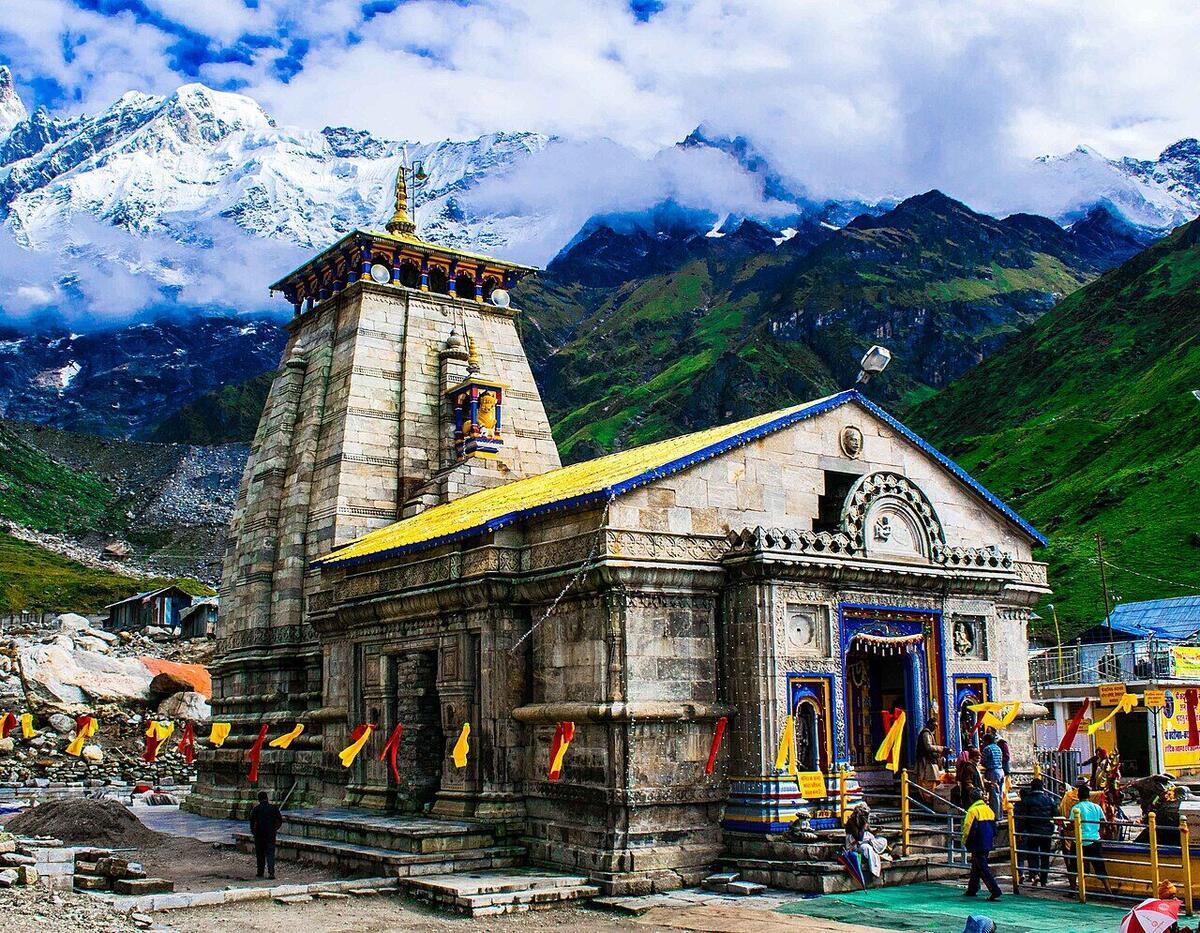
Char Dham Yatra from Delhi
Delhi is where the Himalayan yatra usually begins. Haridwar and Rishikesh are a single day away, and from there the road opens to Yamunotri, Gangotri, Kedarnath and Badrinath. Registration, altitude pacing and every night's halt — planned before you leave home.
Delhi → Haridwar · Char Dham Yatra
Getting there
How Delhi Pilgrims Reach the Yatra
The Char Dham does not begin in Delhi. It begins where the plains end — and for almost every road itinerary that means Haridwar or Rishikesh. From Delhi, that is a single day's travel, by any of three routes.
By rail. Haridwar Junction is the station most Delhi pilgrims use. Uttarakhand Tourism describes it as well connected by rail with Delhi and the other major cities of India, with frequent services — daytime trains that put you in Haridwar by afternoon, and overnight services for families who would rather sleep through the journey. We do not print train numbers and departure times on this page, because they shift through the year and a wrong timing is worse than no timing. Send us your dates and we will tell you what is actually running.
By air. The nearest airport is Jolly Grant, Dehradun (DED) — 37 km from Haridwar, 21 km from Rishikesh, and 35 km from Dehradun city. The Airports Authority of India's own schedule for this season lists several direct Delhi–Dehradun services every single day, flown by IndiGo and Air India, on the summer schedule that runs to late October — covering most of the yatra season.
By road. Buses for Haridwar and Rishikesh leave from ISBT Kashmiri Gate. Most of our Delhi groups prefer a private vehicle from their own gate instead, because the yatra vehicle then stays with the family for the entire circuit — no re-hiring in the hills, no bargaining at a bus stand at midnight.
Past Rishikesh the journey changes character completely. There is no railway and no airport beyond it. From there the whole circuit is mountain road: early starts, long driving days, gate-controlled stretches, and weather that has the final say over any schedule a travel agent writes.
The tradition
The Four Dhams, in the Order They Are Walked
Four shrines in the Garhwal Himalaya, approached in a fixed sequence that runs west to east: Yamunotri → Gangotri → Kedarnath → Badrinath. Two rivers first, then Shiva, then Vishnu. Every Satmarg itinerary follows that order, because the order is part of the yatra.
| Dham | What it is | Altitude | How you reach it |
|---|---|---|---|
| Yamunotri | The source-shrine of the Yamuna, with the natural hot spring of Surya Kund beside the temple | ~3,290 m | The motorable road ends at Janki Chatti; a 5–6 km trek follows. Ponies and palanquins are available. |
| Gangotri | Where the Ganga is worshipped at her origin, on the Bhagirathi | ~3,415 m | Road reaches the temple town. |
| Kedarnath | One of the twelve Jyotirlingas, on the bank of the Mandakini, and one of the Panch Kedar | ~3,580 m | A 16 km trek from Gaurikund — or pony, palki, or the IRCTC helicopter shuttle. |
| Badrinath | Vishnu's Himalayan seat, counted among the 108 Divya Desams, with the Tapt Kund hot springs at the shrine | ~3,300 m | Road reaches the temple. |
Treat the altitudes as approximate. They follow the state health department's Char Dham handbook and BKTC's own temple pages, and the official sources differ from one another by up to a couple of hundred metres. What is not in dispute is that all four dhams stand above three thousand metres.
Kedarnath and Badrinath are administered by the Shri Badarinath Kedarnath Temple Committee (BKTC), which also looks after forty-five smaller shrines along the two routes. Its own account records the Kedarnath temple as having been raised over a thousand years ago by Adi Shankaracharya.
Every duration, every halt and all our packages sit on the main Char Dham Yatra hub.
Before you travel
The Registration Every Pilgrim Must Have
This is the thing a first-time Char Dham pilgrim most often gets wrong. Registration is mandatory. Registration is also free. If anyone asks you for money to arrange it, stop.
Under Government of Uttarakhand travel policy, every pilgrim — and every vehicle — must be registered before the journey begins. The only official portal is registrationandtouristcare.uk.gov.in, run by the Uttarakhand Tourism Development Board. You are issued a Yatra Registration Letter carrying a QR code, and you must present yourself for verification when you reach each shrine.
That verification is not a formality on paper. The state runs registration and check points along the yatra roads — at the Rahi Hotel in Haridwar, the Transit Camp and the Gurudwara in Rishikesh, at Herbertpur and Nayagaon, at Barkot for Yamunotri, Hina for Gangotri, Sonprayag for Kedarnath and Pandukeshwar for Badrinath, and again at Janki Chatti and at the Gangotri and Kedarnath temples themselves. These are the points at which the letter is checked, so it is not a paper to leave at home.
Vehicles. A Green Card and a Trip Card are issued separately, through the State Transport Department's portal at greencard.uk.gov.in — and the passengers must already be registered on the tourism portal before a Trip Card can be generated at all. The two systems are joined.
Helicopter. Kedarnath helicopter shuttle tickets can be booked on heliyatra.irctc.co.in and nowhere else. BKTC and the state registration portal both say it in those words. Anyone else offering you a Kedarnath heli seat is selling you nothing — which is also why you will not find operator names or fares quoted on this page.
For a booked group we file the registration for every pilgrim, and arrange the Green Card and Trip Card for the vehicle. You carry the letter. We carry the paperwork.
Know before you go
Season, Altitude, and Who Should Think Twice
The season. The kapat of each dham open in late April or early May and close for the winter in October or November. BKTC's own account of Kedarnath has the temple reopening in the first week of May, on an auspicious date the committee announces in advance, with the winter worship held at Ukhimath from November until May. The exact dates are fixed afresh each year and announced by the committees — they move, so we confirm them for your travel month rather than printing a date that will be wrong next season. BKTC itself lists May through November as the months to visit Kedarnath and Badrinath.
The altitude is the real subject. All four dhams stand above three thousand metres. The Government of Uttarakhand's Char Dham health handbook, written with the doctors of AIIMS Rishikesh, puts the effective oxygen at the shrines at 17.9–18.6 per cent, against 20.9 per cent at sea level. A family that is on the plains on Monday and sleeping near Kedarnath by the weekend has asked a great deal of the body in a very short time.
That same handbook is blunt about the arithmetic. Do not climb to a sleeping altitude of 2,750 m or more in a single day. Once above that, raise where you sleep by no more than about 500 m a night, and take an extra night for every 1,000 m gained. Avoid alcohol and hard exertion for the first 48 hours at height. And if you intend to fly to Kedarnath, it advises spending a night in the helipad-zone village first, because the ascent from there is usually more than a thousand metres in one lift.
This is why our itineraries look slower than some. The night at Guptkashi or Sonprayag before Kedarnath is not a filler night. It is the yatra.
Who should think twice about the trek. The state's own advisory is honest about it: the deaths that occur on the yatra are overwhelmingly cardiac, and overwhelmingly among pilgrims past sixty, with Kedarnath at the top of that list. If you live with heart disease, uncontrolled blood pressure or a lung condition — or if you simply have not walked sixteen kilometres uphill in some years — see your doctor before you book, and then talk to us about the alternatives rather than about the trek.
There are alternatives, and they are not lesser. Ponies and palanquins run on the Yamunotri trek, and ponies on the Kedarnath trek. The helicopter shuttle removes the climb altogether, and BKTC notes that a pilgrim staying at Sitapur, Sonprayag or Guptkashi can complete Kedarnath darshan in a single day by helicopter or pony. And many Delhi families choose Kedarnath and Badrinath alone for a first season, returning for Yamunotri and Gangotri later. Two dhams done properly is a yatra. Four dhams endured is not.
The plan
How Many Days to Budget from Delhi
Count from your own gate in Delhi, not from Haridwar. The transfer day is a real day, and leaving it out of the calculation is how people end up driving a mountain road in the dark on their first evening.
| Shape of the yatra | Days from Delhi | Who it suits |
|---|---|---|
| Full road yatra, all four dhams | Around a fortnight door to door — a day up from Delhi, the circuit itself, a day back | Pilgrims who want the traditional order at the traditional pace |
| Do Dham — Kedarnath and Badrinath | About a week | Shorter leave, or a first Himalayan yatra |
| Helicopter-assisted | The fewest days of all — the Kedarnath climb disappears | Elders, and anyone whose leave will not stretch |
| One dham at a time | A few days each | Families who return season after season |
Whatever the shape, we build slack into it. In the Garhwal a landslide, a closed gate or one morning of low cloud can cost half a day, and an itinerary with no slack turns that half day into a missed darshan you travelled a fortnight for.
Exact day-by-day plans, halts and all our packages: the Char Dham Yatra hub. The shorter route: Do Dham Yatra.
From enquiry to yatra
How it works
- 1
Tell us your month and your group
Travel month, how many of you, and the age of the eldest traveller — that last one shapes the whole plan. WhatsApp or the form below.
- 2
We send an itinerary and a fixed written quote
Day by day, with every night's halt chosen for altitude. Road, helicopter-assisted, or a mix. The total in writing on WhatsApp before you pay anything.
- 3
Registration, permits and bookings
We file the mandatory Uttarakhand registration for every pilgrim in the group, arrange the vehicle's Green Card and Trip Card, and lock hotels and transport.
- 4
Travel with someone on the phone
Pickup in Delhi, a driver who knows the Garhwal roads, and our team reachable through the yatra — for weather, gate closures, and the small things that come up at altitude.
Questions asked often
Questions Delhi pilgrims ask us
How do I get from Delhi to the start of the Char Dham Yatra?
The yatra starts at Haridwar or Rishikesh, and all three routes from Delhi take a single day. By rail, Haridwar Junction has frequent services from Delhi — daytime and overnight. By air, Jolly Grant (Dehradun) has several direct Delhi flights daily on the current AAI schedule, and sits 37 km from Haridwar and 21 km from Rishikesh. By road, buses run from ISBT Kashmiri Gate, though most of our groups prefer a private vehicle from their own gate so the same vehicle stays with them for the whole circuit. Tell us which you prefer and we plan the first day around your arrival time.
How many days should I take off work for the Char Dham?
Budget from your Delhi doorstep, not from Haridwar. The full four-dham road yatra is roughly a fortnight door to door once you count the day up and the day back. Kedarnath and Badrinath together — the Do Dham — is about a week. A helicopter-assisted yatra is the shortest of all, because the sixteen-kilometre Kedarnath climb disappears. We always leave a buffer day in the plan; in the mountains it gets used more often than not.
Is Char Dham registration compulsory, and does it cost anything?
It is compulsory and it is free. Under Government of Uttarakhand travel policy every pilgrim and every vehicle must be registered before the journey, on the official portal registrationandtouristcare.uk.gov.in run by the Uttarakhand Tourism Development Board. You receive a Yatra Registration Letter with a QR code, and you are verified at check points on the road and again at each shrine. For a booked group we file it for every pilgrim and arrange the vehicle's Green Card and Trip Card as well — at no charge for the registration itself, because there is none.
My parents are over sixty. Can they do the Char Dham?
Many do — but this is a question to answer with a doctor before you answer it with a travel planner. The Uttarakhand health department's own Char Dham handbook, written with AIIMS Rishikesh, records that the deaths on the yatra are overwhelmingly cardiac and overwhelmingly among pilgrims past sixty, with Kedarnath highest. Effective oxygen at the dhams is around 17.9 to 18.6 per cent, against 20.9 at sea level. If there is heart disease, uncontrolled blood pressure or a lung condition, get a fitness check first. Then tell us the ages in your enquiry: we slow the ascent, add acclimatisation nights, arrange the pony and palanquin support that runs on the Yamunotri and Kedarnath trek sections, and put the helicopter option in front of you instead of the trek.
Can you book the Kedarnath helicopter for us?
Kedarnath helicopter shuttle tickets can be booked only on the official IRCTC portal, heliyatra.irctc.co.in — BKTC and the state registration portal both state plainly that heli services can be booked only through IRCTC. We will plan your itinerary around a heli darshan, complete your yatra registration first because it is required before booking, and guide you through the portal. What we will not do is quote you a helicopter fare or name an operator, because anyone promising you a guaranteed seat outside that portal is not selling you a seat.
When does the Char Dham season run, and when should a Delhi family go?
The shrines open in late April or early May and close for winter in October or November — BKTC's own Kedarnath account describes a first-week-of-May reopening on a date the committee announces in advance. The exact dates are set afresh every year, so we confirm them for your month rather than publish a date that ages badly. Broadly: May and June are warm and very crowded, the monsoon months bring landslides and road closures, and the post-monsoon weeks are clear and quiet but cold at Kedarnath and Badrinath. Tell us your month and we will tell you honestly what it will be like.
How much does a Char Dham package from Delhi cost?
The cost depends on the month, the number of pilgrims, the hotel category and whether you fly any leg, so we do not publish a number that would be wrong for half the season. Send us your dates and group size on WhatsApp and you get one fixed written quote — vehicle, hotels, permits, taxes and all — before you pay anything. Nothing is added later.
Your Char Dham Yatra from Delhi Starts Here
Tell us your travel month, your group, and the age of your eldest traveller. We plan the road, the halts and the paperwork.
All options
Choose Your Package
All packages include AC transport and hotel.
Keep travelling
More yatras
Booking & payment
How it works
No surprises. Here is exactly what happens from your first message to the day you walk the yatra.
- 1
Tell us your dates
Share dates, group size, and preferences via WhatsApp, phone, or the enquiry form. No commitment yet.
- 2
Receive itinerary & quote
We send a written itinerary, inclusions, and a fixed quote. You can revise or decline at no cost.
- 3
Pay via online invoice
Payments are processed through standard invoicing and digital payment methods (UPI, cards, net-banking).
- 4
Confirmation & support
A confirmation email lists your bookings, contacts, and pickup times. Refunds, if applicable, follow our published policy.