Sri Venkateswara Swamy of Tirumala is called by many names across the Hindu world — Srinivasa, Govinda, Venkatachalapati, Elumalayan in Tamil and Edu Kondala Vada in Telugu, each meaning the Lord of the Seven Hills, and Balaji in the north. In the sanctum the moolavirat stands facing east, four-armed, bearing shankha and chakra, one hand in the varada posture and one at the waist, with Sri as Vyuha Lakshmi resting upon his chest. Worship follows the Vaikhanasa Agama, and the shrine is counted among the 108 Divya Desams sung in the Naalayira Divya Prabandham of the Alvar saints.
Tirumala and Tirupati belong to one pilgrimage. Tirumala — the name carries the Tamil tiru, sacred — is the hill settlement on Venkatadri, one of the Sapthagiri, the seven peaks of the Seshachalam range that tradition understands as the seven heads of Adisesha. Tirupati is the town at the foot of those hills, where most devotees arrive, bathe, rest and set out. Two ghat roads and two ancient stepped paths join the two, and the pilgrim who climbs barefoot and the pilgrim who comes by bus reach the same golden doorway.
What often surprises a first-time devotee is how brief the moment before the Lord actually is, and how completely the whole hill is arranged around that moment. The Tirumala Tirupati Devasthanams, constituted in 1933, orders the darshan queues, the free meals, the tonsure halls, the laddu kitchen, and every guest house, cottage, choultry and dormitory on the hill — there is no private hotel keeping on Tirumala; the hill is the temple's own household. On an ordinary day the shrine receives well over sixty thousand devotees, and on festival days more than a lakh. Yet beneath that scale the older rhythm holds unchanged: Suprabhatam before dawn, the garlanding of the Lord, archana, the naivedyam of laddus, and Ekanta Seva at the close of night.
Devotees rarely speak of Tirumala as a place they visited. They speak of a vow made and a vow discharged — hair offered, a hundi note dropped, a laddu carried home wrapped in cloth for those who could not come.
Katha and local belief
TTD's own account of the sthala purana begins with Maha Vishnu taking the form of Adi Varaha to rescue Mother Earth, and remaining upon these hills. Of the Lord's dwelling it says that he "took an ant-hill on Venkatadri under a tamarind tree as a dwelling place, besides a Pushkarini." Tradition holds that Brahma and Shiva themselves made known the Lord's desire to remain upon the holy seven hills for the emancipation of humankind from the perpetual trials and tribulations of Kali Yuga.
The most loved strand of the katha is the marriage. Srinivasa, dwelling on the hill, wedded the princess Padmavathi, whom Narada had foretold was destined to be the spouse of Vishnu himself. For the expenses of that divine wedding, TTD's account states, "the Lord also obtained a huge loan from Kubera, the god of wealth." Devotees hold that the loan is still being repaid across the length of Kali Yuga, and that whatever is dropped into the Srivari Hundi is a share in that repayment. It is a belief that explains the shrine's abundance in devotional terms rather than financial ones — what is gathered here is understood not as the Lord's fortune but as the Lord's debt, carried on behalf of those who came to him with their own.
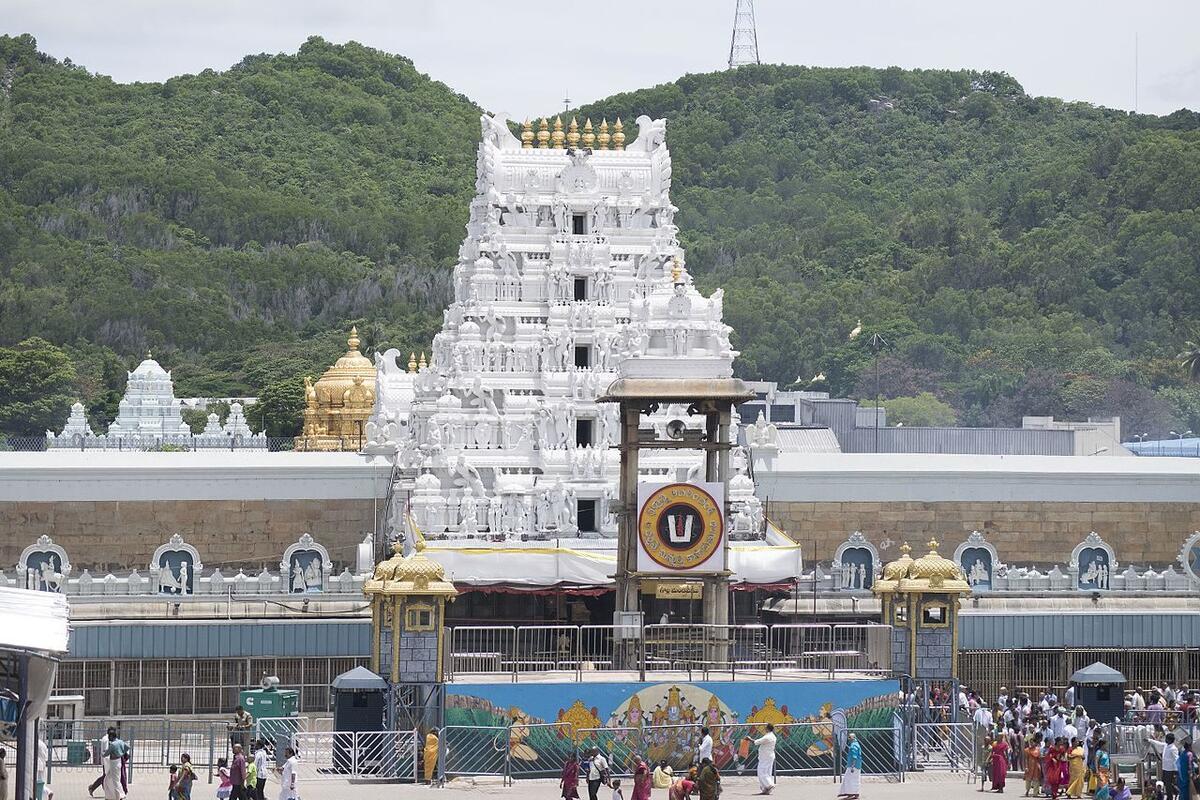
Devotees hold that Venkateswara manifested upon these hills for the sake of an age in which people would have little strength for austerity and long penance. That is the heart of Tirumala's meaning: it is understood as a refuge held open to those who cannot climb by knowledge or by tapas, but can still climb by love and by a promise kept. Here the Lord is approached for the plain things people actually pray for — a child, a marriage, a recovery, work, a debt cleared — and the mokku, the vow, is the language of that relationship.
For the Sri Vaishnava tradition Tirumala is one of the 108 Divya Desams, sanctified by the hymns of the Alvars gathered in the Naalayira Divya Prabandham. In Telugu devotion the hill is inseparable from Tallapaka Annamacharya, remembered to have composed tens of thousands of sankirtanas in praise of Venkateswara — songs that still move through the temple's daily life and through the homes of ordinary families far from Tirumala.
How devotion is expressed here
Three practices carry the faith of the ordinary pilgrim, and each is an act of giving rather than of asking.
- Tonsure. Hair is offered at the Kalyanakatta halls before darshan, most often in fulfilment of a vow taken long before. Devotees understand it as the surrender of what one is proudest of, laid down before the Lord without bargaining. TTD performs the tonsure free of cost at all its Kalyanakattas.
- The Hundi. TTD asks that offerings be deposited only in the Hundi. In devotional understanding this is not a donation to an institution but a contribution towards Srinivasa's wedding debt to Kubera — the devotee standing, for a moment, as the Lord's own family.
- The climb. Those who ascend the stepped paths on foot, touching each step with turmeric and kumkum, hold that the body's effort is itself an offering. TTD recognises this in a distinct darshan stream, Divya Darshanam, kept for those who walk up.
Many families also hold that the yatra is completed only with the darshan of Sri Padmavathi Ammavari at Tiruchanoor near Tirupati, the Mother whose wedding the katha remembers. The temple is administered by TTD, and elders in many households still say plainly that one does not go before the Lord without first standing before the Devi.
History
Worship at Tirumala is older than the records that survive of it. The hill and its Lord are remembered in early Tamil literature, including the epic Cilappatikaram, and the earliest recorded endowment to the temple is dated to 966 CE, made by the Pallava queen Samavai. From that point the shrine passed through the care of the Cholas, the Reddi kings of the twelfth and thirteenth centuries, and above all the rulers of Vijayanagara — but through every change of patron, the offering of worship itself was never interrupted.
The decisive figure in the temple's ritual life is Sri Ramanujacharya, traditionally placed in 1017–1137. TTD's own history records that he visited Tirumala three times and streamlined the rituals of the temple according to the Vaikhanasa Agama. The order of daily worship followed on the hill today descends from that settlement, which is why a pilgrim standing in the queue at three in the morning is participating in something arranged nearly nine centuries ago.
Vijayanagara left the shrine much of its present built form. TTD records that the construction of the fortifications was begun in the twelfth century and completed in the thirteenth; that Saluva Narasimha Raya raised four pavilions in the four corners of the Sampangi Pradakshinam in 1470 and built the Tirumalaraya Mandapam that stands south of the flagstaff; and that Krishnadevaraya installed copper statues in the temple on 2 January 1517. The offering of laddus as naivedyam began later, on 2 August 1715, and has since become the prasadam by which the shrine is known across India; the Tirupati laddu received a Geographical Indication registration in 2009.
In 1843 the East India Company transferred the temple's administration to the mahants of the Hathiramji Mutt, who held it for six generations. In 1933 the Tirumala Tirupati Devasthanams was constituted, and the modern shape of the pilgrimage followed: the first ghat road up the hill was laid in 1944 and the second opened in 1974; free meals for pilgrims began under TTD on 6 April 1985, serving two thousand a day at the start; the Srivari Mettu footpath was renovated in 2008; and Special Entry Darshan was introduced on 21 September 2009 to move pilgrims through more quickly. Each of these is administration, not devotion — but at Tirumala the administration exists only to keep the devotion moving.
Architecture
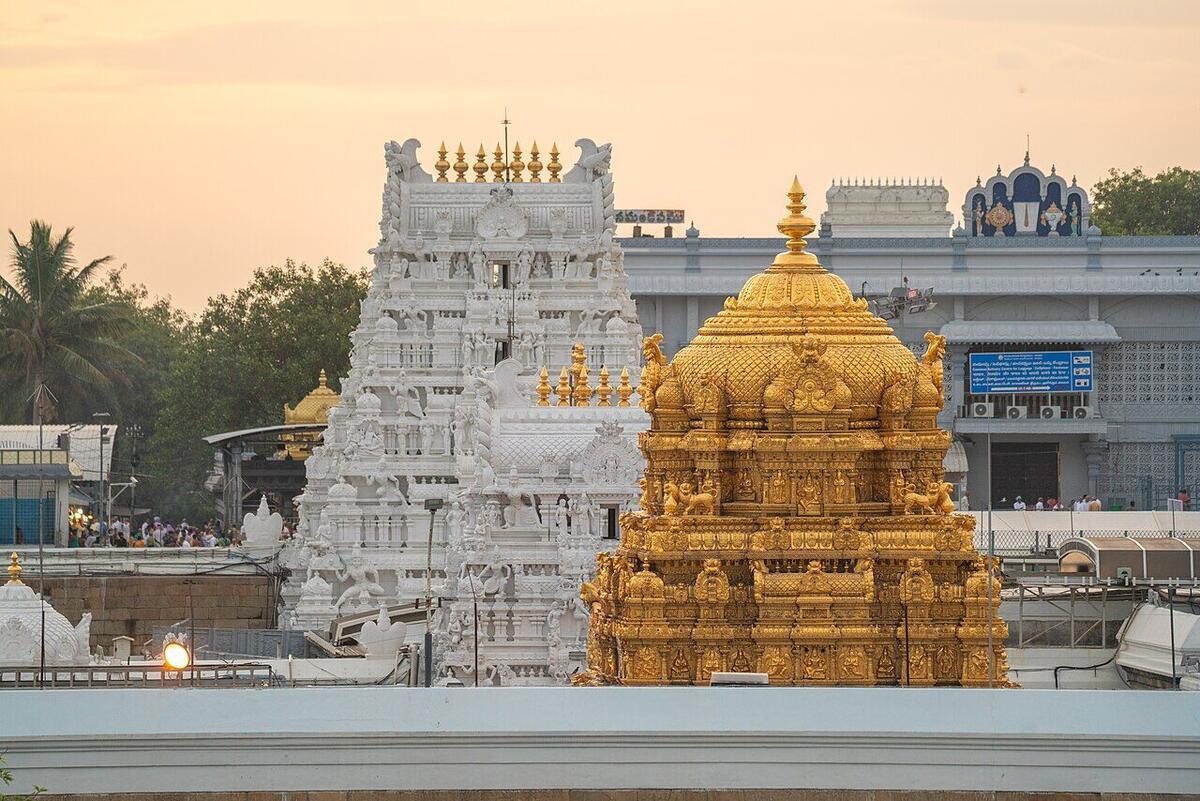
The temple is built in the Dravida idiom of the south, and its single most recognisable form is the Ananda Nilayam, the gilded vimana rising above the garbhagriha. It is this golden crown, seen from the streets below, that most devotees carry as their first and last image of Tirumala.
The approach inward passes through the Bangaru Vakili, the golden gateway of the inner sanctum, beyond which the Lord stands facing east. The complex is ordered in enclosures with their pradakshinam paths, among them the Sampangi pradakshinam within which the temple's laddu potu — the sacred kitchen — stands. A dhwajastambham rises before the shrine; it is here that Dhwajarohanam, the flag-hoisting, opens the annual Brahmotsavam. Around the temple run the four Mada Streets, and these are not ornament: they are the processional route along which the utsava murti, Sri Malayappa Swamy, is carried on his vahanams during festival days.
Beside the temple lies the Swami Pushkarini, the sacred tank, and on its bank the shrine of Sri Varahaswami — the form in which, the sthala purana says, Vishnu first came to these hills. TTD asks pilgrims to bathe in the Swami Pushkarini and worship Sri Bhu Varaha Swamy before going before Sri Venkateswara, and to bathe in the Papavinasanam and Akasa Ganga tirthams; Silathoranam and Srivari Padalu lie on the hill above.
Around this ancient core stands a second architecture, entirely modern and entirely devotional in purpose: the queue complexes with their compartments where pilgrims wait through the night, the Kalyanakatta halls for tonsure, the Matrusri Tarigonda Vengamamba Annaprasada Complex where meals are served without charge, and rows of TTD guest houses and choultries. Very little of it is decorative. It exists because lakhs of people must be brought before a small, lamp-lit sanctum, one after another, with dignity.
Rituals & Practices
The day at Tirumala is a fixed sequence of sevas performed by the temple's archakas in the Vaikhanasa order, and pilgrims move through the sanctum around it rather than through it. TTD publishes the schedule and also notes that seva rates and arrangements may change from time to time, so verify current timings and availability with the temple authorities before planning.
As published by TTD, the daily order runs:
- Suprabhatam — 03:00 to 03:30, the waking of the Lord
- Thomala Seva — 03:30 to 04:00, the adorning of the deity with garlands
- Archana (Sahasranama) — 04:15 to 05:00 from Monday to Friday, and 04:00 to 04:30 on Saturdays and Sundays
- Kalyanotsavam and Arjitha Brahmotsavam — 12:00 to 17:00
- Sahasra Deepalankarana Seva — 17:00 to 17:30
- Ekanta Seva — 01:30, the laying of the Lord to rest, which is not open to pilgrims
Most of these are arjitha sevas — ticketed, and quite separate from the darshan queues; Ekanta Seva is performed by the archakas alone. TTD states that tickets for all arjitha sevas and festivals are sold one month in advance, and demand for the early-morning sevas far exceeds what the sanctum can hold. Suprabhata Seva in particular is a ticketed seva in its own right and is not the same thing as the Special Entry Darshan ticket — a common confusion worth settling before you travel.
Beyond the daily order, the week carries its own rites: Ashtadala Pada Padmaradhana on Tuesday, Tiruppavada Seva on Thursday, and Abhishekam with Vastralankara Seva on Friday. Through the year come Teppotsavam, Vasanthotsavam, Padmavathi Parinayam, Abhideyaka Abhishekam, Pushpa Pallaki, Pavitrotsavam and Pushpa Yagam, and four times a year the temple itself is cleansed in Koil Alwar Thirumanjanam.
For the ordinary devotee, however, the practice of Tirumala is simpler and older than any of this: the vow made at home, the hair offered at the Kalyanakatta, the note placed in the Hundi, the few seconds before the Ananda Nilayam, the laddu received afterwards, and the name of Govinda repeated all the way down the hill.
Festivals & Celebrations
| Festival | When | Crowd |
|---|---|---|
| Srivari Salakatla Brahmotsavam | — | Extremely high â lakhs of devotees across nine days |
| Vaikunta Ekadasi and Vaikunta Dwara Darshanam | — | Extremely high â the heaviest rush of the year |
| Ratha Saptami | — | Very high â a single day of continuous procession |
| Vasanthotsavam | — | High |
| Pavitrotsavam | — | High |
Srivari Salakatla Brahmotsavam: The fullest annual expression of the Lord's kingship over the seven hills, in which the utsava murti comes out to the streets so that those who cannot enter the sanctum may still receive darshan.
Vaikunta Ekadasi and Vaikunta Dwara Darshanam: Devotees hold that passing through the Vaikunta Dwaram on this day carries the grace of release from the cycle of birth and death. For many families it is the one darshan of a lifetime that must not be missed.
Ratha Saptami: Observed as Surya Jayanthi, when the Lord grants darshan on all seven vahanams in one day â a compressed Brahmotsavam offered to those who could not come in September.
Vasanthotsavam: The Lord is honoured as the presence within the turning of the seasons, and spring is offered back to him in flowers and cool waters.
Pavitrotsavam: Understood as the temple asking pardon on behalf of all who worship there â a reminder that even a shrine of this antiquity submits itself annually to correction.
Prepare for Your Visit
Practical guidance to help you plan your pilgrimage
| Pilgrim Guidance | Darshan: understanding the queuesDarshan at Tirumala is organised into distinct streams, and choosing the right one is most of the planning.
Book what you can before leaving home, and treat every published waiting time as an estimate. Non-Hindu visitors who wish to have darshan are asked to sign TTD's declaration of faith in Lord Venkateswara, a requirement in force since a government order of 9 April 1990; the forms are available at TTD's offices at Tirumala. Walking up the seven hillsTwo stepped paths lead up from the foothills, and both are maintained by TTD.
TTD runs a free service by which pilgrims may deposit luggage and footwear at the foot of the hill and collect them at Tirumala. Those who walk up are eligible for Divya Darshanam. Start early, carry water, and plan the climb around the heat rather than the timetable, especially with children or elders in the group. Reaching, staying, and the best time to comeMost pilgrims arrive first at Tirupati town — served by Tirupati's main railway station and by Tirupati International Airport at Renigunta — and go up from there. Two ghat roads connect the town to the hill: the upward road of about 17.8 km and the downward road of about 18 km, the first laid in 1944 and the second opened in 1974. They are open twenty-one hours a day and closed between midnight and 3 a.m. All accommodation on the hill is TTD's own — paid guest houses and cottages, free choultries and dormitory halls. There are no private hotels at Tirumala. Rooms may be reserved in advance through the TTD website, and for free accommodation devotees are directed to the Central Reception Office near the bus stand at Tirumala. TTD also enforces strict checkout timing, with heavy surcharges for overstaying. No one need go hungry or unfed on the hill. Free meals, begun by TTD on 6 April 1985 as the Nithya Annadanam scheme and now carried by the Sri Venkateswara Annaprasadam Trust, are served to all pilgrims at the Matrusri Tarigonda Vengamamba Annaprasada Complex — breakfast from 9:00 to 10:30, lunch from 10:30 to 16:00, and dinner from 17:00 to 22:30. Buy the Srivari laddu only from authorised TTD counters. Tirumala receives pilgrims through the whole year. The cooler months are gentler for the climb and for long waits in the queue compartments. Brahmotsavam in September–October, Vaikunta Ekadasi in December–January and Ratha Saptami in the Magha month are the most powerful occasions and also the most crowded; devotees seeking a quieter darshan generally choose ordinary weekdays outside festival seasons. If you are travelling with elderly pilgrims, plan for the waiting rather than the walking — that is where the day is really spent. |
Location
Tirupati, AP
Pilgrim photos
No pilgrim photos yet.
Community corrections
No corrections yet.
Edit history
No revisions yet.
Plan Your Visit to Tirupati Balaji (Sri Venkateswara Temple)
Get a custom itinerary and pricing for your trip.
Pilgrim Notes
On-ground observations from fellow pilgrims
No pilgrim notes yet. Be the first to share on-ground observations!
Sign in to share a note.
Pilgrim Reviews
15 reviews
Be the first to share your experience at Tirupati Balaji (Sri Venkateswara Temple).
Sign in to write a review.
Nearby sacred places
Discover other sacred places near Tirupati Balaji (Sri Venkateswara Temple)
Explore temples, tirthas, and pilgrimage sites in AP
Explore nearbyPart of these circuits
Walk the traditional pilgrimage routes this destination belongs to.