Grishneshwar Jyotirlinga, also spelled Ghrishneshwar, is traditionally regarded as the twelfth and last of the twelve Jyotirlingas of Lord Shiva. It stands in the small village of Verul in the Aurangabad (Chhatrapati Sambhajinagar) district of Maharashtra, barely a kilometre from the UNESCO World Heritage Ellora Caves.
The temple is built of red basalt stone in the late medieval Deccan style, with intricately carved walls depicting scenes from the Shiva Purana and other epics. Its five-tiered shikhara, Nandi Mandapa, and richly sculpted pillars reflect a blend of Yadava and Maratha architectural traditions. The present structure owes much of its form to the 18th-century restoration by the Maratha queen Ahilyabai Holkar, who revived several Jyotirlingas after centuries of neglect and damage.
Grishneshwar is a popular stop on the Jyotirlinga yatra, often combined with darshan at nearby Ellora and Daulatabad. Pilgrims value it not only for completing the twelvefold circuit but also for the deeply rooted story of Kusuma — a devoted woman whose unwavering bhakti brought Shiva into this land. The shrine remains a living centre of Shaiva worship, with continuous aarti, abhishek and the chanting of Shiva's name.
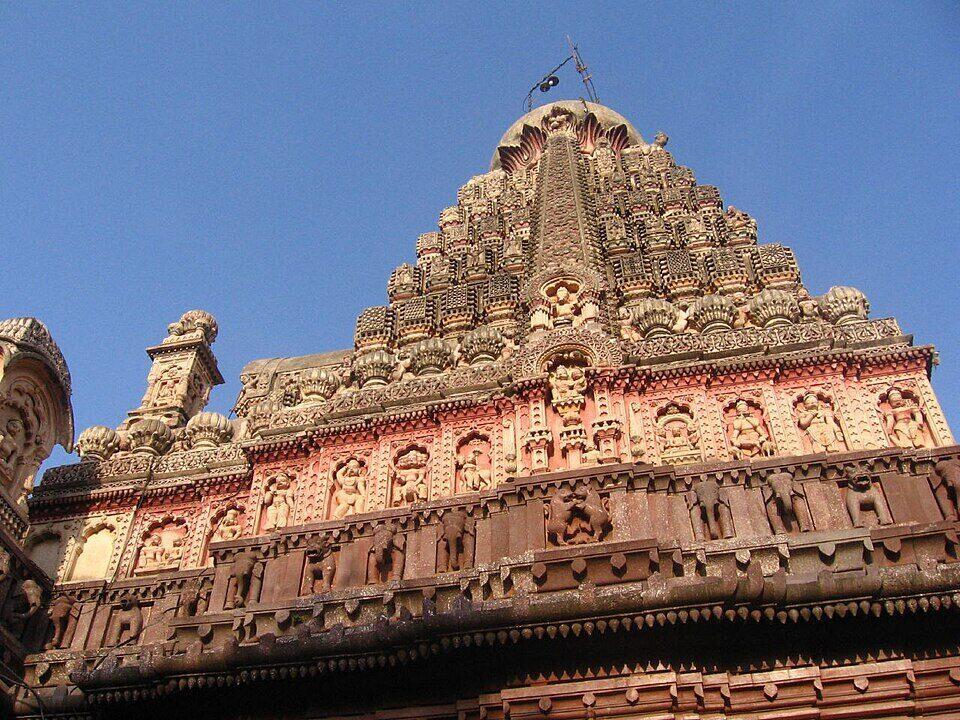
The Shiva Purana narrates that a devout woman named Kusuma worshipped a Shivalinga daily in this region, immersing it in a nearby tank after each puja. Her husband's first wife, Sudeha, consumed by jealousy over Kusuma's son, killed the boy and threw him into the same tank. Kusuma, undeterred by grief, continued her worship with complete faith. Pleased by her unwavering devotion, Shiva restored her son to life and manifested as a self-revealed Jyotirlinga at that very spot. At Kusuma's prayer, the lord agreed to remain here forever, taking the name Grishneshwar (or Ghushmeshwar) after her. The shrine is thus revered as a testament to the power of patient bhakti and forgiveness, and darshan here is believed to bless devotees with family harmony, progeny, and freedom from inner envy.
History

Architecture
Rituals & Practices
Prepare for Your Visit
Practical guidance to help you plan your pilgrimage
| Pilgrim Guidance | The nearest airport is Chhatrapati Sambhajinagar (Aurangabad) Airport, about 30 km away. The nearest railway station is Aurangabad, from where taxis and buses run to Verul-Ellora via Daulatabad. The best months are October to March, when the Deccan climate is pleasant. On normal weekdays darshan takes 30–60 minutes; on Shravan Mondays and Mahashivratri waits can stretch to several hours. Plenty of budget and mid-range hotels are available in Aurangabad city, and a few lodges near Ellora. Most pilgrims combine Grishneshwar with the Ellora Caves, Daulatabad Fort and Bibi ka Maqbara. Carry modest clothing for the sanctum. |
Location
Aurangabad, MH
Pilgrim photos
No pilgrim photos yet.
Community corrections
No corrections yet.
Edit history
No revisions yet.
Plan Your Visit to Grishneshwar Temple, Ellora
Get a custom itinerary and pricing for your trip.
Recommended
Packages for this destination
Pilgrim Notes
On-ground observations from fellow pilgrims
No pilgrim notes yet. Be the first to share on-ground observations!
Sign in to share a note.
Pilgrim Reviews
Be the first to share your experience at Grishneshwar Temple, Ellora.
Sign in to write a review.
Nearby sacred places
Discover other sacred places near Grishneshwar Temple, Ellora
Explore temples, tirthas, and pilgrimage sites in MH
Explore nearbyPart of these circuits
Walk the traditional pilgrimage routes this destination belongs to.