A circuit Package
Adi Char Dham Yatra — 13 Days Pan-India from Delhi
From ₹1,04,500 pp twin-share | All 4 Pan-India Dhams | Flight-Inclusive Ex-Delhi
Traditional order
Priority bookings
Gentle pacing
Briefing included
Satmarg's flagship 13-day Adi Char Dham circuit from Delhi covering all four Dhams established in tradition by Adi Shankaracharya — Badrinath in the north, Puri in the east, Rameshwaram in the south, and Dwarka in the west. Flight-inclusive throughout (Delhi-Dehradun, Delhi-Bhubaneswar, Bhubaneswar-Madurai, Madurai-Ahmedabad via Mumbai, Ahmedabad-Delhi), four-star hotels at every halt, all meals at hotels or pre-vetted satvik dhabas, and a Hindi-speaking yatra coordinator travelling with the group end-to-end. The sequence is arranged in Yuga order — Badrinath (Satya Yuga), Rameshwaram (Treta Yuga), Dwarka (Dwapar Yuga), Puri (Kali Yuga) — though the routing is optimised so the actual order travelled is Badrinath, Puri, Rameshwaram, Dwarka-Somnath, returning to Delhi.
Day-by-day
Itinerary
13 days · click to expand
Early morning pickup from Delhi airport or the specified Delhi address. Brief check-in at the domestic terminal for the flight to Dehradun. On arrival at Dehradun the coordinator meets the group with the AC sedan. The drive to Joshimath begins immediately — the road passes through Rishikesh (brief darshan stop at Triveni Ghat for those willing), then climbs along the Alaknanda through Devprayag (formal sangam of Bhagirathi and Alaknanda where the Ganga is born), Srinagar Garhwal, Rudraprayag, Karnaprayag, Nandprayag, and finally Joshimath. Lunch en-route at a satvik dhaba near Devprayag or Rudraprayag. Arrive Joshimath by late evening at a four-star property; dinner and overnight. The coordinator briefs the group on the next day's Badrinath darshan plan.
Note Flight Delhi to Dehradun: about 50 minutes. Driving distance Dehradun to Joshimath: about 280 km, 9-10 hours including breaks and the Rishikesh darshan stop. The road follows the Panch Prayag (five sacred confluences along the Alaknanda) — a yatra in its own right. Altitude at Joshimath: 1,875 m. Comfortable; no acclimatization concerns. The coordinator carries the Badrinath yatra registration, confirmed in advance on the Uttarakhand Tourist Care portal.
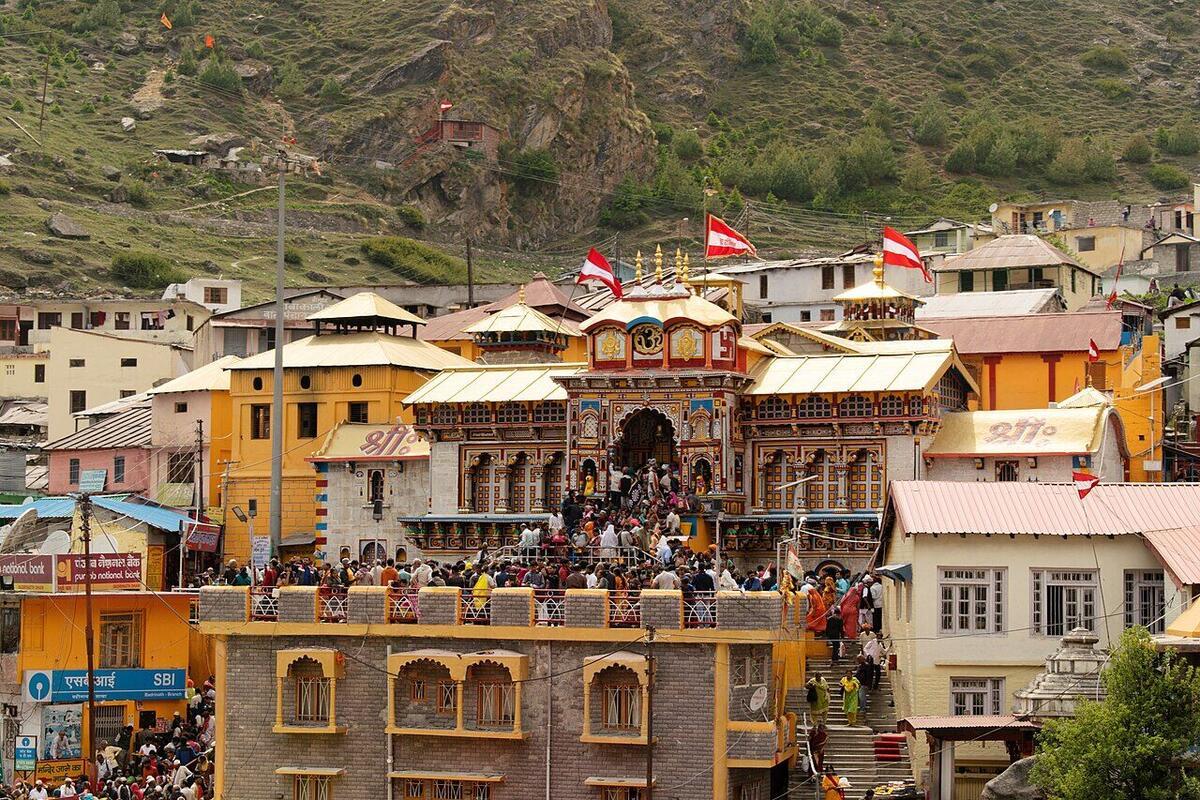
Early breakfast and drive to Badrinath (45 km, about 1.5 hours along the Alaknanda). The Badrinath temple, the seat of Bhagavan Vishnu in his Badri-Vishal form, stands above the Tapt Kund hot spring on the bank of the Alaknanda — the Satya Yuga Dham of Adi Shankaracharya. The traditional sequence: snan at the Tapt Kund (water naturally hot at 45 C), darshan of Badri-Vishal at the morning aarti, and parikrama of the temple. After darshan, drive 3 km onwards to Mana village — the last village before the Tibet border, held by tradition to be where Vyasa Muni dictated the Mahabharata to Ganesha at the Vyas Gufa. Visit Bhim Pul, the Saraswati emergence, and a view of the Vasudhara waterfall (visible from a vantage point at Mana; the full 6 km trek is optional only for the very fit). Lunch at Badrinath or back at Mana. Return to Joshimath by evening; dinner and overnight at the same property.
Note Altitude at Badrinath: 3,300 m. Pilgrims with cardiac or BP conditions should move slowly and stay hydrated. The Tapt Kund water is naturally hot — pleasant for the bath even in cold weather. Mana village is at 3,200 m. The Vasudhara waterfall full trek is 6 km one way and not part of the included programme; the view from Mana is included and sufficient for darshan purposes. Carry warm layered clothing — Badrinath nights are cold even in summer.
Early breakfast and check-out from Joshimath. The drive back down the Alaknanda valley to Dehradun begins — about 280 km, 9-10 hours including breaks. Lunch en-route at a satvik dhaba. Arrive Dehradun by late afternoon and proceed to Jolly Grant airport for the flight to Delhi. On arrival at Delhi the coordinator transfers the group to a four-star airport-area property (Pride or Holiday Inn class). Dinner and overnight at the Delhi hotel; the coordinator briefs the group on the next day's flight to Bhubaneswar.
Note The Day 3 transit is the longest single road segment of the yatra; the group leaves Joshimath early and the coordinator paces breaks to keep the drive comfortable. Flight Dehradun to Delhi: about 1 hour. Delhi hotel chosen for proximity to the airport — under 15 minutes from terminal so the next morning's Bhubaneswar flight is easy. Pack so all baggage for the southern segment is in one bag; the coordinator handles re-check-in next morning.
Early breakfast at the Delhi hotel and transfer to Delhi airport for the flight to Bhubaneswar (about 2 hours 15 minutes). On arrival the coordinator meets the group with the AC sedan. The drive from Bhubaneswar to Puri begins immediately (60 km, about 1.5 hours). Arrive Puri by early afternoon at a beachfront four-star property (Mayfair-class or Toshali Sands category). After check-in and rest, the group walks or is transferred to the Jagannath Mandir for the Sandhya darshan — the evening glimpse of Bhagavan Jagannath, Balabhadra and Subhadra at the bada simhadwara. Puri is the Kali Yuga Dham of Adi Shankaracharya. Return to the hotel for dinner; the coordinator briefs the group on the next day's full Puri programme.
Note Flight Delhi to Bhubaneswar: 2 hours 15 minutes. Driving Bhubaneswar to Puri: 60 km, 1.5 hours. The Jagannath temple has strict entry rules — only those of Sanatani heritage are admitted through the bada simhadwara; the coordinator confirms entry credentials at the temple gate. No leather, mobile phones, or cameras inside the temple. Modest attire required. Puri sea-air is hot and humid year-round; carry light cotton clothing.
Pre-dawn rise for the Mangala Alati at the Jagannath temple — the first seva of the daily niti, the lamp-offering that wakes the deities once the Dwaraphita opens the doors, one of the most sacred sevas in the Vaishnava tradition. After the Mangala Alati darshan, the Mahaprasad arrangement at Ananda Bazar within the temple complex is the breakfast — the only meal in the world that is considered fully sanctified by tradition. Return to the hotel for a brief rest. Mid-morning, drive to the Loknath Temple (an ancient Shiva temple where the lingam is submerged in water year-round and revealed only on Shivaratri), followed by the Gundicha Temple (the destination of the annual Rath Yatra, also called Janakpur). After lunch, drive to Konark (35 km, about 1 hour) for the Konark Sun Temple — the thirteenth-century chariot-temple of Surya, a UNESCO World Heritage site. Return to Puri by evening; sunset walk on Puri beach. Dinner at the hotel.
Note Mangala Alati is at about 5-6 AM, soon after the Dwaraphita opening; early entry through the temple sevayat is arranged by the coordinator. Mahaprasad at Ananda Bazar — bring only minimal cash; the coordinator handles offering arrangements. Konark temple has restricted entry for the inner sanctum (which is in conservation); the outer chariot panels and the Surya idol are fully visible. The beach at Puri is safe for sunset walks but swimming is not recommended due to undertow.
Early breakfast and check-out from Puri. Drive to Bhubaneswar airport (60 km, 1.5 hours). Flight from Bhubaneswar to Madurai (typically via Chennai, total journey 5-6 hours including layover). On arrival at Madurai the coordinator meets the group with the AC sedan. Drive from Madurai to Rameshwaram (170 km, about 3.5-4 hours, crossing the Pamban bridge over the strait that separates Pamban island from the mainland — one of the most scenic rail-and-road approaches in India). Arrive Rameshwaram by late evening at a Hyatt Place Rameswaram or Daiwik Hotels Rameshwaram-class four-star within walking distance of the temple. Dinner and overnight. The coordinator briefs the group on the next day's 22 kund snan, jyotirlinga darshan and Dhanushkodi excursion.
Note Flight Bhubaneswar-Madurai typically routes via Chennai (BBSR-MAA, MAA-IXM); total journey including layover is 5-6 hours. Driving Madurai to Rameshwaram: 170 km, 3.5-4 hours. The Pamban bridge crossing is at sunset on most schedules — a memorable approach to Rameshwaram. Rameshwaram is the Treta Yuga Dham of Adi Shankaracharya, established by Bhagavan Ram before crossing the strait to Lanka. Hot and humid weather year-round; light cotton clothing.
Pre-dawn snan at Agniteertham — the sea-shore tirtha at Rameshwaram where Bhagavan Ram is said to have bathed after the war to absolve the sin of slaying a Brahmin (Ravana, who was of Brahmin lineage). Walk to the Ramanathaswamy Mandir for the morning darshan. The 22 kund snan within the temple complex follows — 22 sacred wells, each with distinct water, from which water is poured over the pilgrim by the temple sevayat in the traditional order. After snan, vastra change and the jyotirlinga darshan — the linga is one of the twelve jyotirlingas of Shaiva tradition, established by Bhagavan Ram himself. Lunch at the hotel. Afternoon drive to Dhanushkodi (18 km, 30 minutes) — the southern tip from which the Ram Setu is said to have been built; on a clear day, the Sri Lanka coast is visible across the strait. Visit the ruins of the Dhanushkodi town (devastated by the 1964 cyclone). Return to Rameshwaram by evening; dinner and overnight at the same property.
Note Agniteertham snan is at 5-6 AM. 22 kund snan within the Ramanathaswamy temple — bring a change of dry clothes; the coordinator carries spare towels for the group. The temple has the longest corridor of any Hindu temple in India — over 1,200 m. Cameras and mobile phones not permitted in the sanctum. Dhanushkodi road is paved up to the last vantage point; the very tip requires a short walk on sand. Hot sun — carry hats, water, and sunscreen.
Early breakfast and check-out from Rameshwaram. Drive to Madurai (170 km, 3.5-4 hours). On arrival, the group visits the Meenakshi Sundareswarar Temple — the great twin-shrine of Devi Meenakshi and Bhagavan Sundareswarar, one of the most architecturally magnificent temples of South India. Quick lunch in Madurai. Transfer to Madurai airport for the flight to Ahmedabad (typically via Mumbai, total journey 5-6 hours including layover). On arrival at Ahmedabad the coordinator meets the group with the AC sedan. The drive to Dwarka begins immediately (440 km — an overnight option is offered, see notes). Pilgrims who prefer rest can take an overnight halt at Ahmedabad and complete the Dwarka drive on Day 9 morning; the included default for fit pilgrims is to drive through the evening with rest stops, reaching Dwarka in the small hours of Day 9 — typically between 3 and 5 AM. Dinner en-route or at the Dwarka hotel on arrival.
Note Driving Rameshwaram-Madurai: 170 km, 3.5-4 hours. Meenakshi darshan: 1.5-2 hours; the temple's four gopurams and 1,000-pillar hall require time to view properly. Flight Madurai-Mumbai-Ahmedabad: total 5-6 hours including layover. Ahmedabad-Dwarka drive: 440 km, 8 hours. The default is the late-night drive, which reaches Dwarka between 3 and 5 AM; senior pilgrims are strongly advised to take the Ahmedabad overnight halt instead, requested at booking. Either way, Day 9 begins with the Dwarka programme.
Pre-dawn rise for the Mangla aarti at the Dwarkadhish Mandir — the morning awakening of Bhagavan Krishna at his capital city Dwarka, the Dwapar Yuga Dham of Adi Shankaracharya. The aarti is held at 6:30 AM; arrive 30 minutes early for a good position. After darshan, a walk across the Sudama Setu — the footbridge over the Gomati creek to the western side of Dwarka. Return to the hotel for breakfast. Mid-morning, drive to the Rukmini Devi Temple (2 km from town) — the goddess consort of Krishna, who by tradition is to be visited before Krishna himself for the full darshan punya. Then drive to Okha (35 km) and cross the Sudarshan Setu — the cable-stayed bridge opened in February 2024 — to Bet Dwarka, the island where Krishna lived with his family. Visit the Dwarkadhish Mandir at Bet Dwarka and the Hanuman Dandi temple. Return by road across the bridge. Drive to Nageshwar Jyotirlinga (15 km) — one of the twelve jyotirlingas of Shaiva tradition. After darshan, return to Dwarka by evening; dinner and overnight at the same property.
Note Mangla aarti is at 6:30 AM; the coordinator arranges seating in the assembly hall. Cameras and mobile phones not permitted inside the Dwarkadhish sanctum. Bet Dwarka is now reached by road over the Sudarshan Setu — about 10 minutes in the vehicle each way, with no jetty queue; the old Okha ferry still runs when the sea allows and can be taken on request. Private speedboat not included. Nageshwar jyotirlinga is a quieter Shaiva temple; allow 45 minutes for darshan and the giant Shiva statue at the entrance. Carry sunscreen and water — Dwarka coastline is hot and exposed.
After breakfast and check-out from Dwarka, the drive to Somnath begins (230 km along the Saurashtra coast, about 5 hours). Lunch en-route at a satvik dhaba near Porbandar (the birthplace of Mahatma Gandhi; brief photo halt possible). Arrive Somnath by mid-afternoon at a Lords Inn Somnath or The Fern Residency Somnath-class four-star property. After check-in and rest, drive to the Triveni Sangam — the confluence of the Hiran, Kapila and the mythical Saraswati rivers at the western coast, held to be the site where Bhagavan Krishna left his mortal body. Visit the Bhalka Tirth — the spot where the hunter Jara's arrow struck Krishna's foot in meditation, ending his earthly leela. Evening darshan and the Somnath jyotirlinga aarti — Somnath is the first of the twelve jyotirlingas in the Dvadasha Jyotirlinga stotra. The light-and-sound show at the Somnath temple at 8 PM is included for those willing to attend. Dinner at the hotel.
Note Driving Dwarka to Somnath: 230 km, 5 hours. Somnath jyotirlinga is the first listed in the Dvadasha Jyotirlinga stotra. The temple was destroyed and rebuilt seven times in history; the present structure was rebuilt in 1951 by Sardar Patel. Triveni Sangam is about 1 km from the main temple and Bhalka Tirth about 4 km; the two are done as a combined evening transfer. The light-and-sound show at 8 PM is in Gujarati and Hindi; the coordinator confirms language slot on the day.
Early breakfast and an optional second darshan at Somnath at the morning aarti (7:00 AM; the temple opens at 6:00 AM) for those willing. After breakfast and check-out, the long drive across Saurashtra to Ahmedabad begins (400 km, 7-8 hours). Lunch en-route at a satvik dhaba near Junagadh or Rajkot. The route passes the foothills of Mount Girnar (visible on a clear day) and through several Saurashtra towns. Arrive Ahmedabad by late evening at an airport-area four-star property. Dinner at the hotel. The coordinator briefs the group on the next day's flight to Delhi and the closing day of the yatra.
Note Driving distance Somnath-Ahmedabad: 400 km, 7-8 hours including breaks. The route is fully on the national highway; comfortable seat travel. Ahmedabad hotel is chosen for proximity to the airport — under 30 minutes from terminal so the next morning's Delhi flight is easy. Mount Girnar is visible from the road near Junagadh; brief photo halts are possible at the coordinator's discretion.
Breakfast at the hotel and transfer to Ahmedabad airport for the flight to Delhi (about 1 hour 30 minutes). On arrival at Delhi the coordinator transfers the group to a four-star airport-area property (Pride or Holiday Inn class). The afternoon and evening are free for rest after the long pan-India circuit. For pilgrims who wish to do final shopping or visit a Delhi temple (Akshardham, Birla Mandir, or Lotus Temple), the coordinator can arrange a Delhi half-day tour at additional cost. Dinner at the hotel; the coordinator briefs the group on the Day 13 departure logistics.
Note Flight Ahmedabad-Delhi: 1 hour 30 minutes. The Day 12 buffer in Delhi is a deliberate design choice — it allows pilgrims to rest, repack, and avoid any same-day connection stress if the Ahmedabad flight is delayed. Akshardham or Lotus Temple half-day Delhi tour: ₹3,500-₹5,000 per couple including driver and entry, arranged on request.
Breakfast at the hotel and check-out. The coordinator hands over the trip documentation packet — temple darshan receipts from Badrinath, Puri, Rameshwaram and Dwarka, Mahaprasad seva certificate from Puri, Mangla aarti slot proof from Dwarka, and the final Adi Char Dham Yatra completion letter from Satmarg acknowledging the sankalpa. Transfer to Delhi airport or the specified Delhi address by the scheduled time. The Adi Char Dham Yatra concludes. A Satmarg post-trip call follows within 48 hours for feedback and any documentation queries.
Note Schedule the departure flight or train for late afternoon or evening to allow for the morning check-out and any final reshuffling. The completion letter from Satmarg is the formal record of having performed the Adi Char Dham sankalpa with our establishment — many pilgrims keep this in their family pooja-grih. The post-trip call is the moment to share any feedback for Satmarg's yatra-quality records.
The story
About this package
Adi Char Dham Yatra is Satmarg's flagship pan-India Char Dham — the four temples set forth in tradition by Adi Shankaracharya in the eighth century as the cardinal Dhams of Bharat. Badrinath in the Himalayas. Puri on the Bay of Bengal. Rameshwaram at the southern tip. Dwarka on the Arabian Sea. To do all four in a single 13-day circuit, flight-inclusive from Delhi, with four-star comfort throughout, is the senior pilgrim couple's once-in-a-lifetime yatra. This is the package designed for that journey.
The Adi Shankaracharya sankalpa
In the eighth century Adi Shankaracharya established the four cardinal mathas of Bharat in the four directions — Jyotir Math near Badrinath in the north, Govardhana Math at Puri in the east, Sharada Math at Dwarka in the west, and Sringeri Math at Sringeri in Karnataka in the south, the matha that tradition pairs with the southern Dham of Rameshwaram. The four Dhams together hold the spiritual cardinal points of the country. A pilgrim who completes all four in one circuit is held by tradition to have done the entire Bharat parikrama in compressed form. This is the yatra Satmarg has built for retired pilgrim couples taking this sankalpa.
Yuga-order sequence
The four Dhams correspond to the four yugas of Hindu cosmology. Badrinath is the Dham of Satya Yuga, when Bhagavan Vishnu sat as Badri-Narayan in tapas. Rameshwaram is the Dham of Treta Yuga, where Bhagavan Ram established the jyotirlinga before crossing to Lanka. Dwarka is the Dham of Dwapar Yuga, the capital of Bhagavan Krishna. Puri is the Dham of Kali Yuga, where Bhagavan Jagannath presides in the present age. The package frames each segment with this yuga-order reverence even though the physical routing (Badrinath, Puri, Rameshwaram, Dwarka) is set by the optimal flight network — the priest at each Dham receives you with the appropriate yuga-sankalpa.
Flight-inclusive across six sectors
The circuit includes six domestic flight sectors — Delhi to Dehradun on Day 1, Dehradun back to Delhi on Day 3, Delhi to Bhubaneswar on Day 4, Bhubaneswar to Madurai (typically via Chennai) on Day 6, Madurai to Ahmedabad (typically via Mumbai) on Day 8, and Ahmedabad to Delhi on Day 12. Flight tickets are part of the package value at economy-class on IndiGo, Air India or Air India Express depending on schedule. Pre-paid airport pickups and drops at every sector. The coordinator handles all check-in and baggage logistics; pilgrims simply walk from the lounge to the boarding gate.
Four-star comfort throughout
Every overnight on this circuit is at a four-star property. Joshimath uses a four-star property within walking distance of the GMVN bus stand for the Badrinath segment. Delhi transit on Day 3 uses an airport-area four-star (Pride or Holiday Inn-class). Puri uses a beachfront four-star (Mayfair-class or Toshali Sands category). Rameshwaram uses the Hyatt Place Rameswaram or Daiwik Hotels Rameshwaram-class four-star within walking distance of the temple. Dwarka uses the Hotel The Fern Residency Dwarka or Atithi Dwarka-class four-star near the Dwarkadhish temple. Somnath uses the Lords Inn Somnath or The Fern Residency Somnath. Ahmedabad transit on Day 12 uses an airport-area four-star.
Personal Hindi yatra coordinator
A Hindi-speaking Satmarg yatra coordinator travels with the group from Delhi pickup to Delhi drop across all 13 days. The coordinator handles flight check-ins, hotel check-ins, temple darshan queue management, restaurant coordination, and any in-route troubleshooting. For senior pilgrim couples taking their once-in-a-lifetime Adi Char Dham, this is the single largest comfort upgrade in the package. The coordinator speaks Hindi as primary and basic English; communication with local temple priests across Odisha, Tamil Nadu and Gujarat is facilitated by the coordinator throughout.
All meals at hotels or satvik dhabas
Breakfast, lunch and dinner are included for the full 13 days. Hotel meals are taken at the property restaurant. En-route lunches on driving days are taken at pre-vetted satvik dhabas — places we have used repeatedly and trust for hygiene. The Puri segment includes the traditional Mahaprasad seva at the Jagannath temple kitchen, which is the most sacred offering meal in the Vaishnava tradition.
What is not included
Satmarg believes in transparent pricing. The package does not include any pony or palki charges at temple approaches, additional dakshina to priests beyond standard, samagri for any optional puja the pilgrim chooses to commission, travel insurance, camera fees, or any personal expenses. All optional items are listed clearly in the exclusions below.
What you get
Highlights
Logistics
What's included
Inclusions
- Ex-Delhi pickup and drop (Delhi airport / specified Delhi address)
- Six domestic flight sectors in economy class — Delhi-Dehradun (Day 1), Dehradun-Delhi (Day 3), Delhi-Bhubaneswar (Day 4), Bhubaneswar-Madurai via Chennai (Day 6), Madurai-Ahmedabad via Mumbai (Day 8), Ahmedabad-Delhi (Day 12)
- 12 nights at four-star hotels: Joshimath (2N), Delhi transit (1N), Puri (2N), Rameshwaram (2N), Dwarka (2N), Somnath (1N), Ahmedabad transit (1N), Delhi buffer (1N)
- Private AC sedan or Tempo Traveller for all road segments — Dehradun-Joshimath, Bhubaneswar-Puri, Madurai-Rameshwaram, Ahmedabad-Dwarka, Dwarka-Somnath, Somnath-Ahmedabad
- All meals — breakfast, lunch and dinner at hotels or pre-vetted satvik dhabas
- Hindi-speaking yatra coordinator travelling with the group end-to-end
- Badrinath darshan day with Mana village and Vasudhara Falls view
- Puri Sandhya darshan, Mangala Alati morning darshan, Mahaprasad arrangement at Ananda Bazar
- Loknath Temple, Gundicha Temple, Konark Sun Temple visits
- Rameshwaram Ramanathaswamy darshan + 22 kund snan + Agniteertham snan + Dhanushkodi excursion
- Madurai Meenakshi Temple darshan on flight day
- Dwarkadhish Mangla aarti slot + Rukmini Devi temple + Sudama Setu walk + Bet Dwarka via the Sudarshan Setu + Nageshwar jyotirlinga
- Somnath jyotirlinga darshan + Triveni Sangam + Bhalka Tirth
- All airport pickups and drops at all six flight sectors
- Filtered drinking water in vehicle on all road segments
- Toll, parking, driver allowances, fuel
- GST as applicable on the booking value
Not included
- International or domestic flights to and from Delhi at the start and end of the yatra
- Travel insurance (recommended; Satmarg can recommend providers)
- Any pony, palki, or porter at temple approaches where required
- Personal samagri for any optional puja beyond darshan
- Additional dakshina to temple priests beyond standard
- Special darshan tickets or VIP queue charges at any temple (Satmarg follows the standard temple queues)
- Camera or video fees at any temple
- Boat charges at Dwarka (the optional Okha ferry, a private speedboat) — the included Bet Dwarka transfer is by road across the Sudarshan Setu
- Any personal expenses — laundry, telephone, mineral water beyond what is provided, tips
- Anything not explicitly listed in inclusions
- Any increase in flight fare, fuel surcharge, road tax or governmental levies after booking confirmation
- Cost of evacuation in case of medical emergency (covered by recommended insurance)
- Optional extensions such as Chilika Lake at Puri, Madurai temple sightseeing beyond Meenakshi, or Gir National Park near Somnath
Before you book
Questions pilgrims ask
What is the Adi Char Dham, and how is it different from the Char Dham most people mean?
The Adi Char Dham is a set of four temples — Badrinath, Puri, Rameswaram and Dwarka — established by Adi Shankaracharya in the eighth century, one in each direction of India. This is different from the Uttarakhand "Chota Char Dham" (Yamunotri, Gangotri, Kedarnath, Badrinath), which most Indians mean when they say "Char Dham yatra" today. Only Badrinath appears on both lists, so if you're looking for the four-shrine Himalayan circuit, this is not that trip.
How much flying does this 13-day trip actually involve?
This pan-India route covers six flight sectors — Delhi-Dehradun-Delhi, Delhi-Bhubaneswar, Bhubaneswar-Madurai via Chennai, Madurai-Ahmedabad via Mumbai, and Ahmedabad-Delhi — all in economy class on carriers like IndiGo and Air India. Two of those legs involve a layover and connection, so expect long travel days on days 6 and 8 in particular, not just short hops.
Can this trip run at any time of year?
No — Badrinath is only open roughly from Akshaya Tritiya in late April/early May through around Bhai Dooj in early-to-mid November, and it is closed the rest of the year due to Himalayan snow. Since this itinerary starts with Badrinath, your travel dates have to fall inside that window; confirm the exact opening and closing dates for your travel year with us before booking, since the temple committee sets them separately each year.
Will everyone in our group be able to enter all four temples?
Non-Hindus and foreign nationals are not permitted inside the Jagannath Temple at Puri — this is a long-standing rule of the temple, not something we or anyone else can arrange around. Badrinath, Rameswaram and Dwarka do not have the same restriction, but if your group includes anyone who may be affected at Puri, tell us before booking so we can plan that day around it.
What's the well-bathing ritual at Rameswaram about?
Rameswaram's Ramanathaswamy temple complex has 22 theerthams, sacred wells said to represent the 22 arrows in Lord Rama's quiver, and bathing in them in sequence is considered a form of penance central to the pilgrimage. Our itinerary includes this along with a dip at Agni Theertham on the seashore and an excursion to Dhanushkodi.
How do we get to Dwarka and Bet Dwarka?
You'll have a Mangla aarti slot at the Dwarkadhish temple in Dwarka town, and Bet Dwarka — the island temple linked to Krishna's residence — is reached by road over the Sudarshan Setu bridge, which opened in 2024 and connects Okha to the island. The itinerary also covers the Nageshwar jyotirlinga nearby.
What does the ₹1,04,500 price include, and what doesn't it cover?
The price covers ex-Delhi pickup and drop, all six domestic flight sectors, 12 nights at four-star hotels, private vehicle transport on the road segments, all meals, a Hindi-speaking coordinator travelling with you throughout, and the listed temple darshan programs. It does not cover your flights into and out of Delhi, travel insurance, special darshan or VIP queue charges, camera fees, optional boat charges at Dwarka, or personal expenses.
How physically demanding is this trip?
Badrinath sits at roughly 3,300 metres, so reasonable cardiovascular fitness matters, and anyone with cardiac, respiratory or blood pressure conditions should check with a doctor before booking. The pace through the rest of the trip is moderate with built-in afternoon rest, and it's designed more for pilgrims who can manage 4-6 hours of walking and seated transit a day than for a high-intensity itinerary.
How big is the group, and do we travel with a guide throughout?
Groups are capped at a maximum of 8 pilgrims, and a Hindi-speaking Satmarg coordinator travels with you from Delhi pickup to Delhi drop across all 13 days, handling logistics, temple queue coordination and local contacts at each stop. This isn't a locally-guided-only trip — the same coordinator stays with your group the whole way.
Send an Enquiry
Leave your name and number — our team will call you.
Enquire for pricing
Get a custom quote
Replies in minutes on WhatsApp · 7 AM–10 PM
Trusted by Pilgrims
“We came for my mother's 75th birthday darshan. Satmarg arranged wheelchair access, a pandit who spoke her dialect, and a private boat for her Ganga aarti.”
“Third time using Satmarg. The cab service is top-notch — AC Innova, polite driver, no surprise charges.”
Udyam-registered MSME · UDYAM-UP-75-0177698
Varanasi-based operator · local guides & pandits
Hindi & English support · 7 AM–10 PM