Rising from the forested Nallamala hills of Andhra Pradesh, Mallikarjuna Jyotirlinga at Srisailam is among the most spiritually charged sites in the Indian peninsula. It holds a distinction no other pilgrimage centre can claim: it is simultaneously one of the twelve Jyotirlingas of Lord Shiva and one of the eighteen Maha Shakti Peethas of the Divine Mother. The Shiva shrine enshrines Mallikarjuna Swamy, while the adjoining shrine honours Goddess Bhramarambika Devi, making a single yatra to Srisailam equivalent to two of the most important pilgrimages in Sanatana Dharma.
The temple sits on the southern bank of the Krishna River, surrounded by dense forest, deep gorges and ancient meditation caves once used by rishis and siddhas. Devotees across the Telugu, Kannada, Tamil and Marathi worlds have revered Srisailam for more than a thousand years, and saints from Adi Shankaracharya to Akka Mahadevi have described it as a doorway to liberation. Pilgrims come not only for darshan but to circumambulate the hills, bathe at Patala Ganga on the Krishna, and feel the stillness of a shrine where Shiva and Shakti reside together.
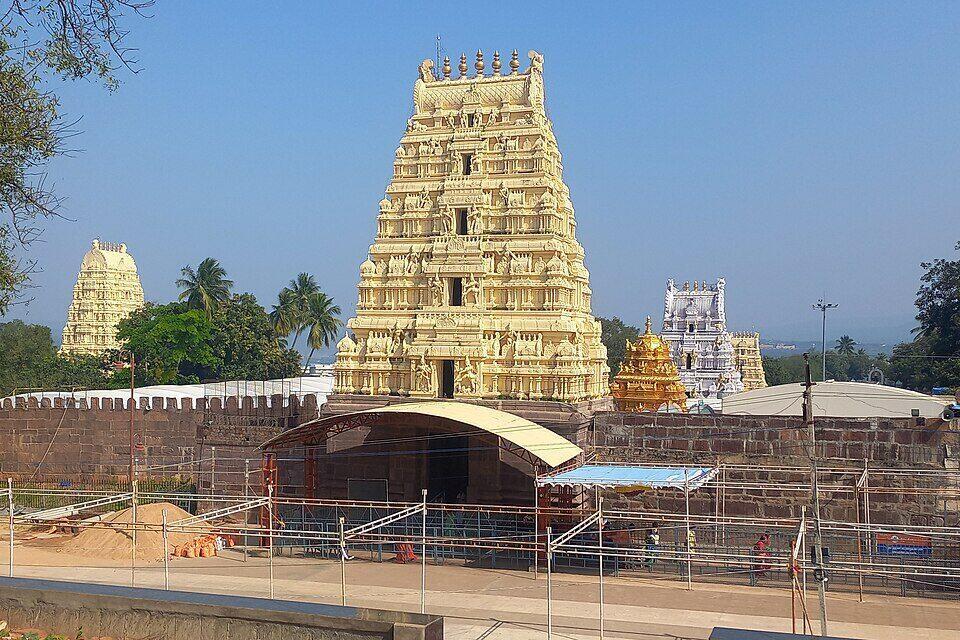
According to the Shiva Purana, when young Kartikeya (Skanda) believed he had been wronged in the contest with his brother Ganesha over the celestial fruit of wisdom, he left Kailasa in anger and settled on the Krauncha mountain in the south. The grieving Shiva and Parvati followed their son and, to remain close to him forever, manifested on this hill — Shiva as Mallikarjuna (jasmine-crowned Arjuna) and Parvati as Bhramaramba (the goddess of the bees). A parallel tradition links the lingam to Princess Chandravati, who worshipped Shiva with jasmine (mallika) flowers, and to the Pandava Arjuna, who is said to have performed penance here — giving the deity his twin name: Mallika (jasmine) plus Arjuna.
History
Srisailam's sanctity is attested in the Mahabharata, the Skanda Purana and the Shiva Purana, and the hill has been an unbroken pilgrimage site for over a millennium. The present temple complex took shape under the Satavahana, Ikshvaku, Chalukya and Kakatiya dynasties, with major expansions by the Reddy kings of the 14th century and the Vijayanagara emperors, especially Krishnadevaraya, who is credited with the grand mandapas and the outer prakara walls. Adi Shankaracharya is believed to have composed the Sivananda Lahari here. The temple survived centuries of invasions thanks to its remote forest location.
Architecture
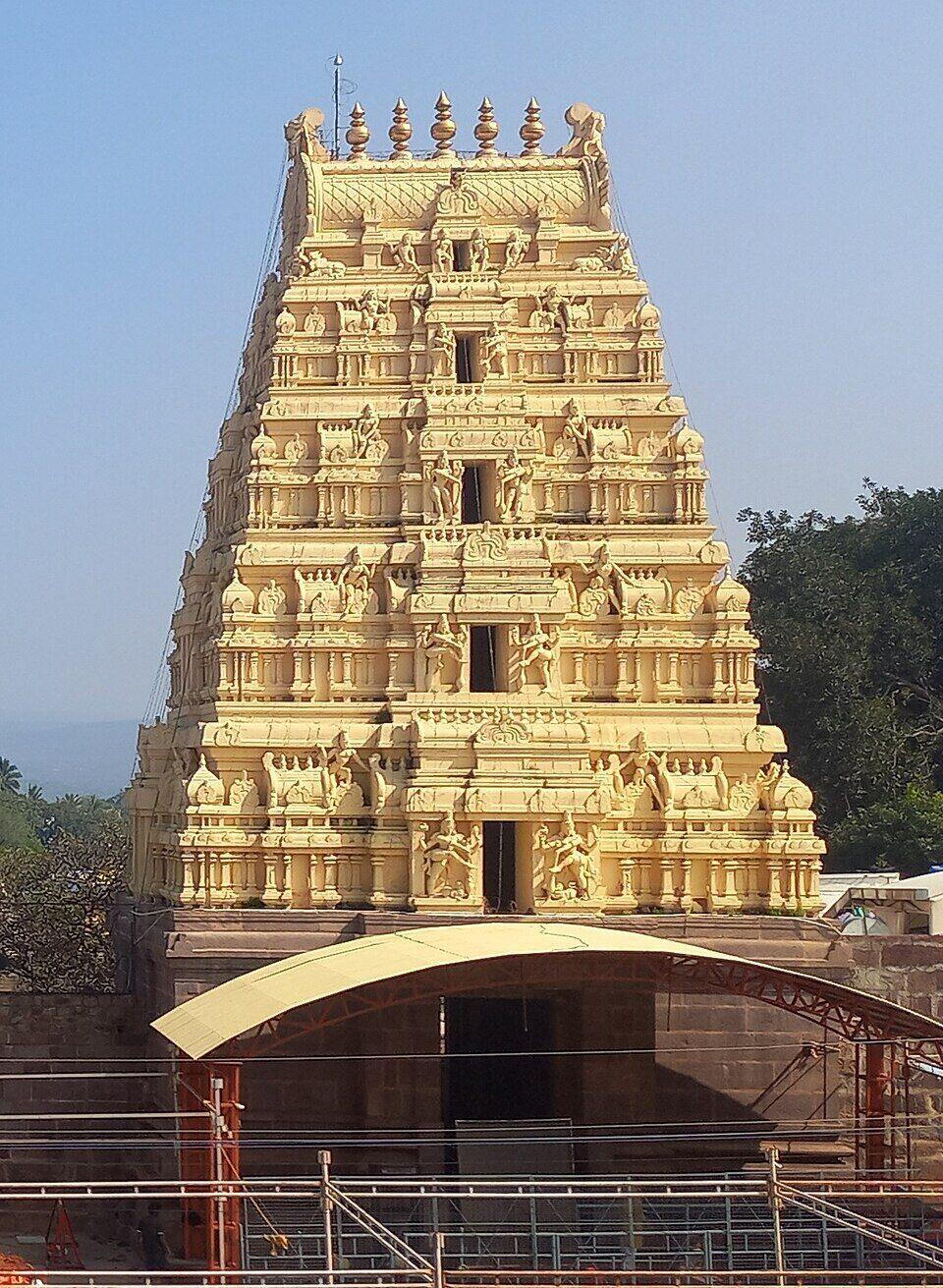
The temple is a fortified complex built in the Dravidian idiom, enclosed by a tall stone prakara wall carved with scenes from the Puranas. The garbhagriha houses the swayambhu Mallikarjuna lingam under a modest vimana, while the Bhramaramba Devi shrine stands to the rear. The Mukha Mandapa, pillared halls and gopurams bear Kakatiya and Vijayanagara-period sculpture. A notable feature is the thousand-pillar-style mandapa and the Veerashaiva-linked Mallikarjuna Shivalaya, reflecting the confluence of Shaiva traditions drawn to the hill.
Rituals & Practices
Daily worship follows the Shaiva Agama tradition with a sequence of abhishekam, alankaram and aartis from early morning until night; exact timings are set by the Devasthanam and are best confirmed on arrival. Rudrabhishekam, Kumkumarchana at the Bhramaramba shrine, and special pujas on Mondays and Pradosham are particularly sought after. The greatest festival is Maha Shivaratri, drawing lakhs of devotees for the Lingodbhava and night-long jagarana. Ugadi, Dasara and Karthika Masam also bring dense crowds. Many pilgrims sponsor Maha Nyasa Purvaka Rudrabhishekam as their core offering.
Prepare for Your Visit
Practical guidance to help you plan your pilgrimage
| Pilgrim Guidance | Srisailam is about 210 km from Hyderabad and 180 km from Kurnool, reached by road through the Nallamala forest — the ghat drive is stunning but can take longer than maps suggest. The nearest railhead is Markapur Road (around 85 km); the nearest airport is Hyderabad. Accommodation is offered by the Devasthanam and private hotels within walking distance of the temple. Plan darshan for early morning or late evening; break-darshan tickets are usually available. Combine the visit with Patala Ganga on the Krishna, Sakshi Ganapati, Hatakeshwaram and the ropeway viewpoints. Carry light woollens in winter and drinking water on the forest roads. |
Location
Kurnool, AP
Pilgrim photos
No pilgrim photos yet.
Community corrections
No corrections yet.
Edit history
No revisions yet.
Plan Your Visit to Mallikarjuna Temple, Srisailam
Get a custom itinerary and pricing for your trip.
Recommended
Packages for this destination
Pilgrim Notes
On-ground observations from fellow pilgrims
No pilgrim notes yet. Be the first to share on-ground observations!
Sign in to share a note.
Pilgrim Reviews
Be the first to share your experience at Mallikarjuna Temple, Srisailam.
Sign in to write a review.
Nearby sacred places
Discover other sacred places near Mallikarjuna Temple, Srisailam
Explore temples, tirthas, and pilgrimage sites in AP
Explore nearbyPart of these circuits
Walk the traditional pilgrimage routes this destination belongs to.