Rishikesh is, before it is anything else, a name of the Lord. Hrishikesha — he who is master of the senses — is a name of Vishnu, and tradition holds that this stretch of the Ganga received it after the Lord appeared here to the sage Raibhya, who had undertaken long austerity on its bank. Pilgrims therefore approach Rishikesh not as a pleasant hill town on a famous river, but as a tirtha whose very name is a remembrance of Narayana.
The town stands on the right bank of the Ganga in Dehradun district of Uttarakhand, at about 340 metres above sea level, at the point where the river has come down through the Garhwal hills but has not yet spread into the plains — that happens roughly twenty-five kilometres downstream at Haridwar. This is why the water here is felt by devotees to be mountain-Ganga: cold, swift, and close to her source. The oldest devotional centre of the town is Triveni Ghat in Mayakund, revered as a sangam of Ganga, Yamuna and the unseen Saraswati. Here pilgrims take snan, offer water to their ancestors, and gather at dusk for the aarti.
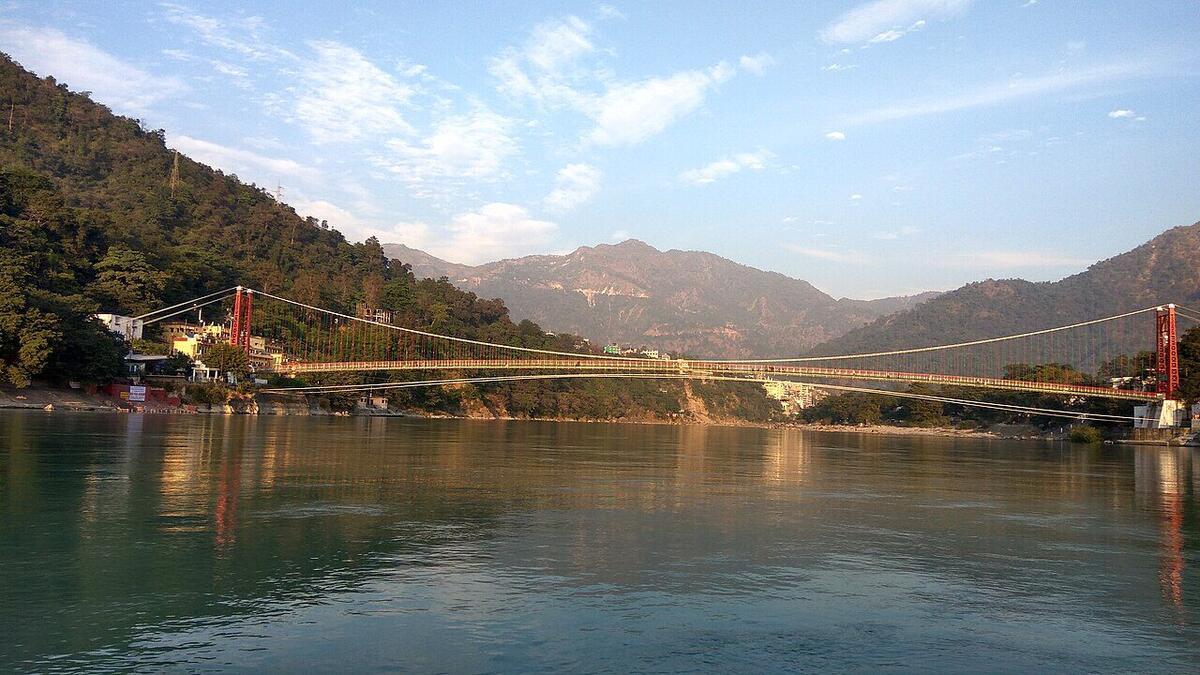
Devotional life spreads outward from the ghat in a few clear directions. A little upstream, Ram Jhula carries pilgrims across to Swargashram, where Parmarth Niketan, Gita Bhawan and a long line of ashrams and temples face the water. Further up at Tapovan stands Lakshman Jhula, the iron suspension bridge of 1930, raised at the spot where local tradition says Lakshmana crossed the Ganga on ropes of jute. And in the hills across the river, about 32 kilometres away, is Neelkanth Mahadev, among the most beloved Shiva shrines of Garhwal.
Rishikesh is also where a great many pilgrims formally begin the Char Dham Yatra. Counters for the Uttarakhand government's mandatory yatra registration are set up here each season, and the road to Yamunotri, Gangotri, Kedarnath and Badrinath begins from this town. Alongside this, Rishikesh has been for nearly a century a settled home of sadhana — Swami Sivananda founded the Divine Life Society here in 1936, Parmarth Niketan was established in 1942, and the study of yoga, Vedanta and meditation has drawn seekers from India and abroad ever since. The town's long-standing prohibition on the sale of meat, fish and liquor belongs to the same character: Rishikesh is kept, deliberately, as a place of restraint.
The mahatmya of Rishikesh rests on three things held together: the name of Vishnu, the presence of Ganga, and the town's long use as a ground of tapasya. Devotees hold that a tirtha carrying the Lord's own name gives benefit through mere residence and remembrance, and many pilgrims begin by simply uttering the name Hrishikesha at the water's edge before any other observance.
Ganga at Rishikesh is approached as she is in her mountain course. Tradition understands the river as a goddess who descended for the deliverance of the ancestors, and it is this understanding that shapes what happens at Triveni Ghat. Devotees hold that a dip at this sangam cleanses accumulated sin, and that water offered here to one's forebears brings them peace. Whether a pilgrim stays a single day or a full month, the ghat is where the devotional life of the town gathers.
Rishikesh is also a threshold. For those bound for the Himalayan dhams, this is the last town of the open country before the road climbs into Garhwal, and many take snan, offer at a temple, and make their sankalp here before setting out. In devotional understanding the yatra begins not when the vehicle moves but when the sankalp is spoken — and for a great many families that has happened at Rishikesh for generations.
Finally, the town is tapobhumi. These banks and the hills above them have sheltered ascetics for a very long time, and the tradition is unbroken: the ashrams here still keep the daily order of hawan, japa, satsang and scriptural study that a seeker of any age would recognise. That yoga came to be internationally associated with Rishikesh in the twentieth century is, in devotional terms, a late chapter of something much older.
Katha and local belief
Several kathas are attached to this reach of the Ganga. They are recounted here as tradition tells them.
Raibhya Rishi and the name of the town. Tradition holds that the sage Raibhya performed severe austerity on this bank, and that Vishnu appeared before him as Hrishikesha, master of the senses. The place took the Lord's name and has carried it ever since.
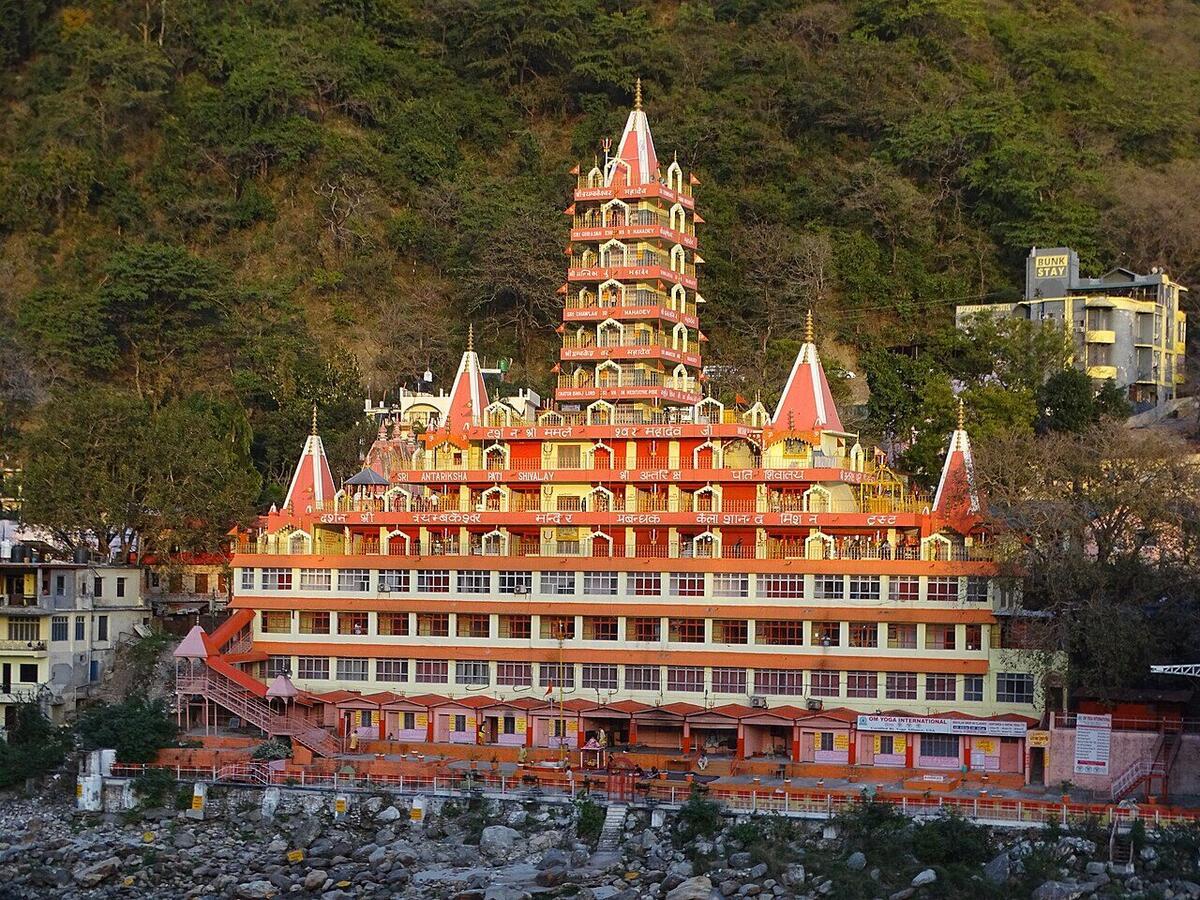
Lakshmana's crossing. Local tradition holds that Lakshmana, the brother of Rama, crossed the Ganga at Tapovan on ropes of jute, and that he performed penance on this bank. The suspension bridge raised at that spot is named Lakshman Jhula in memory of it, and the small temples clustered at either end — the Lakshman temple, Trayambakeshwar and Raghunathji's shrine among them — belong to the same devotional memory.
Neelkanth and the halahala. The Puranas tell of the churning of the ocean, when the poison halahala rose before the nectar, and Shiva drank it to spare creation, holding it in his throat until the throat turned blue. Devotees hold that he drank it at the place now called Neelkanth Mahadev, in the Manikoot hills above Rishikesh, and that he remained there in meditation long afterwards. The shikhara of the temple carries sculpted scenes of that churning.
Triveni Ghat. Beyond the sangam of the three rivers, local telling connects the ghat with Rama, who is said to have come here in penance after the war with Ravana, and with Krishna. It is on the strength of these associations that the ghat has long been the chosen place in Rishikesh for rites offered to the departed.
History
The history of Rishikesh is best read as a continuity of worship rather than of rule. Its oldest continuous thread is the daily worship at Bharat Mandir in Mayakund, dedicated to Hrishikesh Narayan — Vishnu under the town's own name. The temple's own account holds the shrine to be older than Adi Shankaracharya, citing an inscription in Pali-Prakrit and excavated brick and pottery, and records that Adi Shankaracharya installed the Shri Yantra in the sanctum at the beginning of the ninth century during a renovation. The Ministry of Tourism's account, following the Kedarkhand, attributes the main edifice to Shankaracharya and notes that the temple was rebuilt after the invasion of 1398 — the outer structure restored in 1832 by Maharaja Yashwant Singh of Nabha. Excavation at the site has also yielded a Buddha image, suggesting the ground was in monastic use in an earlier age. Through all of it, the five-foot image of Hrishikesh Narayan, carved from a single block of black shaligram, has remained the object of worship.
The story of the crossings is the story of how pilgrims reached the far bank. Tradition remembers a rope bridge at Tapovan; a bridge of 284 feet stood there until the great floods of October 1924 carried it away. The iron suspension bridge that replaced it — Lakshman Jhula, 450 feet of span with a carriage way of six feet, standing about 59 feet above the summer water — was built between 1927 and 1929 and opened to traffic on 11 April 1930. It carried pilgrims for close to nine decades. On 12 July 2019 the state administration closed it after engineers found several of its components failing; the Additional Chief Secretary, Om Prakash, said that it could no longer be permitted to carry even pedestrians. It has not reopened. Downstream, Ram Jhula — an iron suspension bridge of about 230 metres, built in 1986 between Shivanandanagar and Swargashram — now carries the greater part of pilgrim traffic. A replacement for Lakshman Jhula, the glass-floored Bajrang Setu, has been built at the same site; as of the first half of 2026 it had completed technical testing but had not been formally inaugurated, and access to its glass walkway was restricted while damaged panels were replaced.
The twentieth century gave Rishikesh its ashram belt. Swami Sivananda settled on the right bank and founded the Divine Life Society in 1936 at Shivanandanagar, about three kilometres upstream of the town, with the aims of spreading spiritual knowledge and of serving the poor through hospitals, dispensaries, schools and publications. Parmarth Niketan was founded in 1942 by Pujya Swami Shukdevanand and grew into the largest ashram in Rishikesh, with more than a thousand rooms. In the 1960s Maharishi Mahesh Yogi established his meditation academy in the forest above the river at Chaurasi Kutia, and the stay of the Beatles there in 1968 brought the town an international audience it has never lost. Since 1999 the International Yoga Festival has been held at Parmarth Niketan each March, now with the support of the Ministry of Tourism.
The civic character of the town has followed its sacred one. The sale of meat and fish has been prohibited in Rishikesh since 1956, and liquor is banned across the whole municipal corporation area, with a further prohibition within a two-kilometre radius of the Virbhadra temple.
Architecture
Rishikesh has no single dominant temple that gathers everything to itself. Its sacred architecture is distributed: a Vishnu shrine in the old town, a Shiva shrine in the hills, stepped ghats along the water, and the bridges built to stitch the two banks together.
Bharat Mandir is built of heavy stone. Its most striking feature is the roof — nine domes standing three by three — and the crowning dome is said to be a single block of rock weighing 125 tonnes. Within, the five-foot murti of Hrishikesh Narayan is carved from one piece of black shaligram, the same sacred stone from which the images of Badrinath and Tirupati are made.
Neelkanth Mahadev, at about 1,330 metres in the Manikoot hills, is unusual for Garhwal. Its tower rises in receding tiers in a manner closer to a South Indian gopura than to the stone shikharas of the surrounding hills, and its surfaces carry sculpted scenes of the samudra manthan — the churning that the shrine commemorates. A natural spring beside the temple is used by pilgrims for bathing before darshan, and the shrine stands near the confluence of the Pankaja and Madhumati streams, among the valleys of Manikoot, Brahmakoot and Vishnukoot.
The ghats are plain by design: broad stepped stone descending into fast water, chains and railings at the bathing points, and open platforms where the evening aarti is performed and where rites for the departed are conducted through the day. At Parmarth Niketan the ashram's own ghat opens directly to the river, with a fourteen-foot Shiva murti standing in the shallows.
The suspension bridges deserve to be counted here as sacred architecture, because they were built to carry devotion. Lakshman Jhula's slim iron span and narrow six-foot walkway were made for pilgrims on foot; Ram Jhula, longer at about 230 metres, was built in 1986 for the same purpose. In the forest above the river at Chaurasi Kutia stand rows of small domed stone meditation cells built for solitary sadhana — eighty-four of them, for the eighty-four lakh forms of life that tradition counts.
Rituals & Practices
Worship in Rishikesh is organised around the river far more than around any single sanctum. Timings shift with the season and with the level of the water, so pilgrims should confirm the day's schedule with the ghat samiti, the ashram or the temple before planning around it.
Snan. For most pilgrims the first act is a dip in the Ganga, usually at Triveni Ghat. The current is strong and the water cold; devotees bathe at the chained and railed sections and do not step beyond them.
Rites for the ancestors. Triveni Ghat is a recognised place for tarpan, pind daan and shraddha, and for mundan. Purohits sit along the ghat through the morning. It is customary — and wise — to settle the sankalp and the dakshina clearly before the rite begins.
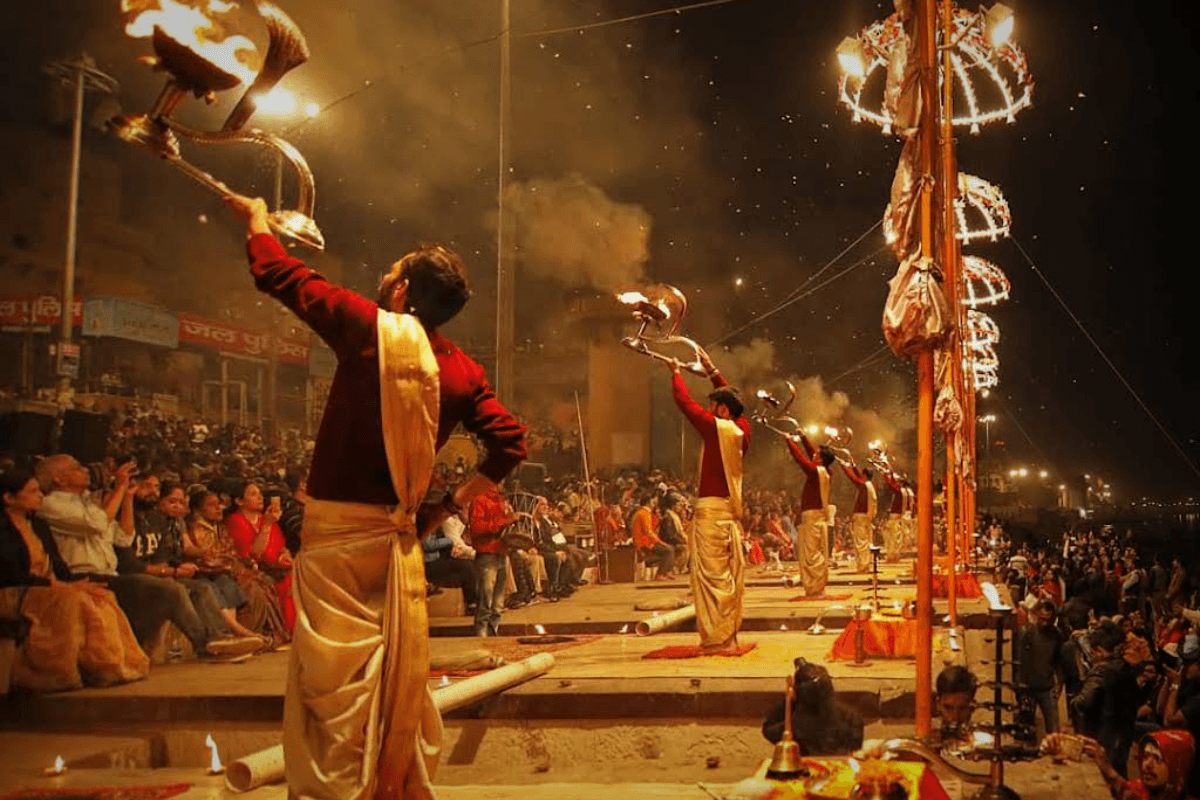
Ganga aarti. Two aartis draw the town each evening. At Triveni Ghat the aarti is conducted by the Ganga Seva Samiti, with hymns in praise of the river, lamps raised together, and leaf-boats of diyas set upon the water; it is commonly described as beginning around six in the evening and lasting roughly three quarters of an hour, and there is a nominal contribution for those who wish to take part in the offering, which goes to the upkeep of the ghat. At Parmarth Niketan, about five hundred metres from Ram Jhula, the aarti is performed at sunset by the ashram's students of the Vedas, with hawan, mantra and bhajan. It is open to all, without distinction of nationality, caste or creed.
At Neelkanth Mahadev. Devotees offer bilva patra, coconut, flowers, milk, honey, fruit and water to the linga, and many bathe first in the spring beside the shrine. Darshan is commonly available from early morning until evening. During Shravan and on the two Shivratris the queue can be very long, and the hill road slow.
Sankalp before the yatra. Pilgrims bound for the dhams commonly take snan, offer at a temple, and speak their sankalp at Rishikesh before boarding.
In the ashrams. Hawan at dawn, japa, satsang and discourse on the scriptures continue through the day in the ashram belt at Shivanandanagar and Swargashram. Most are open to visitors who come with a quiet intention and keep the house rules.
Festivals & Celebrations
| Festival | When | Crowd |
|---|---|---|
| Maha Shivratri | — | Very high, especially at Neelkanth Mahadev |
| Shravan and the Kanwar Yatra | — | Extremely high; roads, bridges and the whole town are affected |
| Char Dham Yatra season | — | High from the opening of the portals |
| International Yoga Festival | — | High within the ashram belt |
| Akshaya Tritiya at Bharat Mandir | — | Moderate to high in the old town |
Maha Shivratri: Devotees hold that Neelkanth marks the place where Shiva drank the halahala that rose from the churning of the ocean. Shivratri is therefore kept at this shrine with particular intensity.
Shravan and the Kanwar Yatra: Shravan is Shiva's month. The Shravan Shivratri fair at Neelkanth and the kanwar processions are the most intense devotional period of the Rishikesh year.
Char Dham Yatra season: Rishikesh is the traditional place of departure for the Himalayan dhams. Many pilgrims bathe, offer at a temple and speak their sankalp here before the road begins to climb.
International Yoga Festival: The festival is the modern face of a far older association between Rishikesh and the disciplines of yoga, meditation and scriptural study.
Akshaya Tritiya at Bharat Mandir: Akshaya Tritiya is held to be a day whose merit does not diminish. At the town's oldest temple it is marked by circumambulation of the Lord whose name the town itself carries.
Prepare for Your Visit
Practical guidance to help you plan your pilgrimage
| Pilgrim Guidance | How the town is arrangedRishikesh is not one place but a string of settlements along several kilometres of river. Knowing the order saves a great deal of moving about.
Please note about Lakshman Jhula. The bridge has been closed since 12 July 2019 and cannot be walked across. It can be seen, and the temples, lanes and shops at either end remain open as before, but the crossing itself is not available. Its replacement, the glass-floored Bajrang Setu, has been built at the same site, but as of the first half of 2026 it had not been formally inaugurated and its glass walkway was still restricted while damaged panels were replaced. Please check locally whether it is open on the day you visit rather than planning a crossing in advance; Ram Jhula remains the dependable pedestrian crossing. If Rishikesh is the start of your Char Dham YatraRegistration is mandatory under Uttarakhand government policy for Yamunotri, Gangotri, Kedarnath and Badrinath, and for Hemkund Sahib. Register on the state portal at registrationandtouristcare.uk.gov.in or through the Tourist Care Uttarakhand app before you travel; offline counters operate in season at Rishikesh, Haridwar and Vikasnagar. You receive a yatra registration letter with a QR code, which must be carried and shown at the check points, and verification is done again at each dham. Vehicles must be registered as well as pilgrims. The season runs through the warmer months: the portals open in April and close in November, and the exact dates are announced afresh every year — in the 2026 season, for instance, the Kedarnath portals opened on 22 April. Plan around the announced dates rather than assuming them, and keep a day of margin at Rishikesh for registration, snan and rest before the climb. Preparation and best time
|
Location
Dehradun, UK
Gallery
Pilgrim photos
No pilgrim photos yet.
Community corrections
No corrections yet.
Edit history
No revisions yet.
Plan Your Visit to Rishikesh
Get a custom itinerary and pricing for your trip.
Recommended
Packages for this destination
Pilgrim Notes
On-ground observations from fellow pilgrims
No pilgrim notes yet. Be the first to share on-ground observations!
Sign in to share a note.
Pilgrim Reviews
15 reviews
Be the first to share your experience at Rishikesh.
Sign in to write a review.
Nearby sacred places
Discover other sacred places near Rishikesh
Explore temples, tirthas, and pilgrimage sites in UK
Explore nearbyPart of these circuits
Walk the traditional pilgrimage routes this destination belongs to.