Somnath is revered as the first among the twelve Jyotirlingas of Mahadev. The Shree Somnath Trust, which administers the shrine, greets pilgrims as visitors to the holy place of the First Aadi Jyotirling Shree Somnath Mahadev, and the Dwadasha Jyotirlinga stotra opens with this very name — Saurashtre Somanatham cha. In devotional understanding, to stand before this linga is to stand at the first of the twelve seats where Shiva is held to have manifested as light.
The temple stands at Prabhas Patan, near Veraval, in the district that now carries the shrine's own name — Gir Somnath. This is the kshetra the Puranas praise as Prabhasa. Close by, at the Triveni Sangam, tradition holds that the Hiran, the Kapila and the Saraswati meet and pour together into the sea, and pilgrims who come for Somnath darshan almost always take the sangam and the neighbouring tirthas into the same journey.
What a pilgrim notices on arrival is that the sea belongs to the temple. The shrine faces open water with nothing built between the mandap and the horizon; the sound of the waves carries inside, and the evening aarti is performed with that sound beneath it. On the shore stands the Baan Stambh, the arrow-pillar, whose Sanskrit inscription is read as declaring an abadhit jyotirmarg — an unobstructed path — running from this coast to the South Pole, the nearest land in that line lying, by the Trust's reckoning, some 9,936 kilometres away. Devotees read that pillar as a statement about the place itself: Somnath stands where the land of Bharat ends and offers itself to the sea.
Somnath is also a shrine that Hindus remember as having been broken and raised again more than once. The building seen today was consecrated on 11 May 1951, when Dr. Rajendra Prasad, the first President of India, performed the pran-pratishtha of the Jyotirlinga. But the deeper identity of the place is not the building. Devotees hold that worship at Prabhas never stopped — through ruin, through rebuilding, and through the long stretches when a small temple quietly carried the tradition until a larger one could rise again. Pilgrims come here not to see a monument to survival, but to offer water to a Lord who, in their understanding, never left this shore.
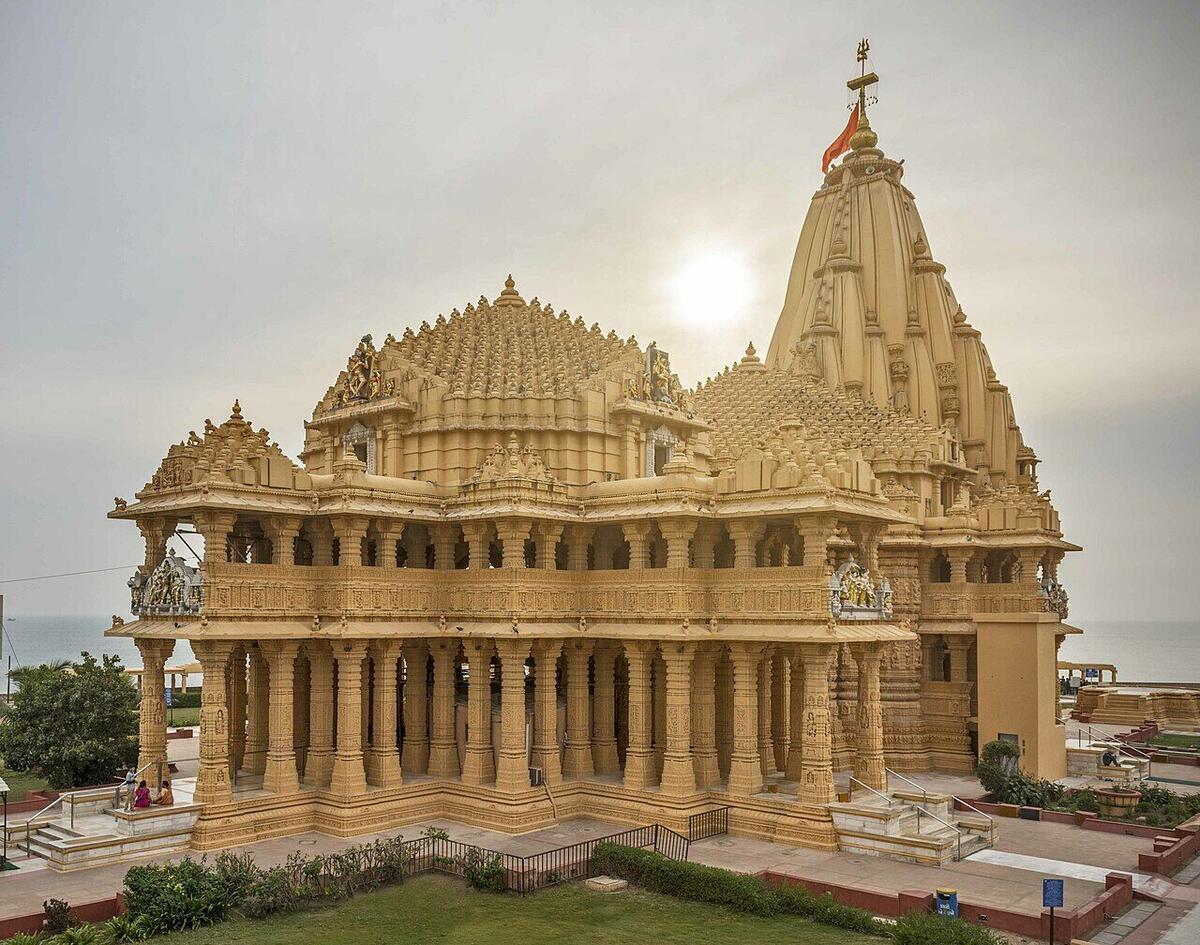
In the Shaiva tradition a Jyotirlinga is not one linga among many. It is understood as Shiva's own light, self-arisen, taking a form that human hands can bathe and human eyes can behold. The Shree Somnath Trust records the classical understanding in the words tradition preserves — that Shiva is always present everywhere, but especially in twelve forms and places as the Jyotirlingas. Somnath is counted the first among these twelve.
The name itself carries the meaning. Soma-natha is the Lord of Soma, the Lord of the Moon. Devotees hold that it was Chandra who first worshipped Shiva at this shore and was released here from a curse of wasting, and that Shiva accepted Prabhas as his abode from that moment. Somnath is therefore approached as a tirtha of restoration. Pilgrims come with prayers for what has waned in their lives — health, strength, dignity, fortune — because tradition holds that this is the place where waning itself was met with grace.
Prabhas kshetra holds a second sacred memory beside Shiva's. Tradition tells that Bhagwan Shri Krishna, struck by a hunter's arrow at Bhalka, came to the bank of the Hiran and there performed his Nijdham Prasthan — his departure from this world. The Somnath Trust maintains that ground at Bhalka Tirth and at Golokdham, also called Dehotsarg, within a short journey of the main temple. For many pilgrims the Somnath yatra is therefore twofold: Mahadev at the shore, and the memory of Krishna's leave-taking on the riverbank nearby. Few places in India hold both a Jyotirlinga and a Krishna-nijdham tirtha within the same kshetra.
Katha and local belief
The Shiva Purana, in its Kotirudra Samhita, tells the katha that gives Somnath its name. Daksha Prajapati gave his twenty-seven daughters, the nakshatras, in marriage to Chandra, on the understanding that he would hold them all equally dear. Chandra's love went to Rohini alone, and the others were neglected. Daksha, displeased, cursed him with kshaya — a wasting away — and the moon began to fade from the sky.
The katha continues that Brahma counselled Chandra to go to Prabhasa kshetra, to bathe there, and to worship Shiva with the Mrityunjaya mantra. Chandra performed that tapas here, the tradition says for six months without break, reciting the mantra crores of times. Shiva, pleased, gave a boon that neither cancelled the curse nor allowed it to destroy him: for one paksha his light would diminish, and for the next it would return. Devotees hold that the waxing and waning of the moon, month after month, is that boon still visible in the sky. This is why Somnath is remembered as a place where grace is given not by erasing what is broken, but by giving it a rhythm of renewal — a belief that later generations found painfully apt for the temple's own story.
The gods, the katha adds, then asked Shiva to remain at Prabhas, and he consented to abide there as the Jyotirlinga.
The Trust's own telling preserves a further tradition: that the shore temple was raised four times before recorded history begins — in gold by Soma, in silver by Ravi, in wood by Shri Krishna, and in stone by King Bhimadeva. Pilgrims do not treat this as a chronicle of dates. They treat it as a statement of the shrine's character, that Somnath has always been a temple which gets built again.
History
Worship at Prabhas is old, and its continuity is the true thread of Somnath's history. By the tenth century a stone temple stood here under the Chaulukya, or Solanki, kings of Gujarat. Historians associate the earliest of these structures with Mularaja, before 997 CE, and record that King Kumarapala rebuilt the shrine in 1169 in fine stone.
The temple was raided and desecrated more than once across the centuries — the raid of Mahmud of Ghazni in 1026, an assault in 1299 in the time of Alauddin Khalji, and an order of demolition under Aurangzeb in 1706 are the events most often recorded. Each of these is one fact in a much longer account. What followed each of them matters more to a pilgrim: the shrine was restored, and the Jyotirlinga went on receiving worship.
Among the most cherished of those restorations is that of Maharani Ahilyabai Holkar of Indore, who in 1783 had a temple built at Prabhas with an image consecrated for daily worship. That shrine — known today as Old Somnath, or the Ahilyabai Mandir, standing a short walk from the present temple — carried the tradition through the years when nothing larger stood. Pilgrims still take darshan there, and the Trust lists it first among the sacred places to visit at Somnath.
The temple of the present day belongs to India's first years of freedom. In November 1947 Sardar Vallabhbhai Patel came to Somnath and resolved before a public gathering that the shrine would be rebuilt. Mahatma Gandhi, consulted on the plan, advised that the funds should come from the public rather than from the state, and they were raised that way; the Jam Saheb of Nawanagar, Digvijaysinhji, was among the first large donors. The Shree Somnath Trust was constituted to hold and administer the shrine, and K. M. Munshi carried the work through after Patel's death. The foundation stone was laid on 8 May 1950. On 11 May 1951, Dr. Rajendra Prasad performed the pran-pratishtha of the Jyotirlinga in the new sanctum. The Trust keeps that date as Somnath Sthapna Din and observes it every year.
Building continued long after the consecration: the temple was completed in November 1966, and the Digvijay Dwar, the ceremonial gateway to the complex, was finished in 1970. In January 2026 Somnath observed the Somnath Swabhiman Parv — a national commemoration organised by the Ministry of Culture and marked on the Trust's own calendar on 11 January — noting a thousand years since the raid of 1026 and seventy-five years since the 1951 consecration, and framed not as a remembrance of destruction but as a tribute to endurance.
Architecture
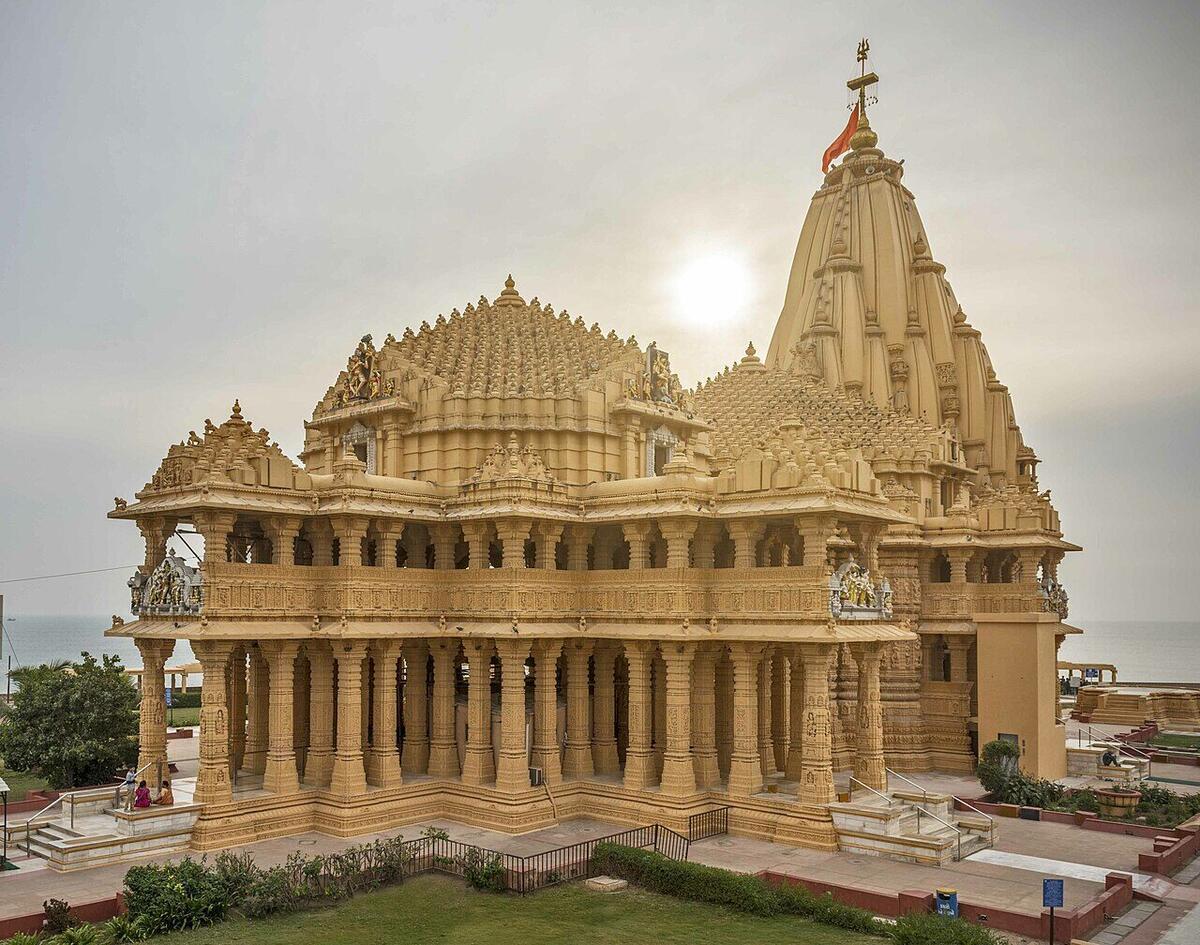
The present temple was designed by the architect Prabhashankar Sompura, working in the Maru-Gurjara idiom of western India — the Chaulukya or Solanki tradition of temple building. The Trust names the form specifically: the Kailash Mahameru Prasad, the temple conceived as Shiva's own mountain rising from the shore.
The plan follows the classical three-part order — garbhagriha, sabhamandap and nrityamandap. Above the sanctum rises the shikhara, which the Trust gives as 155 feet. The kalash crowning it weighs about ten tonnes, and the dhwajadand that carries the temple flag stands 27 feet high and measures a foot in circumference. Pilgrims on the seafront look up for the flag flying from it.
Inside, the sanctum is unhurried in feeling. The Jyotirlinga is worshipped with abhishek and shringar, and the darshan is close rather than distant. The stone of the mandaps is carved in the restrained western Indian manner — bands of moulding, figured brackets, a ceiling worked into concentric rings — the ornament serving the approach to the sanctum rather than competing with it. The honey-coloured stone takes the coastal light differently through the day, warm at midday and almost golden before the evening aarti.
Nandi faces the sanctum, and the shrine as a whole faces the open sea. That orientation is part of the temple's meaning rather than a matter of siting. On the shore stands the Baan Stambh, the arrow-pillar, inscribed with the claim of an unobstructed path from this point to the South Pole. The Digvijay Dwar forms the ceremonial gateway to the complex. Devotees who walk the seafront after darshan usually pause at both.
Rituals & Practices
The Shree Somnath Trust keeps the shrine open for darshan from 6:00 am to 10:00 pm, and aarti is performed three times each day — at 7:00 am, at 12 noon, and at 7:00 pm. These are commonly known as the Mangala, Madhyahn and Sandhya aartis. Timings can change on festival days and through Shravan, so pilgrims planning their day around a particular aarti should verify the current schedule with the temple authorities.
Before each aarti the Jyotirlinga receives abhishek and shringar — the bathing of the linga and its adornment with flowers and ornaments. The evening aarti, performed with the sea audible behind the mandap and the temple lit against the dark, is the one most pilgrims try to attend, and the one that stays with them.
For those who wish to have a rite performed in their name, the Trust records the principal pujas offered at Somnath:
- Homatmak Laghurudra
- Homatmak Maharudra
- Homatmak Atirudra
- Savalaksha Samput Mahamrityunjaya Jaap
The Mahamrityunjaya jaap carries a particular resonance at this kshetra, since tradition holds that it was with this very mantra that Chandra worshipped Shiva at Prabhas. Bookings for havan and yagna are arranged through the Trust, and prasad and special puja can also be booked through its official channels. Many pilgrims, however, offer nothing more than water, bilva patra and folded hands — which the tradition has always held sufficient.
In the evening the Trust presents the Jay Somnath light and sound show at the temple, from 8:00 pm to 9:00 pm, in which the history of the shrine is narrated. The 3D projection version introduced in 2017 uses the voice of Amitabh Bachchan. The show is not held during the monsoon.
Festivals & Celebrations
| Festival | When | Crowd |
|---|---|---|
| Mahashivratri | — | Very high â long queues through the night |
| Shravan Maas | — | Very high â the whole month, and heaviest on Mondays |
| Kartik Purnima | — | High â a five-day fair fills the town |
| Somnath Sthapna Din | — | Moderate |
| Golokdham Utsav | — | Moderate |
Mahashivratri: The most important night of the Shaiva year. Devotees hold that vigil, fasting and abhishek offered on this night draw Shiva's direct grace, and at a Jyotirlinga that grace is held to be especially near.
Shravan Maas: Tradition holds Shravan to be the month in which offerings to Shiva bear the greatest fruit. Jalabhishek during Shravan, and especially on Shravan Mondays, is among the simplest and most cherished acts of Shaiva devotion.
Kartik Purnima: Kartik Purnima is counted among the most sacred full moons of the year for bathing and offering at a tirtha. At Somnath, the day joins the shrine to the bathing tradition of the Triveni Sangam nearby.
Somnath Sthapna Din: A day of thanksgiving rather than spectacle â remembered by devotees as the day worship returned to a full temple at Prabhas after a long interruption.
Golokdham Utsav: Marks Bhagwan Shri Krishna's Nijdham Prasthan, which tradition places at this spot after he was struck by a hunter's arrow at Bhalka. It gives the Somnath kshetra its Vaishnava dimension alongside the Jyotirlinga.
Prepare for Your Visit
Practical guidance to help you plan your pilgrimage
| Pilgrim Guidance | Reaching SomnathThe temple stands at Prabhas Patan in Gir Somnath district, on the Saurashtra coast. By the Trust's own reckoning, Somnath railway station is about half a kilometre from the temple and Veraval about 7 kilometres; the nearest airports are Diu at about 85 kilometres, Rajkot at about 200, and Ahmedabad at about 390. Most pilgrims arrive by rail at Veraval or Somnath, or by road across Saurashtra. The Trust runs its own guest houses at Somnath — Sagar Darshan Atithi Gruh, Lilavati Atithi Bhavan and Maheshwari Atithi Bhavan — which can be booked online in advance. This is worth doing well ahead for Mahashivratri, for Shravan, and for the Kartik Purnima fair, when the town fills. Preparation for pilgrims
The wider Prabhas kshetra, and when to comeSomnath darshan is rarely taken alone. The Trust lists the sacred places of the kshetra within a short radius: the Ahilyabai temple, Bhalka Tirth, the Shashi Bhushan temple, the Triveni Sangam ghat, Golokdham Tirth, the bethak of Harihar Mahaprabhuji, and Prachi Tirth. Pilgrims with a full day usually take the Triveni Sangam and Bhalka in the morning and keep the temple itself for the evening aarti. Further out lie Sasan Gir at about 65 kilometres, Diu at about 85, Junagadh at about 90, Porbandar at about 130 and Dwarka at about 230 — which is why Somnath and Dwarka are so often taken together as one yatra across Saurashtra. October to February is the most comfortable season on this coast. Shravan and Mahashivratri are the most charged times spiritually and also the most crowded; the Kartik Purnima fair in November fills Somnath for five days. Pilgrims who want a quiet, unhurried darshan do best on an ordinary weekday morning, when the 7:00 am aarti can be attended without a long wait. |
Location
Gir Somnath, GJ
Pilgrim photos
No pilgrim photos yet.
Community corrections
No corrections yet.
Edit history
No revisions yet.
Plan Your Visit to Somnath Temple
Get a custom itinerary and pricing for your trip.
Recommended
Packages for this destination
Pilgrim Notes
On-ground observations from fellow pilgrims
No pilgrim notes yet. Be the first to share on-ground observations!
Sign in to share a note.
Pilgrim Reviews
15 reviews
Be the first to share your experience at Somnath Temple.
Sign in to write a review.
Nearby sacred places
Discover other sacred places near Somnath Temple
Explore temples, tirthas, and pilgrimage sites in GJ
Explore nearbyPart of these circuits
Walk the traditional pilgrimage routes this destination belongs to.