Anandmayi Ghat lies on the southern reach of the Kashi riverfront, in the neighbourhood of Bhadaini, seventh in the ghat sequence that begins at Assi — between Janaki Ghat and Vaccharaja Ghat. Heritage documentation of the Varanasi ghats records that it was earlier called Imaliya Ghat, and that it came to carry its present name after 1944, when Sri Anandamayi Ma acquired the ghat and developed the terrace above it for her ashram. Born Nirmala Sundari at Kheora in 1896, she was given the name Anandamayi Ma — the joy-permeated Mother — by devotees in the 1920s, and her followers came to revere her as an incarnation of the Goddess.
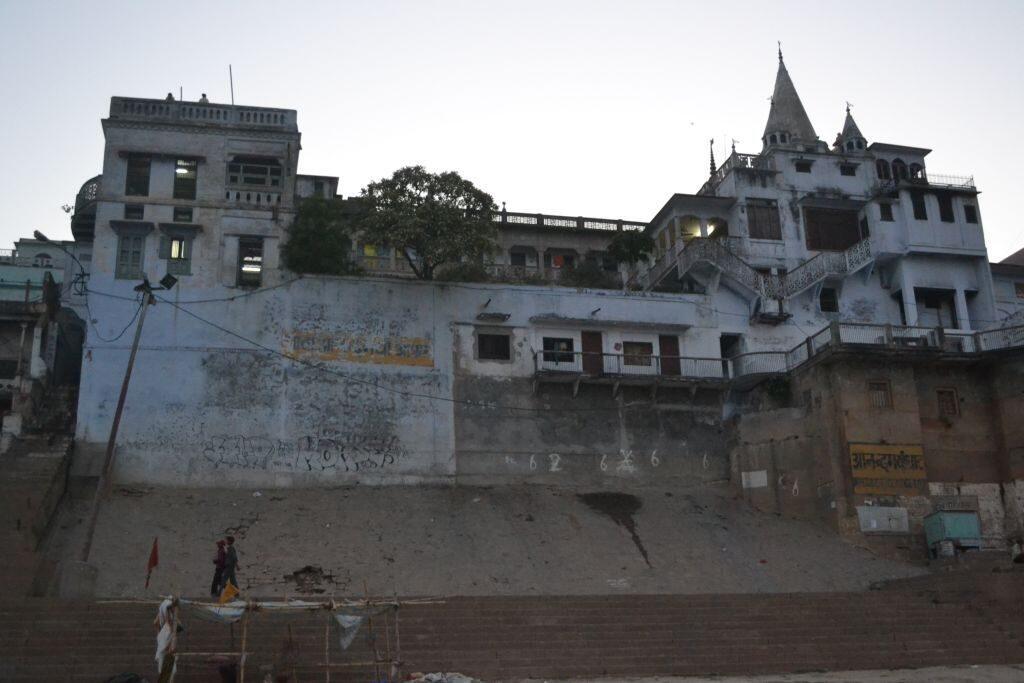
What stands above the steps is not a palace but a working ashram. The heritage record describes two attached buildings raised here: the Anandamayi Ashram, which holds a temple of Annapurna and Shiva and a large hall for yajna, and the Anandamayi Kanyapith, a residential school where girls are given spiritual training together with a general education. From the 1950s the headquarters of the Sangha founded in Ma's name was established at Varanasi, and the Sangha's quarterly has been published from this city since.
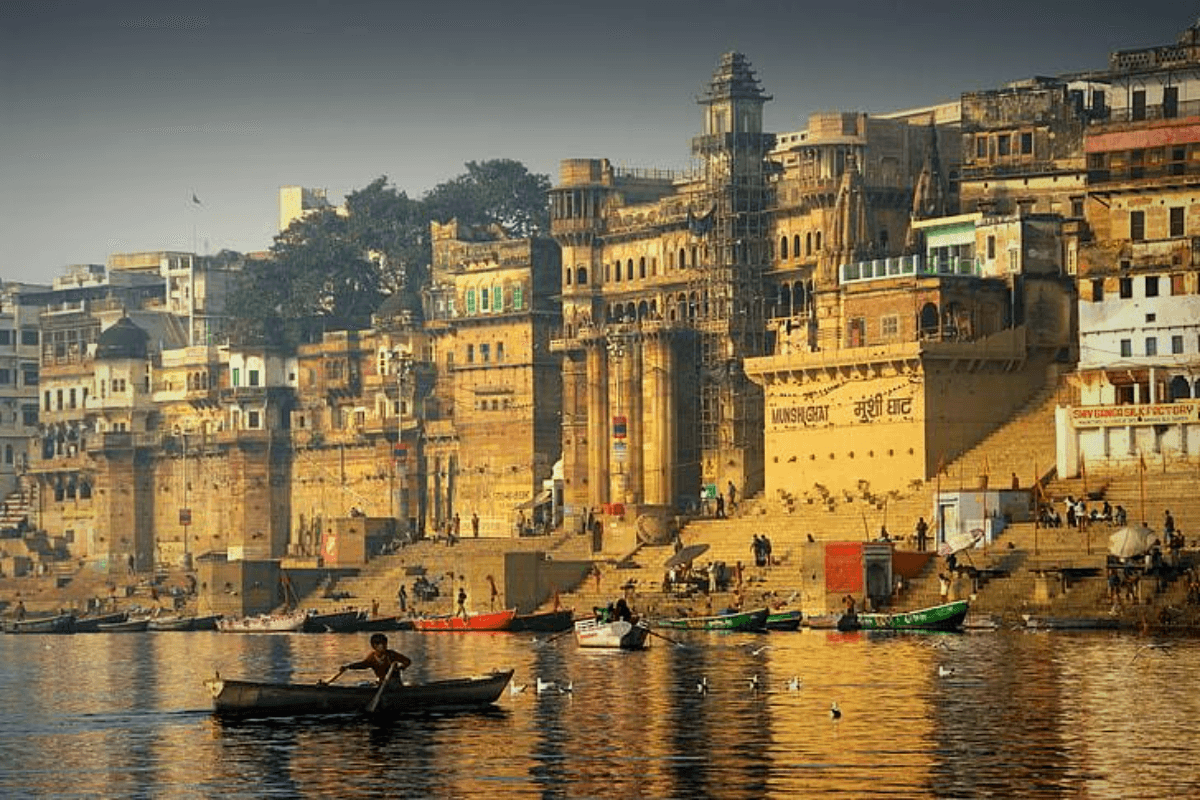
The ghat itself is unhurried. No aarti platform stands here, and the heritage record notes no ceremony at these steps beyond the daily bath. Before sunrise the steps fill briefly with residents of Bhadaini taking snan, and by mid-morning the river is quiet again. For a pilgrim walking north from Assi towards Dashashwamedh, Anandmayi Ghat is the place where the riverfront is still domestic — the sound of kirtan drifting down from the terrace, a few people sitting on the steps, the Ganga running north in front of them.
Like every ghat on the Kashi crescent, Anandmayi Ghat shares in the sanctity of the river itself. The Ganga here is Uttaravahini, turned north against her own course, and tradition holds that snan taken anywhere along this bank is snan taken in a tirtha. A devotee bathing here takes the same Ganga as a devotee bathing at Dashashwamedh; sankalp and tarpan for ancestors may be performed here as at any ghat.
What is distinctive about this ghat is not an ancient katha but a modern one — a devotional lineage barely a century old, given a permanent home within a city that has been receiving sampradayas for as long as anyone can count. Kashi has never treated newness as a disqualification; it has absorbed sant, siddha and acharya alike, and Anandmayi Ghat is the twentieth century's addition to a bank built and rebuilt across many earlier ones. That an ashram founded in 1944 now sits a few minutes' walk from ghats named in Puranic literature is, in Banaras, entirely ordinary.
The Mother who feeds, on the terrace above
The ashram's principal temple is dedicated to Annapurna and Shiva. In Kashi, Annapurna is understood as the Mother who feeds the city — the form of Parvati who, in the well-loved Banarasi telling, holds the ladle from which Shiva himself receives alms, so that in this kshetra no one goes hungry. That a foundation built around a woman whom devotees called Mother should keep Annapurna at its centre is felt by them as fitting rather than accidental. The temple was opened in Ma's presence at Deepavali in 1950.
A samadhi elsewhere, a presence here
It should be said plainly, because it is often confused: Sri Anandamayi Ma left her body at Dehradun on 27 August 1982, and her samadhi shrine was built two days later in the courtyard of her ashram at Kankhal, near Haridwar. There is no samadhi at this ghat. What Kashi holds is what she built here and what continues in it — the temples, the yajna hall, the school, the kirtan. For those who follow her, this is not a lesser inheritance. Devotees hold that a place shaped by a realised life keeps something of that life; they come to the ghat and the ashram in that understanding, and sit.
History
Before it carried its present name the ghat was known as Imaliya Ghat. Heritage documentation of the Varanasi ghats records that it was first made pucca in about 1942 by Rai Baldeo Sahai; that in 1944 Sri Anandamayi Ma acquired the ghat and developed the upper part for her ashram; and that in 1945 the lower portion was made pucca by Shiv Prasad Gupt. The ashram's own chronology matches this closely: it records that in March 1944 Ma first set foot on the new ashram land at Varanasi and that the first Vasanti Durga Puja was held there that month, and that in April 1945 the second Basanti Puja was held at the new ashram, along with the inauguration of a Smriti Mandir in memory of Swami Akhandananda.
The two decades that followed were the ashram's building years, and the record of them is unusually well kept. A three-year Akhanda Gayatri Mahayajna began at the Varanasi ashram in January 1947 and concluded in January 1950 with a great feeding of brahmins and a procession through the city. The Viraja Mandir was opened in July 1950; the temple of Annapurna was opened in Ma's presence at Deepavali the same year. In October 1951 the Kanyapeeth's Shilpa Pratisthan block and a Shishu Kalyan centre were opened. In August 1952 the first Samyam Saptah — the week of collective meditation, discourse and kirtan that became an annual observance of the Sangha — was held here.
From the 1950s the headquarters of the Sangha founded in Ma's name was established at Varanasi. Among her followers was Mahamahopadhyaya Gopinath Kaviraj, the Sanskrit scholar and philosopher, principal of the Government Sanskrit College at Varanasi. The building went on: the Ananda Jyoti Mandir was inaugurated at this ashram in April 1968, and in the same year a Gopal Mandir was raised at the neighbouring Vaccharaja Ghat at Ma's instance. The indoor section of the Mata Anandamayee Hospital — the Sangha's hospital, which stands at Shivala further north along the river — began functioning in July 1971, and a new Shiva temple was inaugurated at this ashram in March 1972.
Sri Anandamayi Ma left her body at Dehradun on 27 August 1982. The Sangha she founded continues at Varanasi, publishing the quarterly Amrit Varta in English, Hindi, Gujarati and Bengali. Heritage records note that the trust owns the property along the ghat while the ghat area itself is maintained by the Municipal Corporation — an arrangement that has kept the steps in ordinary public use, which is what a ghat is for.
Architecture
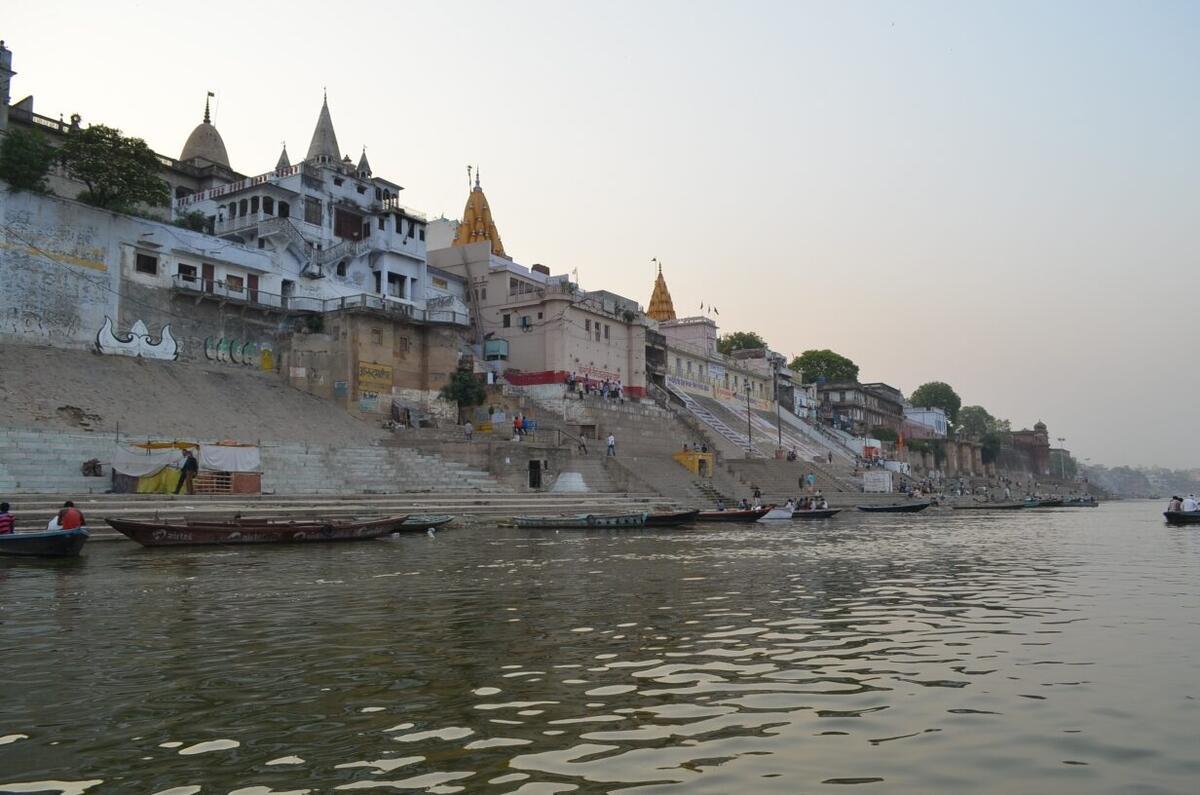
The ghat is plainly built and was made pucca in two campaigns — in about 1942 by Rai Baldeo Sahai, and the lower portion in 1945 by Shiv Prasad Gupt. The heritage dossier treats it as one unit with the neighbouring Bhadaini and Janaki Ghats, a group of roughly 0.32 hectare on this reach of the river, and records no ornamental feature at the steps themselves. The steps do what steps must do: carry people down to the Ganga and back.
The interest of the site is what rises behind them. Two attached buildings occupy the terrace: the ashram proper, which contains the temple of Annapurna and Shiva and a large hall built for yajna, and the Kanyapith beside it, a residential school. Both are institutional buildings of the mid-twentieth century, built for use rather than display — the ashram's hall was large enough to carry a three-year yajna, and the Kanyapith houses and teaches its students.
Seen from the river, this makes the ghat read very differently from the palace-fronted stretch further north. Where Darbhanga and Rana Mahal present the porches of princely houses, Anandmayi Ghat presents the walls of a working ashram, with a temple among them. The ashram's building did not stop at its own boundary either: the Gopal Mandir on the adjacent Vaccharaja Ghat was raised at Ma's instance in 1968, so that this whole short stretch of the Bhadaini riverfront carries the mark of one foundation.
Rituals & Practices
At the water's edge the practice is simple and daily. Residents of Bhadaini come down for snan before sunrise, offer water to the rising sun, and go back up. Families visiting Kashi may perform sankalp and tarpan here; no standing panda establishment is recorded at this ghat, so families who want a panda to guide the rites usually arrange them at Assi or Kedar and come here for the quiet.
The devotional life of the site belongs to the terrace above. The ashram keeps worship at its Annapurna and Shiva temples, holds kirtan and satsang, and uses its large hall for yajna — the tradition of sustained yajna here goes back to the three-year Akhanda Gayatri Mahayajna of 1947 to 1950. The Kanyapith runs its own daily order of study and practice for its resident students. The Samyam Saptah, a week given to collective meditation, discourse and devotional music, was first held at this ashram in August 1952 and became an annual observance of the Sangha; the annual Samyam Mahavrata is now organised by the Sangha at Haridwar, so pilgrims hoping to attend should confirm the venue.
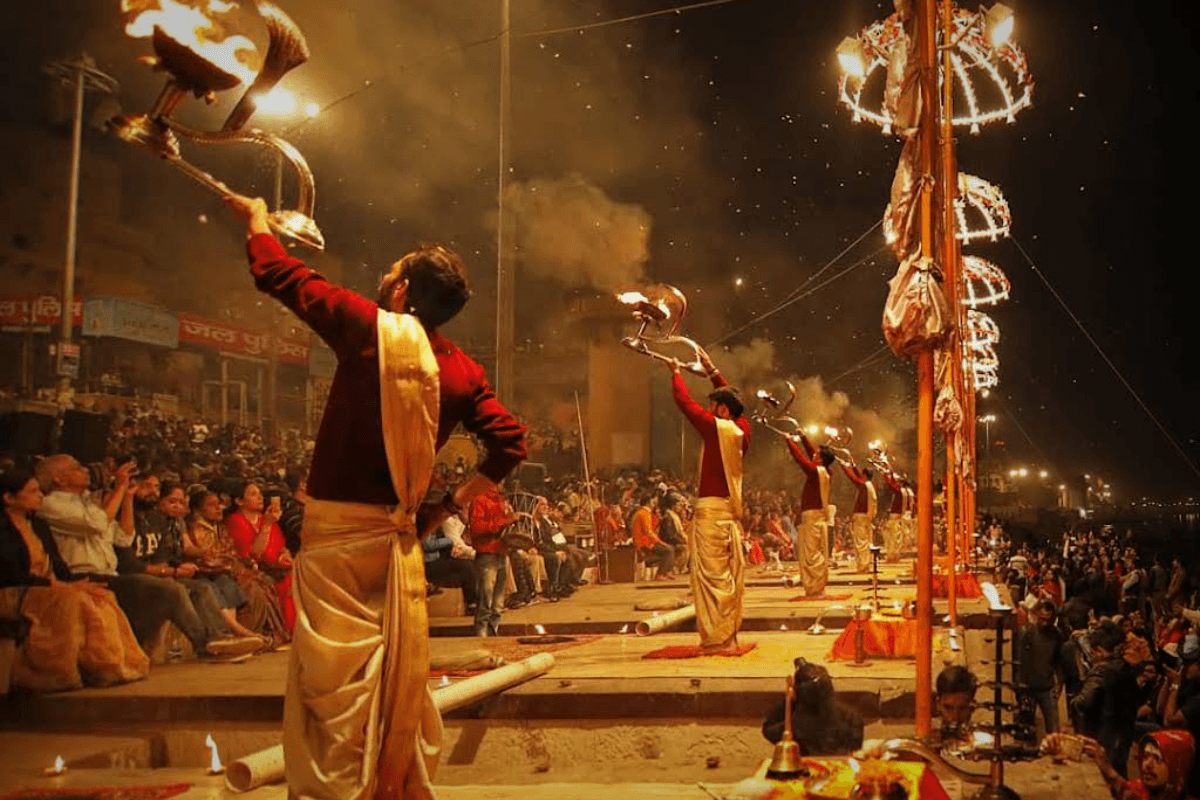
Two practical notes. There is no formal evening Ganga Aarti at Anandmayi Ghat; the nearest is the aarti at Assi Ghat to the south, with the great aarti of Dashashwamedh further north. And the ashram is a functioning religious institution with residents and students, not a monument — timings for darshan, satsang and any programme should be confirmed at the ashram office rather than assumed.
Festivals & Celebrations
| Festival | When | Crowd |
|---|---|---|
| Sri Anandamayi Ma Janmotsav | — | High at the ashram; the ghat itself stays walkable |
| Vasanti (Basanti) Durga Puja | — | Moderate to high at the ashram |
| Sharadiya Durga Puja | — | Moderate to high at the ashram |
| Samyam Saptah | — | High wherever it is held; the annual congregation is organised from Haridwar |
| Deepavali and the Annapurna temple | — | Moderate |
| Dev Deepawali and Kartik Purnima snan | — | Very high on the riverfront; this stretch is calmer than the central ghats |
| Ma's Mahasamadhi tithi | — | Moderate; a reflective, inward observance |
| Daily Ganga snan | — | Light to moderate, before sunrise |
Sri Anandamayi Ma Janmotsav: The principal annual occasion of the lineage. Devotees hold that the day renews their connection to the Mother they knew, and the Sangha keeps it by the Hindu calendar, so it falls in Vaishakha rather than on the English date of her birth, 30 April 1896.
Vasanti (Basanti) Durga Puja: The observance with which the Kashi ashram began, and for devotees the annual marking of the ground on which it stands.
Sharadiya Durga Puja: Devotees of the lineage revere Ma as a presence of the Mother, and Navaratri is kept at the ashram in that understanding.
Samyam Saptah: The lineage's principal retreat, in which householders keep a week of disciplined practice together â the observance Ma is most associated with after her Janmotsav.
Deepavali and the Annapurna temple: In Kashi, Annapurna is worshipped as the Mother who feeds the city, and the ashram's temple carries her name.
Dev Deepawali and Kartik Purnima snan: Tradition holds that the devas descend to Kashi to bathe in the Ganga on this night, and the lamps on every step are set in greeting. The Puranas praise Kartik Purnima snan as bearing great devotional fruit.
Ma's Mahasamadhi tithi: Her samadhi shrine stands at Kankhal near Haridwar, not at this ghat; what Kashi keeps is the day itself, in the house she built here.
Daily Ganga snan: In Banaras the daily bath is itself the observance, and a ghat's life is measured by whether people still come down its steps.
Prepare for Your Visit
Practical guidance to help you plan your pilgrimage
| Pilgrim Guidance | How to reachAnandmayi Ghat is seventh in the ghat sequence that begins at Assi, in the Bhadaini locality. The pleasantest approach is on foot along the river from Assi Ghat, past Ganga Mahal, Rewan, Tulsi, Bhadaini and Janaki Ghats — a short and level walk that most pilgrims manage comfortably in the cool of the morning. From the city side the approach is by the Bhadaini lanes; auto and cycle rickshaws reach the neighbourhood, and the last stretch to the river is walked. By boat, it lies on the run between Assi and Dashashwamedh and any boatman working that stretch will know it. Visiting the ashram
Best time to visitOctober to March is the most comfortable season on the ghats. Early morning is when this stretch is at its best — the snan hour, and the hour when the river is clearest of boats. The ashram's principal days are Sri Anandamayi Ma's Janmotsav in Vaishakha (April or May by the Hindu calendar), the Vasanti Durga Puja in Chaitra, and Navaratri in Ashwin; confirm the year's programme with the ashram office. During the monsoon the lower steps go under water; keep to the upper terraces, and take care on wet stone. |
Location
Varanasi, UP
Gallery
Pilgrim photos
No pilgrim photos yet.
Community corrections
No corrections yet.
Edit history
No revisions yet.
Plan Your Visit to Anandmayi Ghat
Get a custom itinerary and pricing for your trip.
Recommended
Packages for this destination
Pilgrim Notes
On-ground observations from fellow pilgrims
No pilgrim notes yet. Be the first to share on-ground observations!
Sign in to share a note.
Pilgrim Reviews
Be the first to share your experience at Anandmayi Ghat.
Sign in to write a review.
Nearby sacred places
Discover other sacred places near Anandmayi Ghat
Explore temples, tirthas, and pilgrimage sites in UP
Explore nearbyPart of these circuits
Walk the traditional pilgrimage routes this destination belongs to.