Banaras Hindu University — known across India simply as BHU — is one of the largest residential universities in Asia and one of the great centres of Sanskrit learning, Indology, classical music, the arts, and the modern sciences. It was founded in 1916 by Pandit Madan Mohan Malaviya, together with Maharaja Prabhu Narayan Singh of Kashi and other founders, on land donated by the Kashi Naresh on the southern edge of the city.
Malaviya's intention was clear from the beginning. The University was to be a place where the inherited learning of India — Veda, Vedanta, Vyakarana, Jyotisha, Ayurveda, classical music, and the dharmic literatures — would be cultivated alongside modern sciences, engineering, medicine, and the arts. The deep conviction of the founding was that vidya and dharma belong together, and that learning is itself a form of devotional practice in the Indian tradition.
The campus today extends over a circular ground-plan of more than thirteen hundred acres, entered through the wide Singha Dwar on its northern side. Within it stand academic faculties, the Bharat Kala Bhavan museum, the Institute of Medical Sciences, and — at its devotional heart — the white-marble New Vishwanath Temple. For the pilgrim who comes to Kashi, BHU is not only a university to be admired from outside; it is a place where the city's life of learning and the city's life of worship meet under the same broad sky.
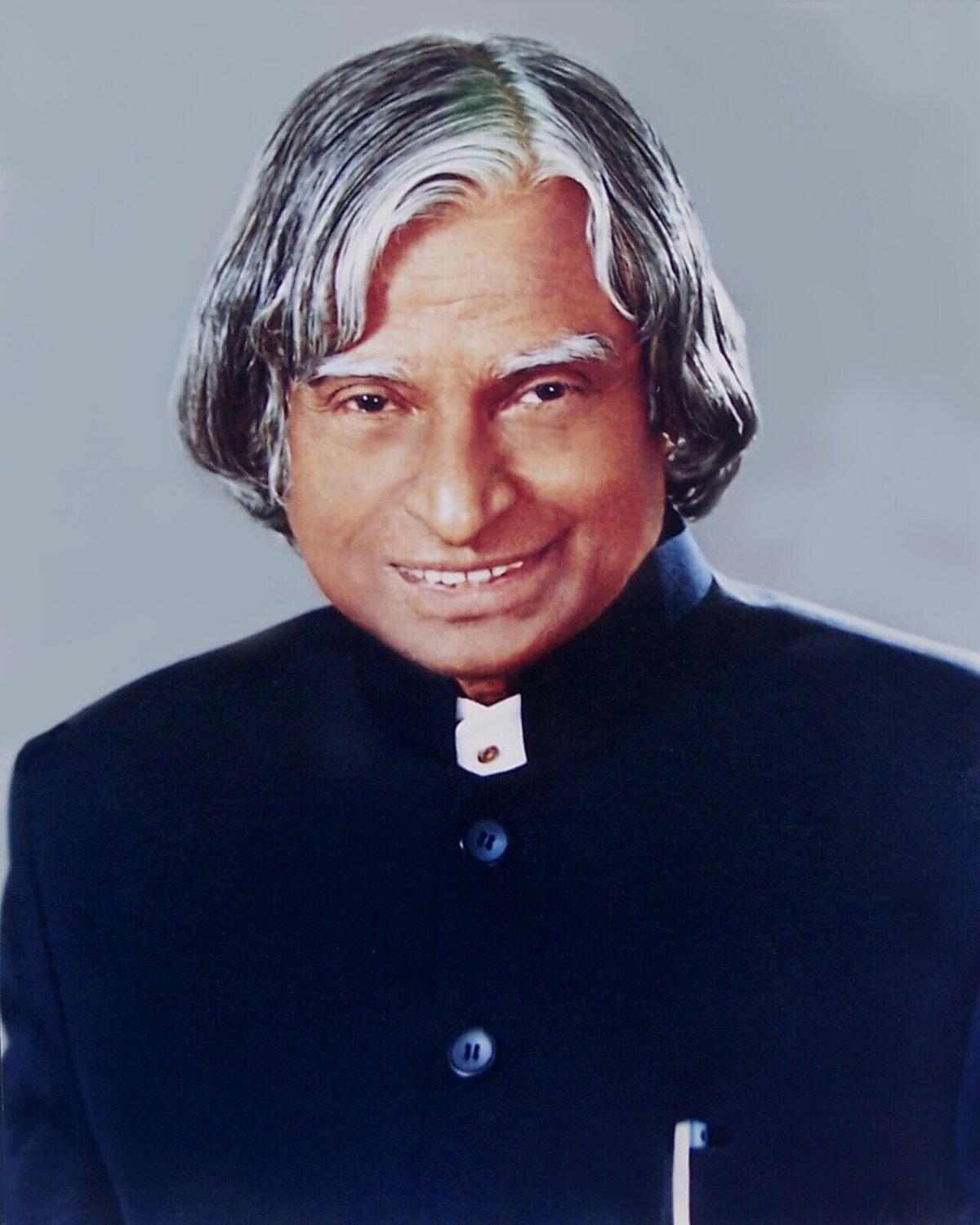
BHU is best understood in the Indian tradition as a place of vidya-yajna — the offering of learning as a form of worship. From the Upanishads onward, the pursuit of knowledge has been counted in the dharmic tradition as one of the highest sadhanas. The University carries this conception into a modern form: the laboratory, the library, the lecture hall, and the music studio held together as parts of a single devotional life.
Within the campus this conception is given visible form. The New Vishwanath Temple, founded by Malaviya as a Shiva temple open to devotees of every caste, places the daily worship of Mahadev at the centre of the University's life. Together with the music sung in the Faculty of Performing Arts, the Sanskrit recited in the Sanskrit Vidya Dharma Vijnana Sankaya, and the Ayurvedic preparations of the IMS, the campus carries a quiet, continuous devotional rhythm of its own.
Vidya as yajna
The dharmic understanding of learning is well captured in the traditional benediction Saha nau-avatu, saha nau bhunaktu, saha viryam karavavahai — "May we together be protected, may we together be nourished, may we together work with great energy." BHU was founded in this spirit, as a sangha of teachers and students offering their work to a larger end. The student who studies here, the teacher who guides, and the devotee who circumambulates the marble Vishwanath shrine are all, in the dharmic understanding, performing a single offering.
The University's motto — Vidyayāmṛtam aśnute, "through knowledge one attains the deathless" — is drawn from the Isha Upanishad. It expresses the founding belief: that learning, rightly pursued, is not separate from the spiritual path. Many pilgrims come to BHU after Kashi Vishwanath darshan, in the spirit of carrying the prayer of the Jyotirlinga into the wider life of vidya that BHU represents.
History
The idea of a great Hindu university in Kashi took shape in the early years of the twentieth century, drawing on the work of Pandit Madan Mohan Malaviya, the earlier Central Hindu College of Annie Besant, and the wider movement for educational self-reliance in pre-Independence India. Malaviya's vision was that India needed a place where its own classical learning would stand on equal footing with modern sciences and arts, and that this learning should be open to students across the Hindu fold.
The BHU Act of 1915 received parliamentary assent on 1 October 1915. The foundation stone was laid on 4 February 1916 by Lord Hardinge, in a gathering that included Maharaja Prabhu Narayan Singh of Kashi, who donated the land on which the campus stands, and several leading figures of the time. Mahatma Gandhi delivered his first major public address in India at this gathering, two years after his return from South Africa. Malaviya served as the Vice-Chancellor of the new University and shaped its faculties, its temple, and its character through the early decades.
Construction proceeded through the 1920s and 1930s. The New Vishwanath Temple at the centre of the campus was begun in 1931 and grew in stages over the following decades, funded substantially by the Birla family. By the time of Independence, BHU had emerged as one of the leading universities of the country, and it has continued in that role ever since, with Sanskrit, music, medicine, engineering, sciences, and the arts all flourishing within the same campus.

Architecture
The campus of BHU was laid out on a circular plan with the central library and administrative tower at its heart, broad radial roads leading outward to the faculties, and the gates set at the cardinal directions. The principal entrance, the Singha Dwar, faces north toward the city and carries a relief of a lion above the central arch.
The campus buildings draw on a quiet Indo-Saracenic idiom — chhatris, jharokhas, jaali screens, broad verandahs, and red-stone facades — combined with the practical requirements of laboratories, lecture halls, hostels, and a hospital. The form is neither purely classical Indian nor purely colonial; it reflects the founding intention to hold the old and the new together in a single architectural language.
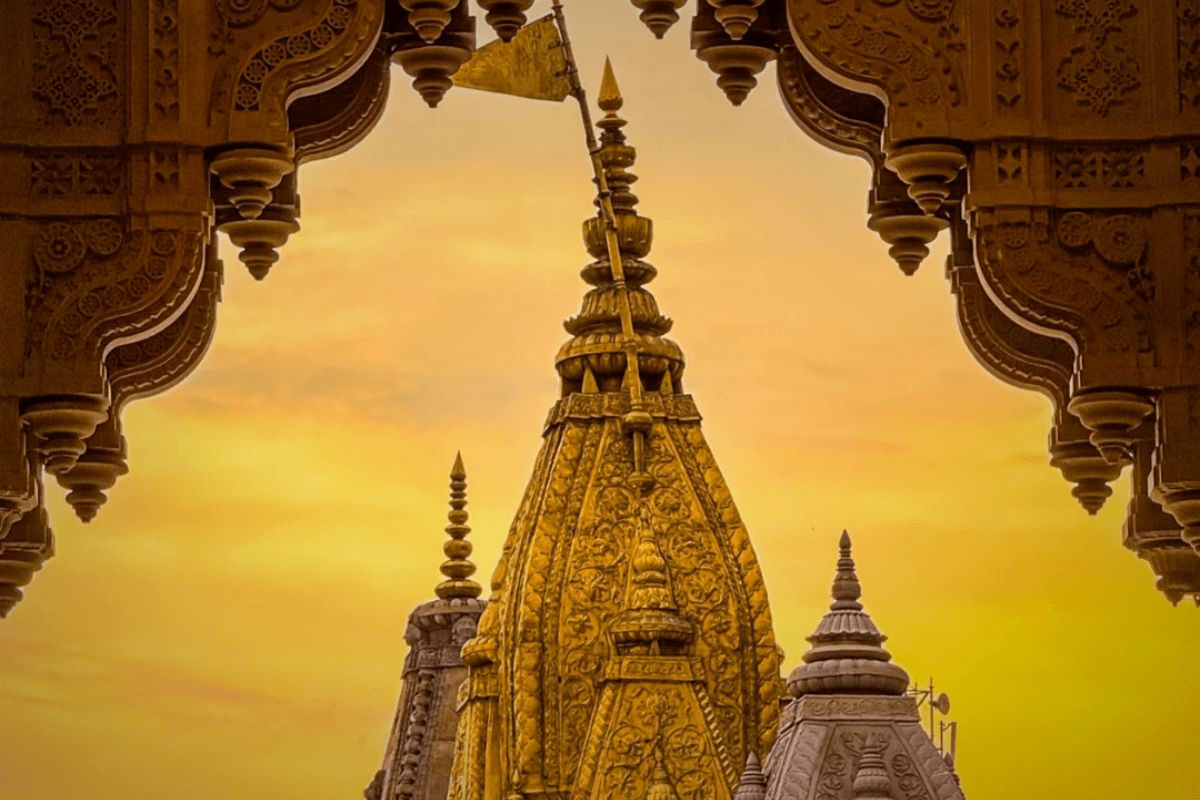
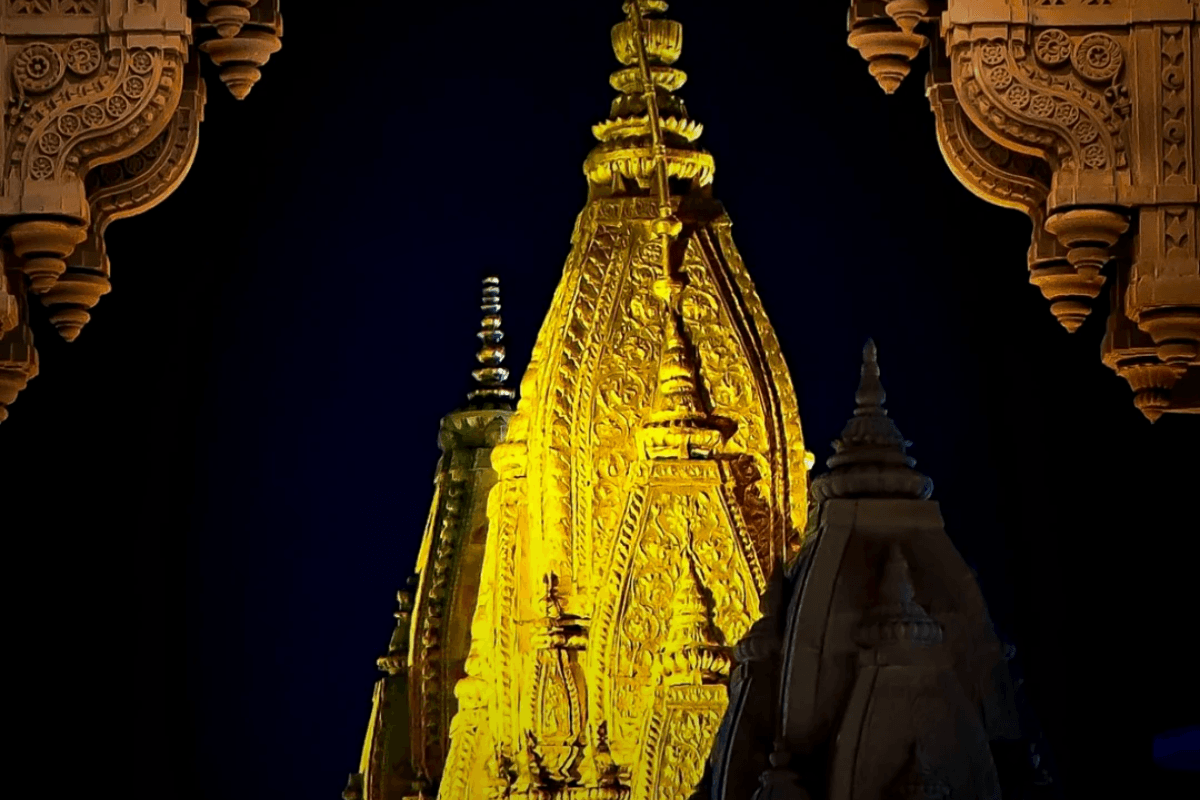
At the devotional centre of the campus stands the New Vishwanath Temple, built in white marble in the Nagara style with a shikhara of seventy-seven feet — the tallest temple shikhara within the campus precinct. Around these the academic buildings, the music school, the Ayurveda faculty, and the gardens form the wider devotional and intellectual landscape of the campus.
Rituals & Practices
BHU is a heritage and learning site, not a temple-precinct in the conventional sense. Its devotional life is carried through the shrines within the campus and through the wider rhythm of a residential university dedicated to vidya.
- Campus parikrama. Many pilgrims and visitors walk a quiet pradakshina of the campus — from the Singha Dwar along the broad ring road, pausing at the New Vishwanath Temple and the Bharat Kala Bhavan, and returning through the gardens. The full parikrama takes a leisurely half-day.
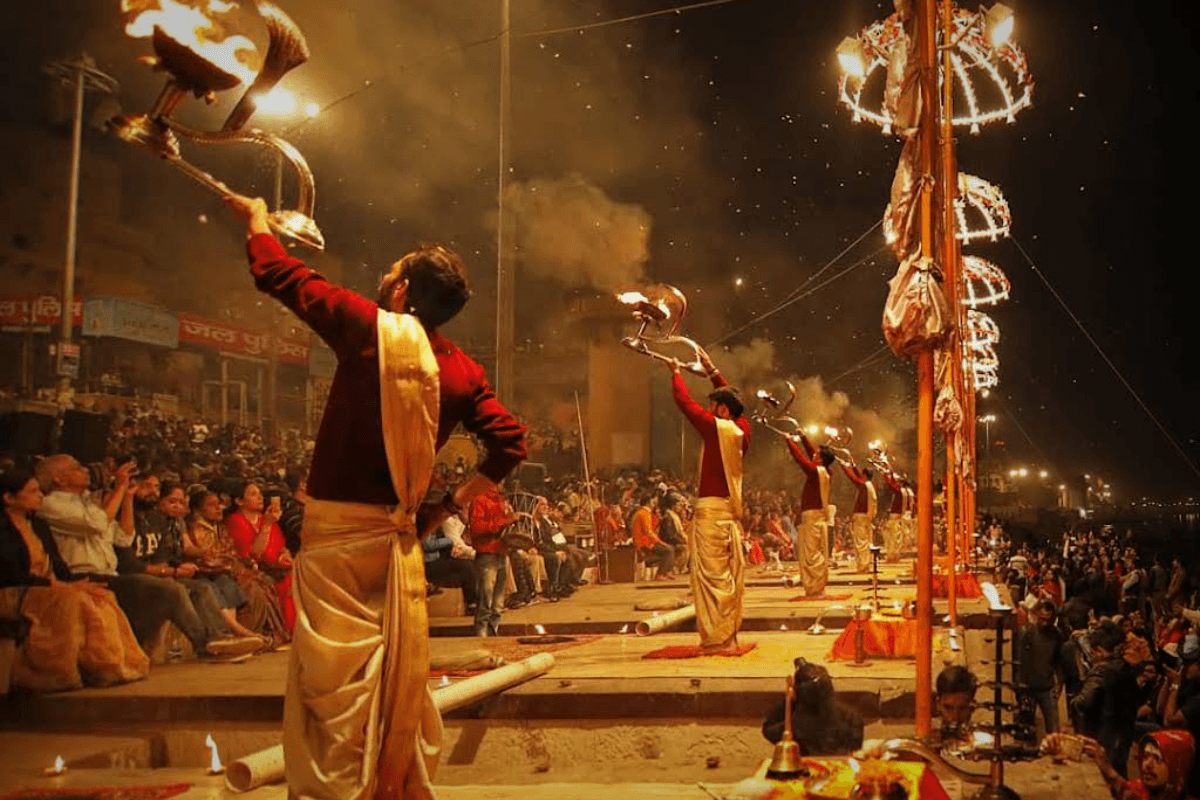
- New Vishwanath aarti. The marble Shiva temple at the centre of the campus follows the classical Shaiva sequence — morning aarti, abhishek through the day, evening aarti, and night closing. Many pilgrims time their visit to BHU around the early morning or evening aarti of the New Vishwanath.
- Foundation Day observances. 4 February, the foundation day of the University, and 25 December, Malaviya's birth anniversary, are remembered each year with quiet observances on the campus.
Specific timings of the shrines may vary; pilgrims are encouraged to verify before a visit. The campus itself is open to visitors during daylight hours; entry into academic and hostel areas is restricted.
Festivals & Celebrations
| Festival | When | Crowd |
|---|---|---|
| Foundation Day | — | High on campus; not a city-wide festival |
| Malaviya Jayanti | — | Moderate |
| Mahashivratri | — | Very high at the New Vishwanath Temple |
| Vasant Panchami | — | Moderate on campus |
| Guru Purnima | — | Moderate on campus |
Foundation Day: Marks the founding of the University as the great modern seat of vidya in Kashi.
Malaviya Jayanti: Honours the founder whose vision shaped the University and its temple.
Mahashivratri: The principal Shaiva festival; observed at the open-to-all Shiva temple Malaviya founded.
Vasant Panchami: A fitting observance for a University whose deepest character is the worship of vidya in the form of Saraswati.
Guru Purnima: Honours the lineage of teachers without which vidya cannot pass from one generation to the next.
Prepare for Your Visit
Practical guidance to help you plan your pilgrimage
| Pilgrim Guidance | How to reachBHU lies on the southern side of Varanasi, reached through the Singha Dwar on Lanka Road. From Godowlia the distance is about 6 km — around 20 to 30 minutes by auto-rickshaw, depending on traffic. The Lanka and Sundarpur sides have several entry gates; private vehicles may require a pass, but walk-in and auto-rickshaw entry is generally straightforward. Suggested BHU circuit
Many pilgrims combine the BHU circuit with a morning visit to Sankat Mochan Hanuman, Tulsi Manas, and Durga Temple — all within a few kilometres of the University. Preparation for Pilgrims
Best Time to VisitOctober to March is the most comfortable season. The campus is especially alive on foundation day (4 February), on Mahashivratri at the New Vishwanath, on Shravan Mondays, and on Malaviya's birth anniversary (25 December). Weekday mornings give the calmest visit; weekends and academic events bring larger gatherings. |
Location
Varanasi, UP
Gallery
Pilgrim photos
No pilgrim photos yet.
Community corrections
No corrections yet.
Edit history
No revisions yet.
Plan Your Visit to Banaras Hindu University (BHU)
Get a custom itinerary and pricing for your trip.
Recommended
Packages for this destination
Pilgrim Notes
On-ground observations from fellow pilgrims
No pilgrim notes yet. Be the first to share on-ground observations!
Sign in to share a note.
Pilgrim Reviews
Be the first to share your experience at Banaras Hindu University (BHU).
Sign in to write a review.
Nearby sacred places
Discover other sacred places near Banaras Hindu University (BHU)
Explore temples, tirthas, and pilgrimage sites in UP
Explore nearbyPart of these circuits
Walk the traditional pilgrimage routes this destination belongs to.