Bhagirath Shila is the ancient stone at Gangotri Dham in Uttarkashi district, 3,100 metres above the sea on the bank of the Bhagirathi river, the headstream of the Ganga. The shila lies a few steps from the Ganga temple built by the Gorkha general Amar Singh Thapa in the early 19th century. By unbroken Garhwali tradition, this is the very rock on which King Bhagiratha sat through long years of austerity, praying for Mother Ganga to descend from the heavens and liberate his ancestors. The temple, the kund, the river itself — all the holiness of Gangotri gathers first around this shila, because without Bhagiratha's tapasya there would be no Ganga on the earth.
Pilgrims who come to Gangotri after the long ascent from Uttarkashi typically bow at the Bhagirath Shila before entering the Ganga temple. The stone is not large, not ornate — a worn, dark, water-shaped rock at the edge of the Bhagirathi, often half-touched by the river's spray. But for those who know the katha, it carries one of the deepest memories in the Hindu sacred tradition: the memory of a king who would not turn back, of a goddess who came down at his prayer, and of a Lord who agreed to hold her in his locks so the earth would not shatter.
The katha of Ganga-avatarana
The story is told across the Ramayana, the Mahabharata, and the Bhagavata Purana. King Sagara of Ayodhya, an ancestor of Sri Rama, performed an Ashvamedha yajna. Indra, anxious for his throne, hid the sacrificial horse in the ashrama of the sage Kapila Muni, deep in the underworld. Sagara's sixty thousand sons, the Sagara putras, went searching, dug through the earth, and at last burst into Kapila's ashrama and accused the silent sage of theft. Disturbed in his meditation, Kapila opened his eyes — and the fire of his tapas reduced all sixty thousand to ash in an instant. Their souls, unconsecrated by the funeral waters, could not find rest.
Sagara's descendants tried in turn to bring those souls peace. Amshuman attempted; Dilipa attempted; both failed. At last Bhagiratha, of the line of Sagara, took the vow that he would not rest until his ancestors were liberated. He climbed to the high Himalaya and sat upon this shila at Gangotri, performing tapasya for years upon years, eating little, sleeping little, holding only one prayer: that Mother Ganga, who flowed in Brahma's kamandalu in the heavens, would descend to the earth and pour her waters over the ashes of the Sagara putras.
Ganga, moved by his tapas, agreed. But she warned: her descent would be of such force that the earth itself would split. So Bhagiratha prayed again — this time to Shiva. And Shiva, in his grace, stood at the meeting-place of heaven and earth and let Ganga fall upon his head. She rushed into the matted locks of his jata, was held there, calmed, and released gently to the earth — first as a mountain stream at Gangotri, then as the Bhagirathi (the river of Bhagiratha), and downstream as the Ganga who washes the karma of all who bathe in her. Bhagiratha walked ahead of her all the way to the ocean, and at Ganga Sagara her waters at last touched the ashes of his ancestors, and the sixty thousand souls found liberation.
This is why the river is called Bhagirathi at her source — she came because of Bhagiratha. This is why his shila at Gangotri is honoured before the Ganga temple itself. And this is why, in Hindu speech to this day, a difficult, persistent effort to achieve a great good is called a Bhagirath prayatna — a Bhagiratha-like effort.
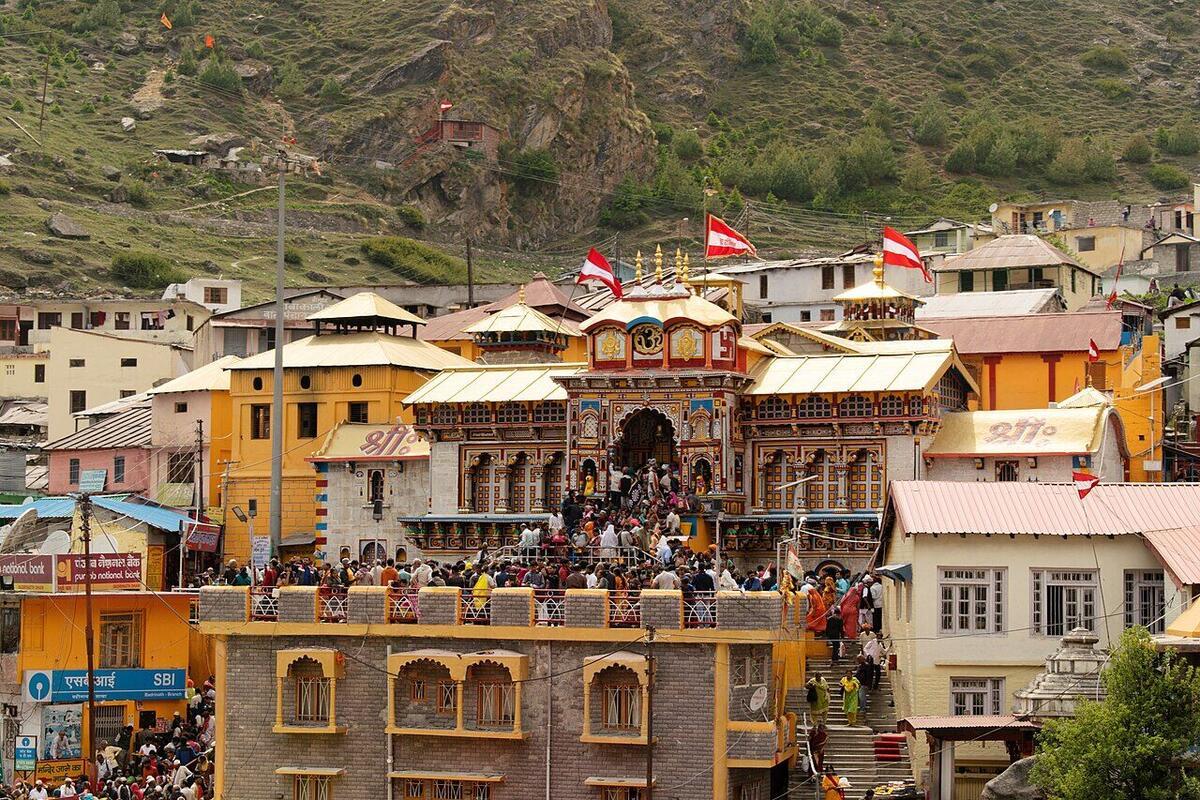
Bhagirath Shila is the devotional anchor of the entire Gangotri tirtha. The Ganga temple is the formal seat of darshan, but the shila is the older sanctity — the stone is held to predate the temple by ages, going back to the tapasya itself. To touch Bhagirath Shila is to touch the rock where the Ganga-avatarana was prayed into being; to sit beside it, even for a few moments, is to enter the bhav of one who would not give up until the dead were given peace and the impossible was brought down to the earth.
The shila is sacred to three streams of devotion at once. To the Ganga-bhakta, it is the rock where Mother Ganga first agreed to come down. To the Shiva-bhakta, it is the rock from which Bhagiratha prayed Shiva into the act of catching her in his jata — and so the shila quietly carries the bond of Ganga and Shiva, river and Lord, who are inseparable in the Hindu sacred imagination. To the ancestor-conscious pilgrim, it is the rock that stands behind every shraddha rite ever performed on the Ganga's banks, because the river was first sought for the liberation of the Sagara putras and remains, to this day, the river by which the Hindu dead are entrusted to the larger flow.
At Gangotri the river is still narrow, ice-cold, and astonishingly clear — green and white over the boulders, almost a mountain stream rather than the wide goddess of the plains. To bow at Bhagirath Shila beside this young, fierce, just-arrived Ganga is to meet her at her beginning, before she has carried the karma of the world. The whole Char Dham yatra of Garhwal — Yamunotri, Gangotri, Kedarnath, Badrinath — has its emotional centre here, at this stone, on this bank.
History
Gangotri's sanctity as the source-tirtha of the Ganga reaches deep into Puranic memory; the shila itself is held by tradition to be far older than any built structure on the site. References to Gangotri as a Ganga-avatarana tirtha appear in the medieval Garhwali pilgrimage tradition and in the Char Dham accounts of later centuries. For long ages the worship at the shila and the riverside was open and unenshrined.
The present Ganga temple a few steps from the shila was built in the early 19th century by Amar Singh Thapa, a Gorkha general, in the simple Garhwali stone-and-wood idiom. The temple was later renovated under the patronage of the kings of Tehri Garhwal. Through all the rebuilding of the surrounding shrine, the Bhagirath Shila itself has been left as it stood — a worn, water-shaped stone at the river's edge, unornamented except for the sindoor and flowers offered by pilgrims.
The actual source of the Bhagirathi, the glacier-mouth Gaumukh, lies 18 km further upstream and was identified by tradition as the true point where the river emerges from Shiva's jata onto the earth. Gangotri itself — temple, shila, kund — is the riverside tirtha at which the Ganga can be approached and worshipped, while Gaumukh is the inner, harder darshan reserved for those who can undertake the trek. The shila has stood on this bank through floods, landslides, and the great Uttarkashi disasters of recent decades; the surrounding compound has been rebuilt many times, but the rock itself remains.
Architecture
Bhagirath Shila is a single dark stone, worn smooth by river and weather, set on a low platform at the edge of the Bhagirathi a few steps downstream of the Ganga temple. The platform is paved in local stone; a low railing or wall holds the river back during high flows. The shila itself is left unenshrined — no chamber, no shikhara, no idol on it — only the rock, the river, the high peaks of the Bhagirathi range visible behind, and the line of pilgrims bending to touch it.
The surrounding site is built in the simple Garhwali stone-and-wood idiom: grey stone walls, a small temple with a low pyramidal shikhara, prayer flags, brass bells. The Bhagirathi runs immediately beside the shila — narrow here, fast, intensely cold, carrying glacier-fine silt. Adjacent to the shila is Surya Kund (not to be confused with Yamunotri's Surya Kund) and Gauri Kund, small natural pools where the river plunges over rocks; these are part of the Gangotri tirtha-complex, with the Bhagirath Shila as their devotional centre on the temple side.
Rituals & Practices
The principal rite at Bhagirath Shila is simple: pradakshina of the shila if the platform allows, pranam with hands folded, and a small offering of flowers, kumkum, or a few coins. Many pilgrims first take a brief Ganga-sparsha — touching the cold Bhagirathi water — and then bow at the shila with that wet hand. Some sit beside the rock for a few minutes of silent prayer, remembering Bhagiratha's tapasya and offering the names of their own ancestors.
The traditional sequence at Gangotri is: a brief darshan at the Bhagirathi (water-touch or bath in a calm pool if conditions permit), pranam at Bhagirath Shila, darshan at the Ganga temple, and then a quiet circuit of the riverside kunds. Pilgrims undertaking shraddha or pind-daan for ancestors often perform the rite on the river bank near the shila, since the whole Ganga-avatarana katha was prayed-for at this very stone. Brahmin priests for these rites are available on site through traditional arrangements.
Bathing in the Bhagirathi at Gangotri is possible only in calm shallow pools and only briefly — the water is glacier-melt, just above freezing. Most pilgrims do a symbolic sprinkling rather than a full immersion. The bhav of the act, not its duration, is what is honoured.
Festivals & Celebrations
| Festival | When | Crowd |
|---|---|---|
| Akshaya Tritiya (Kapat Opening) | — | very_high |
| Ganga Dussehra | — | very_high |
| Ganga Jayanti | — | high |
| Diwali / Annakoot (Kapat Closing) | — | very_high |
| Char Dham Yatra Season | — | high |
Akshaya Tritiya (Kapat Opening): The opening-day of the Gangotri yatra, when the deity returns from Mukhba to her seat at Gangotri.
Ganga Dussehra: The descent-day of Ganga, the very event that Bhagiratha's tapasya at this shila brought about.
Ganga Jayanti: The birth-day of Ma Ganga.
Diwali / Annakoot (Kapat Closing): The closing-day of the Gangotri yatra; the river goddess goes to her winter seat.
Char Dham Yatra Season: The Garhwali Himalayan yatra tradition.
Prepare for Your Visit
Practical guidance to help you plan your pilgrimage
| Pilgrim Guidance | How to reachGangotri is reached by road from Uttarkashi (about 100 km, 4-5 hours) via Bhatwari, Harsil, and Lanka bridge. Uttarkashi itself is 7-8 hours from Dehradun. The road climbs steadily; the final stretch through the Bhagirathi valley is among the most beautiful in the Himalaya. Bhagirath Shila is at the riverside in the main Gangotri shrine compound — a short walk from the bus stand and parking area. PreparationAltitude (3,100 m) and cold are the principal concerns. Dress in layered woollens; even in summer the riverside air is cold and the wind from the Bhagirathi valley is sharp. Carry small offerings — flowers, kumkum, a small lota for Ganga-jal. Many pilgrims fill a sealed container of Bhagirathi-jal at Gangotri to take home for puja and shraddha; this is a treasured tradition. Footing near the river can be slippery; move slowly on the wet stone platform around the shila. Best time to visitThe shrine is open only during the Gangotri yatra season — typically from Akshaya Tritiya (late April or early May) to Diwali or Annakoot (late October or early November). The dham is closed in winter; during those months the deity is taken in procession to Mukhba village near Harsil. May-June and September-October are the most settled weather windows. Monsoon (July-August) brings landslides and road risk. The kapat-opening and kapat-closing days draw very large crowds. |
Location
Uttarkashi, UK
Pilgrim photos
No pilgrim photos yet.
Community corrections
No corrections yet.
Edit history
No revisions yet.
Plan Your Visit to Bhagirath Shila, Gangotri
Get a custom itinerary and pricing for your trip.
Recommended
Packages for this destination
Pilgrim Notes
On-ground observations from fellow pilgrims
No pilgrim notes yet. Be the first to share on-ground observations!
Sign in to share a note.
Pilgrim Reviews
Be the first to share your experience at Bhagirath Shila, Gangotri.
Sign in to write a review.
Nearby sacred places
Discover other sacred places near Bhagirath Shila, Gangotri
Explore temples, tirthas, and pilgrimage sites in UK
Explore nearbyPart of these circuits
Walk the traditional pilgrimage routes this destination belongs to.