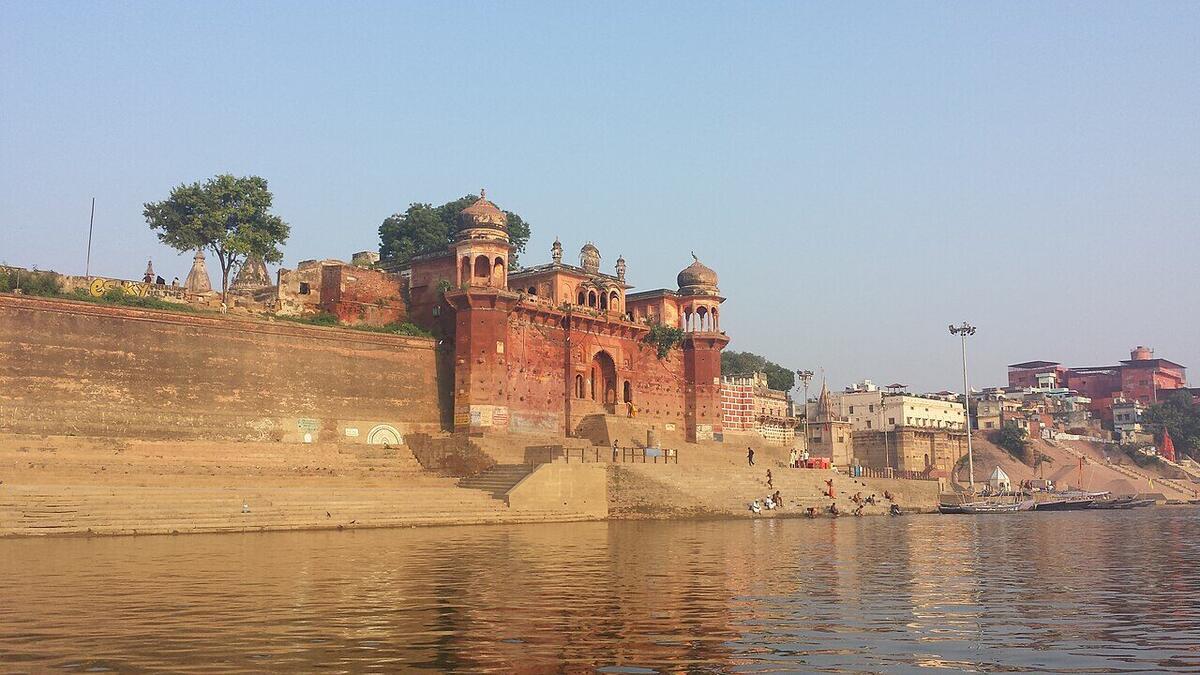
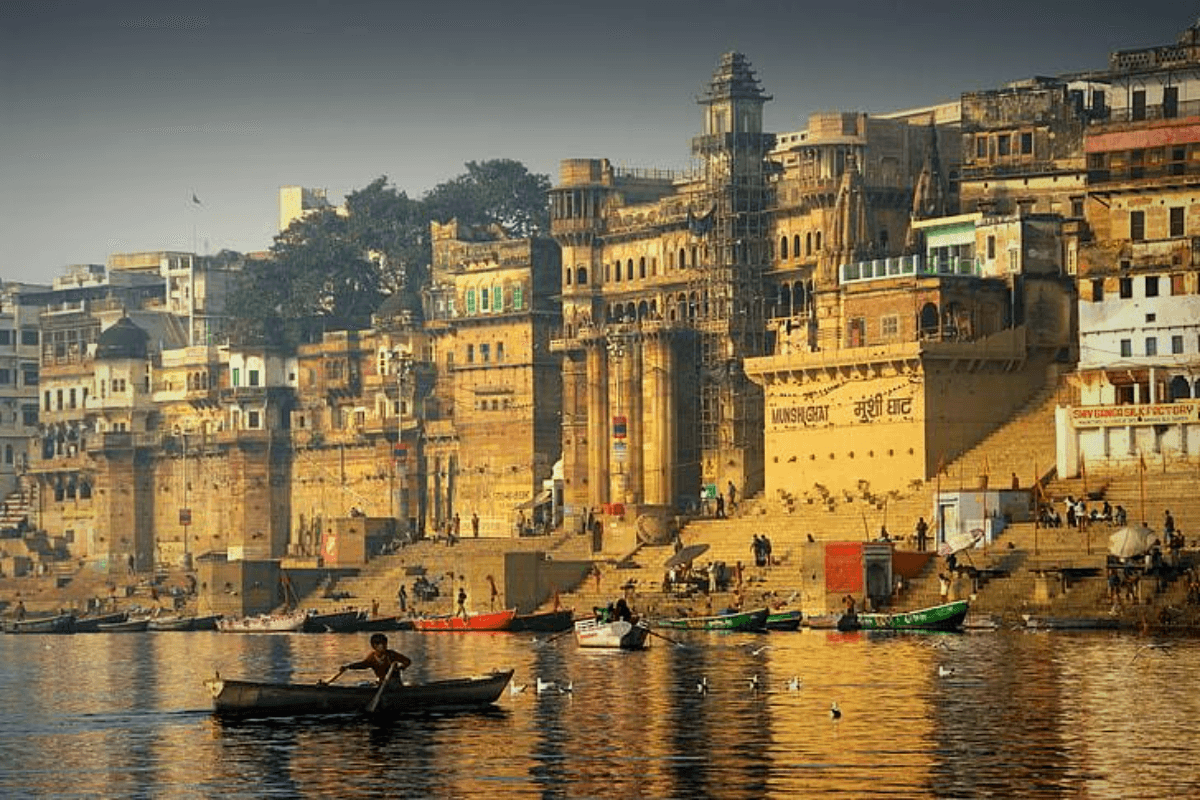
Chet Singh Ghat lies on the southern arc of the Kashi riverfront, in the Shivala stretch, counted thirteenth in the sequence that runs northward from Assi. Above its steps rises the fortified riverside palace of Maharaja Chet Singh, ruler of Banaras from 1770 to 1781 — its terrace, its monumental gateway and its two octagonal domed pavilions make this length of the river easy to identify from the water. Heritage documentation prepared for the Ghats of Varanasi records three state temples of Shiva standing within the compound, built across the eighteenth and nineteenth centuries.
The ghat below is a working bathing ghat, and a quiet one. It serves the households of the Shivala mohalla, the ascetics of the akharas immediately north, and pilgrims who would rather take snan without the press of Dashashwamedh. The day here is made of ordinary sacred things — a dip at first light, a lota of Ganga-jal carried up the steps, tarpan for the ancestors on the appointed tithis, a diya set on the water at dusk. The Varanasi district heritage listing describes the site simply as a place where monks chant and pilgrims bathe, and that remains an accurate account of its afternoons.
In the ghat sequence Chet Singh Ghat stands between Panchkot Ghat to the south and Niranjani Ghat to the north, with Mahanirvani and Shivala Ghats following. Those neighbouring ghats were once part of this same royal compound: heritage records state that the Banaras royal house donated the northern portion to Naga ascetics of the Dashanami orders, who built their akharas and their own ghats there, the Niranjani akhara being dated by an inscription to 1897. A few hundred steps therefore carry a pilgrim from a king's river terrace into the quarters of renunciants — a compression of Kashi's two great vocations, rule and renunciation, into one short walk along the water.
In devotional understanding, no stretch of the Kashi riverfront is ordinary ground. The Ganga along this bank is approached as she is approached everywhere in the city — as a mother received rather than a river used — and a bath taken here is a bath taken in Kashi, with all that tradition attaches to it. That, plainly stated, is the sanctity of Chet Singh Ghat.
It carries no separate Puranic katha of its own, and that is worth saying plainly. Its devotional weight comes from three things that can be pointed to. The first is the river itself. The second is Shiva: the whole neighbourhood takes its name from the shivalas above these steps, and the palace compound holds three Shiva temples raised by the Banaras royal house, so this length of the bank has been Shaiva ground for as long as it has been built ground. The third is the presence of the ascetics.
A stretch shaped by renunciants
Immediately north of the ghat, on land given away by the Banaras rulers themselves, live the Naga ascetics of the Niranjani and Mahanirvani akharas, counted in heritage records among the ten Dashanamis — the order that tradition traces to Adi Shankaracharya. Heritage documentation notes that the Niranjani akhara compound holds a temple of Karttikeya, recorded as the only Karttikeya temple in Varanasi, together with shrines keeping the footprints of Guru Niranjani, and images of Durga, Gauri-Shankara and the Ganga. Devotees who care for the Shaiva family of deities often walk this short stretch for that reason alone.
For pilgrims, the significance of Chet Singh Ghat is best understood as position rather than legend. It is where the Kashi riverfront turns from the open, garden-like southern reaches near Assi into the tight, storeyed, temple-crowded bank that carries on toward Kedar and Dashashwamedh. Standing on these steps at dawn, a pilgrim sees both halves of the crescent at once.
History
The devotional life of this bank is older than any of its buildings; what history records is when the stone was laid. Heritage documentation for Shivala Ghat states that Raja Balwant Singh, ruler of Banaras and father of Chet Singh, had this stretch made pucca in 1767, and that Chet Singh extended it in 1770 while his palace was under construction. The Varanasi district heritage listing credits Balwant Singh with the ghat and the fortress together, built under the guidance of the engineer Baijnath Mishra, and notes that the original name of the whole stretch was Shivala Ghat. The World Heritage dossier prepared for the Ghats of Varanasi instead names Chet Singh himself as the builder of the palatial fortress. The two records agree on the family and the century; where they differ on the individual, both are worth stating rather than choosing.
Chet Singh was the third ruler of the Banaras state from the Narayan dynasty and succeeded his father in 1770. In 1781 his refusal of the East India Company's escalating demands led to a confrontation at this very compound between his troops and those of Warren Hastings. Chet Singh was defeated, left the fort, and died at Gwalior in 1810; Mahip Narayan Singh of the same house was installed at Banaras on 14 September 1781 (records differ on the exact relationship between the two men). The episode is remembered in Banaras less as a battle than as a couplet recorded in the city's own histories — ghode pe hawda, haathi pe jeen, aise bhaga Warren Hastings. The fort passed into British hands and stayed there for roughly a hundred and twenty-five years.
In 1895, according to the district heritage listing, Maharaja Prabhu Narayan Singh recovered the Shivala property for the Banaras royal house, and it is from that recovery that the ghat carries Chet Singh's name in his memory rather than the older name of Shivala. The northern part of the compound was given to the Naga ascetics, whose akharas and ghats — Niranjani and Mahanirvani — grew there from the late nineteenth century onward.
One vanished tradition deserves recording. Until the middle of the twentieth century the water between Chet Singh Ghat and Shivala Ghat was the setting of Budhva Mangal, the great spring festival of Banarasi music, when decorated boats were moored across the stretch and rival parties of musicians performed through the night. The observance lapsed here; the cultural department of Uttar Pradesh later revived a form of it further north at Rajendra Prasad Ghat.
The palace and its compound are today held by the Kashiraj Trust of the Maharaja of Banaras, along with the other properties of the estate.
Architecture
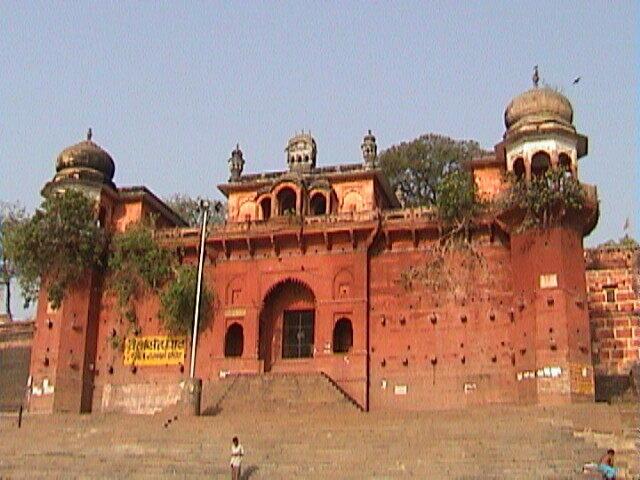
The drama of this site belongs to the terrace above rather than to the steps below, and it is worth looking at from the river, where it was designed to be seen. Heritage documentation describes the palace as having a particularly favoured relationship with the Ganga: it opens directly onto the ghat, which continues the building rather than merely serving it, and is reached through monumental gateways. The gateway houses a stairway that climbs to the terrace, and on that terrace a central pavilion looks out over the water — the place from which the Maharaja showed himself to the city. Two corners of the terraced level are anchored by massive structures capped with octagonal domed pavilions, the feature that identifies the ghat from a boat.
The compound was laid out as a small fortress in three parts: the palace with its river pavilions; a group of buildings for the women of the household, since demolished; and a Mughal-style garden with a darbar and a water tower. Three state temples of Shiva stand within it, built across the eighteenth and nineteenth centuries. The Varanasi district listing notes that the fortress walls still carry the marks of 1781 — cannon holes in the stone and cracked ramparts.
The ghat itself is plain, and honestly so: a broad flight of plain stone steps, without the carved river-façades of Darbhanga or Munshi Ghat; heritage documentation records the ghat and palace together as covering about 0.47 hectares. Heritage documentation records that later construction and repair in the compound has been uneven and unregulated, and that the older fabric has suffered for it. What survives is still legible — a river palace built to face the Ganga, and to be seen from her.
Rituals & Practices
This is a bathing ghat before it is anything else, and its practices are the ordinary ones of the Kashi riverfront. Devotees take Ganga snan from first light, make a sankalp before entering the water, and offer arghya to the sun. Tarpan for the ancestors is performed here on Amavasya, on the tithi of a departed elder, and through the Pitru Paksha fortnight, generally with the help of a local panda rather than any organised establishment.
Ganga-jal drawn from these steps is carried up to the Shiva shrines of the Shivala mohalla, and this is the ghat's most characteristic daily movement — the short climb from water to linga, repeated by householders through the Mondays of Shravan and on Mahashivratri. In Kartik, families set clay diyas on the water at dusk as dip-daan.
The three Shiva temples within the palace compound belong to the estate rather than to a public darshan circuit. Heritage documentation records that the palace is opened only for occasional celebrations once or twice a year, so pilgrims should not plan on entering it; the compound is not a regularly open museum. Where the gate is open and darshan is permitted, it is offered by the courtesy of those who keep it, and should be received that way. Access and any timings are best confirmed locally on the day.
Festivals & Celebrations
| Festival | When | Crowd |
|---|---|---|
| Dev Deepawali | — | Very high across the riverfront; lighter on these steps than at the central ghats |
| Kartik Purnima Snan | — | High through the morning |
| Mahashivratri | — | High in the Shivala lanes, moderate on the steps |
| Sawan Somvar | — | High on Mondays, moderate on other days |
| Ganga Dussehra | — | Moderate to high |
| Pitru Paksha tarpan | — | Moderate |
| Daily Ganga snan | — | Low to moderate |
Dev Deepawali: Tradition holds that Dev Deepawali marks the descent of the gods to bathe in the Ganga at Kashi. The lamps are set as a welcome to them, and the whole crescent of the river is treated as one continuous offering.
Kartik Purnima Snan: The Puranas praise snana and daana in Kartik as bearing especial fruit, and the Purnima is the fullest day of that month for the Ganga's devotees.
Mahashivratri: Tradition holds that the offering of Ganga-jal and bilva patra to the linga on this night carries particular grace. For a Shaiva neighbourhood such as Shivala, it is the fullest night of the year.
Sawan Somvar: Shravan is held in tradition to be Shiva's own month, and the offering of Ganga-jal to the linga is its central devotional act across Kashi.
Ganga Dussehra: Devotees hold that snan on this day carries the grace of the river's own arrival, and it is one of the year's most auspicious mornings anywhere along the Kashi bank.
Pitru Paksha tarpan: Kashi is held in tradition to be among the foremost places for the rites of the ancestors, and any ghat of the city serves for tarpan during this fortnight.
Daily Ganga snan: The continuous devotional life of the ghat, kept by the households of the neighbourhood rather than by any institution.
Prepare for Your Visit
Practical guidance to help you plan your pilgrimage
| Pilgrim Guidance | Where the ghat sits on the riverfrontChet Singh Ghat belongs to the southern half of the Kashi crescent, in the Shivala area, with Panchkot Ghat immediately south and Niranjani, Mahanirvani and Shivala Ghats immediately north. Walking from Assi, it is a steady twenty to twenty-five minutes along the ghat path, past Tulsi, Bhadaini, Janaki, Anandamayi, Vaccharaja, Jain, Nishadraj, Prabhu and Panchkot Ghats. Walking down from Dashashwamedh, it lies beyond Kedar, Vijayanagaram, Lali, Harishchandra, Karnataka, Hanuman, Dandi, Gularia and Shivala Ghats — a longer walk, and one that passes the cremation ground at Harishchandra, which should be crossed quietly and without photographs. Reaching Chet Singh Ghat
Best time to visitFrom first light to about nine in the morning is the ghat's own hour — the snan is under way, the stone is cool, and the light falls directly on the palace face from the river. Late afternoon is the second good hour, quieter still, and the best time to sit on the steps. October to March is the most comfortable season; through the monsoon the lower steps go under water and the stone stays slippery for weeks afterwards. Kartik Purnima and Dev Deepawali fill the whole riverfront, this ghat included, and demand an early arrival and patience. |
Location
Varanasi, UP
Gallery
Pilgrim photos
No pilgrim photos yet.
Community corrections
No corrections yet.
Edit history
No revisions yet.
Plan Your Visit to Chet Singh Ghat
Get a custom itinerary and pricing for your trip.
Recommended
Packages for this destination
Pilgrim Notes
On-ground observations from fellow pilgrims
No pilgrim notes yet. Be the first to share on-ground observations!
Sign in to share a note.
Pilgrim Reviews
Be the first to share your experience at Chet Singh Ghat.
Sign in to write a review.
Nearby sacred places
Discover other sacred places near Chet Singh Ghat
Explore temples, tirthas, and pilgrimage sites in UP
Explore nearbyPart of these circuits
Walk the traditional pilgrimage routes this destination belongs to.