Darbhanga Ghat is a bathing ghat on the central crescent of the Kashi waterfront, set between Rana Mahal Ghat and Munshi Ghat and only a short walk south of Dashashwamedh. It is not a ghat of a single great katha or a single famous shrine. It is one of the steady, working links in the unbroken stone chain that carries Banaras down to the Ganga, and its worth to a pilgrim is exactly that: clean broad steps, an open reach of river, and a place to stand in the water without being carried along by a crowd.
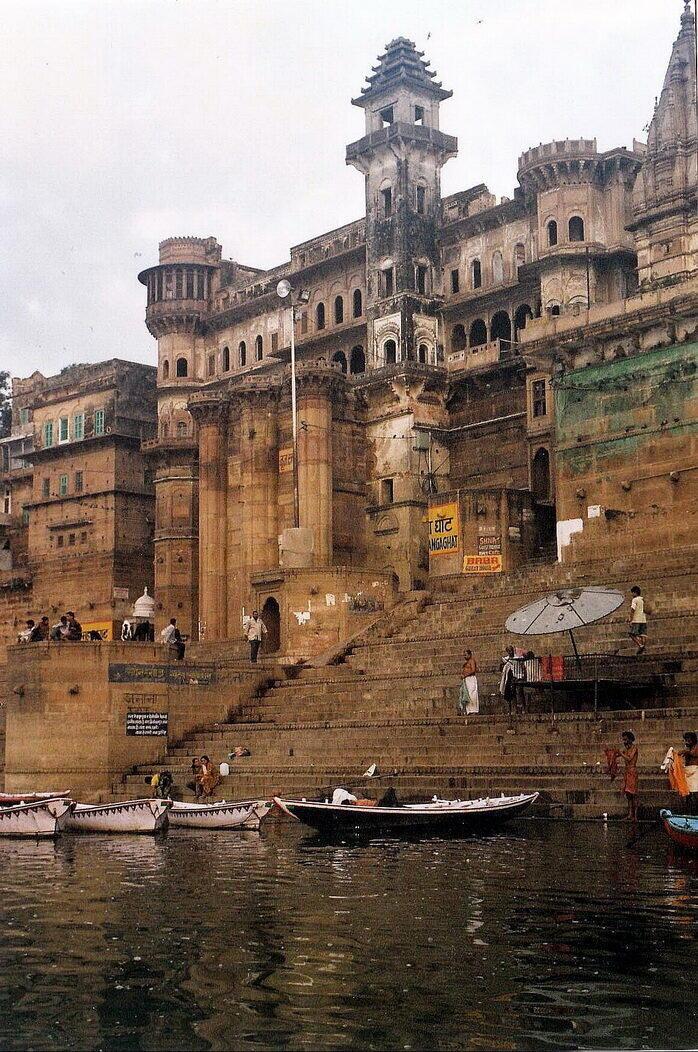
What happens here is what has happened on this bank for centuries. Devotees come down before sunrise for snan, take sankalp with the river before them, and offer tarpan with folded hands and Ganga-jal for the pitr. Small earthen diyas are floated at dusk. Boatmen tie up along the lower steps and carry pilgrims north toward the evening aarti at Dashashwamedh, and many families walk that same stretch on foot along the ghats. Through the day the steps belong to the neighbourhood as much as to the yatri — washing, resting, sitting with the river.
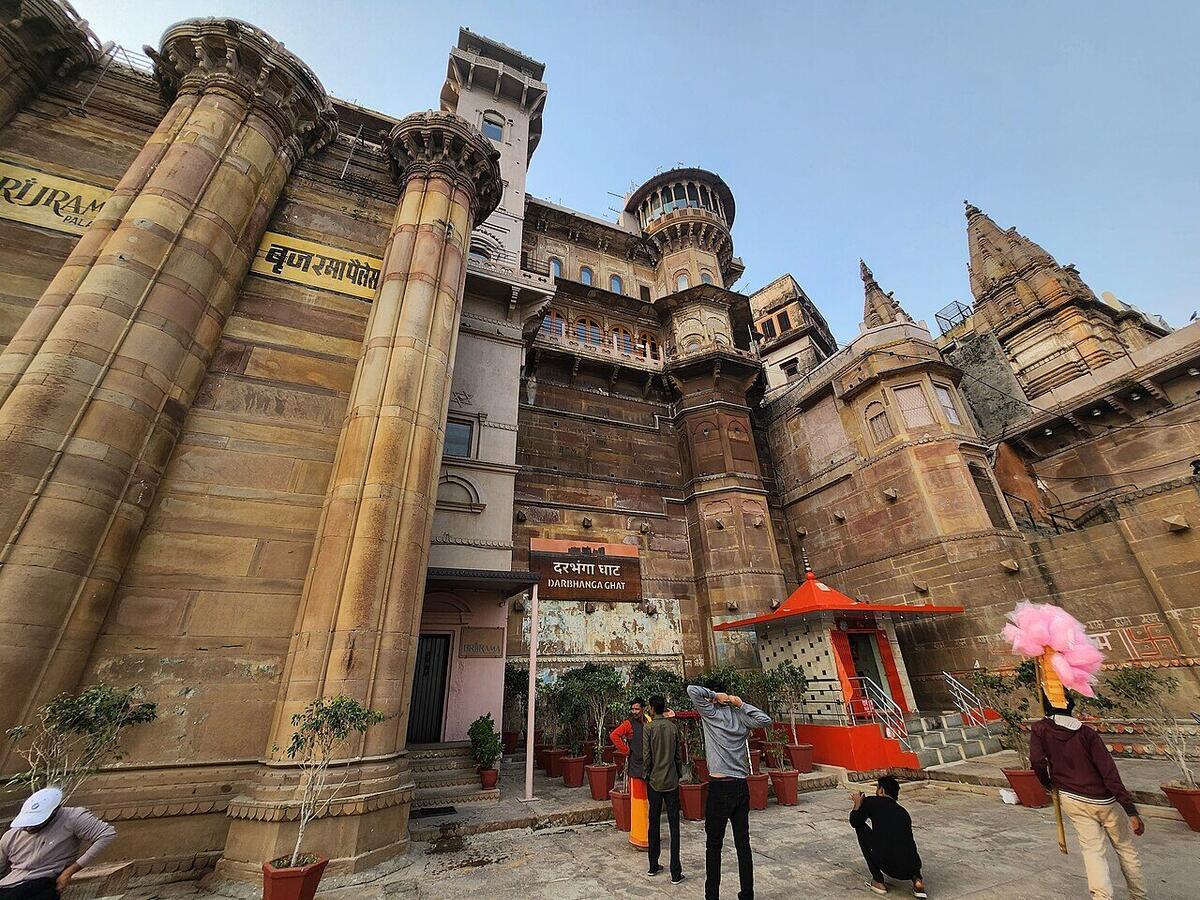
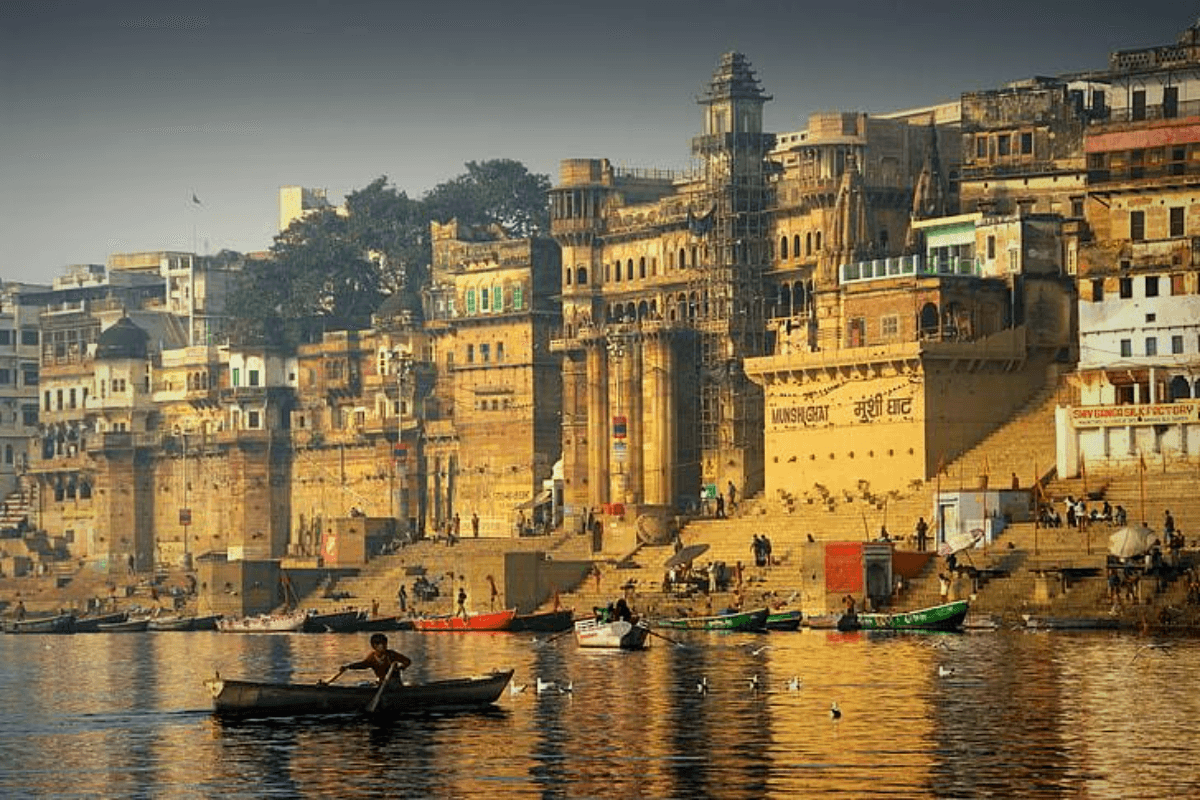
Above the steps stands the great sandstone palace from which the ghat takes its present name. Its presence is the second thing this ghat has to teach. Kashi was never built by Kashi alone: Maratha, Mithila, Bengali, Rajput and South Indian houses each kept a house, a ghat or a dharamshala on this bank so that their people would have a place to bathe, to stay, and to die in the city of moksha. Darbhanga Ghat is the Mithila stone in that long wall.
Banarasi tradition does not attach a separate katha to Darbhanga Ghat, and it would be wrong to give it one. Its sanctity is the sanctity of the Ganga herself. Devotees hold that at Kashi the river turns north — uttaravahini — and that this northward reach of water, held between Asi and Adi Keshava, is one continuous tirtha rather than a string of separate holy points. On that understanding, snan at Darbhanga is snan in the same sacred water as at any of the great ghats, and the merit is held to lie in the sankalp and the shraddha of the one who takes it, not in the fame of the step he stands on.
Its place in the sacred order is a matter of position. Darbhanga sits inside the central stretch that holds Dashashwamedh — the ghat that is counted among the five Panchatirtha tirthas whose snan is traditionally held to complete the Kashi yatra. Pilgrims lodged along this reach commonly begin their day here with a quiet bath, walk north for the Panchatirtha snan and for darshan at Kashi Vishwanath, and return in the evening when the ghat line fills with lamps.
A devout house on the Ganga
The name the ghat carries is itself a devotional fact. The Darbhanga Raj of Mithila was among the notable Hindu houses of its time: Maharaja Rameshwar Singh, who ruled from 1898 to 1929 and whom the Varanasi district listing names as the purchaser of the palace in 1915, served as president of the Bharat Dharma Mahamandal, the orthodox Hindu assembly of the period, and as president of the Hindu University Society. To hold ground on the Ganga at Kashi was, for such a house, an act of the same order as endowing a pathshala or a temple — a way of standing permanently at the tirtha.
History
The stone here is early nineteenth century. Heritage documentation of the Varanasi ghats records that Sridhara Narayana Munshi, a finance minister in the estate of Nagpur, built this ghat and part of the palatial building above it, and that the whole stretch was accordingly known as Munshi Ghat. The Varanasi district listing dates that work to 1812.
In 1915 the Maharaja of Darbhanga acquired the palace and extended the ghat, and the extended portion came to be called Darbhanga Ghat — the adjoining stretch keeping the older name of Munshi Ghat to this day. Sources differ on the details: the Varanasi district listing names Rameshwar Singh Bahadur as the Maharaja who took the property, while some accounts name a later ruler of the house, and accounts also differ on whether the palace was purchased or given. What is not in dispute is the year and the house.
Through all of this the ghat below went on doing its ordinary sacred work — snan at dawn, tarpan, diyas at dusk — without interruption, and the steps themselves remain in the charge of the Municipal Corporation rather than of any private owner.
The building above changed hands again in 1994, when it was bought by the Clarks Hotel Group and renamed Brijrama Palace for conversion into a heritage hotel. Heritage documentation of the site records that much of the old structure was pulled down and rebuilt taller and wider during that conversion, and that further demolition was stopped after citizens’ conservation groups took the matter up with community and judicial support. Pilgrims should therefore understand the facade they see as a restored and substantially rebuilt one, standing on an old and genuine site.
Architecture
The ghat itself is in the ordinary and excellent Banarasi manner: broad flights of stone steps descending in stages to the water, with wide landings where families can set down their bundles, and a lower run that the river takes back every monsoon and returns every winter. The stone is the warm buff sandstone of Chunar, quarried upstream and used across the older Varanasi ghats, worn smooth by bare feet and river silt.
The palace above is the distinguishing feature of this stretch of the waterfront. Heritage documentation describes it as built of Chunar sandstone with deep porches and Greek pillars — the neoclassical columns that entered Banaras riverfront building in the nineteenth century. Riverside terraces, ranked balconies and a tall arcaded frontage give the building the vertical presence that makes it a navigation landmark from the water.
Seen from a boat mid-river, the Darbhanga facade reads as one of the strong verticals of the central ghat line, standing between Rana Mahal Ghat and Munshi Ghat. It is worth remembering that in Kashi such buildings were never the point. The steps are the point; the buildings are what devout houses put behind the steps so that the steps would be kept.
Rituals & Practices
Darbhanga is a bathing ghat and not a temple ghat, and its practice is correspondingly simple and daily rather than ceremonial. There is no aarti of its own here.
Before sunrise, devotees descend for Ganga snan, take sankalp facing the river, and offer tarpan — water given with folded hands and darbha grass for the ancestors — a rite offered on these steps every morning. Some carry a small lota home filled with Ganga-jal for the household shrine. At dusk, clay diyas are floated on the current, and through the month of Kartik lamps are raised along the ghat line as they are across Banaras.
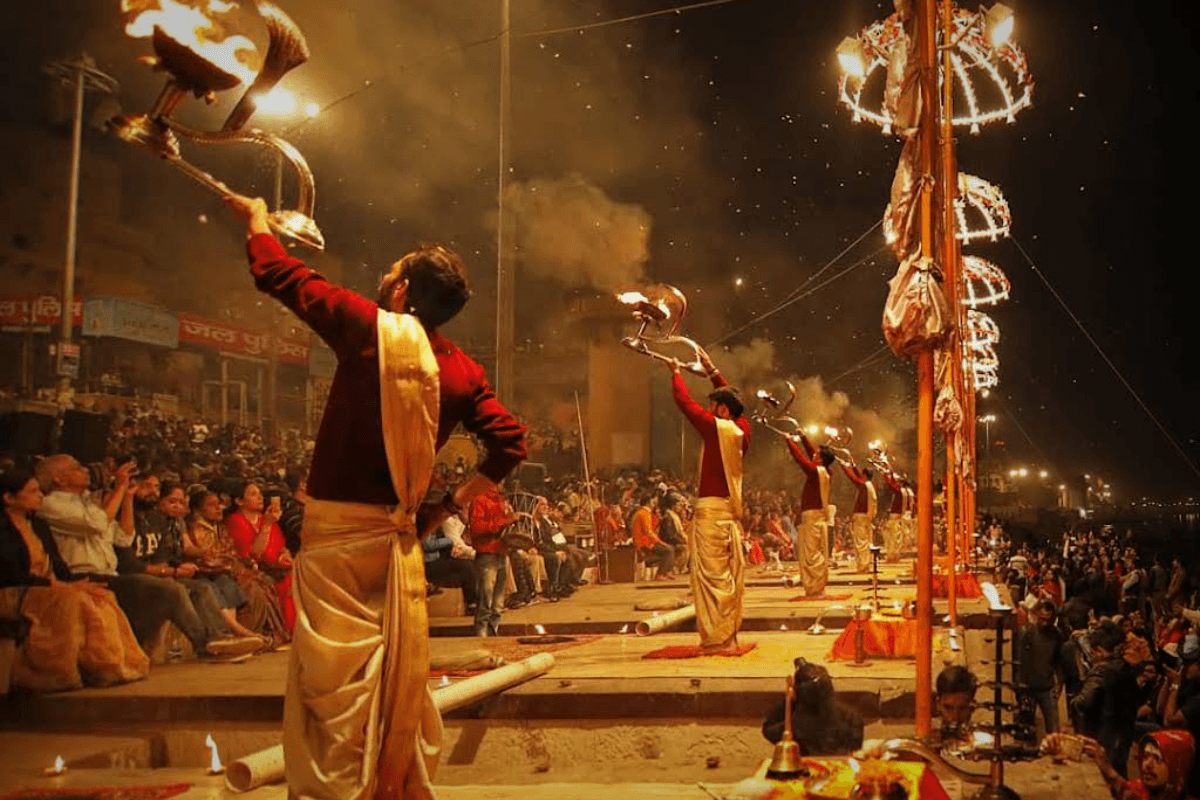
The evening belongs to Dashashwamedh. Most pilgrims staying near Darbhanga either walk the ghats north for the Ganga Aarti or take a boat from the lower steps here, which gives an unhurried river-side view of the aarti platforms. On Dev Deepawali the entire ghat line, this one included, is lit with rows of earthen lamps, and the ghat becomes a place of offering in its own right for that one night.
Festivals & Celebrations
| Festival | When | Crowd |
|---|---|---|
| Dev Deepawali | — | Extremely high â the ghat line is packed from afternoon onward |
| Kartik Purnima and the Kartik snan | — | High through the month, extreme on Purnima |
| Ganga Dussehra | — | Very high |
| Chhath Puja | — | Very high |
| Makar Sankranti | — | Very high |
Dev Deepawali: Tradition holds that on this night the devas descend to bathe in the Ganga at Kashi, and that the lamps on the ghats are lit in their welcome. Devotees also connect the day to Shiva's victory over Tripurasura.
Kartik Purnima and the Kartik snan: The Puranas praise snan in Kartik at a Ganga tirtha as bearing great merit, and Kartik Purnima is held to be the most auspicious bathing day of the month.
Ganga Dussehra: Tradition holds that snan on this day at a Ganga tirtha removes the ten kinds of sin â the dasha-papa from which the festival takes its name.
Chhath Puja: Chhath is offered to Surya and to Chhathi Maiya for the wellbeing of the family. The vrata is among the most demanding in the Hindu calendar, kept with a long waterless fast.
Makar Sankranti: Marks the sun's entry into Makara and the start of Uttarayana. Snan and daan on this day at a Ganga tirtha are held to bear great devotional fruit.
Prepare for Your Visit
Practical guidance to help you plan your pilgrimage
| Pilgrim Guidance | How to reachThe usual approach is on foot from the Godowlia crossing, down through the lanes toward the river and then south along the ghats past Ahilyabai and Munshi Ghat; the tall sandstone palace front is unmistakable and serves as the landmark. From Kashi Vishwanath it is a short walk south along the waterfront. By water, any boat from Dashashwamedh or Assi can set you down at the steps, and boatmen know the ghat by name. Vehicles cannot reach the ghat; the last stretch is always on foot through the galis. What to expectThis is a calmer ghat than Dashashwamedh, used by residents as much as by pilgrims, with room to bathe and sit without pressing crowds. Steps are wet and slippery near the waterline — move slowly and let elders take the rail side. The lower steps go under water in the monsoon and the bathing line shifts upward. The palace above is a private heritage hotel; the steps are public, but the property line begins where the terraces begin. Best time to visitOctober to March is the most comfortable season for a Kashi yatra, and Kartik in particular fills these steps with pilgrims taking the month-long snan. Early morning, from first light to about nine, is when the ghat is at its most devotional. Late afternoon light falls full on the sandstone facade and is the best hour for those who wish to photograph the building. Avoid the deep monsoon weeks if bathing is your purpose, as the current here runs strong and the safe bathing area is much reduced. |
Location
Varanasi, UP
Gallery
Pilgrim photos
No pilgrim photos yet.
Community corrections
No corrections yet.
Edit history
No revisions yet.
Plan Your Visit to Darbhanga Ghat
Get a custom itinerary and pricing for your trip.
Recommended
Packages for this destination
Pilgrim Notes
On-ground observations from fellow pilgrims
No pilgrim notes yet. Be the first to share on-ground observations!
Sign in to share a note.
Pilgrim Reviews
Be the first to share your experience at Darbhanga Ghat.
Sign in to write a review.
Nearby sacred places
Discover other sacred places near Darbhanga Ghat
Explore temples, tirthas, and pilgrimage sites in UP
Explore nearbyPart of these circuits
Walk the traditional pilgrimage routes this destination belongs to.