Digpatiya Ghat is a short flight of stone steps on the Kashi crescent, set between Sarveshvara Ghat and Chausatthi Ghat. Heritage documentation of the Varanasi riverfront treats Digpatiya and Chausatthi as a single sacred area of roughly 0.30 hectare, with the temple of Chausatthi Devi — the shrine of the sixty-four Yoginis — standing at its head. The name of the ghat comes from its nineteenth-century patron: the Varanasi Heritage Dossier names the king of Digapatiya — which it places in Champaran, Bihar — who built this lower portion of the ghat in 1830, and who is recorded as having fully repaired and renovated the ghat later in the nineteenth century.
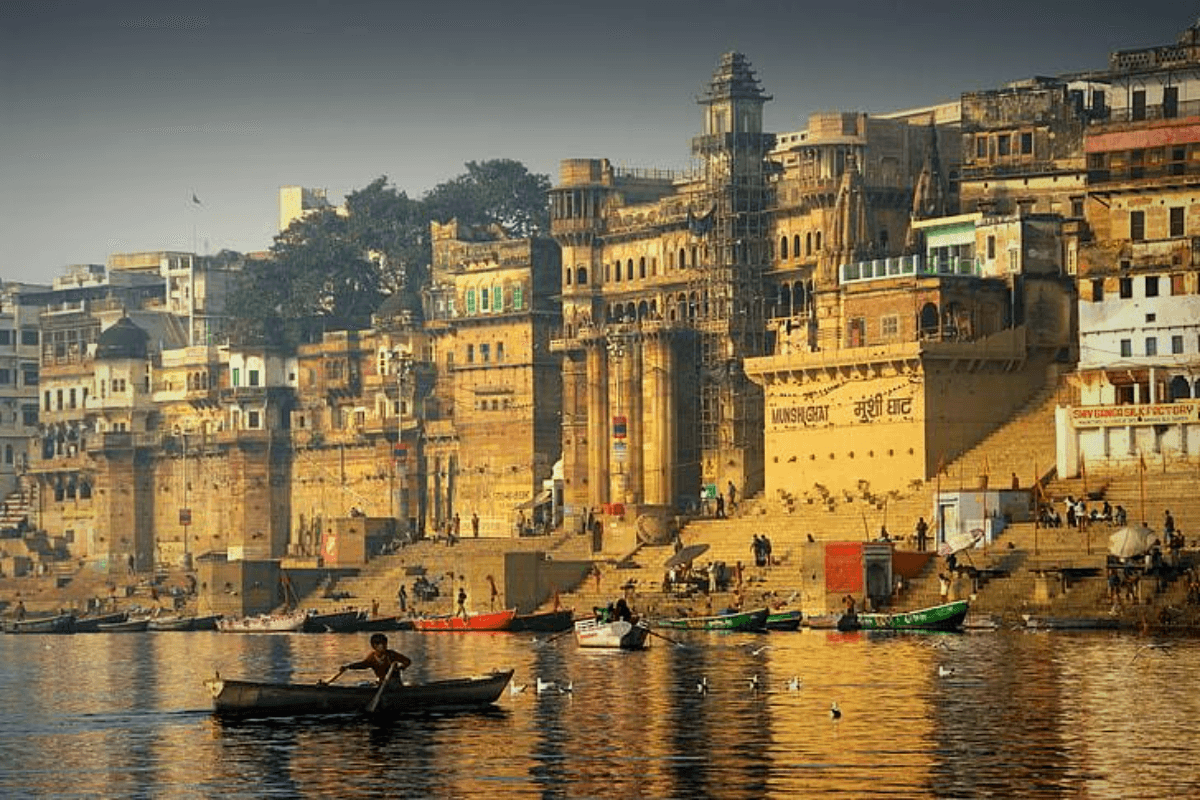
This is a working neighbourhood ghat rather than a thronged one. Mornings bring bathers from the surrounding lanes, women washing at the water's edge, boats tied along the stone, and the ordinary unhurried devotion of a Kashi ghat where no aarti is performed and no crowd gathers. Those who come with a purpose usually come for the Devi — a bath first at the water, then the climb to the temple compound above. On the steps themselves rests a stone image of Mayuri, the peacock-headed Yogini; heritage documentation records that of the traditional sixty-four Yogini images only sixteen now survive in Varanasi, and that two of them stand in the vicinity of Chausatthi Devi — Mayuri being the one on the steps of the ghat.
Above the steps stands the palace built by the Digpatiya patron, its porches set on both sides in a style heritage documentation describes as Bengali. It is no longer a princely residence; it serves today as the Sitarama Omkara Das Kashi ashram, so the building has stayed within the devotional life of the riverfront rather than passing out of it. For pilgrims, Digpatiya is a few minutes' walk upriver from Dashashwamedh, past Ahilyabai, Munshi, Darbhanga and Rana Mahal ghats — close enough to fold into a morning at the river, quiet enough to be worth the detour.
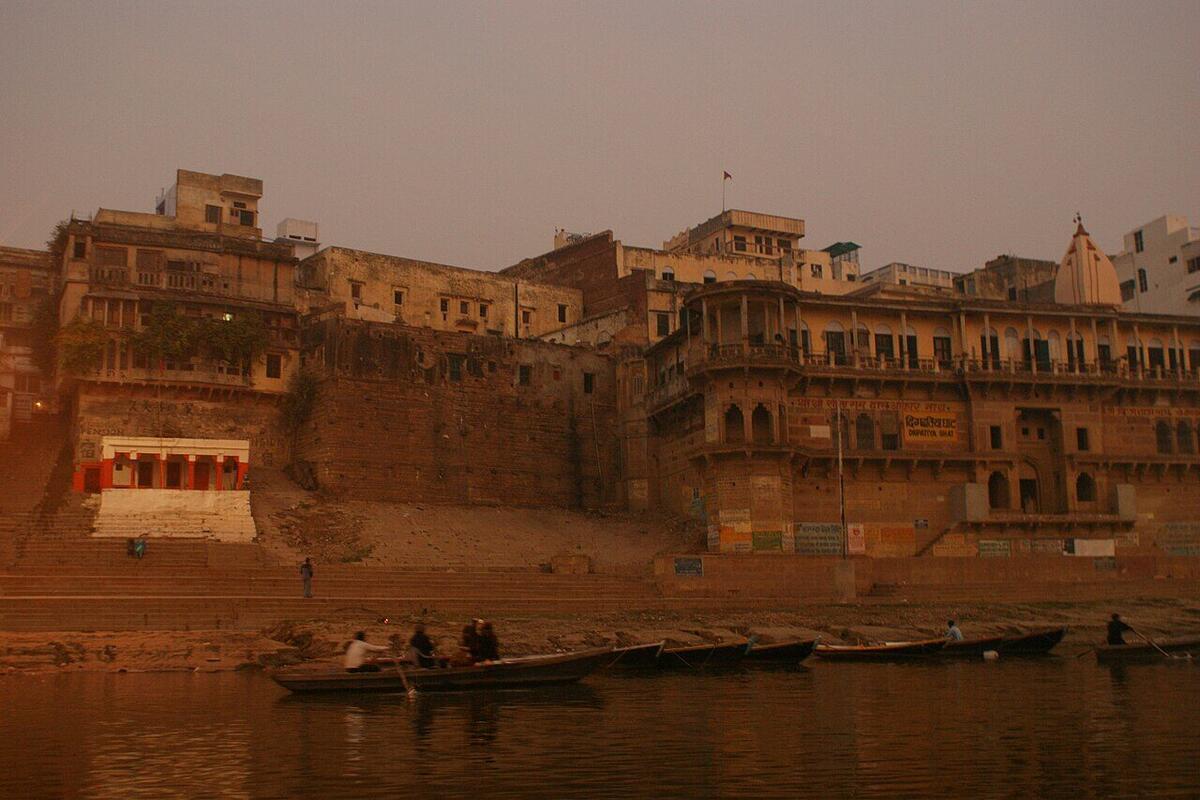
The sacred identity of this stretch of the riverfront belongs to the Yoginis. Heritage documentation of the Varanasi riverfront cites the Kashi Khanda (61.176–177) as describing this ghat together with the images of the Yoginis, and as naming two jala-tirthas — sacred spots associated with the water — here. The same records note that the goddess Chausatthi and her ghat are mentioned in the Giravana-padamanjari (1600–60), which places the shrine within Kashi's older documented tirtha geography rather than in later local memory alone.
The Yoginis are held in tradition to be among the most ancient groups of goddesses. Their number, chausath — sixty-four — is understood in devotional and scholarly explanation as a symbolism of direction and multiplication: eight mother-goddesses, each with eight attendant goddesses; or the eight directions of the earth answered by the eight directions of the celestial realm. In either reading, sixty-four stands for a completeness that surrounds the devotee on every side.
For a pilgrim, the order of the visit carries its own meaning. The Ganga is approached first — snan at the steps, a little water offered, a sankalp taken — and only then the ascent to the Devi. Water below, Shakti above: the ghat is not a viewpoint but a threshold, and in devotional understanding the bath is what prepares one for the darshan.
History
The devotional life of this ghat is older than any of its stones. Digpatiya is documented as the lower portion of Chausatthi Ghat, and the record belongs to the two together. Heritage documentation notes that the goddess Chausatthi and her ghat are named in the Giravana-padamanjari (1600–60), and cites the Kashi Khanda as describing the Yogini images here — so the site was already an established tirtha well before its present steps existed. The same records note that this ghat gave shelter to the Sanskrit scholar Madhusudana Sarasvati (1540–1623), who is remembered in the Advaita tradition.
The building history runs through several hands. The ghat was first made pucca in the late sixteenth century under King Pratapaditya, and that work was partly destroyed over time. Around 1670 the king of Udaipur renovated and extended it. The present built structure dates to 1807. Until the eighteenth century the principal image of Chausatthi Devi stood in the Rana Mahal palace nearby, and was moved later to the shrine where it is worshipped today.
The name Digpatiya belongs to the nineteenth century. Heritage documentation records that the Raja of Digpatiya — placed by the Varanasi Heritage Dossier in Champaran, Bihar — built the lower portion of the ghat in 1830 and repaired and renovated the whole of it, and that the palace he raised above the steps was built in Bengali style. From that patronage the lower ghat came to be called Digpatiya. The steps were given their present pucca form in 1965 by the Government of Uttar Pradesh. Today the temple is looked after by the Chausatthi Temple Trust and by local families, while the ghat itself is under the Municipal Corporation; what has kept the site alive is not a conservation programme but the unbroken daily worship of the neighbourhood.
Architecture
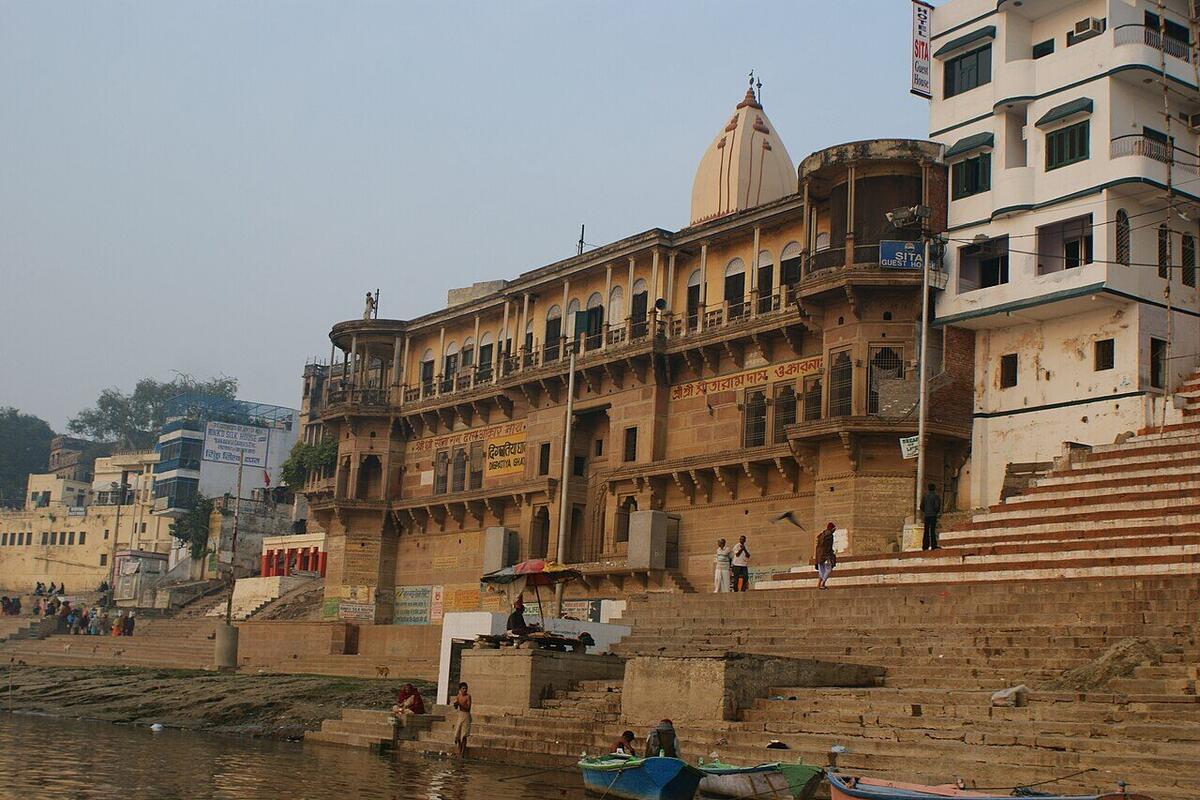
Digpatiya is a compact ghat, and its character comes from the relationship between three things: the water, a short run of stone steps, and the palace above them. The steps were given their present pucca form in the 1965 reconstruction by the Government of Uttar Pradesh. Ghat and temple complex together cover about 0.30 hectare, so this is a compact descent rather than a broad amphitheatre like Dashashwamedh.
The palace built by the Digpatiya patron is the visual anchor. Heritage documentation describes it as an architecturally accomplished building in Bengali art and style, with porches set on both sides. It now houses the Sitarama Omkara Das Kashi ashram, so its rooms and verandas remain in devotional use.
Above and beside the steps lies the Chausatthi Devi temple compound, which holds old images of Kali, of Shiva, Ganesha and Kartikeya, and of folk goddesses. Two Yogini images survive in the vicinity of Chausatthi Devi — Gajanana, the elephant-headed, recorded at a house nearby, and Mayuri, the peacock-headed, on the steps of the ghat itself. Its dignity is in continuity of use rather than in scale.
Rituals & Practices
Most of what happens at Digpatiya is the daily practice of a river ghat: snan at first light, a lota of Ganga-jal carried up for the household shrine, tarpan offered for ancestors, a lamp set afloat in the evening. There is no organised aarti here and no ceremony staged for visitors; the rhythm is domestic and unbroken.
Two occasions in the year draw pilgrims to the steps specifically. On the twelfth of the dark half of Chaitra (March–April), devotees come in numbers for darshan at the Yogini temple and take a ritual bath at this ghat. The second is the evening of Holi, marking the turn into Chaitra, when a rite of homage is performed at the ghat.
Pilgrims who wish to perform a formal sankalp, tarpan or shraddha here should arrange it in advance rather than expecting priests to be waiting on the steps, as they are at the larger ghats. Temple timings at the Chausatthi Devi shrine are set by the trust and are best confirmed locally on the day of the visit.
Festivals & Celebrations
| Festival | When | Crowd |
|---|---|---|
| Chaitra Krishna Dwadashi (Yogini darshan) | — | Moderate |
| Holi evening | — | Moderate |
| Dev Deepawali | — | Very high |
| Kartik Purnima snan | — | High |
| Daily Ganga snan | — | Low to moderate |
Chaitra Krishna Dwadashi (Yogini darshan): The principal Yogini observance of the shrine, tying the bath at the ghat directly to the darshan above.
Holi evening: A seasonal observance recorded in heritage documentation of the ghat, marking the beginning of the new lunar month.
Dev Deepawali: Tradition holds that Dev Deepawali marks Shiva's victory over Tripurasura and the descent of the devas to bathe in the Ganga; the lamps are offered as a greeting to them.
Kartik Purnima snan: The Puranas praise snana in Kartik, and especially on the purnima, as bearing great devotional fruit.
Daily Ganga snan: The unbroken daily practice that has kept this small ghat a living tirtha rather than a monument.
Prepare for Your Visit
Practical guidance to help you plan your pilgrimage
| Pilgrim Guidance | Where the ghat sitsDigpatiya lies on the main southern arc of the Varanasi ghats, between Sarveshvara Ghat and Chausatthi Ghat, with Rana Mahal, Darbhanga and Munshi ghats just beyond. The simplest approach is on foot along the riverfront from Dashashwamedh — a walk of a few minutes past Shitala, Ahilyabai, Munshi, Darbhanga and Rana Mahal. It can also be reached through the lanes behind, coming down from the Dashashwamedh road, or by boat, asking the boatman to set you down at Chausatthi. During the monsoon, when the river rises over the lower steps, the riverfront walk between ghats is often closed and the lane approach is the only one. Best time to visitEarly morning is when the ghat is most itself — bathers, sunlight on the far bank, boats going by. October to March is the most comfortable season. Chaitra Krishna Dwadashi and the evening of Holi are the two days recorded as drawing a gathering here. Avoid the peak monsoon weeks of July to September, when the lower steps are submerged and slippery. What to expectThis is a small, unornamented ghat and it should be approached as such. There are no facilities on the steps, no shops, no formal ceremony. Carry your own water and a cloth if you intend to bathe, and small change for the temple offering. Ghat steps are uneven and can be slick with river silt, so those travelling with elderly pilgrims may prefer the lane approach to the temple rather than the climb from the water. Allow twenty to thirty minutes here if you are combining it with a longer ghat walk; longer if you wish to sit. |
Location
Varanasi, UP
Pilgrim photos
No pilgrim photos yet.
Community corrections
No corrections yet.
Edit history
No revisions yet.
Plan Your Visit to Digpatiya Ghat
Get a custom itinerary and pricing for your trip.
Recommended
Packages for this destination
Pilgrim Notes
On-ground observations from fellow pilgrims
No pilgrim notes yet. Be the first to share on-ground observations!
Sign in to share a note.
Pilgrim Reviews
Be the first to share your experience at Digpatiya Ghat.
Sign in to write a review.
Nearby sacred places
Discover other sacred places near Digpatiya Ghat
Explore temples, tirthas, and pilgrimage sites in UP
Explore nearbyPart of these circuits
Walk the traditional pilgrimage routes this destination belongs to.