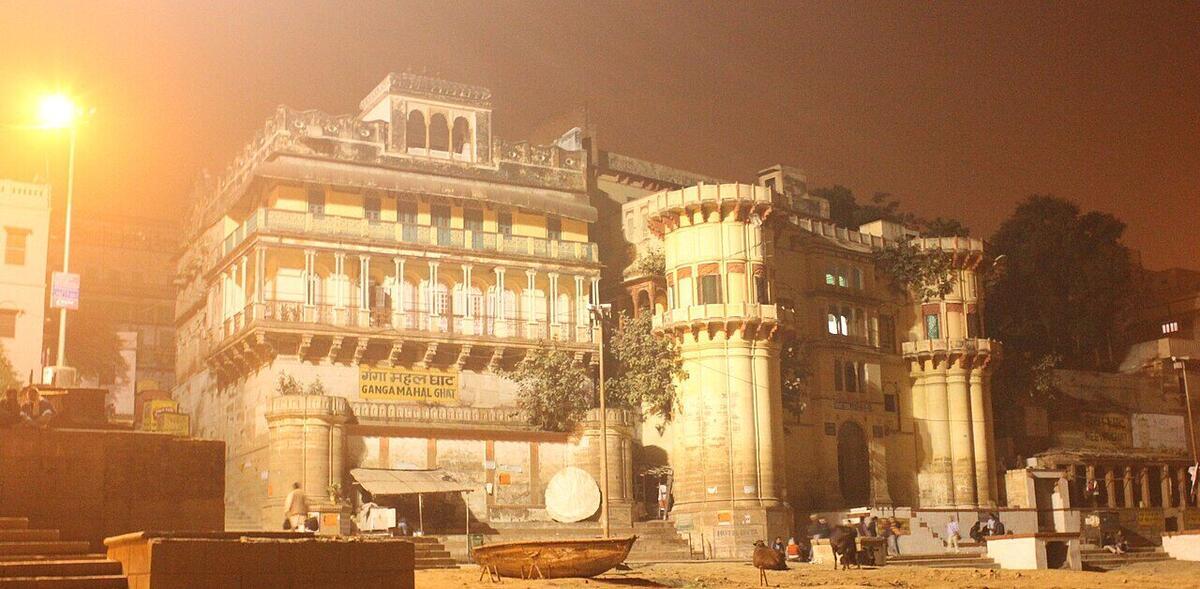
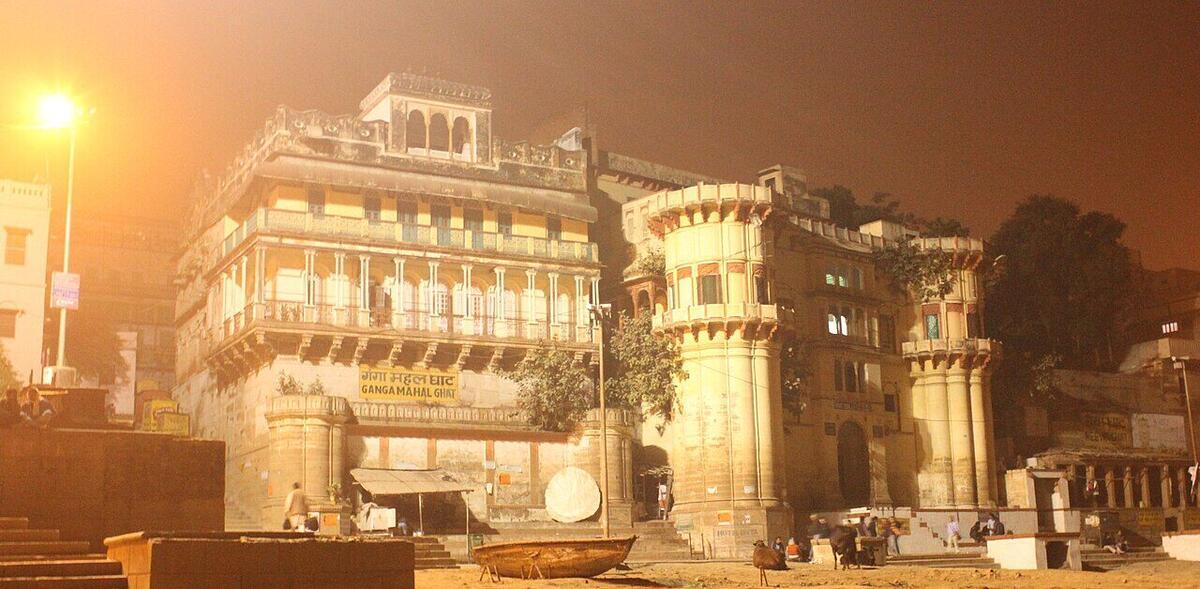
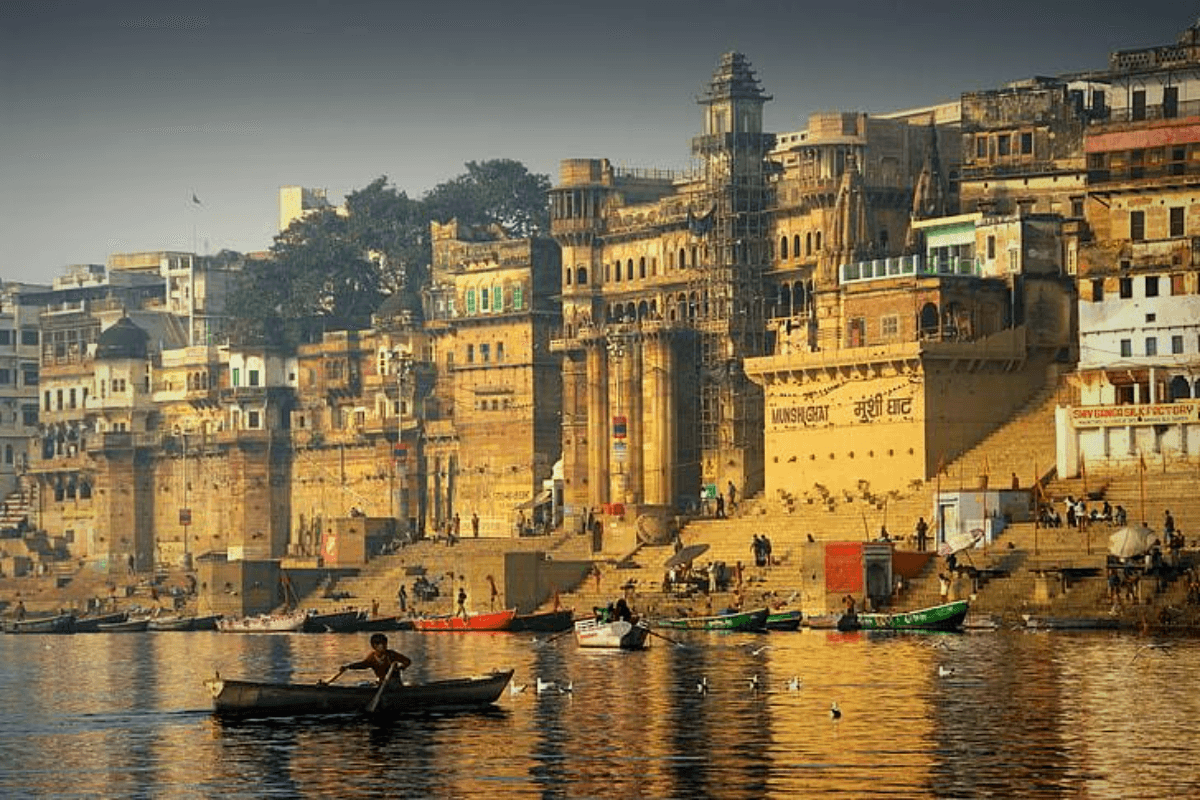
Ganga Mahal Ghat stands at the southern edge of the Kashi waterfront, immediately north of Asi Ghat. A single flight of stone steps is all that divides the two, and heritage documentation describes Ganga Mahal as the extended part of Asi Ghat rather than as a ghat of separate standing. The name belongs to the palace above: the Ganga Mahal, a river-facing residence built around 1830 under the patronage of the Banaras royal house, whose brown stone facade gives this short stretch its landmark.
What happens here is what has always happened on the southern crescent. Pilgrims come down in the dark for snana, take sankalp with the water in cupped hands, offer arghya to the rising sun, and perform tarpan for their ancestors. Families sit on the upper steps to dry and dress; boatmen wait for the first passengers of the day; a few sadhaks stay on into the morning with japa. Because Asi carries the crowd and the loudspeakers, the Ganga Mahal steps often hold the quieter half of the same devotion — the pilgrim who wants a bath without a gathering usually walks the few paces north.
By evening the ghat turns into a viewing place rather than a ritual one. There is no formal Ganga Aarti offered on these steps; the lamps are lit next door at Asi, and the great aarti of the city is far to the north at Dashashwamedh. From here the ghats run away northward in a long stone curve, and the palace above catches the last of the light. In Kartik the steps fill again after dark for deepdan, when small earthen lamps are set afloat and the current carries them northward along the ghats.
The sanctity that pilgrims come to Ganga Mahal Ghat for is not a sanctity of its own steps. It is the sanctity of the Asi tirtha that these steps continue, and of the Ganga herself. This is worth saying plainly: Kashi has ghats that carry a great mahatmya of their own — Dashashwamedh, Manikarnika, Panchganga — and it has ghats that exist to serve the devotion of a tirtha beside them. Ganga Mahal is the second kind, and there is no diminishment in that.
The tirtha it serves is a considerable one. Tradition counts Asi as the first of the Panchatirtha, the five sacred bathing places whose snana is held to complete a Kashi pilgrimage — Asi, Dashashwamedh, Manikarnika, Panchganga and Adi Keshava. They lie along the river from Asi in the south to Adi Keshava in the north, and the yatra is begun at Asi. Asi is also understood as the southern boundary of the Kashi kshetra, the point where the Asi stream meets the Ganga and where the sacred city begins. Ganga Mahal lies just inside that boundary. A pilgrim who bathes on these steps is bathing within the kshetra, and the sankalp that is spoken here names Kashi and the Ganga, not the ghat.
What devotees hold
Banarasi devotional understanding treats the whole crescent from Asi to Varana as a single tirtha-kshetra, with the named ghats as its doorways rather than as separate destinations. On this reading, the merit of a Kartik or Magh snana does not depend on which flight of steps a devotee walks down, provided the sankalp is taken with attention and the bath is offered rather than merely taken. Local practice bears this out: on the great bathing days the steps of Ganga Mahal are as full as those of its famous neighbour, and no one there considers themselves to be in the wrong place.
The ghat also carries a household devotion above it. The district administration's own listing records a Radha-Krishna shrine in the Nagara style within the Mahal, and, separately, an eighteenth-century Lakshmi Narayan temple near the ghat — older, by that dating, than the palace from which the ghat takes its name. That older shrine is the quiet evidence that this bank was a place of worship before it was a place of architecture.
History
The devotional use of this bank is older than its stonework. An eighteenth-century Lakshmi Narayan temple is recorded near the ghat, which places worship on this bank before the palace that gave the ghat its name. The steps themselves belong to the nineteenth century.
Both the Varanasi district administration and the heritage documentation of the city's ghats date the Ganga Mahal palace to about 1830 and name the Banaras royal house as its patron. Both records name Raja Prabhu Narayan Singh as the builder, though that identification cannot be taken as settled: Prabhu Narayan Singh was born in 1855 and ruled Banaras only from 1889, so the work of about 1830 belongs to an earlier ruler of the same house. The date and the patronage are well attested; the individual name is not. Once the palace stood over the water, the steps below it took the palace's name, and Ganga Mahal Ghat entered the city's ghat sequence as the northern continuation of Asi. A further palatial structure was raised alongside it, giving the adjoining Rivan (Rewan) Ghat.
Responsibility for the site today is divided, as it is at many of Kashi's palace ghats. Heritage documentation records the Ganga Mahal palace as held by the Maharani Trust of the Banaras royal house, the Rivan Mahal by Banaras Hindu University, and the ghat steps themselves by the Varanasi Nagar Nigam. The palace has found modern occupants — a textile design studio on the lower floors and the Indo-Swedish Study Centre run in association with Karlstad University above — and observers of the ghats have noted that this occupied building has been kept in better repair than several of its neighbours. Through all of it, the steps have continued to be used for the same thing every morning.
Architecture
The presence of this ghat is the palace, not the stair. The Ganga Mahal presents a tall brown stone facade to the river, which the district listing describes as fortress-like, looking down on the Ganga. Heritage documentation characterises the building as a mixture of Rajput and local traditional styles. Beyond that the records do not itemise its features, and this page does not either.
The ghat below is straightforward: broad flights of stone descending to the water, with the level changing where the steps meet Asi to the south, and a landing wide enough for bathers to gather and for boats to come alongside. There is no aarti platform, no bank of shrines along the waterline, no covered pavilion of pandas — the plainness is part of why the ghat stays calm.
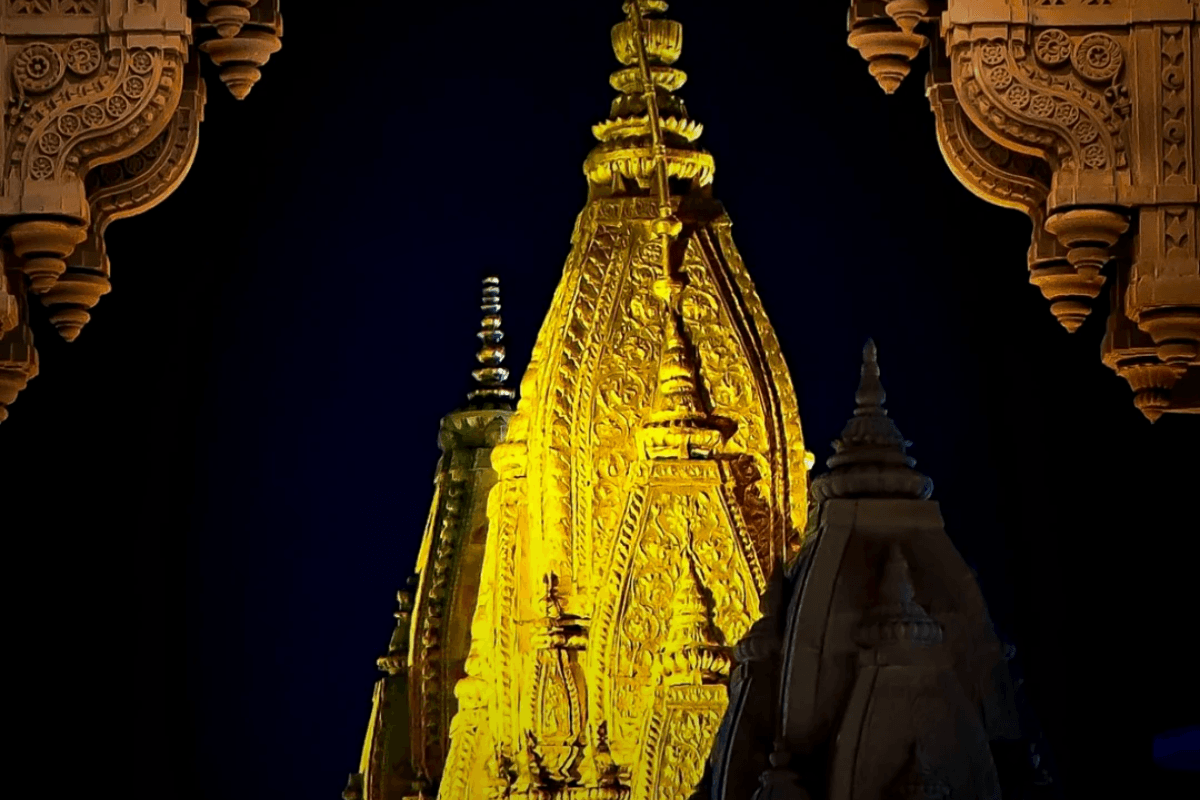
Within the Mahal stands the Radha-Krishna shrine, built in the Nagara manner; the older Lakshmi Narayan temple is recorded near the ghat rather than inside the palace. Because the palace is in private and institutional use, these are not open like a public temple; pilgrims should treat them as the household shrines of a heritage building rather than as darshan stops, and should ask before approaching.
Rituals & Practices
The ghat's ritual day is a bathing day. From well before sunrise devotees come down for snana, take sankalp standing in the water, offer arghya to Surya as the light comes over the far bank, and perform tarpan for their forebears. Many carry a small lota back up the steps with Ganga-jal for the household shrine. Barbers work the upper steps for the shaving that precedes shraddha rites, and priests are available for those who want the vidhi spoken correctly, though there is no large panda establishment here as at the central ghats.
Kartik is the ghat's fullest month. Devotees keeping the Kartik-snana vow bathe here daily through the month, and on the evenings of the month lamps are floated from these steps — the deepdan that reaches its height on Kartik Purnima and Dev Deepawali, when every ghat of the city is lit. Magh brings a second bathing discipline, and Ganga Dussehra in May or June brings a day of particular offering to the river.
Above the steps, the shrines within the Mahal keep their own calendar. The district administration's listing records the observance of Krishna Janmashtami, Ram Navami, Ganesh Chaturthi and Shivratri at the Radha-Krishna shrine, and a Krishna Leela during which Brahmins are offered alms and a meal. These are the observances of a family shrine within a private building; pilgrims who wish to attend should enquire locally rather than assume access.
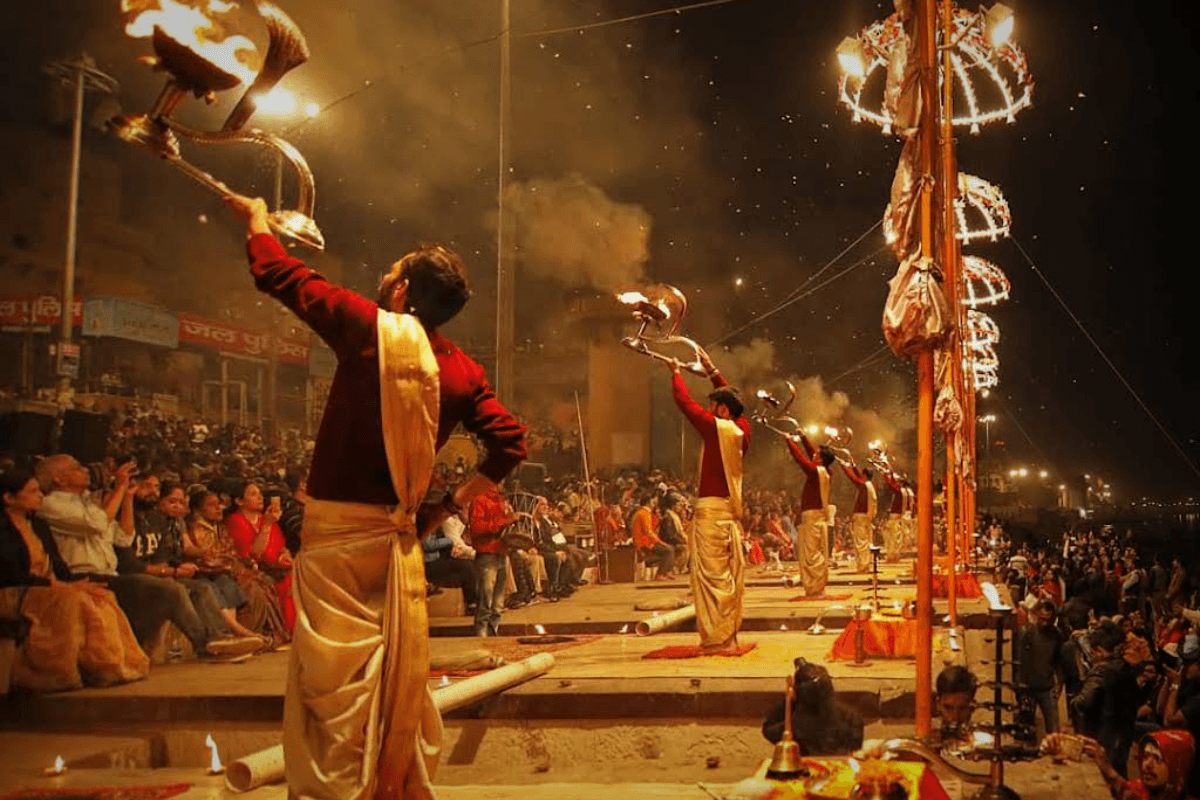
No formal evening Ganga Aarti is offered at Ganga Mahal Ghat. The aarti nearest to these steps is on Asi, a minute's walk south; the city's principal aarti is at Dashashwamedh. Timings for all of these shift with the season and with the river, and are best confirmed on the day.
Festivals & Celebrations
| Festival | When | Crowd |
|---|---|---|
| Dev Deepawali | — | Very high â the southern ghats fill from late afternoon |
| Kartik Purnima Snan | — | Very high |
| Ganga Dussehra | — | High |
| Makar Sankranti | — | High |
| Krishna Janmashtami | — | Moderate |
| Daily Ganga snan | — | Moderate in the early morning, light through the day |
Dev Deepawali: Tradition holds that Dev Deepawali marks Shiva's victory over Tripurasura and the descent of the devas to bathe in the Ganga. Lighting lamps along the ghats is offered as a welcome to them.
Kartik Purnima Snan: The Puranas praise snana in Kartik, and Kartik Purnima above all, as bearing exceptional devotional fruit. Bathing within the Kashi kshetra on this day is held to be especially meritorious.
Ganga Dussehra: Tradition holds that a bath offered to the Ganga on this day removes the dasha-papa, the ten kinds of transgression. It is among the most important river-days of the Banaras year.
Makar Sankranti: Marks the sun's passage into Makara and the beginning of Uttarayana. Snana and daan on this day are held to bear great fruit.
Krishna Janmashtami: The observance belongs to the household shrine above the ghat rather than to the steps themselves. Pilgrims wishing to attend should enquire locally, as the building is in private and institutional use.
Daily Ganga snan: This unbroken daily use, more than any single festival, is what makes a Kashi ghat a living tirtha rather than a heritage site.
Prepare for Your Visit
Practical guidance to help you plan your pilgrimage
| Pilgrim Guidance | How to reachGanga Mahal Ghat sits about six kilometres south-east of Varanasi Junction and roughly a hundred metres north of Asi Ghat. The simplest approach is to come to Asi Ghat by auto or cab — the Asi crossing is a landmark every driver knows — and then walk north along the riverfront; the flight of steps separating the two ghats is the only marker you need. From the city side, the lanes of Bhadaini and Asi bring you down to the same point. By river, any boat from Asi, Tulsi or Kedar Ghat will drop you at the landing, and the Ganga Mahal facade is recognisable from the water. The ghats immediately north — Rivan, Tulsi, Bhadaini — are all walkable along the riverside path in dry season. What to expect at these steps
Best time to visitThe hour before sunrise is the ghat at its truest — the bathing, the arghya, the light coming up over the sandbank on the far shore. October to March is the most comfortable season for pilgrims travelling with elders or children. Kartik Purnima and Dev Deepawali bring the whole southern crescent alive with lamps and also bring very large crowds; Ganga Dussehra and Makar Sankranti fill the steps from before dawn. For a still darshan of the river, a weekday morning outside the festival months is hard to better. |
Location
Varanasi, UP
Pilgrim photos
No pilgrim photos yet.
Community corrections
No corrections yet.
Edit history
No revisions yet.
Plan Your Visit to Ganga Mahal Ghat
Get a custom itinerary and pricing for your trip.
Recommended
Packages for this destination
Pilgrim Notes
On-ground observations from fellow pilgrims
No pilgrim notes yet. Be the first to share on-ground observations!
Sign in to share a note.
Pilgrim Reviews
Be the first to share your experience at Ganga Mahal Ghat.
Sign in to write a review.
Nearby sacred places
Discover other sacred places near Ganga Mahal Ghat
Explore temples, tirthas, and pilgrimage sites in UP
Explore nearbyPart of these circuits
Walk the traditional pilgrimage routes this destination belongs to.