Haridwar carries its meaning in its name. Hari-dvara is read as the gateway of Vishnu, and in the Shaiva reading of the same city, Har-dwar, the gateway of Shiva — because from here the roads run on to Badrinath and to Kedarnath alike. Older names remain in use in devotional speech: Gangadvara, the door of the Ganga; Mayapuri, the city of Maya Devi; and Kapilasthana, the place of the sage Kapila. In the verse that lists the seven moksha-giving cities — Ayodhya Mathura Maya Kashi Kanchi Avantika, Puri Dvaravati chaiva saptaita moksha-dayikah — Haridwar is named only as Maya, and that older name is still how the city knows itself.
The city stands at about 314 metres, at the exact place where the Ganga finishes her mountain course and turns out into the northern plains. This geography is not incidental to the pilgrimage; it is the pilgrimage. The heart of it is Har Ki Pauri, whose name is understood as the footstep of Hari, and within it Brahma Kund, the most sacred stretch of the ghat. A stone bearing what devotees revere as Vishnu's footprint is set into the upper wall there, touched by the river. Tradition attributes the building of this ghat to King Vikramaditya in the first century BCE, in memory of his brother Bhartrihari, who is said to have meditated on this bank.
Haridwar, however, is not a single shrine. Devotional custom binds the city into a circuit known as the Panch Tirth: Gangadwara at Har Ki Pauri, the Kushavart Ghat, Kankhal, Bilwa Tirtha where Mansa Devi sits on the hill, and Neel Parvat where Chandi Devi sits on the ridge opposite. Alongside these stands Maya Devi, the tutelary goddess from whom the city took its old name. Between them the pilgrim moves from river to hill and back again, and the day is spent walking, bathing, climbing and returning rather than standing in one queue.
The city also lives several other lives at once. It is one of the four seats of the Kumbh Mela, held here in the year when Jupiter stands in Aquarius and the Sun enters Aries. Every Shravan it fills with Kanwariyas who come to lift Ganga-jal for their home Shiva shrines. Kankhal, at its southern edge, is a settlement of old ashrams and of the Daksheswara Mahadev temple. And in the lanes behind the ghats sit the teerth purohits, keepers of handwritten family registers called vahis, in which generations of pilgrim families have been recorded by gotra and ancestral village. Many devotees come to Haridwar and find, in a panda's cupboard, the signature of a grandfather who came before them.
Katha and local belief
The deepest katha of Haridwar belongs to Brahma Kund. Tradition holds that when the ocean was churned and the pot of amrit was carried away, drops of that nectar fell at this spot on the Ganga. This is why the bathing here is held to be of a different order from ordinary snan, and why the Kumbh at Haridwar is understood as the return of that moment in the turning of the planets.
A second katha belongs to Kankhal. There, tradition tells, Daksha Prajapati held his great yagna and did not honour Shiva; his daughter Sati gave up her body in that fire; and from Shiva's grief and wrath arose Virabhadra. The Vayu Purana carries a long account of this sacrifice. The Sati Kund at Kankhal is revered as the spot of her self-offering, and the Daksheswara Mahadev temple stands beside it — a shrine where the story ends not in anger but in Shiva's own name being joined to Daksha's.
The goddess-shrines of the city carry their own kathas. Maya Devi is sometimes counted a Shakta pitha, on the belief that the heart and navel of Sati fell where the temple now stands. Chandi Devi on Neel Parvat is remembered for the victory of the Goddess over Chanda and Munda, and then over Shumbha and Nishumbha who had displaced Indra from his heaven. Mansa Devi on Bilwa Parvat is held to have arisen from the mind — mansa means wish — and is spoken of as the sister of Vasuki, the serpent king; devotees tie a thread on the tree in her courtyard when they ask, and return to untie it when the wish is granted. Mansa Devi, Chandi Devi and Maya Devi together are called the three Siddh Peeths of Haridwar, places where what is asked for is believed to be fulfilled.
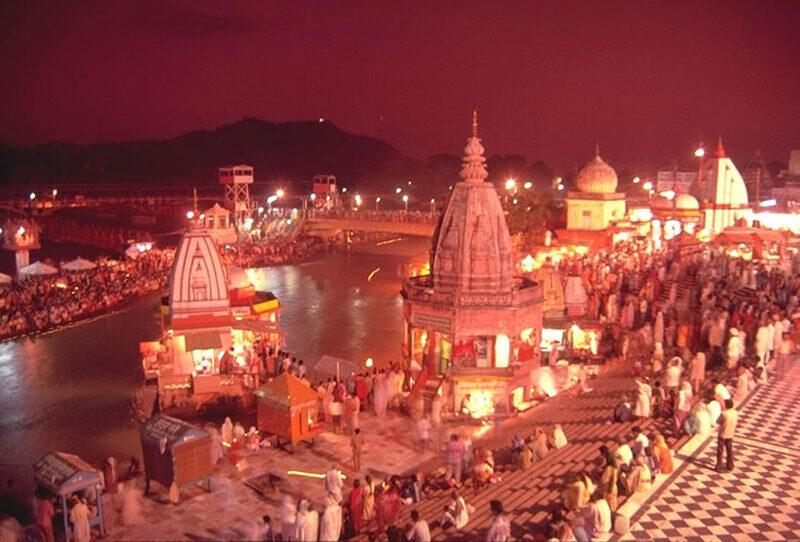
Haridwar's standing in Hindu tradition rests first on the Sapta Puri. The verse that names Ayodhya, Mathura, Maya, Kashi, Kanchi, Avantika and Dvaravati calls these seven cities moksha-dayikah, givers of liberation. Haridwar enters that list under its older name, Maya, and the whole devotional life of the city grows from this claim: that dying, bathing, offering and remembering here are not ordinary acts.
Its second claim is that of Gangadvara. Ganga is worshipped along her whole course, but Haridwar holds the threshold — the last of the mountains and the first of the plains. Devotees hold that the Ganga is at her most receptive here, still carrying the cold and clarity of the hills. This is why the water taken at Haridwar is what Kanwar pilgrims carry hundreds of miles home for the jalabhishek of their own Shiva shrines, and why families across northern India bring the ashes of their dead here rather than to a river nearer home.
The Panch Tirth
Local tradition does not treat Haridwar as one tirtha but as five. The Mahabharata, in the Anusasana Parva, says of these very places that one who bathes at Gangadwara, Kushavarta, Bilvaka, the Nila mountain and Kankhala is cleansed of sin and ascends to heaven; the Narada Purana carries the same list. The five are Gangadwara (Har Ki Pauri), Kushavart Ghat, Kankhal, Bilwa Tirtha (Mansa Devi) and Neel Parvat (Chandi Devi). To make the Panch Tirth is to understand the city as a single sacred body: the river at its centre, the two goddesses on the hills that flank it, and Kankhal at its southern foot where the memory of Sati rests.
Kankhal's own sanctity is old and independently attested. The Mahabharata knows it as Kanakhala and counts it among the tirthas where bathing cleanses; Kalidasa names it in the Meghaduta. For many families the deepest purpose of coming to Haridwar is fulfilled here and at the ghats — asthi visarjan, pind daan, shraddha and tarpan for those who have gone before. These rites are performed at Har Ki Pauri and at the Kankhal ghats, and it is here that the vahi registers of the teerth purohits are opened, read out, and added to. In devotional understanding, the family that returns to Haridwar for its dead is not visiting a place; it is keeping a thread unbroken.
Haridwar's third role is as a threshold in a different sense. It is the gateway to the Char Dham of Uttarakhand — Yamunotri, Gangotri, Kedarnath and Badrinath — and countless pilgrims begin the Himalayan yatra by first bathing at Har Ki Pauri and taking the Ganga's blessing for the road ahead.
History
Haridwar's continuity as a tirtha is long and unbroken. The Mahabharata already knows Kankhala as a place of bathing and merit, and the city's older names — Gangadvara, Mayapuri, Kapilasthana — carry associations that pre-date any surviving building. Tradition attributes the founding of the ghat at Har Ki Pauri to King Vikramaditya in the first century BCE, raised in memory of his brother Bhartrihari.
The Chinese pilgrim Xuanzang, travelling in 629 CE, recorded the city as Mo-yu-lo, an early outside confirmation of its standing. Guru Nanak visited Haridwar on Baisakhi in 1504 CE and bathed at Kushavart Ghat — the day was already one of the great bathing days here, and remains so. Of the older shrines that still stand, the Maya Devi temple dates to the eleventh century and is among the small number of genuinely ancient temples in the city to survive intact.
Much of what a pilgrim sees today was built or rebuilt in the modern centuries by patrons of one kind or another. The Daksheswara Mahadev temple at Kankhal, on the site of the Daksha yagna, was built in its present form by Queen Dhankaur in 1810 and rebuilt in 1962. The Chandi Devi temple on Neel Parvat was constructed in 1929 by Suchat Singh, the king of Kashmir, though tradition holds that Adi Shankaracharya installed the principal image there in the eighth century. Kankhal's ashram life also took modern shape in this period, with the Ramakrishna Mission Sevashrama established in 1901 and the Ma Anandamayi Ashram following later.
The nineteenth century changed the river itself at Haridwar. Work on the Upper Ganges Canal began in April 1842 and the canal opened in 1854, and the railway reached Haridwar in 1886, which brought pilgrims in numbers the old ghats had never carried. The evening aarti as it is known today belongs to this modern chapter too: it was begun by Pandit Madan Mohan Malaviya in 1916, and has been organised ever since by Shri Ganga Sabha, whose priests conduct it.
Through all of this the Kumbh has kept its own reckoning, held here when Jupiter stands in Aquarius and the Sun enters Aries. Haridwar's recent Kumbh years are 1998, 2010 and 2021 — the last held after eleven rather than twelve years, on the astrologers' reading of that year's calculation. The most recent Ardh Kumbh at Haridwar was in 2016.
Architecture
Haridwar is not a city of one great temple, and its sacred architecture should be read as a set of relationships rather than as a single monument. The organising form is the ghat: long flights of stone steps descending to the water, walls and platforms built up over centuries of patronage, and the river channelled close and shallow enough for ordinary people, elderly and children among them, to stand safely in it.
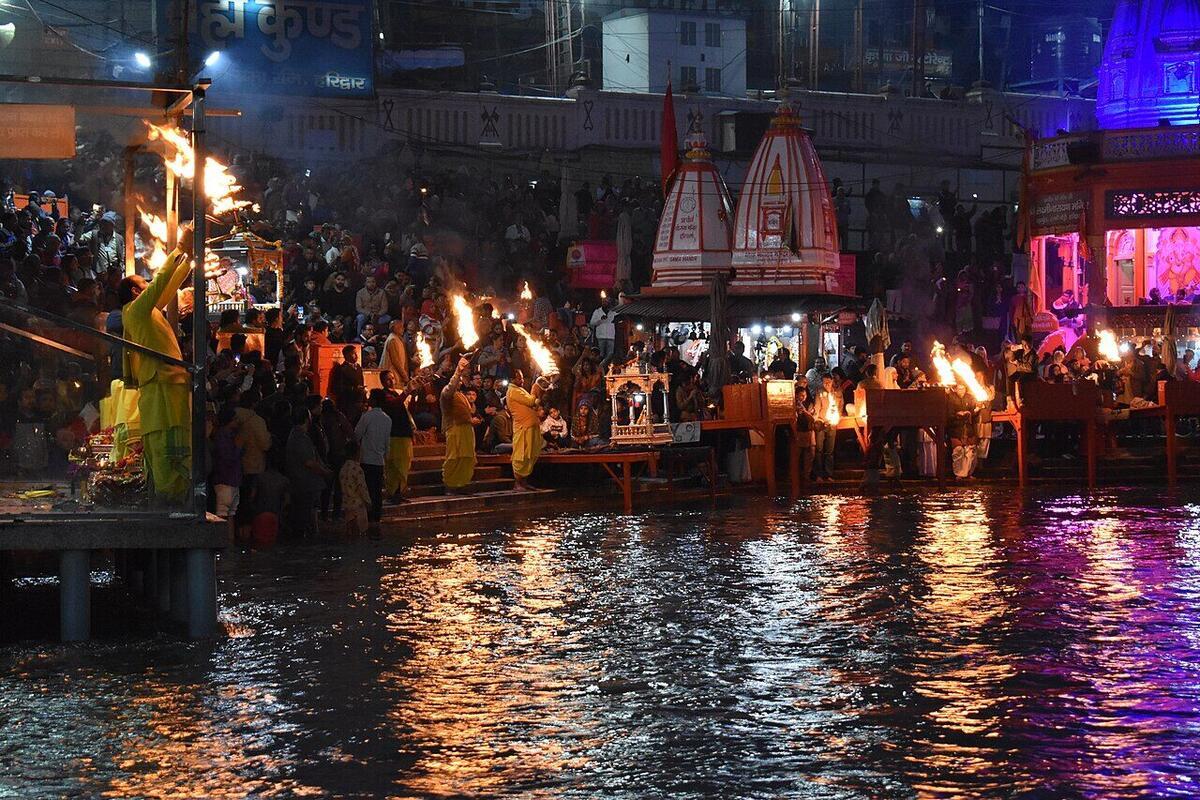
At Har Ki Pauri the most venerated element is not a structure at all but a stone — the slab bearing what devotees revere as Vishnu's footprint, set into the upper wall where the water reaches it. Around it Brahma Kund holds the crowd, with the ghats stepping up on both banks so that the evening aarti can be seen from across the water as well as from beside it. The river frontage as it now stands took its modern shape alongside the great nineteenth-century river works at Haridwar, when construction on the Upper Ganges Canal ran from April 1842 to its opening in 1854.
The two hill shrines are built to a different logic — small sanctums on high ground, reached by climbing. Mansa Devi stands on Bilwa Parvat, the ropeway to it running about 540 metres in length and rising some 178 metres. Chandi Devi stands on the eastern summit of Neel Parvat in the Shivalik range; its present structure dates to 1929, and its ropeway runs about 740 metres and rises about 208 metres, with a walking path of roughly three kilometres from Chandighat for those who prefer to climb. Neither shrine is large. Their power in the devotional imagination comes from height and from effort — the pilgrim looks down on the Ganga and on the whole city from the courtyard of the Goddess.
At Kankhal the Daksheswara Mahadev temple keeps a plainer North Indian form, rebuilt in 1962 on the structure Queen Dhankaur raised in 1810, and its sanctity is anchored less in its stone than in the Sati Kund beside it. The Maya Devi temple, dating to the eleventh century, preserves in its image the three-headed, four-armed form of the goddess after whom the city was once named — the oldest architectural memory Haridwar still holds.
Rituals & Practices
The first rite of Haridwar is snan. Devotees bathe at Brahma Kund within Har Ki Pauri, often before sunrise, taking sankalp and offering water to the sun and to the ancestors. Many carry away Ganga-jal in a sealed vessel for use at home through the year. The bathing is the reason most pilgrims come, and everything else in the day arranges itself around it.
The Ganga Aarti is performed at Har Ki Pauri twice each day by priests of Shri Ganga Sabha — Mangala Aarti at sunrise and Shringar Aarti at sunset. Because both are tied to the sun rather than to the clock, the time shifts through the year, and the evening aarti falls markedly earlier in winter than in summer; the Government of India's Utsav portal lists the evening aarti in the range of about 6:00 to 7:00 PM. Pilgrims should confirm the day's time locally rather than rely on a fixed hour. The aarti is free and open to all and is held every day of the year. Bells are rung, conches sounded, hymns recited, and great tiered lamps are raised over the water; devotees float small diyas of leaf and flower, and the current carries them downstream.
Rites for the departed are among the most important reasons families come. Asthi visarjan, pind daan, shraddha and tarpan are performed at Har Ki Pauri and at the Kankhal ghats, in the vicinity of the Sati Kund and the Daksheswara Mahadev temple, and at Kushavart. These are conducted through a family's teerth purohit, who will also open the family vahi — the handwritten register kept by gotra and ancestral village — read out the earlier entries, and add the present visit to them. Mundan and other family sanskars are also performed at the ghats.
At the hill shrines the practice is simpler and very old. At Mansa Devi devotees tie a thread on the sacred tree while making their prayer and return to untie it when the prayer is answered; coconut, fruit, garlands and incense are the customary offerings there. At Chandi Devi and Maya Devi, worship follows the ordinary Shakta pattern, intensifying greatly through Navratri.
Through the month of Shravan, the city's rhythm changes entirely for the Kanwar Yatra. Pilgrims come on foot to fill their kanwars with Ganga-jal at Haridwar and carry it home, sometimes hundreds of miles, for the jalabhishek of their local Shiva temple on Shravan Shivratri.
Aarti times, ropeway hours and temple schedules all change with the season and with the mela calendar. Verify current timings locally before planning a day around them.
Festivals & Celebrations
| Festival | When | Crowd |
|---|---|---|
| Kumbh Mela and Ardh Kumbh | — | Extremely high â the largest gathering the city sees; plan far in advance or avoid |
| Kanwar Yatra | — | Extremely high â around thirty million devotees were estimated across the 2023 and 2024 yatras; highway traffic is diverted |
| Baisakhi and Mesha Sankranti | — | Very high |
| Navratri | — | Very high at the hill shrines; long ropeway queues |
| Maha Shivaratri | — | High â concentrated at Kankhal |
Kumbh Mela and Ardh Kumbh: Tradition holds that drops of amrit fell at Brahma Kund when the pot of nectar was carried away after the churning of the ocean. The Kumbh is understood as the return of that moment in the turning of the planets, and bathing at the appointed hour is held to carry merit beyond that of ordinary snan.
Kanwar Yatra: The water lifted at Haridwar is offered as jalabhishek at the pilgrim's own Shiva shrine at home â a rite of thanksgiving in which the Ganga of Gangadvara is carried to a Shiva who could not be reached otherwise.
Baisakhi and Mesha Sankranti: Mesha Sankranti is the same solar entry that governs the reckoning of the Haridwar Kumbh, which gives the day a particular weight at Brahma Kund.
Navratri: Devotees hold that what is asked at a Siddh Peeth is fulfilled. Many come during Navratri to tie the thread at Mansa Devi, and many return in a later Navratri to untie it.
Maha Shivaratri: The shrine holds a story that begins in Daksha's refusal to honour Shiva and in Sati's self-offering, and ends with Shiva's own name joined to Daksha's â which is why Kankhal is approached on this night as a place of reconciliation as much as of power.
Prepare for Your Visit
Practical guidance to help you plan your pilgrimage
| Pilgrim Guidance | Har Ki Pauri and the daily aartiPlan the bathing for early morning, when the ghats are quieter, and keep the evening for the aarti. Because the Shringar Aarti is set by sunset and not by the clock, it comes considerably earlier in the winter months than in summer; ask at your dharamshala or hotel for that day's time. Reach the ghat well before it begins — the steps around Brahma Kund fill first, and once the aarti starts, movement is difficult and inconsiderate. Views from the opposite bank and from the upper steps are often calmer and just as complete. The aarti is free; nothing needs to be bought to attend it. If you are coming for rites for the departed, arrange your teerth purohit beforehand rather than at the ghat. Ask for the family's vahi by gotra and by ancestral village — that is how the registers are ordered, and it is often how a family finds records of visits made generations earlier. The hill shrines and the Panch TirthMansa Devi on Bilwa Parvat and Chandi Devi on Neel Parvat sit on opposite heights above the city, and most pilgrims do both in one day. Each can be reached by ropeway or on foot; the ropeway to Mansa Devi runs about 540 metres, the one to Chandi Devi about 740 metres, and the walking path to Chandi Devi from Chandighat is roughly three kilometres. Fares and operating hours change and are set by the operator, so check them on the day, and expect long queues at the ticket counters through Navratri, weekends and mela periods. Those wishing to complete the traditional Panch Tirth should keep time for Kushavart Ghat and for Kankhal, at the southern edge of the city, where the Daksheswara Mahadev temple, the Sati Kund and a number of long-established ashrams stand together. Kankhal is quieter than Har Ki Pauri and rewards an unhurried visit. Season, crowds and onward yatraHaridwar lies at about 314 metres, so it does not carry the altitude concerns of the higher shrines, but the Ganga here comes straight off the mountains and is cold at every season — enter slowly. October to March is generally the most comfortable stretch for walking and climbing. Two periods transform the city. Through Shravan (roughly July to August) the Kanwar Yatra brings enormous numbers on foot — around thirty million devotees were estimated across the 2023 and 2024 yatras — and highway traffic is diverted for it. The Kumbh and Ardh Kumbh bring the largest gatherings of all. Haridwar's Kumbh years in recent memory are 1998, 2010 and 2021, and the most recent Ardh Kumbh was 2016; the next Ardh Kumbh is expected at Haridwar in 2027, for which the Akhil Bharatiya Akhara Parishad has announced shahi snan dates of 6 March, 8 March and 14 April 2027. Confirm the official mela calendar nearer the date. If you want a quiet darshan, avoid these seasons; if you want to see Haridwar at its fullest, they are the reason to come. Most pilgrims treat Haridwar as the first step rather than the whole journey, since it is the gateway to the Char Dham of Uttarakhand. If the Himalayan yatra is your intention, allow a full day here first — bathe, take darshan, and let the body settle before the roads climb. For journeys arranged through Satmarg, nothing is quoted over a phone call. You receive a fixed written quote on WhatsApp, with the itinerary and inclusions set out plainly, before anything is booked. |
Location
Haridwar, UK
Pilgrim photos
No pilgrim photos yet.
Community corrections
No corrections yet.
Edit history
No revisions yet.
Plan Your Visit to Haridwar
Get a custom itinerary and pricing for your trip.
Recommended
Packages for this destination
Pilgrim Notes
On-ground observations from fellow pilgrims
No pilgrim notes yet. Be the first to share on-ground observations!
Sign in to share a note.
Pilgrim Reviews
15 reviews
Be the first to share your experience at Haridwar.
Sign in to write a review.
Nearby sacred places
Discover other sacred places near Haridwar
Explore temples, tirthas, and pilgrimage sites in UK
Explore nearbyPart of these circuits
Walk the traditional pilgrimage routes this destination belongs to.