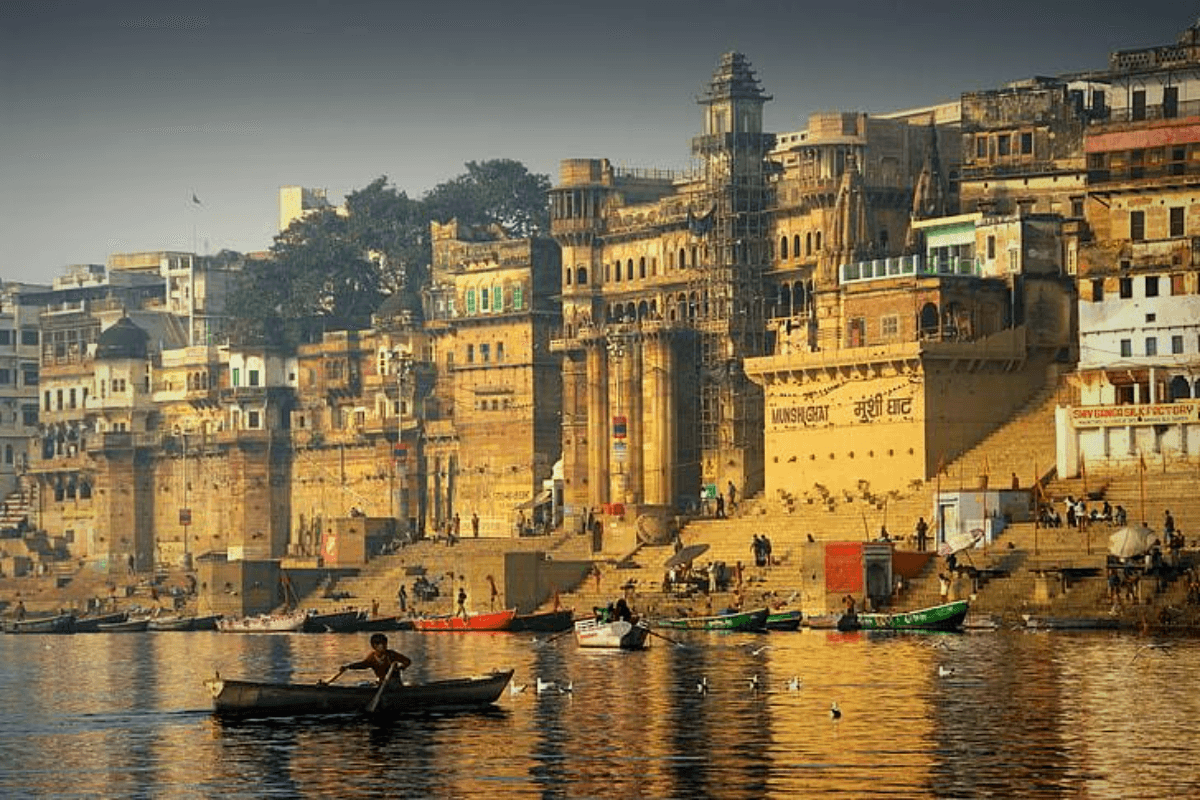
Jain Ghat lies in the southern reach of the Kashi riverfront, a short walk downstream from Assi, with Vaccharaja Ghat — commonly called Bachraj Ghat — immediately above it and Nishadraj Ghat below. It is counted ninth in the traditional sequence of the city's eighty-four ghats. Its recorded area is only about 0.26 hectares; what distinguishes it is not size but whose tirtha it is. This is the Jain ghat of Banaras, and the temples above its steps belong to the Jain tradition.
The name is a devotional one. Jain tradition holds that Suparshvanath, the seventh Tirthankara, was born in this quarter of Banaras, to King Pratishtha and Queen Prithvi; the neighbouring locality of Bhadaini carries the same memory and a shrine commemorating his birth. In commemoration here, a temple of Suparshvanath was raised on the upper part of the ghat in 1885. Sources differ on its sect: the heritage dossier calls it a Svetambara shrine, while the state's own listing describes the Suparshvanath temple at Jain Ghat as Digambara and places the Svetambara one next door at Vaccharaja Ghat. Both sects have shrines to Suparshvanath in this Bhadaini–Jain Ghat quarter. Three Jain temple properties are recorded along this stretch, each maintained by its own trust, and local account holds that Jain merchant families and princes long held these ghats.
Kashi's place in Jain devotion is older than the ghat itself. Jain tradition names Banaras as the birthplace of Parshvanath, the twenty-third Tirthankara, son of King Ashwasena and Queen Vamadevi, whose kalyanakas are commemorated at the temples of Bhelupur; and it names Chandrapuri — Chandrawati, some twenty-three kilometres downstream from the city, near where the Gomti joins the Ganga — as the birthplace of Chandraprabha, the eighth Tirthankara. For a Jain pilgrim, Banaras is therefore not a city passed through but a cluster of janma-bhumis.
The ghat itself is unhurried, and a visitor should not expect the riverside ceremony of Dashashwamedh here. Jain observance here rests on the temple above the steps rather than on the river — approached in silence, with darshan of the Tirthankara image and the recitation of the Namokar Mantra — though the state's record notes that Jain devotees also bathe at the southern end of the ghat. The steps below belong to the neighbourhood — much of it a boatmen's quarter, with Nishadraj Ghat and its large mallah community immediately downstream — for their own daily snan and work. Two traditions share a few metres of stone here and have done so for well over a century.
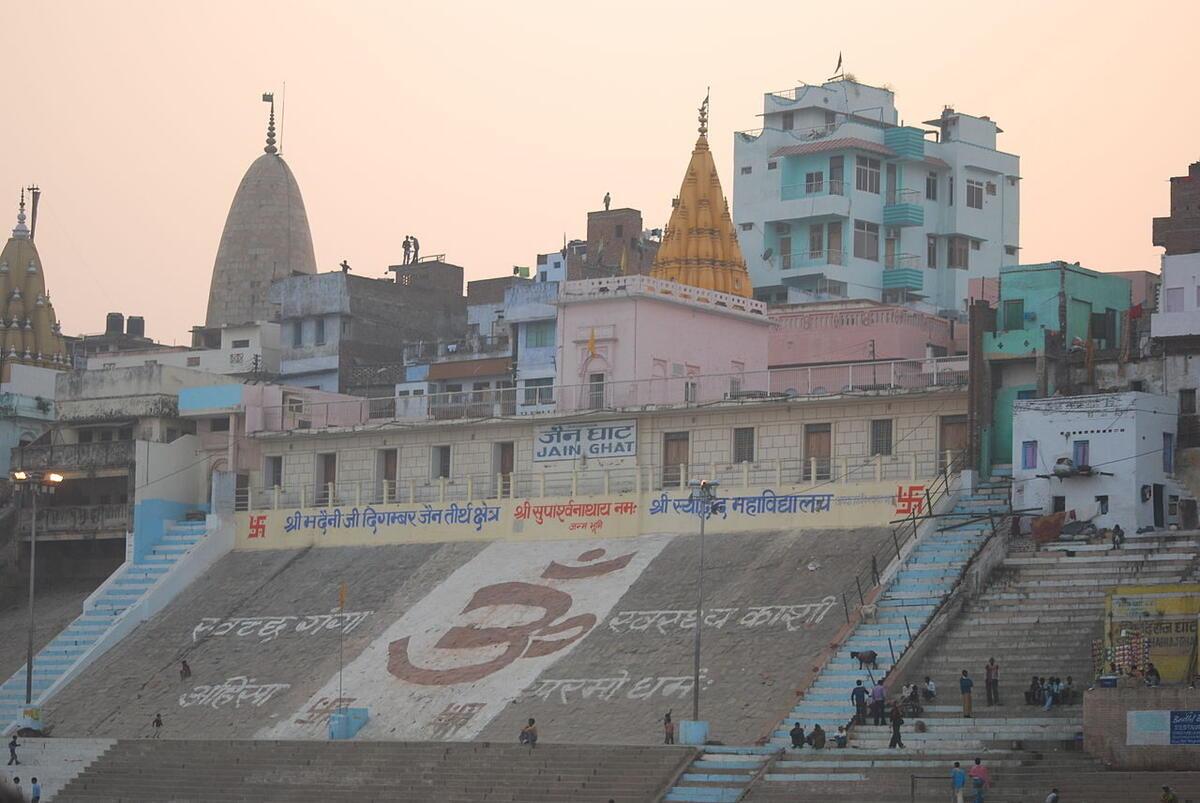
In Jain understanding a Tirthankara is a ford-maker — one who has crossed the stream of worldly existence and left a crossing behind for others. A tirtha, in that light, is not first of all a place where water is sacred, but a place made sacred by such a life having touched it. Jain Ghat is a tirtha in exactly this sense: its sanctity rests on the tradition that Suparshvanath took birth in this neighbourhood, and not on the river at its foot.
Jain tradition marks the great moments of a Tirthankara's life as kalyanakas — conception, birth, renunciation, the attainment of omniscience, and final liberation — and honours the places where they occurred. Banaras holds such memory more than once. Suparshvanath, whose lanchhana or emblem is the swastika, is remembered here and at Bhadaini. Parshvanath, whose images carry a serpent hood of seven heads or more above the head — Suparshvanath's hood, where it appears, has five — is remembered at Bhelupur, where the temples were built to mark three of his kalyanakas. Chandraprabha, whose emblem is the crescent moon, is remembered at Chandrapuri near the city. Historians differ over how much of this can be established from evidence; Jain devotional memory holds it regardless, and that holding is itself a form of continuity.
What a devotee does here is inward. Darshan is taken before the image; the Namokar Mantra is recited, which salutes not a person but the qualities of the awakened — the arihants, the siddhas, the acharyas, the teachers and all sadhus; and a period of quiet reflection follows. The offerings are simple and free of injury: flowers, rice, sandal, a lamp. Ahimsa is not an added rule at a Jain shrine but the ground on which everything else stands, and a visitor who understands that will understand the temperature of the place.
A shared riverbank
Kashi has long held more than one tradition within a few steps of itself, and this stretch shows it plainly. Immediately upstream at Vaccharaja Ghat stand temples of Shiva and Ganesha on the platforms, a shrine of the goddess Ganga added in 1931, and the Gopal Mandir and Akrureshvara Shiva temple above. Immediately downstream, Nishadraj Ghat honours Nishadraj, the boatman-king of the Ramayana who ferried Rama across the Ganga. Between them, the Jain tirtha keeps its own silence without contradiction. Pilgrims of every tradition should treat that arrangement as something to be protected.
History
Jain Ghat is young as a named ghat and old as a Jain place. Until 1931 this ground was part of Vaccharaja Ghat, which a wealthy Banarasi merchant is recorded as having built in 1790 and whose name preserves his memory. In 1931 Babu Shekhar Chanda built this section separately and, with the support of Jain monks, gave it the name Jain Ghat. The same patron is recorded as having repaired the neighbouring Vaccharaja Ghat in that year and raised a shrine of the goddess Ganga there.
The Jain temple on the upper part of the ghat is older than the separation. The temple of Suparshvanath was built in 1885, in commemoration of the Tirthankara's birth in the neighbourhood; the records differ on whether it is this stretch's Svetambara or Digambara shrine. The Jain presence in this quarter is older still, and the shrines here are held today by their respective trusts.
The ghat was renovated and reconstructed in 1988 by the irrigation department of the Government of Uttar Pradesh, which gave it the stone form pilgrims use today. Its immediate neighbours were built up in the same modern century: the present structure of Vaccharaja Ghat was made by the state government in 1965, and Nishadraj Ghat was made pucca in 1946 with the support of the boatmen's organisation.
The temple properties along the ghat are held and maintained by their respective trusts, while the ghat surface is the responsibility of the Municipal Corporation. Heritage documentation of the riverfront notes that conservation here has depended largely on each trust's own initiative rather than any coordinated plan, and records unauthorised construction on the ghat frontage as a continuing concern — one reason pilgrims and residents alike are asked to treat the built edge of the river with care.
Architecture
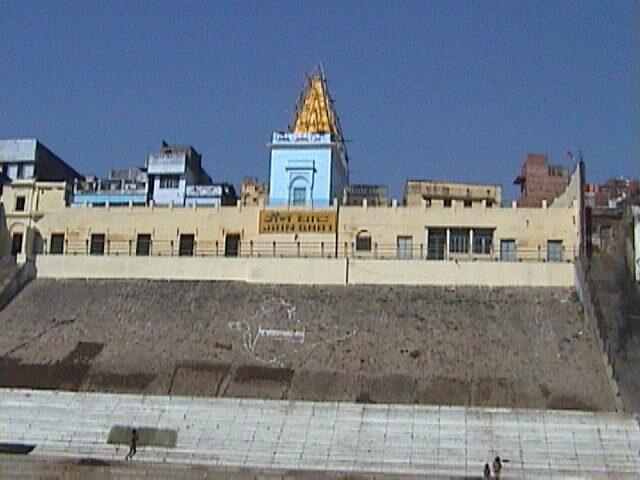
The ghat itself is compact and unadorned: stone steps in the standard Banarasi form, rebuilt in 1988, descending from the lane to the water across a frontage of some 0.26 hectares. Its architecture of consequence is above the water, not on it. The Jain temple stands on the upper part of the ghat and is entered from the lane; the gate to the temple compound is near the turning towards Assi.
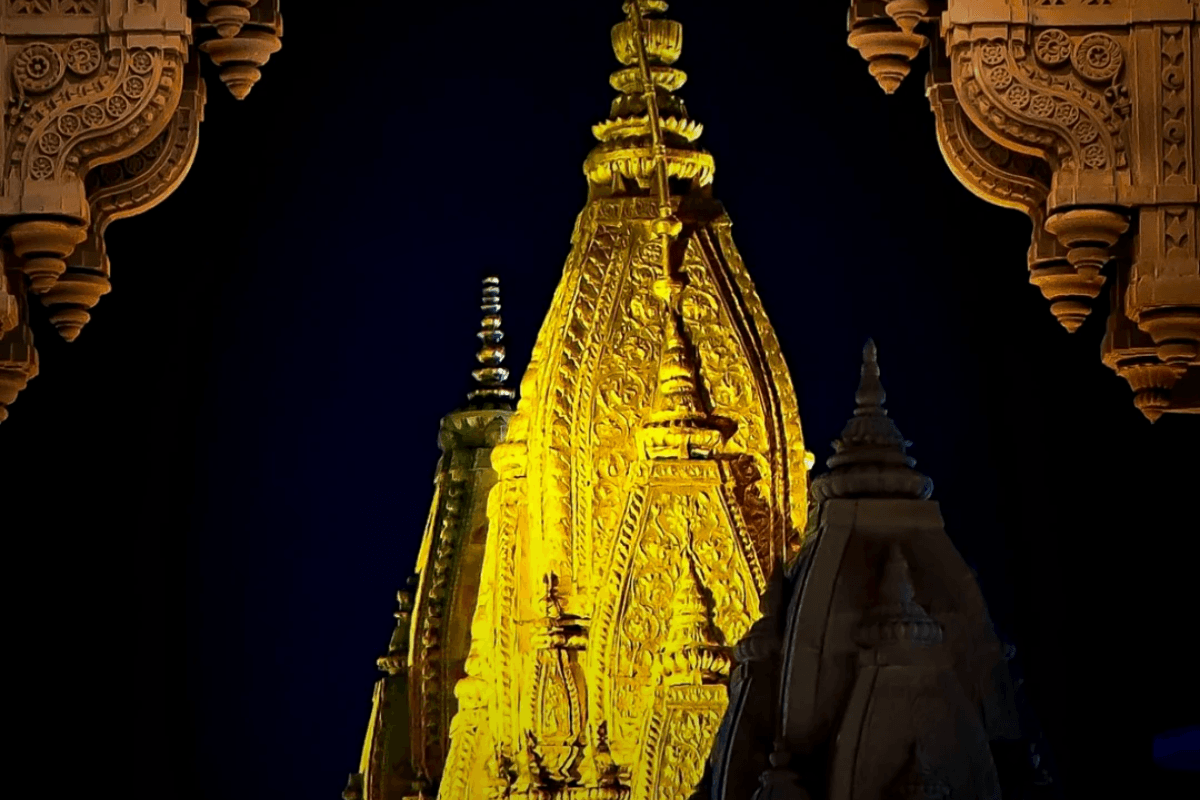
Jain temple architecture in northern India, at whatever scale, is organised around the image of the Tirthankara in the garbha-griha — seated in padmasana or standing in the kayotsarga posture — approached through a hall for devotees. The image is identified by its lanchhana, the emblem set below it; for Suparshvanath this is the swastika, an ancient auspicious mark in Jain and wider Indic use. Ornament in Jain shrines tends toward fine, restrained detail and an ordered symmetry: marble, careful carving, and a stillness the building is designed to hold rather than to interrupt.
Immediately upstream on Vaccharaja Ghat, layers of platforms between the bank and the upper level carry temples of Shiva and Ganesha, with the Gopal Mandir — built in 1968 — and the Akrureshvara Shiva temple on the higher ground. Seen from a boat, the two ghats read as one continuous stone edge, and only the gateways above tell a visitor which tradition's ground is which.
Rituals & Practices
Jain practice at this ghat is devotional rather than ceremonial in the riverside sense. Devotees climb to the temple for darshan of the Tirthankara, perform puja according to sect and family custom, recite the Namokar Mantra, and sit for a period of quiet reflection or samayik. The offerings are simple and non-violent — flowers, rice, sandal, a lamp. A Jain pilgrim's visit is complete at the temple; the state's record notes that devotees also bathe at the southern end of the ghat, but the observance rests above the steps.
The temple's rhythm follows the observances of its trust rather than any public schedule. The days of particular observance in the Jain year, kept at the community's temples across the city, are Mahavir Jayanti in Chaitra; the days of Paryushan, kept over eight days in the Svetambara tradition and as Das Lakshana over ten days in the Digambara tradition; and Diwali, observed by Jains as the night of Bhagavan Mahavir's nirvana. Whether this particular shrine keeps a special programme on any of them is for its trust to say. On ordinary days it is quiet, and that quiet is the point.
On the steps below, the neighbourhood keeps its own separate rhythm — morning snan, washing, and the working life of a boatmen's quarter. The two do not interfere with each other.
Opening hours are set by the temple trust and are not published. Pilgrims travelling specifically for darshan should verify timings locally, and should approach the trust in advance if they wish to perform a particular puja.
Festivals & Celebrations
| Festival | When | Crowd |
|---|---|---|
| Mahavir Jayanti | — | High among the Jain community of Banaras; otherwise quiet |
| Paryushan Parva / Das Lakshana | — | Moderate to high among Jain devotees |
| Diwali â Mahavir Nirvana | — | High among the Jain community |
| Suparshvanath Janma Kalyanak | — | Low to moderate; a community observance rather than a public one |
| Daily darshan | — | Low |
Mahavir Jayanti: Mahavir's teaching of ahimsa, satya, asteya, brahmacharya and aparigraha is the foundation of Jain practice, and his birth is honoured as the beginning of that transmission in the present age.
Paryushan Parva / Das Lakshana: Jain tradition holds these days as the annual occasion for cleansing the soul of accumulated karma through austerity, reflection and reconciliation.
Diwali â Mahavir Nirvana: The lamp on this night is understood as standing for the light of knowledge left behind when the Tirthankara's own light departed the world.
Suparshvanath Janma Kalyanak: The janma kalyanak honours one of the five great moments of a Tirthankara's life, and this ghat carries the name of Suparshvanath precisely because tradition places that birth in this neighbourhood.
Daily darshan: The unbroken daily practice by which a small shrine on the Ganga has remained a living Jain tirtha for well over a century.
Prepare for Your Visit
Practical guidance to help you plan your pilgrimage
| Pilgrim Guidance | How to reachThe ghat is in the Bhadaini–Shivala quarter, a short distance downstream from Assi Ghat. On foot, walk the riverfront north from Assi past Ganga Mahal, Rewan, Tulsi, Bhadaini, Janaki and Anandamayi ghats; Vaccharaja (Bachraj) Ghat comes next, and Jain Ghat immediately after it — twenty minutes at an easy pace. From the road side, the entrance gate to the temple compound is near the turning towards Assi. Auto and rickshaw drivers know this stretch as Bachraj Ghat more reliably than as Jain Ghat, so use both names. Preparation for pilgrims
Best time to visitOctober to March is the most comfortable season in Banaras, and mornings are the calmest hours at this ghat. Mahavir Jayanti in Chaitra and the days of Paryushan in Bhadrapada bring the city's Jain community here; choose those days if you wish for company in observance, and avoid them if you wish for solitude. During the monsoon the lower steps go under water and boats may not be able to land, though the temple above remains reachable by the lane. |
Location
Varanasi, UP
Pilgrim photos
No pilgrim photos yet.
Community corrections
No corrections yet.
Edit history
No revisions yet.
Plan Your Visit to Jain Ghat
Get a custom itinerary and pricing for your trip.
Recommended
Packages for this destination
Pilgrim Notes
On-ground observations from fellow pilgrims
No pilgrim notes yet. Be the first to share on-ground observations!
Sign in to share a note.
Pilgrim Reviews
Be the first to share your experience at Jain Ghat.
Sign in to write a review.
Nearby sacred places
Discover other sacred places near Jain Ghat
Explore temples, tirthas, and pilgrimage sites in UP
Explore nearbyPart of these circuits
Walk the traditional pilgrimage routes this destination belongs to.