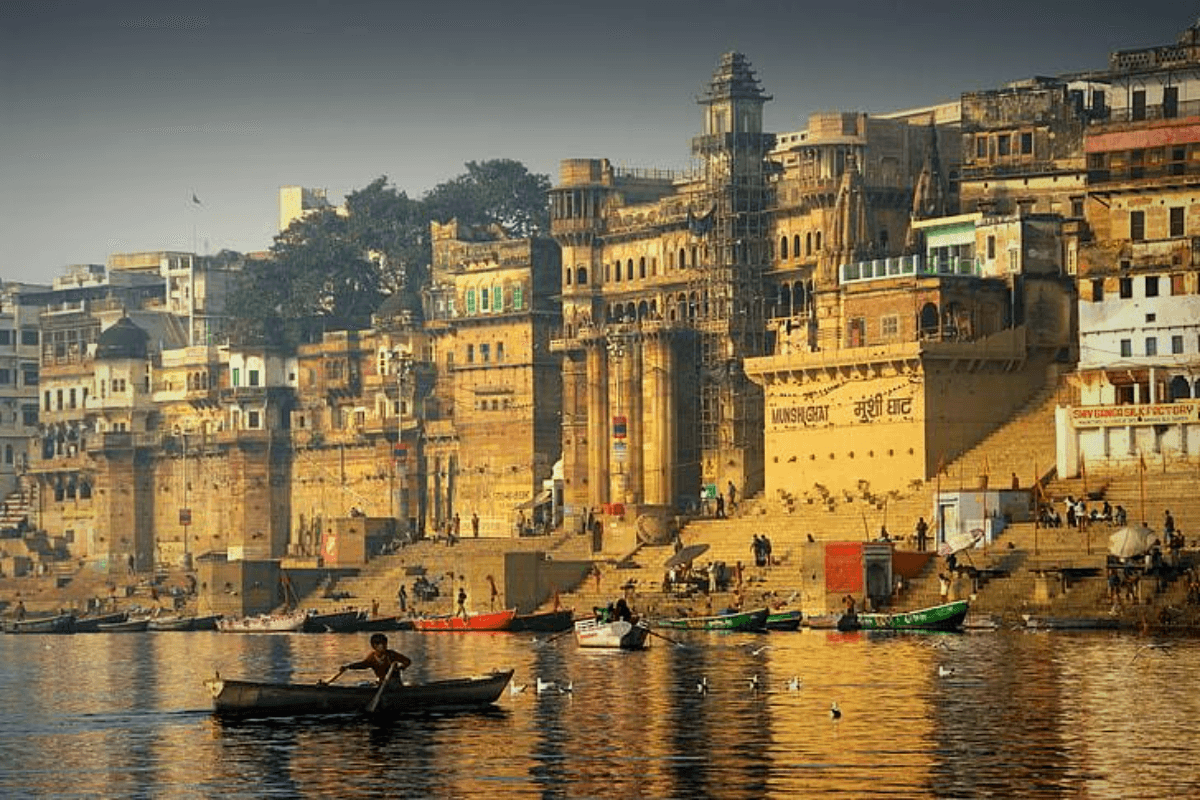
Jantar Mantar at Man Mandir Ghat is the eighteenth-century astronomical observatory built atop Man Mandir Ghat by Maharaja Sawai Jai Singh II of Jaipur (1688-1743), the polymath ruler whose passion for astronomy resulted in five great Jantar Mantars across India — at Delhi, Jaipur, Ujjain, Varanasi, and Mathura. The Banaras observatory, smaller than its Jaipur counterpart but exquisite in design, uses massive stone instruments to track the heavens, mark equinoxes, calculate solar declinations, and serve as a working scientific instrument of its era.
The observatory is a heritage site rather than a religious shrine, but its placement atop a sacred ghat — and its function of measuring the time-cycles that organise Hindu ritual — places it within the wider Kashi devotional geography in an unusual way. Pilgrims often visit it as part of the broader ghat circuit alongside the temples and ghats.
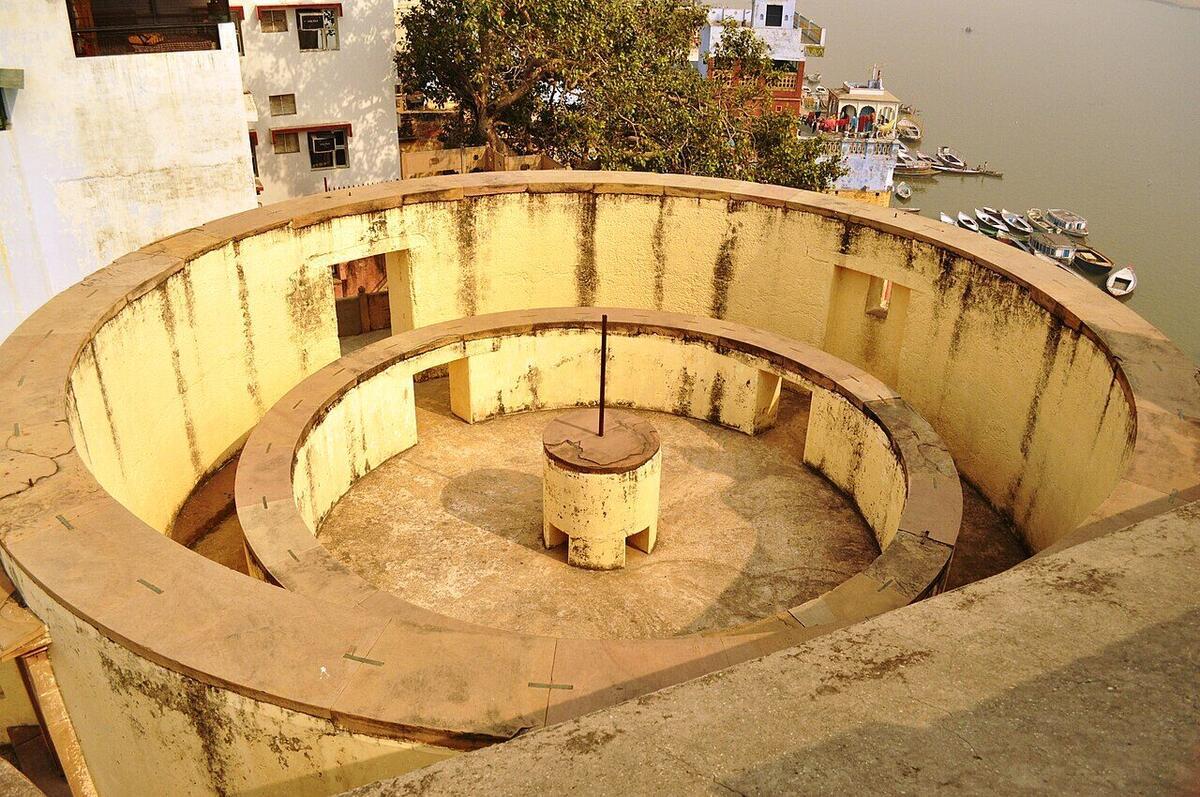
The Jantar Mantar is heritage and scientific rather than directly devotional. Its connection to Hindu life is in its function — the precise calendrical and astronomical calculations on which Hindu ritual timings (panchang, muhurta, festival dates) ultimately rest. Visiting the observatory is a meaningful way to engage with the technical-cultural foundation of Hindu time-keeping.
History
Built by Maharaja Sawai Jai Singh II in approximately 1737, the Banaras Jantar Mantar is among the smaller of the five but architecturally distinguished. The Maharaja built the observatories to update Hindu calendrical calculations using the most advanced astronomical methods of the era, drawing on Indian, Islamic, and European traditions. The Banaras observatory has been preserved as a heritage monument and is open to visitors.
Architecture
The observatory consists of large stone instruments — the Samrat Yantra (great equinoctial sundial), Dakshinottara Bhitti Yantra (north-south wall instrument), Chakra Yantra (zodiacal circle), and others. Each is sized for measurable astronomical observation rather than visual appeal, though their geometric precision is itself striking. The setting on the bluff above Man Mandir Ghat gives the instruments a commanding view of the river.
Rituals & Practices
As a heritage site, the practices here are observation and learning rather than ritual. Visitors walk among the instruments, observe the sun-shadow markings, and engage with the scientific-cultural heritage. Guides are available on site to explain the function of each instrument.
Festivals & Celebrations
| Festival | When | Crowd |
|---|---|---|
| Equinoxes (March 21 and September 23) | — | Moderate |
| Solstices (June 21 and December 21) | — | Moderate |
| Heritage observance days | — | Moderate |
| Kartik Purnima (Dev Deepawali) | — | Very high |
Equinoxes (March 21 and September 23): The astronomical occasions for which the instruments were built.
Solstices (June 21 and December 21): Solar declination at its extremes is observable.
Heritage observance days: Heritage-aware visiting.
Kartik Purnima (Dev Deepawali): Heritage and devotional convergence.
Prepare for Your Visit
Practical guidance to help you plan your pilgrimage
| Pilgrim Guidance | How to reachAt Man Mandir Ghat on the central Varanasi waterfront. Approach by boat or through the lanes. The site is administered as a heritage monument; entry is generally free or with a nominal fee. Preparation
Best timeLate morning when the sun is high gives the best view of the shadow-instruments in action. October to March is the most comfortable window. Avoid summer afternoons. |
Location
Varanasi, UP
Gallery
Pilgrim photos
No pilgrim photos yet.
Community corrections
No corrections yet.
Edit history
No revisions yet.
Plan Your Visit to Jantar Mantar Observatory at Man Mandir Ghat
Get a custom itinerary and pricing for your trip.
Recommended
Packages for this destination
Pilgrim Notes
On-ground observations from fellow pilgrims
No pilgrim notes yet. Be the first to share on-ground observations!
Sign in to share a note.
Pilgrim Reviews
Be the first to share your experience at Jantar Mantar Observatory at Man Mandir Ghat.
Sign in to write a review.
Nearby sacred places
Discover other sacred places near Jantar Mantar Observatory at Man Mandir Ghat
Explore temples, tirthas, and pilgrimage sites in UP
Explore nearbyPart of these circuits
Walk the traditional pilgrimage routes this destination belongs to.