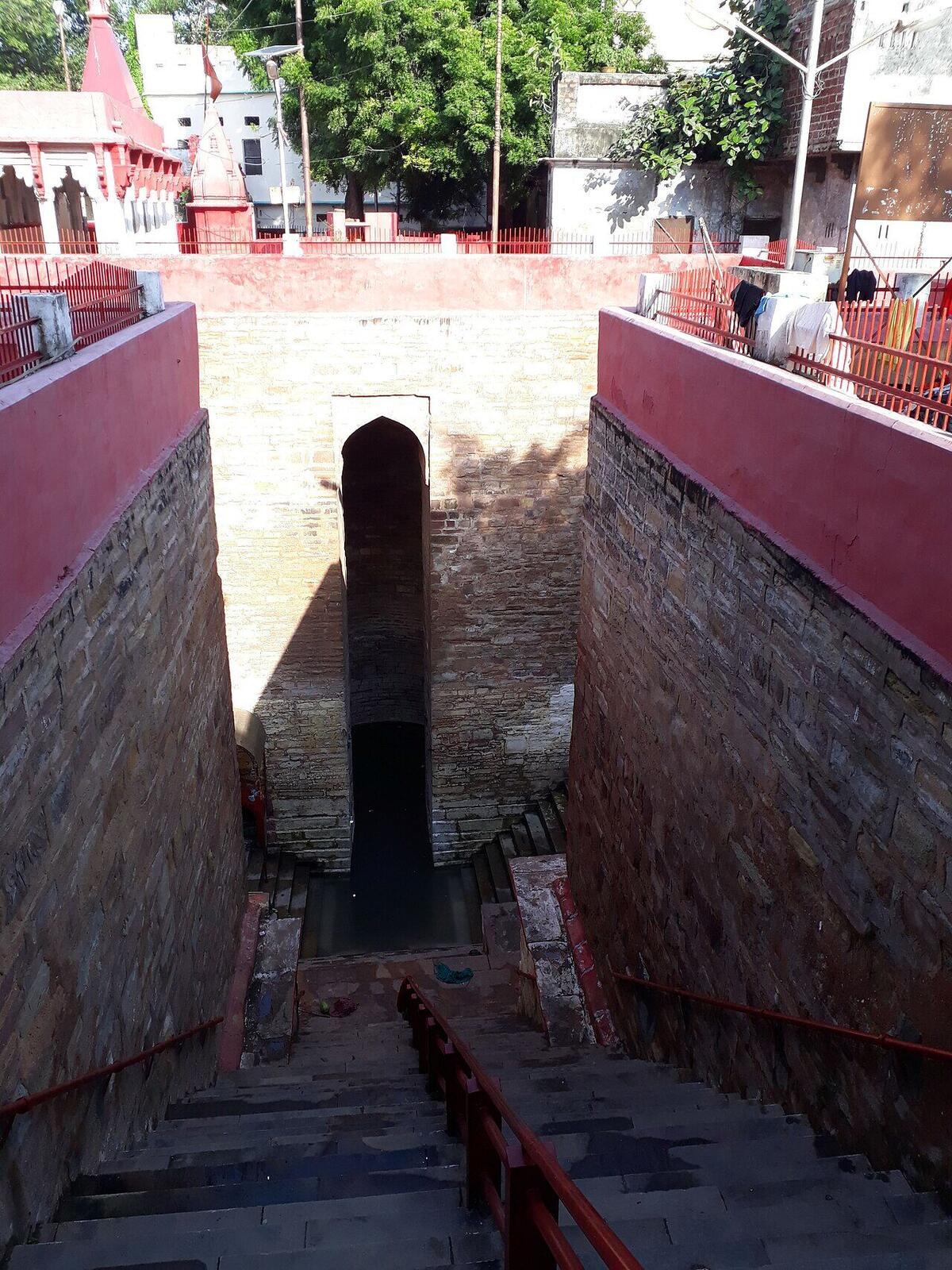
Lolark Kund is among the most ancient sacred sites of Kashi, a stepped sacred tank in the southern part of the city worshipped as a tirtha of Surya. Here the sun is honoured as Lolarka — the trembling or quivering sun, the dawn-rising Aditya at the edge of the horizon. Tradition counts Lolark among the dwadasha Adityas, the twelve solar shrines of Kashi, and devotees hold it to be the first and foremost among them.
The kund lies in southern Kashi, near Tulsi Ghat and the Bhadaini quarter; the adjoining ghat on the river bears the name Lolarka Ghat in the shrine's honour. A stepped tank descending in broad stone tiers to a central basin of water, with the shrine of Lolarkeshwar Mahadev beside it, Lolark is not an ordinary bathing tank but a sacred tirtha that has received devotees through many centuries of the city's life.
Though revered daily as a Surya tirtha, Lolark is most widely known for one living tradition above all: the Lolark Shashthi vrata, observed each year on the sixth tithi of the bright half of Bhadrapada (August-September). On that day tens of thousands of couples — above all those praying for a child, for a son, or for the wellbeing and long life of children already born — gather at the kund for a ritual bath and the prescribed offerings.
Katha and local belief
Tradition holds that a couple who bathe together in Lolark Kund on Shashthi, entering the water with a heartfelt sankalp and completing the prescribed worship at the Lolarkeshwar shrine, receive the blessing of santan-prapti — the gift of progeny — and the protection of the children granted to them. Banaras remembers across generations the families who trace a child back to this vrata, and the day carries the accumulated weight of countless such prayers offered.
A distinctive part of the vrata is the leaving-behind of offerings beside the kund. Parents traditionally leave clothes and vegetables, and many take a lasting vow to give up a favourite vegetable as a token of their sankalp, abstaining from it thereafter in gratitude for the blessing sought. Devotees hold that this small renunciation, carried quietly through life, keeps the prayer living long after the day of the bath.
Lolark Kund holds a twofold sacred identity in Kashi. It is, first, a tirtha of Surya — one of the dwadasha Adityas, the twelve solar shrines through which the Sun is venerated across the sacred geography of the city. In Vedic tradition Surya is honoured as the source of life, light, health, and generative power, and at Lolark he is worshipped in his dawn form, the rising Aditya whose first light is held to be especially auspicious.
Yet among all the city's shrines, Lolark is unusual in the sharpness of its devotional purpose. Most Kashi tirthas are approached for a wide range of sankalpas — moksha, darshan, healing, protection. Lolark has always been, first and foremost, the tirtha for the prayer for children and for their wellbeing.
In traditional understanding three sacred streams meet at the kund:
- Surya, the Aditya, source of life and generative power, invoked from Vedic times for healthy and long-lived offspring
- Lolarkeshwar — Shiva, worshipped here as the witness and guarantor of the couple's sankalp
- The sacred tank — the holy waters that the couple enter together, the prayer joined and shared between husband and wife
The vrata and its vow
The Shashthi vrata is undertaken with full traditional gravity. Couples arrive ahead of the day, observe fasting, perform preliminary worship, and complete the joint bath and sankalp on the Shashthi morning. Devotees hold that the vow taken at Lolark binds not for a day but for years: the favourite vegetable surrendered, the offerings of cloth and grain left behind, become a continuing thread of devotion connecting the family to the kund long after they return home.
Outside the Shashthi period the kund receives a quieter, steadier flow of devotees, while the Lolarkeshwar shrine draws ordinary Shaiva worshippers for Rudrabhishek and bilva-arpana, particularly on Mondays and through Sawan.
History
Lolark Kund is among the oldest documented sacred sites of Kashi. The Kashi Khanda of the Skanda Purana names it among the principal tirthas of the city and among the solar shrines of the Adityas, placing its veneration deep within the sacred memory of Banaras. The Shashthi tradition is preserved across many centuries in regional devotional records.
The present stepped tank and the adjoining shrines reflect rebuilding of the Maratha period in the eighteenth century. The form — a rectangular stepped kund descending in tiers to a central basin, ringed by small niche-shrines along its walls — is characteristic of the traditional Banarasi kund design once seen at many sites across the city. Lolark is among the best preserved of these.
Through the colonial and modern periods the Shashthi vrata has continued without interruption. Its preservation owes much to the families of Banarasi pandits who have guided couples through the observance across generations, maintaining the ritual sequences and the local understanding of the blessing sought at this particular kund.

Architecture
Lolark Kund is a stepped sacred tank — a rectangular basin set well below ground level, surrounded by broad stone steps that descend to the water in successive tiers. The design follows the traditional Banarasi kund pattern, structured for ritual bathing rather than swimming, each step wide enough for a devotee to stand at the depth that suits the worship.
The surrounding walls carry small niche-shrines — some dedicated to forms of Surya and the Adityas, some to attendant deities, some marking the tirtha itself. The Lolarkeshwar Mahadev shrine stands on one side of the kund; its compact sanctum holds the lingam that devotees approach after the bath.
The architecture is functional and unornamented. The kund does not seek visual grandeur; its purpose is devotional, and its design serves the Shashthi vrata for which it has long existed. During the annual observance the tank fills far beyond its everyday capacity with couples performing the ritual together; at quieter times the stepped logic of the tank stands clearly revealed, and the descent to the water keeps its ancient stillness.
Rituals & Practices
The Lolark Shashthi vrata, observed on the sixth tithi of Bhadrapada Shukla Paksha (August-September), is the principal practice at the kund. Its traditional sequence:
- The previous day — arrival in Kashi, preliminary offerings at the Lolarkeshwar shrine, and the observation of fasting
- Shashthi morning — the joint bath by husband and wife in the kund, undertaken with the sankalp for children and their wellbeing
- After the bath — darshan at the Lolarkeshwar shrine, abhishek of the lingam, and arpana of bilva, milk, and the traditional offerings
- Offerings left behind — clothes and vegetables are left beside the kund as part of the vrata; many couples also take a lasting vow to give up a favourite vegetable as a token of their prayer
- Return — the couple return home having observed the sankalp together, carrying the vow with them
Beyond the annual Shashthi observance, the practices at the kund and shrine include:
- Rudrabhishek at the Lolarkeshwar shrine, particularly on Mondays
- Surya-arpana at sunrise — the offering of water facing the rising sun, fitting for a tirtha of the Aditya
- Bilva and flower offerings at the shrine by passing pilgrims
The date of the annual observance shifts each year with the lunar calendar; pilgrims planning the Shashthi vrata should confirm the date well in advance, and verify ritual arrangements with local temple authorities and pandits.
Festivals & Celebrations
| Festival | When | Crowd |
|---|---|---|
| Lolark Shashthi | — | Extremely high |
| Ratha Saptami | — | Moderate to high |
| Sawan Mondays | — | Moderate to high |
| Mahashivratri | — | High |
Lolark Shashthi: Lolark Shashthi is among the most specific and moving traditions of North Indian pilgrimage, a vrata whose whole purpose is the family's prayer for children. Its unbroken observance across many centuries, and the Banaras families who trace a child to this kund across generations, give the day its particular weight.
Ratha Saptami: Ratha Saptami is the central festival of Surya worship in the Hindu calendar. The Vedic solar tradition of Lolark, as one of the dwadasha Adityas of Kashi, is most clearly seen on this day, distinct from the kund's more widely known Shashthi observance.
Sawan Mondays: The Shaiva dimension of Lolark, distinct from its solar and Shashthi character, is most active through Sawan, when the Lolarkeshwar shrine serves as one of the Shiva-tirthas of its neighbourhood in southern Kashi.
Mahashivratri: Mahashivratri at Lolark carries the weight the festival holds at any Kashi Shiva shrine; the tank's Shashthi character is distinct and is observed at its own appointed time.
Prepare for Your Visit
Practical guidance to help you plan your pilgrimage
| Pilgrim Guidance | How to reachLolark Kund lies in southern Kashi, near Tulsi Ghat and the Bhadaini quarter, a short distance from Assi Ghat. Auto-rickshaws can drop pilgrims near the Assi crossing, from where the kund is a short walk. Arriving by boat along the Ganga, the adjoining Lolarka Ghat lies downstream near Assi. Many pilgrims combine darshan at Lolark with Assi Ghat and nearby Tulsi Ghat in the same half-day. Preparation for Pilgrims
Best Time to VisitLolark Shashthi (Bhadrapada Shukla Shashthi, August-September) is the central annual observance and the essential time for couples undertaking the vrata. Outside Shashthi, the early morning hours are the most fitting, with the dawn worship and the first light upon the kund — appropriate for a tirtha of the rising Aditya. Mondays and the Sawan Somvars bring increased Shaiva worship at the Lolarkeshwar shrine. October to March is the most comfortable window for a general visit. |
Location
Varanasi, UP
Pilgrim photos
No pilgrim photos yet.
Community corrections
No corrections yet.
Edit history
No revisions yet.
Plan Your Visit to Lolark Kund
Get a custom itinerary and pricing for your trip.
Recommended
Packages for this destination


Pilgrim Notes
On-ground observations from fellow pilgrims
No pilgrim notes yet. Be the first to share on-ground observations!
Sign in to share a note.
Pilgrim Reviews
Be the first to share your experience at Lolark Kund.
Sign in to write a review.
Nearby sacred places
Discover other sacred places near Lolark Kund
Explore temples, tirthas, and pilgrimage sites in UP
Explore nearbyPart of these circuits
Walk the traditional pilgrimage routes this destination belongs to.