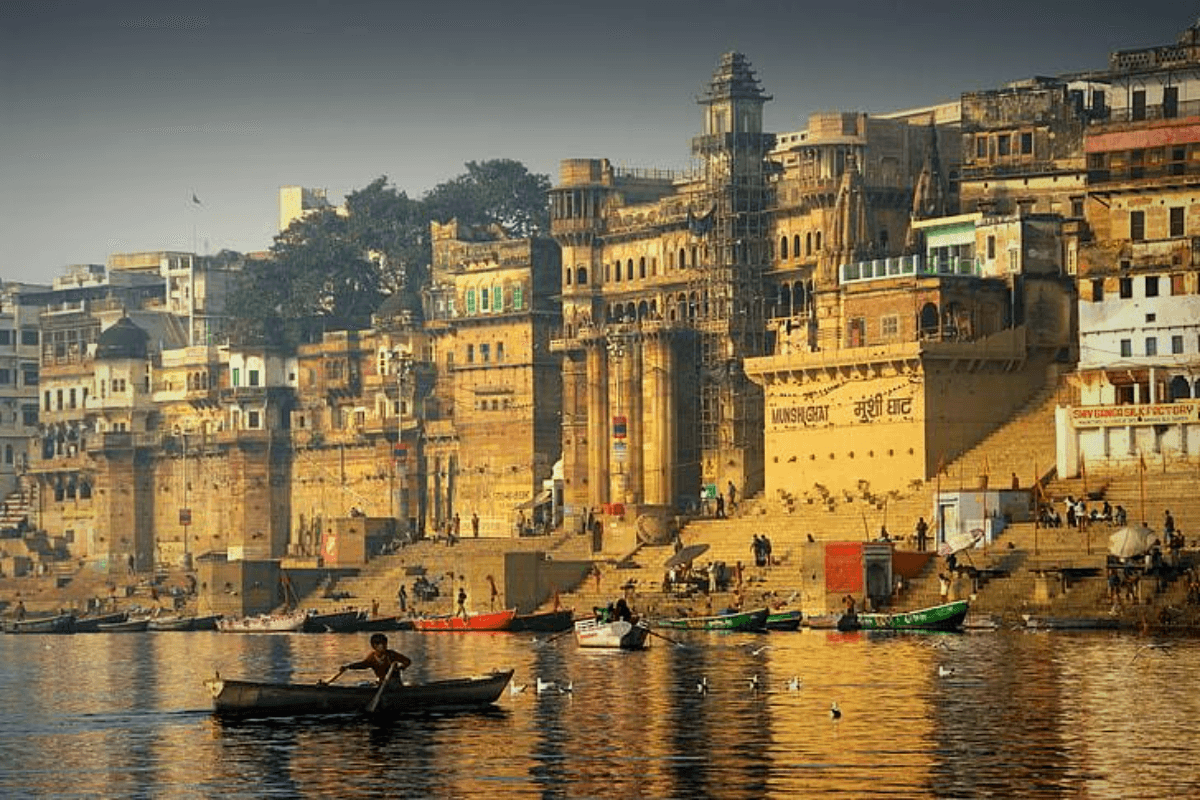
Man Mandir Ghat stands on the central Kashi riverfront a short walk north of Dashashwamedh. Banarasis know it by two names, and the older one is the devotional one: Someshwar Ghat, after the linga of Someshwara — Shiva as the lord of Soma, the moon — which is worshipped here. The name Man Mandir came from the palace above the steps, and over time the palace lent its name to the ghat.
Alongside Someshwara, the ghat carries shrines of Rameshwara and of Sthuladanta Vinayaka, so that a pilgrim who comes down for snan can complete a small round of darshan without leaving the steps — Vinayaka first, as custom asks, then the lingas. None of these shrines is large. They are the ordinary, family-tended devalayas that give a Kashi ghat its working religious life.
The palace itself is the work of Raja Man Singh of Amber, raised around 1600 — the Rajput general who served in Akbar's court and built at Kashi as many Rajput and Maratha houses did, in a city that was nobody's capital and everybody's punya-bhumi. On its terrace sits the masonry observatory that Banaras calls Jantar Mantar and the Archaeological Survey of India lists as the Man Singh Observatory, built by Maharaja Sawai Jai Singh II of Jaipur. Its instruments were laid out to measure local time and to track the altitude and declination of the sun, the stars and the planets, and to compute eclipses — the same reckoning by which a panchang is drawn and a muhurta fixed.
That is the particular character of this ghat. Below, devotees stand in the Ganga at sunrise; above, stone instruments face the same sky that the almanac measures. The ghat is not one of Kashi's crowded stages. It is a calm stretch of steps where both kinds of attention to the heavens have gone on quietly, side by side, for centuries.
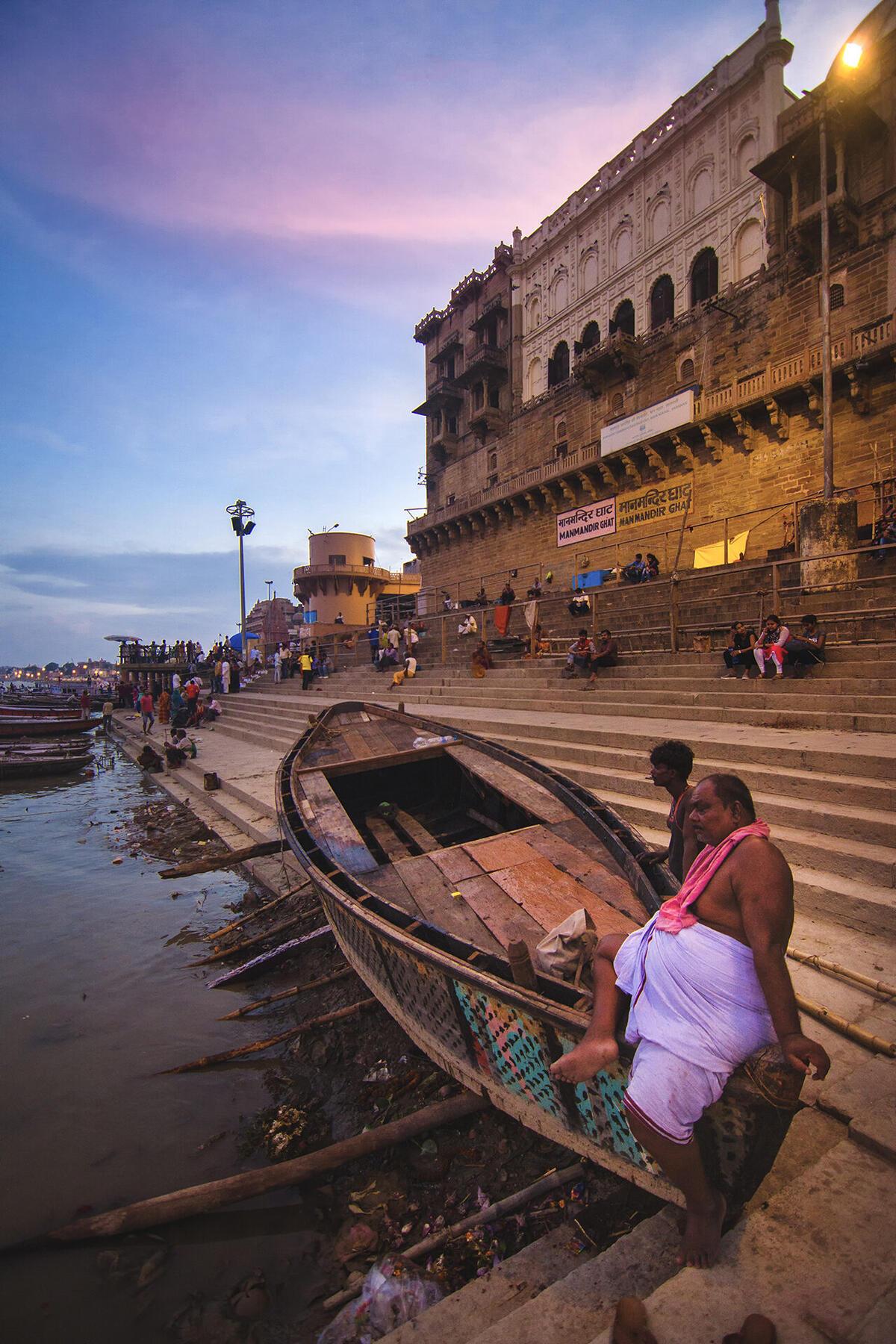
Man Mandir is not counted among the five Panchatirtha ghats of the classical Kashi yatra, and it does not claim a great mahatmya of its own. Its devotional standing is the steady kind: it is a snan ghat with living shrines on it, set on the central stretch of the riverfront, within easy walk of Dashashwamedh and of Kashi Vishwanath.
Someshwara — the linga that names the ghat
The linga of Someshwara is the reason Banaras knew this as Someshwar Ghat, which heritage accounts record as the older of the ghat's two names. Soma is the moon, and in devotional understanding the name holds Shiva in relation to it — the Lord who wears the crescent on his jata. Devotees come to this ghat to offer at Someshwara, and since Monday belongs to Shiva across all of Kashi, that is the day on which those who bathe here most often carry Ganga-jal straight up to the linga.
The shrines on the steps
Rameshwara stands here as another Shiva shrine of the ghat, and Sthuladanta Vinayaka as its Ganesha. Kashi is dense with such shrines; the tradition of the city is not that each one carries a famous katha, but that the whole riverfront is continuous sacred ground and every devalaya on it is a place where the offering is received. A pilgrim who bathes at Man Mandir and offers at these three shrines has done what this ghat asks.
The sky above the steps
There is a quiet fitness in an observatory standing over a bathing ghat. Hindu ritual life runs on the movements the instruments above were built to measure — the tithi that sets a vrat, the sankranti that makes a bathing day auspicious, the eclipse at which the Ganga fills with bathers across Kashi. The devotee at the water and the astronomer on the terrace were reading the same sky. It is not a katha, but it is a real continuity, and it is worth standing on the steps and thinking about.
History
The Someshwara linga gave the ghat the name heritage accounts record as the older of the two, Someshwar Ghat; how far back that usage runs, the sources do not say.
The Man Mandir palace was raised by Raja Man Singh of Amber (1550-1614) around 1600. Man Singh served in the imperial Mughal army under Akbar and is counted among the Navaratnas, the nine gems of that court; his building at Kashi belongs to a long pattern in which rulers whose kingdoms lay elsewhere endowed ghats, palaces and temples in the city they regarded as the ground of moksha.
The observatory on the terrace came later, from the Jaipur line of the same house. Maharaja Sawai Jai Singh II — the builder of the Jantar Mantar observatories at Delhi, Jaipur, Ujjain and Mathura — added the Kashi instruments in the first half of the eighteenth century; published accounts date the work variously to 1710 and 1737, and the decade is the safer claim. The name the Archaeological Survey of India uses for the site, Man Singh Observatory, preserves a competing tradition: an English visitor in 1772 recorded being told at Banaras that the observatory had been built by Man Singh some two centuries earlier. Attribution of the ghat's own masonry is similarly mixed in the record: some accounts credit the stone ghat to the Jaipur house rather than to Man Singh, and the honest summary is that the palace is Man Singh's, the observatory is Jai Singh's, and the steps below were built and rebuilt across both patronages.
James Prinsep, who surveyed Banaras in 1822 and whose drawings of the city were published from 1830 as Benares Illustrated, is recorded in heritage accounts as the first to mention this ghat, in 1831. In the modern period the ghat was rebuilt and repaired by the state Irrigation Department; heritage accounts date that work to 1988 and to 1998, so the decade again is the safer claim. The observatory itself was repaired in the 1850s and restored in 1911-12 by the order of Sawai Madho Singh of Jaipur, as a marble plaque on the wall records. It is protected today under the Ancient Monuments and Archaeological Sites and Remains Act and is held by the Archaeological Survey of India, which lists it among its ticketed monuments; the palace too is under ASI conservation. Through every one of these changes of hand, the snan and the small shrines went on unbroken; that continuity, rather than the succession of patrons, is the ghat's real history.
Architecture
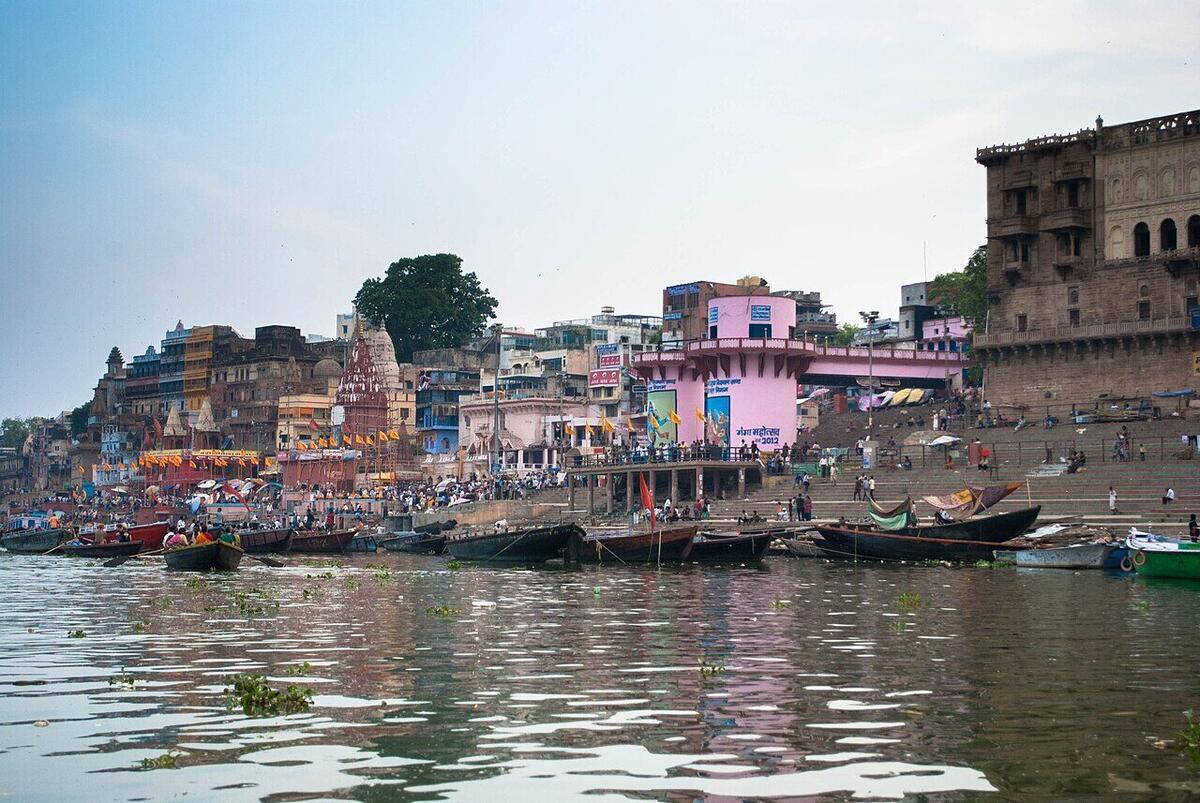
The ghat is defined by the palace standing over it. The Man Mandir facade is Rajput work in sandstone — its most noticed feature the ornate carved window casings, which heritage accounts group with the window treatment of Sawai Jai Singh's observatories at Delhi, Jaipur, Ujjain and Mathura, and a finely worked stone balcony toward the northern end that looks straight down the river. Seen from a boat, the palace reads as one long horizontal band of carved openings above the steps, quite unlike the temple-and-turret silhouette of the ghats further north.
On the terrace stand the masonry instruments of the observatory. They are built, not assembled — large fixed forms of plastered stone whose shape is itself the measuring device, in the manner of all of Sawai Jai Singh's observatories. The heritage record names four: the Samrat Yantra, the largest, a wall set in the plane of the meridian and sloping up toward the celestial pole, from which declination and right ascension are read; a smaller Laghu Samrat Yantra beside it; the Digansha Yantra, used to take the azimuth of a planet or star; and the Bhitti Yantra or mural quadrant at the entrance, now ruined. The instruments were laid out to determine local time, to take the altitude and declination of the sun, the stars and the planets, and to work out eclipses.
The ghat below is in the ordinary Banarasi manner — broad stone steps descending to the water, with the small devalayas of the upper ghat set into the terraces — Someshwara, Rameshwara, Sthuladanta Vinayaka, and Dalabheshwara, 'the giver of lentils', worshipped as a giver of food, in a chamber sunk below the surrounding level. The stone is the sandstone used along the whole riverfront. The ghat was rebuilt and repaired by the state Irrigation Department in the late twentieth century — heritage accounts give the year as 1988 and as 1998 — and the steps remain in daily use.
Rituals & Practices
Man Mandir is above all a snan ghat, and its daily rhythm is the rhythm of the central riverfront. From before sunrise, households and pilgrims come down for the bath, take sankalp, and offer tarpan for ancestors at the water's edge. The steps are broad and comparatively unhurried, and many prefer them to the pressure of Dashashwamedh a few minutes south.
After the bath, devotees offer at the shrines on the ghat itself — customarily Sthuladanta Vinayaka first, then Someshwara and Rameshwara, with Ganga-jal, flowers and bilva patra. Mondays and the Mondays of Shravan bring the most worshippers to the lingas, as at Shiva shrines across Kashi. These are small, family-tended shrines without a published aarti schedule; the timings are best asked for on the spot rather than assumed.
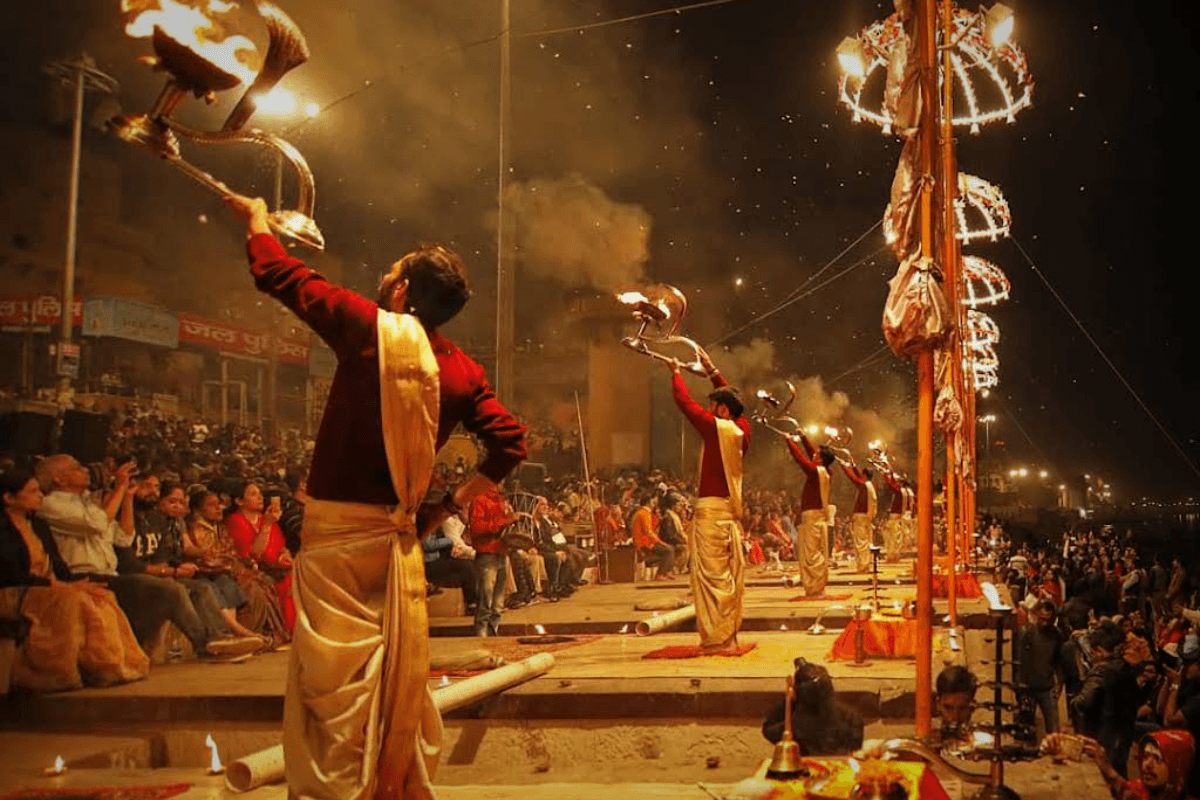
The ghat has no aarti of its own on the scale of Dashashwamedh. Many pilgrims bathe here in the morning and walk south in the evening for the Ganga Aarti, returning to these quieter steps afterwards.
The observatory above is a heritage monument rather than a place of worship, and is visited as such — under Archaeological Survey of India custody, with ticketing and its own opening hours, which are worth confirming on the day.
Festivals & Celebrations
| Festival | When | Crowd |
|---|---|---|
| Dev Deepawali | — | Very high â the whole riverfront fills; reach the ghat well before dusk |
| Kartik Purnima Snan | — | Very high |
| Mahashivratri | — | High |
| Shravan Somvar | — | High on Mondays through the month |
| Ganga Dussehra | — | High |
| Daily Ganga snan | — | Moderate; heaviest at sunrise |
Dev Deepawali: Tradition holds that Shiva destroyed Tripurasura on this day, and that the devas kept it as their own festival of lights â which is why Banaras calls it the Deepawali of the gods. A diya lit on the steps is offered in that welcome.
Kartik Purnima Snan: Tradition counts a Ganga snan on Kartik Purnima among the most auspicious of the year, and holds a bath at Varanasi on this day to be especially so. Deep-daan offered on this night is held to be greatly meritorious.
Mahashivratri: Observed as the night of Shiva, and in Kashi as the night the whole city turns toward its Lord.
Shravan Somvar: Shravan is held to be the month most dear to Shiva, and Monday is his day; jal-abhishek offered then is considered especially fruitful.
Ganga Dussehra: Bathing in the Ganga on this day is held in tradition to remove the ten kinds of sin.
Daily Ganga snan: The unbroken daily life of a Kashi bathing ghat, which is what Someshwar Ghat was before it became Man Mandir.
Prepare for Your Visit
Practical guidance to help you plan your pilgrimage
| Pilgrim Guidance | How to reachMan Mandir sits just north of Dashashwamedh, past Rajendra Prasad Ghat, and the simplest approach is on foot along the riverfront — five to ten minutes from Dashashwamedh, longer when the evening aarti crowd is moving. From Kashi Vishwanath the lanes bring you down in a similar time. Vehicles stop at the outer lanes; the final stretch is always walked. A boat from Dashashwamedh or Assi gives the best view of the palace facade and the carved window casings, which cannot be taken in properly from the steps themselves. Agree the boat fare before boarding. Visiting the observatory aboveThe observatory on the palace terrace is a protected monument in the care of the Archaeological Survey of India, and appears on the ASI's own list of ticketed monuments. Opening hours are daylight hours but are worth confirming on arrival, as ASI sites close on some days and during conservation work. Give it half an hour if you want to read the instruments rather than glance at them, and go in clear weather — the whole point of the place is the sky. The terrace also gives a long view down the river. Best time to visitSunrise is the ghat's own hour, when the steps fill with bathers and the light comes up the river straight onto the palace face. Late morning suits the observatory. October to March is the most comfortable season; in the monsoon the lower steps go under water and the stone turns slippery. If you are combining this with the evening Ganga Aarti at Dashashwamedh, bathe here early, see the observatory before noon, rest through the afternoon, and walk south well before sunset. |
Location
Varanasi, UP
Gallery
Pilgrim photos
No pilgrim photos yet.
Community corrections
No corrections yet.
Edit history
No revisions yet.
Plan Your Visit to Man Mandir Ghat
Get a custom itinerary and pricing for your trip.
Recommended
Packages for this destination
Pilgrim Notes
On-ground observations from fellow pilgrims
No pilgrim notes yet. Be the first to share on-ground observations!
Sign in to share a note.
Pilgrim Reviews
Be the first to share your experience at Man Mandir Ghat.
Sign in to write a review.
Nearby sacred places
Discover other sacred places near Man Mandir Ghat
Explore temples, tirthas, and pilgrimage sites in UP
Explore nearbyPart of these circuits
Walk the traditional pilgrimage routes this destination belongs to.