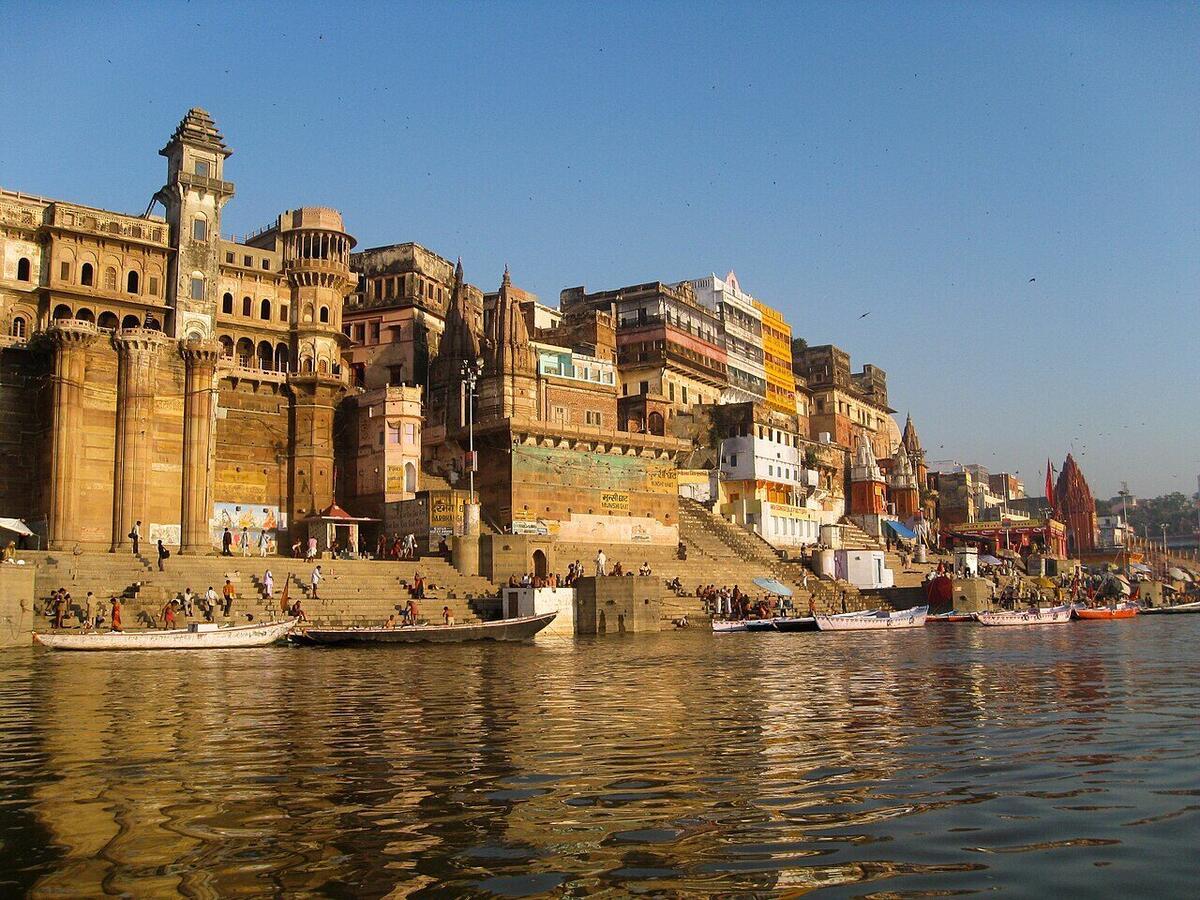
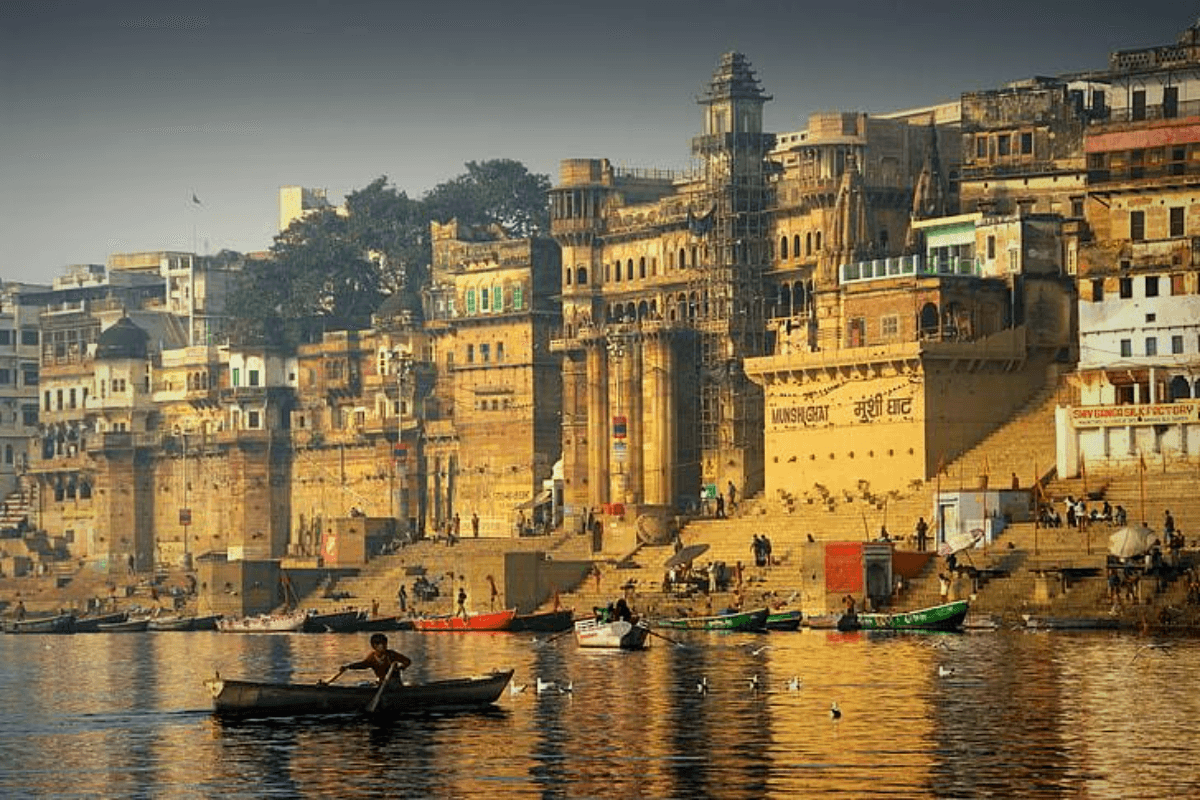
Munshi Ghat lies on the central stretch of the Kashi waterfront, close enough to Dashashwamedh that the sound of the evening aarti carries along the water to it. The ghat takes its name from Sridhara Narayana Munshi, minister to the Raja of Nagpur, who had the steps built in 1812 and, according to the district administration's own record, raised a palace and a temple beside them at the same time. In 1915 the ruling house of Darbhanga bought the ghat and extended it southward, and that extension took a name of its own — Darbhanga Ghat. The two are now inseparable in practice: a single long stone frontage under a colonnaded facade, with the older Munshi steps at its northern end.
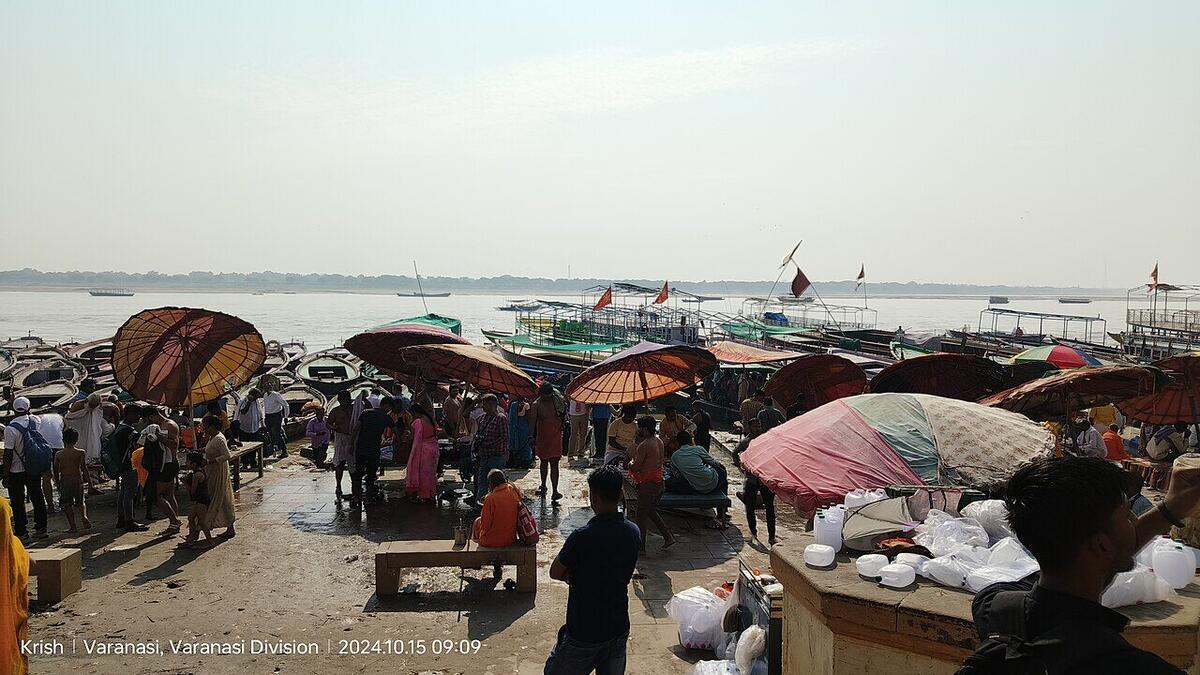
The devotional use of the ghat is the ordinary, unbroken use of the central crescent. Devotees come down before sunrise for snana, stand in the water to take sankalp, offer arghya to the rising sun and perform tarpan for their ancestors. Many bathe here first and then walk up through the lanes for darshan at Kashi Vishwanath, which is the traditional order of a Kashi morning. Priests sit on the upper steps for those who want the vidhi spoken correctly; barbers work the same steps for the shaving that precedes shraddha rites; boatmen wait below for the first passengers.
Through the day the ghat is a place of movement rather than ceremony. It is one of the common boarding points for boats going north towards Dashashwamedh in the evening, and one of the vantage points from which the great aarti is watched from a distance, across water, without entering the crowd on the aarti steps themselves. Because the palace facade above is one of the most photographed elevations on the river, Munshi Ghat is also where a good many visitors stand with a camera — which makes the courtesy owed to the people bathing below rather more important here than at a quieter ghat.
Munshi Ghat carries no separate mahatmya of its own. No Purana names it, no katha is attached to its steps, and nothing is gained by inventing one. Its significance is positional, and in Kashi that is a real kind of significance: these steps stand on the central crescent of the sacred city, within easy reach of Dashashwamedh, the second of the five Panchatirtha ghats and the tirtha most closely bound to the daily worship of the Ganga.
The five panchatirtha ghats — Asi, Dashashwamedh, Manikarnika, Panchganga and Adi Keshava — lie along the river from Asi in the south to Adi Keshava in the north, and Munshi lies inside that stretch. A devotee bathing here is bathing within the Kashi kshetra; the sankalp spoken over the water names Kashi and the Ganga, not the particular flight of steps. For families who come to Banaras to perform tarpan or shraddha for their dead, this matters practically as well as devotionally: the rite is complete when it is performed with attention on this bank, and a quieter ghat near the centre is often the better place to perform it.
What devotees hold
Banarasi devotional understanding treats the whole riverfront from Asi to Varana as a single tirtha-kshetra, with the named ghats as its doorways rather than as competing destinations. On that understanding the merit of a Kartik or Magh snana does not depend on which steps a devotee walks down, provided the bath is offered rather than merely taken. This is why the steps at Munshi fill on the great bathing mornings just as the famous ghats do, and why no one standing here considers themselves to be at a lesser place.
The district administration's listing records that Munshi built a temple beside the ghat along with the palace. Kashi's ghats are full of such shrines — raised by a patron for the household and the neighbourhood, kept up by a handful of families, unnamed in the guidebooks and unbroken in their daily worship. They are, in devotional terms, the working capillaries of the city's sacred life.
History
The bathing has been continuous here far longer than any of the buildings above it. What 1812 gave this bank was permanence in stone.
In that year Sridhara Narayana Munshi, a senior minister — the sources describe him as finance minister — in the service of the Raja of Nagpur, had the ghat built, and with it a palace and a temple at its edge. This was the great century of ghat patronage in Banaras, when Maratha ministers, Rajput houses, Bengali zamindars and the rulers of Indore, Gwalior and Darbhanga each raised a stone frontage over the river, and the pilgrim city acquired the continuous pucca waterfront it has today. The steps took the patron's title, and Munshi Ghat entered the sequence.
In 1915 the ghat was bought and extended by the ruling house of Darbhanga. The purchaser is sometimes named as Maharaja Kameshwar Singh, but that identification cannot be taken as settled: Kameshwar Singh was born in 1907 and succeeded to Darbhanga only in 1929, so a purchase in 1915 belongs to an earlier Maharaja of the same house. The heritage documentation names no individual, recording only the king of Darbhanga. The extension became known as Darbhanga Ghat, and its palace — Chunar sandstone, deep porches, a run of classical columns — became the dominant elevation of this stretch. Further structural work followed in 1930, when the heavy stepped supports for the roof were built.
In 1994 the Darbhanga palace was bought by the Clarks Hotel Group and renamed Brijrama Palace for conversion into a hotel. Roughly half the structure was taken down from the rear during that conversion, and the demolition was stopped after citizens' organisations raised the matter and the courts intervened. Heritage documentation of the ghats records the ownership as it now stands: the palatial building with the hotel group, the ghat steps themselves with the Varanasi Municipal Corporation. The steps, whoever has held the building above them, have gone on being used for snana every morning since 1812.
Architecture
What the eye takes in from a boat as Munshi Ghat is in fact two things joined. The steps at the northern end are the original 1812 work of the Munshi patronage; the tall colonnaded elevation that dominates the photographs belongs to the Darbhanga palace, standing on the ghat that was carved out of Munshi's in 1915. It is worth knowing the difference, because a great deal of writing about this stretch attributes the palace to the Munshi and the steps to Darbhanga.
The palace is built of the warm buff Chunar sandstone that gives most of the older Banaras ghats their colour, with deep porches and a run of classical columns of a kind more often seen in colonial-era civic architecture than on a river frontage — a European vocabulary set on a thoroughly Banarasi plinth. Heavy stepped supports for the roof were added in 1930. Since the 1994 hotel conversion, much of what stands behind the facade is rebuilt rather than original.
The ghat below is generous and plain: broad flights descending to the water, landings wide enough for bathers to gather and for boats to come alongside, and no aarti platform or bank of waterline shrines. Its usefulness is the point. The district listing records that Munshi built a temple beside the ghat along with the palace. It does not name the temple, describe it, or say where it now stands, and no other source consulted does either.
Rituals & Practices
The ritual day here begins in the dark. Devotees come down for snana, take sankalp standing in the water, offer arghya to Surya as the light rises over the far bank, and perform tarpan for their forebears. Many carry Ganga-jal back up in a small lota for the household shrine. The customary order of a Kashi morning is followed by a good number of pilgrims here: bathe at the ghat, then climb through the lanes for darshan at Kashi Vishwanath.
Priests are available on the upper steps for sankalp, tarpan and shraddha-related vidhi, and barbers for the shaving that some of those rites require. There is no large panda establishment as at Dashashwamedh, and for many families that is precisely the appeal — a rite for the dead performed on the central crescent without a crowd around it.
Kartik is the busiest month: devotees keeping the month-long Kartik-snana vow bathe here daily, and in the evenings small clay lamps are floated from the steps, the deepdan that rises to its height at Kartik Purnima and Dev Deepawali. Magh brings a second bathing discipline, and Ganga Dussehra a day of particular offering to the river.
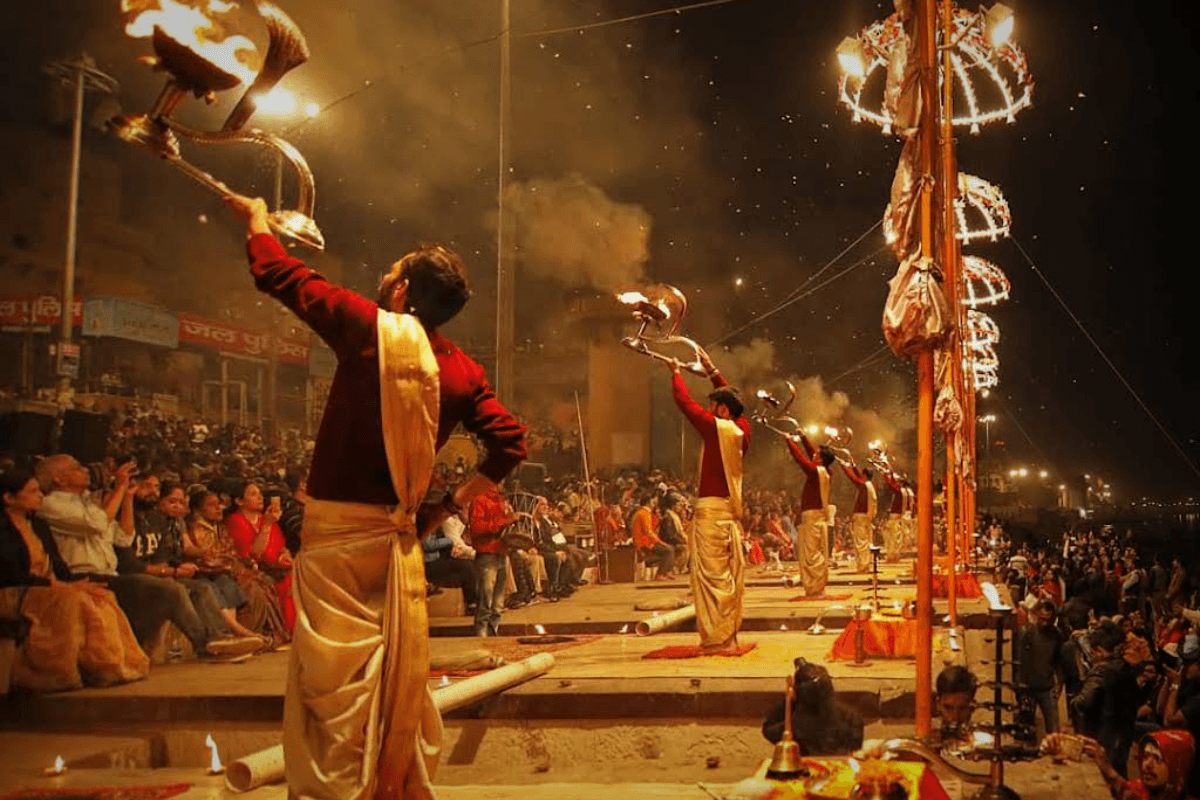
No formal Ganga Aarti is offered at Munshi Ghat. The city's principal aarti is at Dashashwamedh, a short walk or a shorter row to the north, and this ghat is one of the common places to board a boat for it or to watch it from the water at a distance. Aarti timings shift with the season and with the level of the river, so confirm them on the day rather than relying on a fixed hour.
Festivals & Celebrations
| Festival | When | Crowd |
|---|---|---|
| Dev Deepawali | — | Extreme on the central ghats â arrive by afternoon for any position, or take a boat |
| Kartik Purnima Snan | — | Very high |
| Ganga Dussehra | — | Very high |
| Makar Sankranti | — | Very high |
| Mahashivratri | — | Very high |
| Daily Ganga snan and tarpan | — | Moderate in the early morning, light through the day |
Dev Deepawali: Tradition holds that Dev Deepawali marks Shiva's victory over Tripurasura and the descent of the devas to bathe in the Ganga. The lamps along the ghats are offered as a welcome to them.
Kartik Purnima Snan: The Puranas praise snana in Kartik, and Kartik Purnima above all, as bearing exceptional devotional fruit. Bathing within the Kashi kshetra on this day is held to be especially meritorious.
Ganga Dussehra: Tradition holds that a bath offered to the Ganga on this day removes the dasha-papa, the ten kinds of transgression. It is among the most important river-days of the Banaras year.
Makar Sankranti: Marks the sun's passage into Makara and the beginning of Uttarayana. Snana and daan on this day are held to bear great fruit.
Mahashivratri: The night of Shiva, held in Kashi as the greatest observance of the year. The bath is preparatory: the ghat is where the darshan begins.
Daily Ganga snan and tarpan: This unbroken daily use, more than any single festival, is what keeps a Kashi ghat a living tirtha rather than a heritage frontage.
Prepare for Your Visit
Practical guidance to help you plan your pilgrimage
| Pilgrim Guidance | How to reachMunshi Ghat is on the central waterfront, a short walk south of Dashashwamedh. From the city, come to the Godowlia crossing and walk down towards Dashashwamedh Ghat — vehicles do not go to the river here — and then turn south along the riverside, past Ahilyabai Ghat, until the long colonnaded palace facade appears above the steps; the Munshi steps are at its northern end, and Darbhanga is the same frontage continuing south. From the south, the riverside path runs up past Chausatti, Rana Mahal and Darbhanga in the dry season. By river, any boat from Asi, Kedar or Dashashwamedh will put you down at the landing, and the palace elevation is unmistakable from the water. What to expect at these steps
Best time to visitThe hour before sunrise is the ghat at its truest — bathing, arghya, the light coming up over the sandbank opposite, and the first boats going out. October to March is the most comfortable season, particularly for pilgrims travelling with elders or children. Kartik Purnima and Dev Deepawali light the whole central crescent and bring very large crowds; Ganga Dussehra, Makar Sankranti and Mahashivratri fill the steps from before dawn. For a quiet tarpan or a still hour by the river, a weekday morning outside the festival months is the best choice. |
Location
Varanasi, UP
Gallery
Pilgrim photos
No pilgrim photos yet.
Community corrections
No corrections yet.
Edit history
No revisions yet.
Plan Your Visit to Munshi Ghat
Get a custom itinerary and pricing for your trip.
Recommended
Packages for this destination
Pilgrim Notes
On-ground observations from fellow pilgrims
No pilgrim notes yet. Be the first to share on-ground observations!
Sign in to share a note.
Pilgrim Reviews
Be the first to share your experience at Munshi Ghat.
Sign in to write a review.
Nearby sacred places
Discover other sacred places near Munshi Ghat
Explore temples, tirthas, and pilgrimage sites in UP
Explore nearbyPart of these circuits
Walk the traditional pilgrimage routes this destination belongs to.