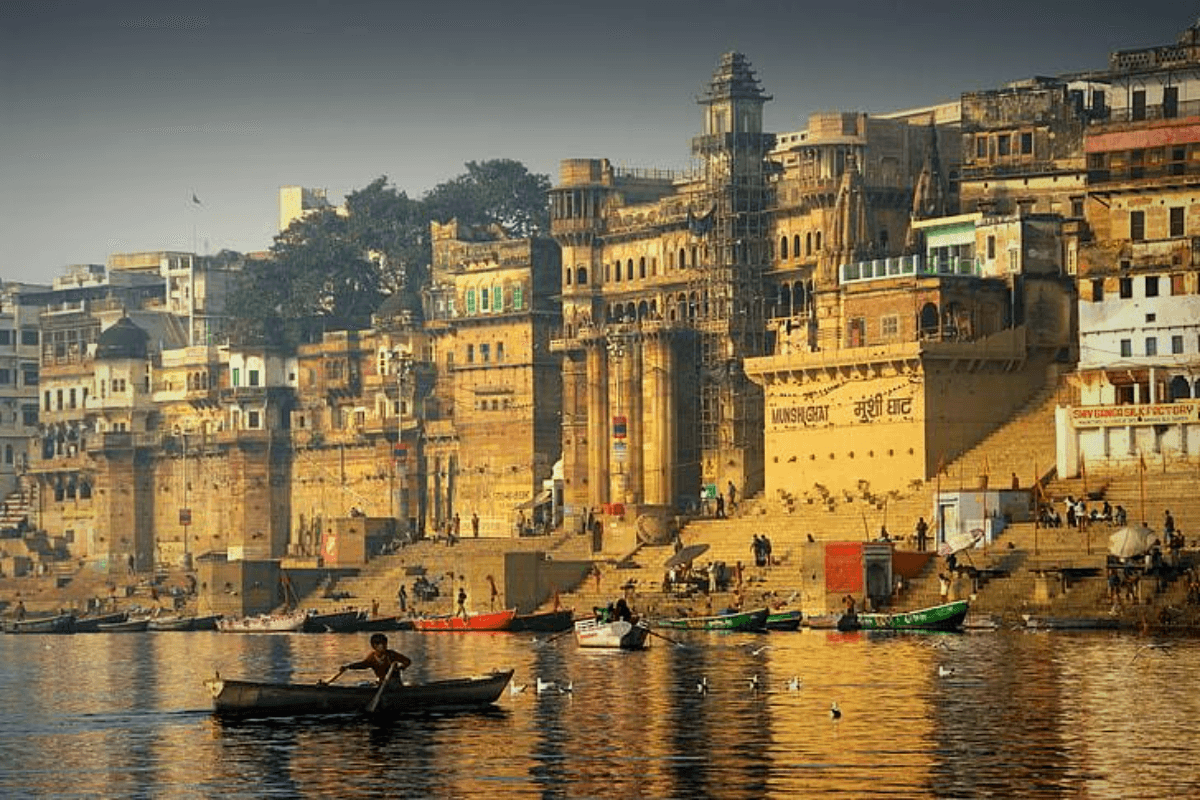
Narad Ghat lies on the central crescent of the Kashi riverfront, counted twenty-ninth in the sequence that runs north from Assi, in the short stretch that carries the Kshemeshvara, Manasarovara and Narada ghats together. It takes its name from Devarshi Narada, the rishi whom tradition remembers for wisdom, for music, and for a life of ceaseless wandering between the worlds. Heritage documentation records that, according to legend, the linga of Naradeshvara on the terrace above these steps was installed by the sage himself.
The ghat is a working bathing ghat and a notably quiet one. Devotees come down at first light for snan, take Ganga-jal up to the lingas on the upper terrace, and sit for a while under the great fig tree that stands above the steps. The Varanasi district heritage listing describes the ghat as quiet and reflective and well suited to those who come alone — an unusually candid line for an official listing.
What Banaras says about this ghat
Narad Ghat is best known in the city for a piece of local belief: a husband and wife are not to bathe here together. The district heritage listing records the reason as the ghat's association with celibacy and solitude, drawn from Narada's own ascetic life; many couples who come therefore avoid bathing together here. It is a belief kept lightly, as such beliefs are in Banaras, and it is a matter of household custom rather than any rule enforced at the ghat. Pilgrims who do not share it should still leave others undisturbed in keeping it.
In the ghat sequence, Manasarovara and Kshemeshvara Ghats lie immediately south — the first named for a water pool that heritage documentation credits to Raja Man Singh of Amber in the late seventeenth century, and which was eulogised as carrying the same merit as the Manasarovara lake itself — and Raja Ghat lies immediately north. Walking this short stretch takes a pilgrim through some of the quieter ghat neighbourhoods of the central riverfront.
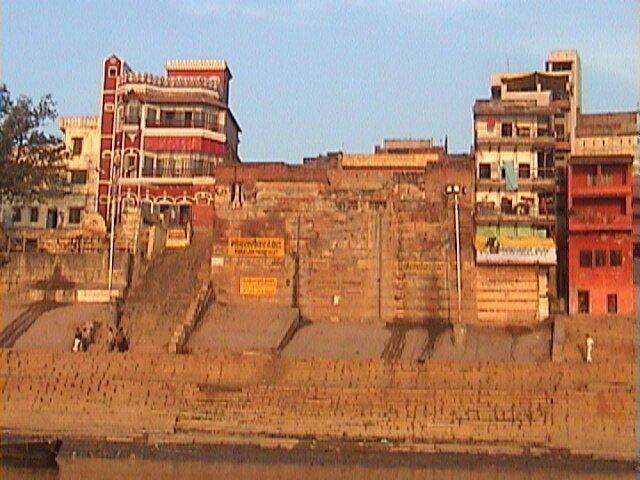
What sets Narad Ghat apart from its neighbours is the cluster of lingas on the terrace above it. Heritage documentation names four: Naradeshvara, Atrishvara, Vasukishvara and Dattatreyeshvara — Shiva worshipped under the names of the sage Narada, the sage Atri, the naga king Vasuki, and Dattatreya. This is the older Kashi habit of naming a linga for the devotee who is remembered as having established it, so that the shrine keeps the memory of the worshipper along with the worshipped. The records do not explain how these four came to stand together, and that gap is best left as it is.
The devotional weight of the ghat rests principally on Narada. Tradition holds him a mind-born son of Brahma and one of the great teachers of bhakti; the Narada Bhakti Sutra, the classical short treatise on devotion as love, is ascribed to him by tradition. Where other tirthas of Kashi are approached for the fruit of a rite, this one carries the name of the rishi who taught that devotion asks for no fruit at all.
The tree and the broken images
Above the steps stands a large sacred fig, and heritage documentation notes that fragments of images of the twelfth and thirteenth centuries lie among its roots. This is a long-kept custom in Banaras: an image too broken for worship in a temple is not discarded but set at the foot of a sacred tree, where it continues to be honoured. For a pilgrim, that root-cluster is the plainest evidence that worship on this bank is far older than the stone steps below it.
Beyond that, Narad Ghat is a Ganga tirtha like every other stretch of the Kashi bank, and a bath taken here is a bath taken in Kashi, with all that tradition attaches to it. It belongs to no pancha-tirtha or sapta-tirtha sequence, and this page does not claim one for it.
History
The devotional life of this bank precedes any of its buildings — the twelfth- and thirteenth-century image fragments under the fig tree are the evidence — but the ghat's documented history is comparatively recent. In the early nineteenth century it was not called Narad Ghat at all. Heritage documentation records that Prinsep, surveying Banaras in 1822, listed it as Kuvai Ghat, a name still remembered in older accounts of the riverfront.
Two records describe how it took its present name. The Varanasi district heritage listing says the name changed to Narad Ghat after the Shiva temple of Naradeshvara was built in the middle of the nineteenth century. The World Heritage dossier prepared for the Ghats of Varanasi puts it differently: the old shrine of Naradeshvara was renovated during the nineteenth century and the ghat then received the name Narada Ghat, as recorded by Greaves in 1909. The two accounts agree on the century and on the shrine; where they differ on whether the temple was newly built or restored, both are worth stating.
The dossier is specific about the ghat's builder. It was constructed around 1888 by Swami Sativedananda Dattatreya, the head of a monastery from South India, who also built the temple of Dattatreyeshvara, the Dattatreya Math, and several of the buildings that still stand behind the steps. The ghat therefore belongs to the long tradition of southern monastic houses establishing themselves along the Kashi riverfront for the care of pilgrims from their own regions; the same records note that the king of Banaras built a math on the neighbouring Shivala stretch for exactly that purpose.
The stone as pilgrims use it today is later still: in 1965 the government of Uttar Pradesh repaired the ghat and made it fully pucca. Ownership remains divided in the ordinary Banaras way — the monastic trusts hold their own properties along the ghat, residents hold the houses, and the Municipal Corporation holds the ghat itself.
Architecture
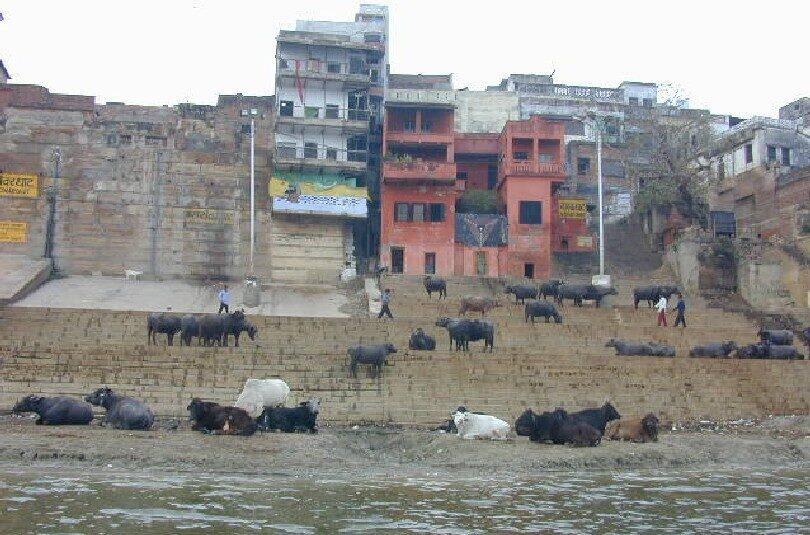
Narad Ghat is a small ghat — heritage documentation records about 0.147 hectares for the Kshemeshvara-Manasarovara-Narada group of which it forms part — and it makes no attempt at the carved river-façades of Darbhanga or Munshi Ghat. Its interest is on the terrace rather than on the water. A flight of plain stone steps, in the form given to it by the Uttar Pradesh government's repairs of 1965, rises from the river to a level where the shrines stand.
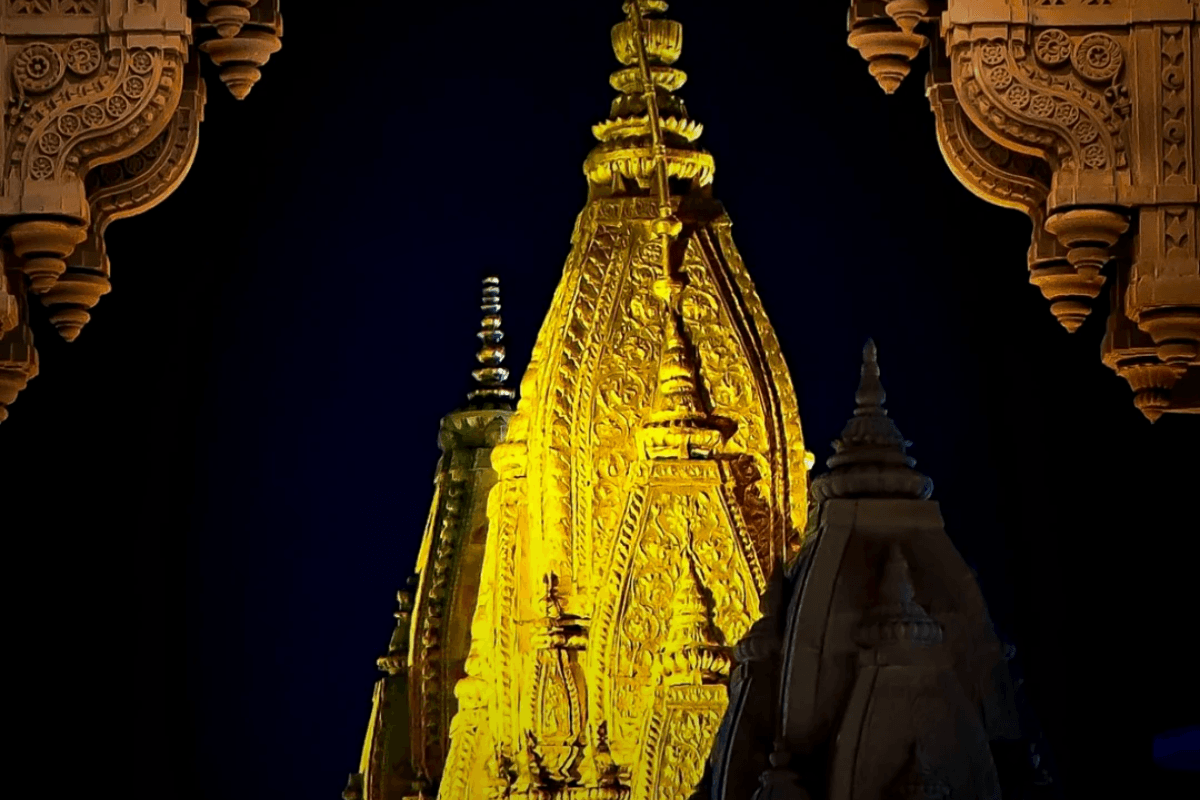
On that upper level are the images the heritage records name — Naradeshvara, Atrishvara, Vasukishvara and Dattatreyeshvara — recorded simply as the important images on the upper side of the ghat, not as large temples. Behind and above them stand the buildings of the Dattatreya Math and the other structures raised by its founder in the late nineteenth century.
The feature that gives the ghat its character is the great sacred fig above the steps, with the twelfth- and thirteenth-century image fragments gathered among its roots. In a city of built monuments, this is a reminder that what is oldest at a ghat is not always what was built there.
Rituals & Practices
The day at Narad Ghat is the ordinary devotional day of the Kashi riverfront, kept without ceremony. Devotees take Ganga snan from first light, make a sankalp before entering the water, and offer arghya to the sun. Tarpan for the ancestors is performed on Amavasya, on the tithi of a departed elder, and through the Pitru Paksha fortnight.
The ghat's own movement is the short climb from the water to the lingas on the terrace: Ganga-jal poured over Naradeshvara and the shrines beside it, with bilva patra, flowers and a little akshat. This is at its fullest on the Mondays of Shravan and on Mahashivratri, when the households of the neighbourhood keep the shrines awake through the night. Devotees also pay their respects at the sacred fig and the images at its roots before they leave.
Two observances belong particularly to this ghat's associations. Narada Jayanti, kept on the pratipada that follows Vaishakha Purnima — Vaishakha Krishna Pratipada in the Amanta reckoning, Jyeshtha Krishna Pratipada in the Purnimanta — is the day tradition keeps for the rishi whose name this ghat carries. Datta Jayanti on Margashirsha Purnima is the principal day of the Dattatreya tradition, to which the math that built this ghat belongs. Whether either day is marked with a formal programme at the ghat varies from year to year and with whoever is keeping the math; pilgrims planning around them should confirm locally.
The local belief that a husband and wife should not bathe here together is observed by many families who come, and simply set aside by others. Nobody at the ghat enforces it.
Festivals & Celebrations
| Festival | When | Crowd |
|---|---|---|
| Narada Jayanti | — | Low to moderate |
| Datta Jayanti | — | Low to moderate |
| Mahashivratri | — | Moderate |
| Sawan Somvar | — | Moderate on Mondays |
| Dev Deepawali | — | High across the riverfront; lighter on these steps than at the central ghats |
| Kartik Purnima Snan | — | High through the morning |
| Ganga Dussehra | — | Moderate |
| Daily Ganga snan | — | Low |
Narada Jayanti: Narada is remembered in tradition as a mind-born son of Brahma and one of the foremost teachers of devotion; the Narada Bhakti Sutra is ascribed to him. The ghat that carries his name is the natural place in Kashi to keep the day.
Datta Jayanti: Puranic tradition remembers Dattatreya as the son of the sage Atri, and honours him as a teacher who took the whole world for his guru. His shrine here stands beside the linga named for Atri himself.
Mahashivratri: Tradition holds that the offering of Ganga-jal and bilva patra to the linga on this night carries particular grace. For small terrace shrines such as these, it is the fullest night of the year.
Sawan Somvar: Shravan is held in tradition to be Shiva's own month, and the offering of Ganga-jal to the linga is its central devotional act across Kashi.
Dev Deepawali: Tradition holds that Dev Deepawali marks the descent of the gods to bathe in the Ganga at Kashi. The lamps are set as a welcome to them, and the whole crescent of the river is treated as one continuous offering.
Kartik Purnima Snan: The Puranas praise snana and daana in Kartik as bearing especial fruit, and the Purnima is the fullest day of that month for the Ganga's devotees.
Ganga Dussehra: Devotees hold that snan on this day carries the grace of the river's own arrival, and it is one of the year's most auspicious mornings anywhere along the Kashi bank.
Daily Ganga snan: The continuous devotional life of the ghat, kept by the households of the neighbourhood and the math above the steps.
Prepare for Your Visit
Practical guidance to help you plan your pilgrimage
| Pilgrim Guidance | Where the ghat sits on the riverfrontNarad Ghat belongs to the central crescent, in the stretch running from Chauki Ghat to Chausatthi Ghat. Manasarovara and Kshemeshvara Ghats lie immediately south of it and Raja Ghat immediately north. From Dashashwamedh, the walk south along the ghat path is about ten to fifteen unhurried minutes, past Shitala, Ahilyabai, Munshi, Darbhanga, Rana Mahal, Chausatthi, Digpatiya, Sarveshvara, Pandey, Khori and Raja Ghats. From Assi the walk is considerably longer and better broken with a boat. Reaching Narad Ghat
Best time to visitFirst light to about nine in the morning is the ghat's own hour, when the snan is under way and the terrace shrines are open. Late afternoon is quieter still and is the better time simply to sit — this is a ghat that rewards sitting. October to March is the most comfortable season. Through the monsoon the lower steps go under water and the stone stays slippery for weeks afterwards. On Kartik Purnima and Dev Deepawali the whole riverfront fills, this ghat included, though far less heavily than the central ghats a short walk north. |
Location
Varanasi, UP
Gallery
Pilgrim photos
No pilgrim photos yet.
Community corrections
No corrections yet.
Edit history
No revisions yet.
Plan Your Visit to Narad Ghat
Get a custom itinerary and pricing for your trip.
Recommended
Packages for this destination
Pilgrim Notes
On-ground observations from fellow pilgrims
No pilgrim notes yet. Be the first to share on-ground observations!
Sign in to share a note.
Pilgrim Reviews
Be the first to share your experience at Narad Ghat.
Sign in to write a review.
Nearby sacred places
Discover other sacred places near Narad Ghat
Explore temples, tirthas, and pilgrimage sites in UP
Explore nearbyPart of these circuits
Walk the traditional pilgrimage routes this destination belongs to.