The New Vishwanath Temple — often simply Vishwanath Mandir, BHU — stands within the campus of Banaras Hindu University, close to the south of the old city. It was established by Pandit Madan Mohan Malaviya, the founder of BHU, as a temple open to worshippers of every caste and tradition. In the Kashi of the early twentieth century, that openness was itself a significant statement, and it shapes the temple's character to this day.
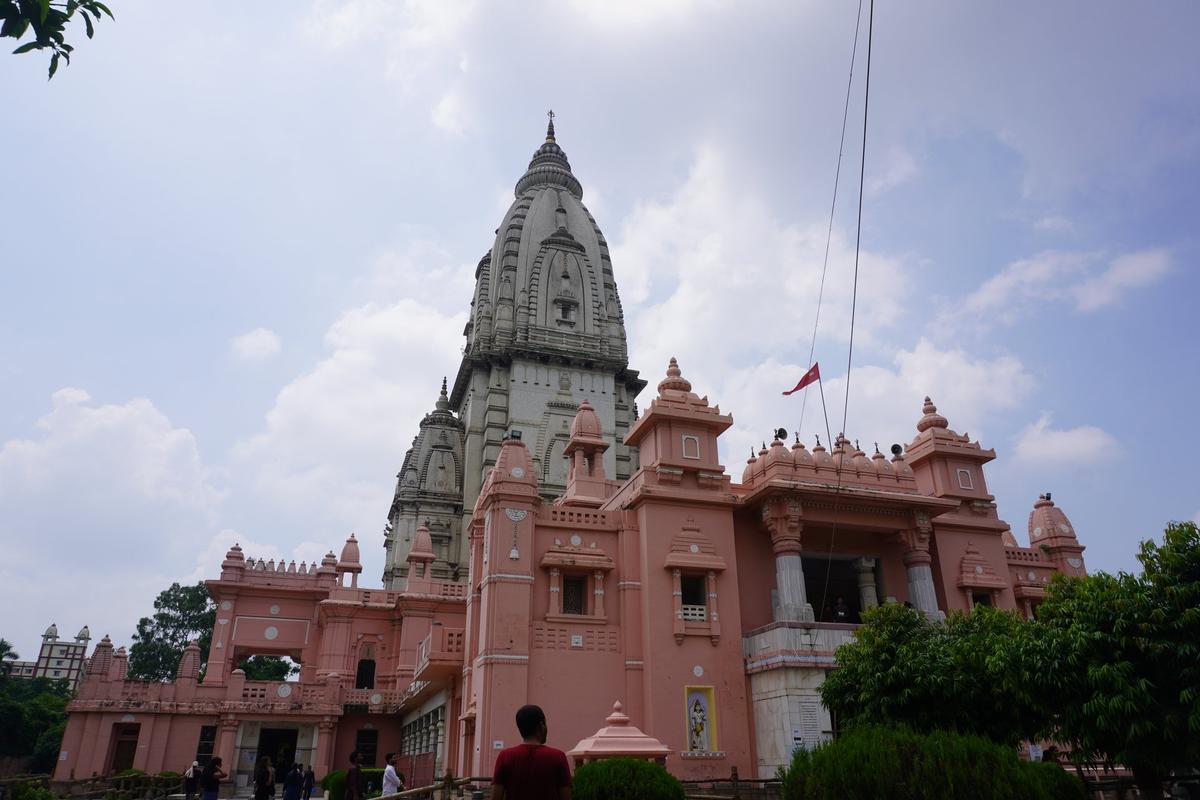
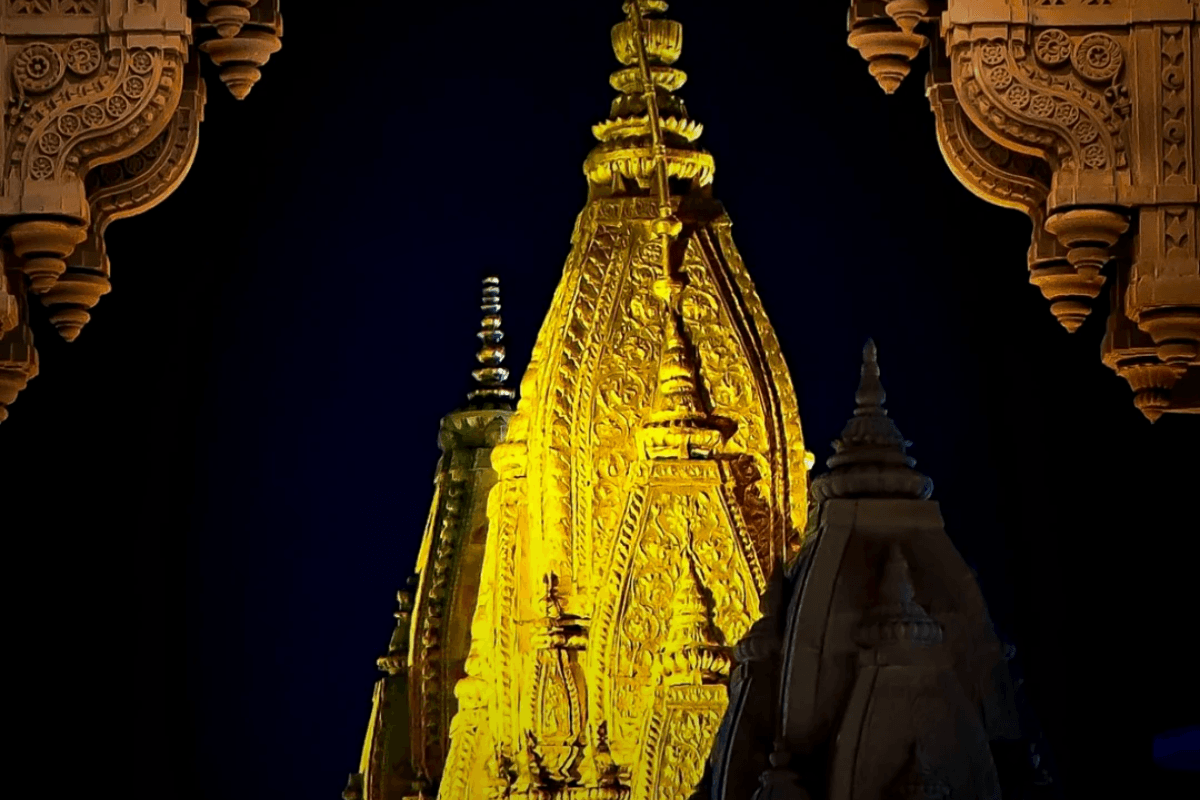
The temple is built in white marble. The central shikhara rises to 77 metres (253 feet) — among the tallest temple towers in India — visible from across the campus. Seven subsidiary shrines surround the main Shiva sanctum, each dedicated to a different deity of the Hindu devotional household. The walls of the mandapa carry the full text of the Bhagavad Gita inscribed in marble, and pilgrims may read selected slokas as they perform the pradakshina.
The temple is reached through the campus's broad tree-lined roads rather than the galis of the old city. Its atmosphere is quieter, its approach calmer, and it is particularly loved by families, students before examinations, and pilgrims seeking an unhurried Shiva darshan within Kashi.
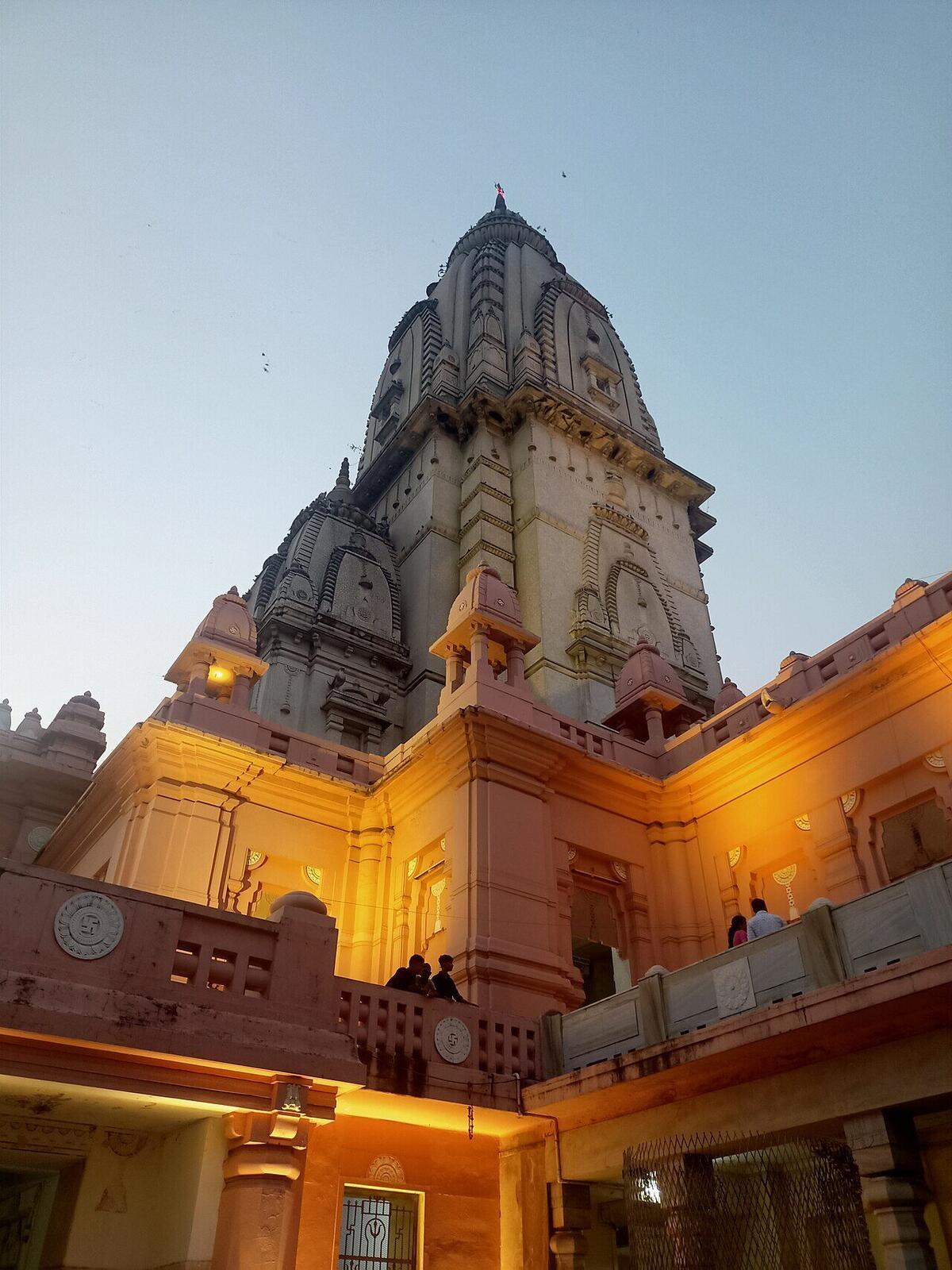
The New Vishwanath Temple carries two significances at once. As a Shiva temple, it serves as a place of regular daily worship in the Kashi Shaiva tradition — abhishek, aarti, bilva patra and Ganga-jal offered to the linga, with the classical sequence of dawn, midday, evening, and night worship.
As a modern foundation, it carries the wider devotional vision of Madan Mohan Malaviya — that the worship of Vishwanath is the heritage of every Hindu, and that the temple of the University should be a place where every learner, scholar, and devotee may stand together before the Lord of all. This openness to devotees of every caste was, in the early twentieth century, a considered theological statement, and it remains a defining feature of the temple's character.
Katha and tradition
In the traditional understanding of Kashi, Shiva is worshipped in many linga-forms throughout the city — the great Jyotirlinga of Vishwanath is first, but many other linga-shrines carry their own traditions. The New Vishwanath at BHU belongs to this wider fabric: not a competitor to the old Jyotirlinga, but a companion temple, a place where the same Lord may be approached in a setting shaped by the ideals of the modern university Malaviya founded.
The seven subsidiary shrines — dedicated to Durga, Saraswati, Lakshmi, Ram, Krishna, Hanuman, and other deities — reflect the breadth of the Hindu devotional household. Many pilgrims visit the surrounding shrines before or after the central Shiva darshan as part of the day's worship here.
History
The foundation stone of the New Vishwanath Temple was laid on 11 March 1931 by Pandit Madan Mohan Malaviya, within the Banaras Hindu University campus he had established in 1916. Construction was funded by the Birla family, whose support for temple-building across modern India is well recorded, and continued across several decades before the temple was completed.
The temple was designed to echo the form of the original Kashi Vishwanath at the heart of the old city, but on a larger scale, in white marble rather than sandstone, and in open-plan rather than lane-bound architecture. The intention was to make devotion unhurried and accessible — to allow families, students, and pilgrims to approach Shiva without the pressures of the very dense traditional precinct.
Malaviya's larger vision was to situate the temple within the wider learning space of the University — vidya and bhakti held together. The Bhagavad Gita inscribed on the walls reflects this intention: the temple is a place for reading and reflection alongside the offering of puja, and the text itself is preserved here alongside the worship.
Architecture
The New Vishwanath Temple is built in white marble in the Nagara style, with clear inspiration from the original Kashi Vishwanath but adapted to the open setting of the University campus. The central shikhara rises to seventy-seven feet, the tallest temple shikhara within the campus precinct, and is visible from much of BHU.
The central sanctum holds the Shiva linga, approached through a spacious mandapa. The walls of the mandapa and the surrounding corridors carry the complete text of the Bhagavad Gita inscribed on marble panels — chapter by chapter, verse by verse — so that the pilgrim may walk through the Gita in the course of circumambulation.
Seven smaller temples stand around the main shrine, each with its own murti and daily worship. Together with the main Shiva sanctum they form a compound that can be approached as an eight-fold darshan on a leisurely walk through the grounds.
The temple stands in an open, landscaped setting — a significant departure from the lane-bound old city temples — with broad walkways, gardens, and space for the large gatherings that attend Shivratri and other major occasions.
Rituals & Practices
The daily worship at the New Vishwanath Temple follows the classical Shaiva pattern.
- Morning aarti. Before sunrise, the linga is bathed and adorned; the aarti is offered with the conch and bell.
- Panchamrit abhishek. Through the day, pilgrims may arrange abhishek with milk, curd, honey, ghee, and Ganga-jal, along with bilva patra.
- Noon bhog and aarti.
- Evening aarti. At sunset, a longer evening observance is held.
- Night aarti and closing. The linga is ritually put to rest at the end of the temple day.
Many families arrange Rudrabhishek or Mahamrityunjaya japa here. The temple trust facilitates these on request; specific pujas can be booked in advance.
Reading the Bhagavad Gita on the temple walls — in sequence, or simply a chapter chosen for the day — is itself a traditional practice here, especially by BHU students and scholars.
Specific timings may vary; pilgrims are encouraged to verify before a visit.
Festivals & Celebrations
| Festival | When | Crowd |
|---|---|---|
| Mahashivratri | — | Extremely high |
| Shravan Mondays | — | Very high |
| Foundation Day | — | Moderate |
| Gita Jayanti | — | Moderate |
Mahashivratri: As a Shiva temple, Mahashivratri is the foremost day of the year. The all-night worship here is attended by devotees of every background, in the spirit of the temple's founding.
Shravan Mondays: Shravan is Shiva's month, and Mondays within it are considered the most potent days for Shiva worship.
Foundation Day: Honours the founding of the temple as a shrine open to worshippers of every caste â a distinctive feature of its history.
Gita Jayanti: Fitting to a temple that carries the full text of the Gita on its walls, and to a University founded on the integration of vidya and bhakti.
Temple Details
| Timings | note: Timings can change on festival days â confirm locally daily: 5:00 AM â 7:00 PM (per Kashi Official Web Portal, kashi.gov.in) |
| Management | Under the direct administration of Banaras Hindu University (BHU) |
Prepare for Your Visit
Practical guidance to help you plan your pilgrimage
| How to Reach | location: Inside the Banaras Hindu University campus, about 1.7 km south-west of the BHU main gate from the city: The BHU campus is about 4.5 km south-west of the Kashi Vishwanath / old city area; reach the BHU main gate by auto or taxi and continue inside the campus to the temple |
| Pilgrim Guidance | How to reachThe New Vishwanath Temple is within the Banaras Hindu University campus, reached through Lanka Gate on the southern side of the city. From Godowlia it is about 6 km — around 20 minutes by auto-rickshaw. A pass may be required to enter the campus by private car; walk-in and auto-rickshaw entry via the main gates is generally straightforward. Suggested BHU circuit
Many pilgrims combine the BHU circuit with a morning visit to Tulsi Manas, Durga Temple, and Sankat Mochan — all within a few kilometres of the University. Preparation for Pilgrims
Best Time to VisitShravan Mondays (July–August), Mahashivratri (February–March), and the temple's foundation day (11 March) are the most significant dates. Weekday mornings are the calmest for an unhurried darshan and a reading of the Gita on the walls. October to March is the most comfortable season overall. |
| Pilgrim Tips |
|
Location
Varanasi, UP
Gallery
Pilgrim photos
No pilgrim photos yet.
Official Links
Community corrections
No corrections yet.
Edit history
No revisions yet.
Plan Your Visit to New Vishwanath Temple (BHU)
Get a custom itinerary and pricing for your trip.
Recommended
Packages for this destination

Pilgrim Notes
On-ground observations from fellow pilgrims
No pilgrim notes yet. Be the first to share on-ground observations!
Sign in to share a note.
Pilgrim Reviews
450 reviews
Be the first to share your experience at New Vishwanath Temple (BHU).
Sign in to write a review.
Nearby sacred places
Discover other sacred places near New Vishwanath Temple (BHU)
Explore temples, tirthas, and pilgrimage sites in UP
Explore nearbyPart of these circuits
Walk the traditional pilgrimage routes this destination belongs to.