Panchganga Ghat lies in the northern stretch of Kashi's sacred waterfront, between Scindia Ghat and Ram Ghat. Its name means "the ghat of the five rivers", and it is one of the oldest tirthas of Banaras. For pilgrims who follow Kashi in its traditional devotional order, Panchganga is counted among the five principal bathing ghats, alongside Assi, Dashashwamedh, Manikarnika, and Adi Keshava.
The atmosphere here is quieter than the crowded ghats further south. Pilgrims come at dawn for snana, climb the long flight of steps, and offer darshan at Bindu Madhav above. Through the month of Kartik, the ghat takes on a special devotional life as families gather at first light for Kartik Snana, keeping a tradition that has shaped Kashi's religious calendar for centuries.
For the sadhaka, the ghat also carries the memory of Trailanga Swami, the revered Shaiva ascetic who is said to have dwelt and meditated in this area for decades. His presence, recalled in the stories of Banaras, adds a quiet weight to the steps of Panchganga.
Tradition says that at Panchganga Ghat, five sacred rivers come together in unseen confluence: the Ganga, the Yamuna, the Saraswati, the Dhutapapa, and the Kirana. Only the Ganga flows visibly; the other four are held to be present in their subtle, spiritual form. For the devotee, this is what makes the ghat a panchatirtha, a meeting of five streams of sacred grace.
A bath here is therefore understood as no ordinary snana. The Puranas tell that Dhutapapa washes away sin, Kirana grants inner radiance, Saraswati awakens wisdom, Yamuna offers grace, and Ganga carries the soul toward liberation. To bathe at the confluence of five rivers, even if four are unseen, is to stand at one of Kashi's most concentrated points of blessing.
Above the ghat rises the Bindu Madhav shrine, where Vishnu is worshipped as the lord of this sacred confluence. In the old devotional understanding of Kashi, Shiva at Vishwanath and Madhav at Bindu Madhav stand together as the two great tutelary deities of the city. Many traditional pilgrims therefore pair their Vishwanath darshan with Bindu Madhav darshan, so that both Hari and Hara are honoured in the same yatra.
The ghat is also one of the strongholds of the month-long Kartik Snana tradition. Through Kartik, devotees begin their day before sunrise with a bath here, hoping that the dawn waters of this month, at this tirtha, carry a grace that ordinary days cannot hold.
Katha, Mahatmya, and Sacred Memory
The sacred identity of Panchganga is shaped by scripture, devotional tradition, and living memory.
The Kashi Khanda of the Skanda Purana praises Panchganga as one of the supreme tirthas of Kashi, where the unseen rivers join the Ganga and where bathing is said to grant liberation from accumulated sins. The Panchatirthi Yatra, a traditional pilgrimage of five ghats, includes Panchganga among its essential halts.
Devotional memory holds that many of Kashi's great saints bathed here, sang here, and sat here in the hours before dawn. Above all, the ghat is associated with Trailanga Swami, the revered Shaiva sadhu remembered for his asceticism and siddhis, who is said to have lived and meditated in the area around Panchganga and Bindu Madhav for a long period. Paramahamsa Ramakrishna honoured him as "the walking Shiva of Varanasi". To this day, pilgrims point out spots by the ghat where his presence is still felt.
Over centuries the Bindu Madhav shrine itself passed through difficult times. The original grand temple that once stood above the ghat was destroyed during the reign of Aurangzeb in the seventeenth century, and a mosque was built upon the site. A smaller Bindu Madhav shrine nearby continues to receive the devotion of pilgrims, and Vishnu-worship at Panchganga has never ceased. The unbroken thread of devotion, across all that the centuries brought, is itself a part of the ghat's sacred memory.
History
Panchganga Ghat is among the most ancient recognized tirthas of Kashi. Puranic tradition counts it as a panchatirtha, one of the five principal bathing points along the Ganga, and its sanctity is praised in the Kashi Khanda. Pilgrims have been drawn to this point of the waterfront for well over a thousand years.
For centuries the ghat was dominated by the great Bindu Madhav temple, one of the most revered Vishnu shrines in North India. Travellers' accounts describe it as one of the crown temples of medieval Kashi, frequented by saints, scholars, and pilgrims from across Bharatvarsha.
In the late seventeenth century the temple was destroyed during the reign of Aurangzeb, and the Gyanvapi-era wave of demolitions reached Panchganga as well. A mosque was built in place of the original shrine. Yet Vishnu-worship at the ghat did not end. A smaller Bindu Madhav shrine was established nearby, and the devotional life of Panchganga continued without break.
In the eighteenth and nineteenth centuries, Maratha patrons, Rajput families, and Bengali zamindars built or restored several ghat structures, chhatris, and shrines in this stretch of the waterfront. The stone steps of the present ghat, the small shrines tucked along its levels, and the platforms used for Kartik Snana all belong to this long and layered history. What the pilgrim sees today is the accumulated patronage of many centuries, held together by unbroken worship.
Architecture
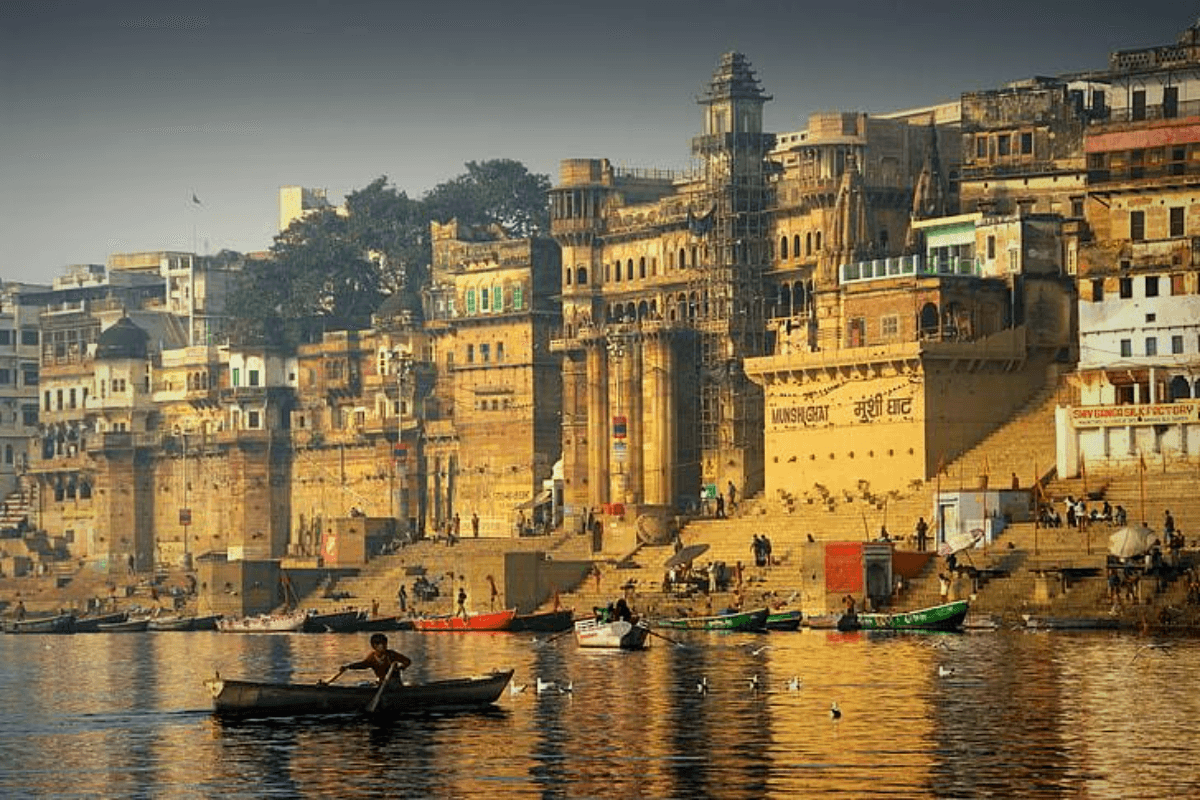
Panchganga Ghat is built in the layered stone style typical of the Kashi waterfront. A long flight of steps rises from the river to the upper lanes, interrupted by broad platforms where pilgrims perform snana-sankalpa, tarpan, and small rituals.
Along the steps, visitors will notice numerous small niches and chhatris, many originally intended for meditation, recitation, and the sheltering of ritual offerings. Some of these small structures are still in devotional use; others stand as quiet witnesses to earlier centuries of pilgrimage.
The upper level is dominated by the large structure that sits above the ghat, within which the traces of the old Bindu Madhav temple can still be seen in the carved lower walls. The present Bindu Madhav shrine, smaller but continuously worshipped, stands a short distance away and is the focus of Vishnu darshan for pilgrims who come to Panchganga.
Unlike the wide, open stages of Dashashwamedh or the funerary gravity of Manikarnika, Panchganga has an inward, contemplative architecture. Its steps invite sitting, its platforms invite prayer, and its upper shrines invite darshan performed without hurry.
Rituals & Practices
The devotional life of Panchganga is centred around three practices: snana (bathing in the Ganga), Bindu Madhav darshan, and the seasonal discipline of Kartik Snana.
For the ordinary pilgrim, a visit here typically follows a simple order. Pilgrims descend the steps in the quiet hours before or just after sunrise. They offer sankalpa, bathe in the Ganga, and perform tarpan for ancestors. From the ghat they then climb up to offer darshan at Bindu Madhav, pairing the grace of Ganga with the grace of Madhav in a single journey.
Offerings commonly made here include:
- A lota of Ganga-jal carried up for the Vishnu shrine
- Tulsi leaves, especially dear to Madhav
- Flowers, chandan, and a simple diya
- Sesame, water, and darbha grass for tarpan by the river
The most distinctive ritual of Panchganga is Kartik Snana. Through the month of Kartik (October-November), devotees begin their day with a pre-dawn bath at this ghat. Many perform the discipline for the full month, some for shorter vows. Small hanging lamps, called Akasha Deep, are lit above the ghat during Kartik in memory of ancestors, giving the pre-dawn waterfront a gentle glow that is one of the loveliest sights of Kashi.
Trailanga Swami's memory also shapes quieter personal practices at Panchganga. Sadhakas sit in silent japa along the upper steps, devotees recall his name and teachings, and some maintain a personal discipline of visiting Bindu Madhav after their bath.
Festivals & Celebrations
| Festival | When | Crowd |
|---|---|---|
| Kartik Snana | — | High â especially at dawn |
| Kartik Purnima Snan | — | Very high |
| Dev Deepawali | — | Extremely high |
| Ganga Dussehra | — | High |
| Makar Sankranti | — | Very high |
Kartik Snana: Tradition holds that bathing at Panchganga during Kartik, especially in the brahma muhurta before dawn, grants merit far beyond ordinary snana. It is considered one of the most cherished disciplines of the Kashi calendar.
Kartik Purnima Snan: One of the most meritorious bathing days of the Hindu calendar, said to equal countless ordinary tirtha snanas.
Dev Deepawali: Believed to be the night the gods descend to bathe in the Ganga. One of the most sacred festival nights of the Kashi waterfront.
Ganga Dussehra: Commemorates the day the Ganga descended to earth through Shiva's matted locks. A deeply auspicious day for bathing at any Kashi tirtha.
Makar Sankranti: Counted among the most sacred bathing days at a panchatirtha. Bathing at Panchganga on this day is held to carry the merit of many tirthas together.
Prepare for Your Visit
Practical guidance to help you plan your pilgrimage
| Pilgrim Guidance | Traditional Pilgrim SequencePanchganga belongs to the Panchatirthi Yatra, the traditional pilgrimage of five ghats of Kashi. Pilgrims who wish to follow the old devotional order perform bathing and darshan at:
Within this sequence, Panchganga usually comes in the middle of the day's journey. Many also pair Panchganga with Vishwanath darshan, keeping the ancient tradition that honours both Vishwanath (Shiva) and Bindu Madhav (Vishnu) as twin patrons of Kashi. Preparation for PilgrimsA small amount of forethought helps the visit to Panchganga feel unhurried and inward.
Boats can also approach Panchganga from the river, and many pilgrims include it in a morning boat yatra of the ghats. From the water, the old terraced architecture of the ghat is seen at its most striking. Best Time to VisitOctober to March is the most comfortable season overall. Within this, Kartik (October-November) is the most sacred period at Panchganga, with the famous month-long bathing discipline and the lighting of Akasha Deep lamps. Kartik Purnima and Dev Deepawali transform the whole waterfront, and Panchganga during these days carries one of the oldest and most beautiful devotional atmospheres in Kashi. |
Location
Varanasi, UP
Pilgrim photos
No pilgrim photos yet.
Community corrections
No corrections yet.
Edit history
No revisions yet.
Plan Your Visit to Panchganga Ghat
Get a custom itinerary and pricing for your trip.
Recommended
Packages for this destination
Pilgrim Notes
On-ground observations from fellow pilgrims
No pilgrim notes yet. Be the first to share on-ground observations!
Sign in to share a note.
Pilgrim Reviews
210 reviews
Be the first to share your experience at Panchganga Ghat.
Sign in to write a review.
Nearby sacred places
Discover other sacred places near Panchganga Ghat
Explore temples, tirthas, and pilgrimage sites in UP
Explore nearbyPart of these circuits
Walk the traditional pilgrimage routes this destination belongs to.