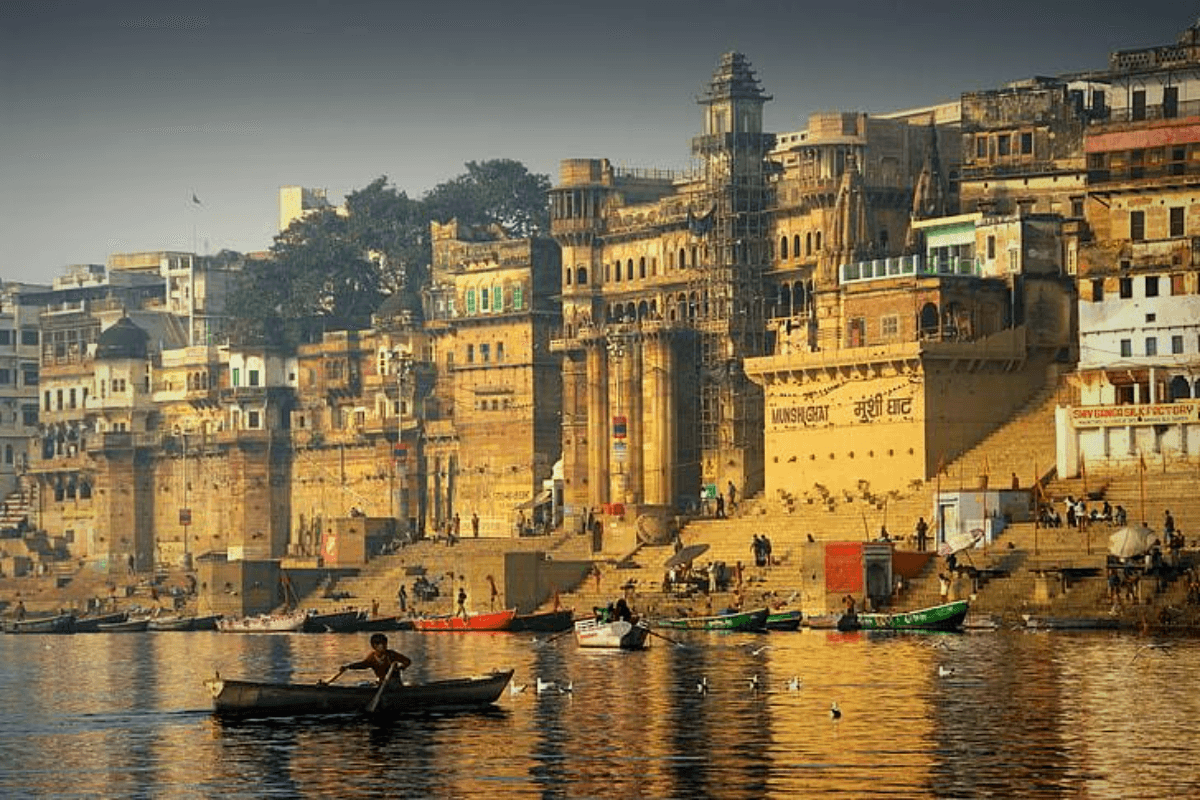
Raja Ghat stands on the middle reach of the Kashi riverfront, in the stretch that runs down from Mansarovar Ghat to Pande Ghat; its immediate neighbours are Narad Ghat above and Khori Ghat below. It is counted thirtieth in the traditional sequence of the city's ghats, which is read from Asi in the south to Adi Keshava in the north. For a pilgrim walking the riverfront, it arrives well before the great gathering-ghats — a place to bathe and to sit, rather than a place to be part of a crowd.
The ghat carried the name of its patron for a long time. James Prinsep, surveying Banaras in 1821 and 1831, recorded it as Amritarao Ghat, and Edwin Greaves still wrote it that way in 1909; the name Raja Ghat appears in Motichand's account of 1931 and has stayed since. Both names point to the same memory — a Maratha patron who turned his wealth toward the river's edge at Kashi.
Above the steps the ground is divided by the stairway itself. The northern side holds the ghat's palace; the southern side holds the Annapurna Math. On the terraces of the compound stand three temples — of Annapurna, Lakshminarayana and Shiva — and above the ghat are the four shrines raised by the patron: Amriteshvara, Vinayakeshvara, Narayaneshvara and Gangeshvara, with four smaller shrines beside them.
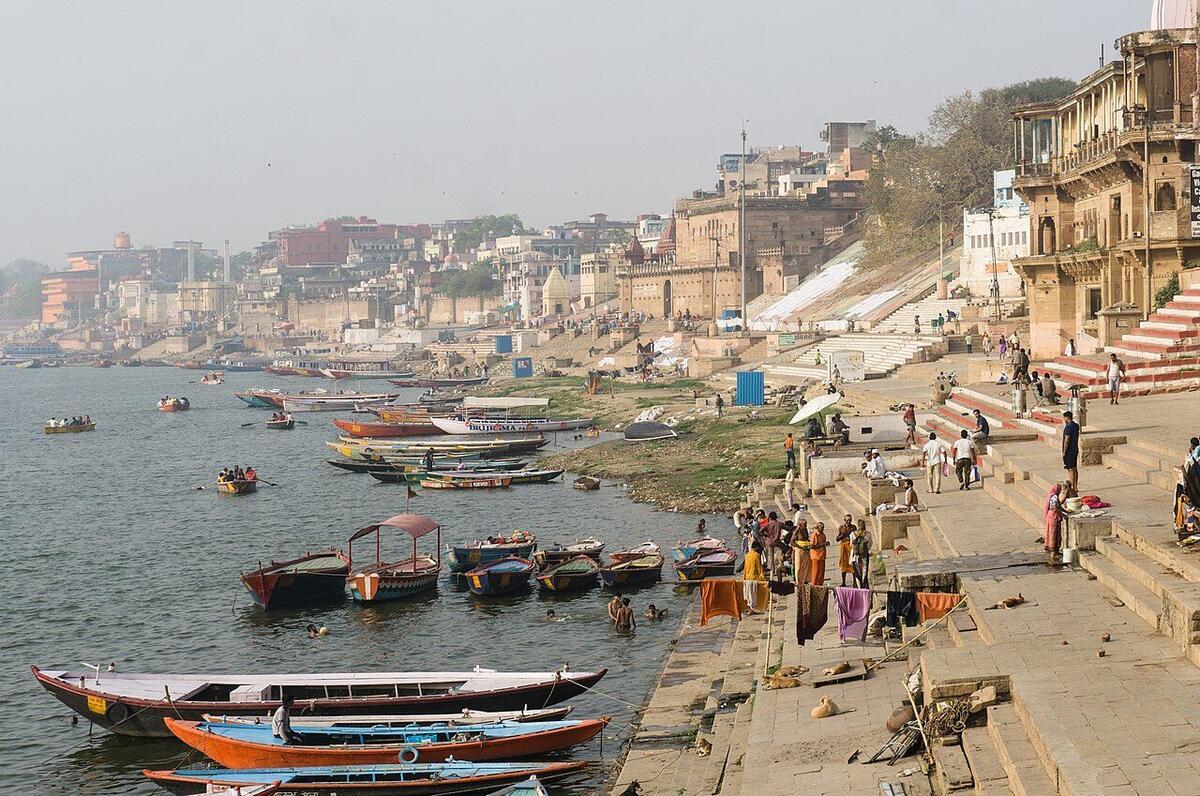
What happens here is what has always happened at a working ghat. Householders come down for snan before the day begins; some sit afterwards on the dry steps for sandhya-vandan; cloth is washed and spread to dry on the upper stones; boats pull in and out. The Ganga receives all of it without distinction, and that ordinariness is itself part of Kashi's devotional life.
A note on the name
Kashi has two ghats whose names are easily confused. This is Raja Ghat, on the middle reach of the riverfront. Raj Ghat — also called Bhaisasur Rajghat — lies far to the north near the Malaviya bridge and Kashi station, and is a separate ghat with its own history and its own priests. When arranging a boat or an auto, name a neighbouring ghat as well, or you may be taken to the other end of the city.
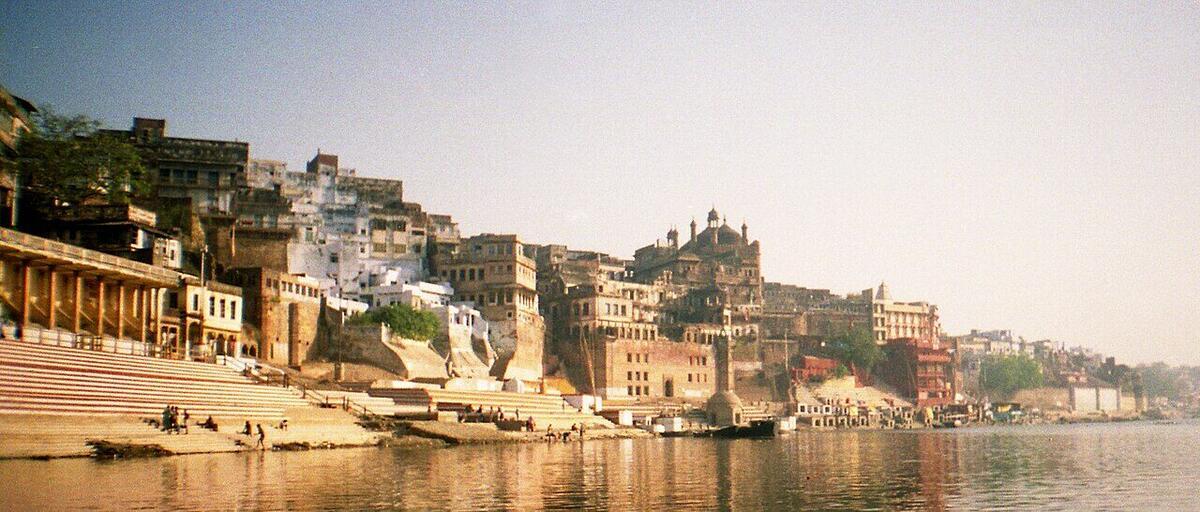
Raja Ghat does not carry a katha of its own in the way Dashashwamedh or Manikarnika do, and it is more honest to say so than to borrow one. Its sanctity is the sanctity of the Kashi tirtha itself: in devotional understanding the whole crescent of the river within the city is holy ground, and a bath taken anywhere along it is taken within Kashi kshetra. The great ghats concentrate that belief; the working ghats simply live inside it.
The shrines the patron raised here read almost as a small statement of faith. Amriteshvara and Gangeshvara are forms of Shiva named for nectar and for the river; in Vinayakeshvara the name of Ganesha, remembered first at any beginning, is joined to Shiva's; and in Narayaneshvara the name of Vishnu is joined to it in the same way, a pairing Kashi has always held together without difficulty. Heritage documentation also records that Amrit Rao renovated a tirtha at this ghat, named in the records as Prabhasa Tirtha — a reminder that Kashi's sacred geography is dense with smaller tirthas that never became famous.
For many Banarasi families the ghat nearest the house is the ghat of daily practice: the first snan of Kartik, arghya offered to the rising sun, a lamp floated on Kartik Purnima, a sankalp taken before a journey. Devotees hold that the grace of the Ganga is not measured by the fame of the step one stands on. Raja Ghat is that kind of ghat, and it has been so for two centuries.
Annadan as devotion
The compound above the steps once kept a tradition that Hindu practice counts among the highest forms of giving — annadan, the gift of food. Until about 1980 Brahmins, students of Sanskrit and wandering ascetics were fed here, and a refectory was built beside the main entrance for the purpose. That tradition has lapsed, but the building remains, and it explains the ghat better than any legend would: this was a place where a family's wealth was turned into worship, first in stone and then in cooked rice.
History
The riverfront of Banaras took its present stone form largely through eighteenth and nineteenth century patronage, and Raja Ghat belongs squarely to that story. Heritage documentation of the riverfront records that the ground here was first levelled and given built structure around 1720, under a patron the record names as Rajirao Balaji — a name that could not be corroborated elsewhere.
The stone ghat as it stands is credited to Amrit Rao Peshwa, who rebuilt it with stone slabs. Heritage documentation gives the period of that work as 1780–1807, but the opening date cannot be squared with his life: he was born about 1770 and was held in confinement in the Deccan until the mid-1790s, so the rebuilding belongs to the later part of that span rather than to the whole of it. Amrit Rao, adoptive brother of Baji Rao II, renounced his claim to the Peshwa's office by agreement with the British in 1803 in return for a pension and a jagir in Bundelkhand, and his later life is closely tied to Banaras. The city remembers him for his charity — he once paid off the debts of every person then imprisoned for debt in Benares — and in 1814 he made a pilgrimage from Banaras to Baidyanath with a company of nearly two thousand. He died on 6 September 1824 at Sikraul (Secrole), near Banaras.
Along with the ghat he raised four temples — Amriteshvara, Vinayakeshvara, Narayaneshvara and Gangeshvara — together with four auxiliary shrines, and renovated the tirtha recorded as Prabhasa. The ghat is called Amritarao Ghat in the surveys of James Prinsep (1821 and 1831) and of Edwin Greaves (1909); Motichand's account of 1931 uses the name Raja Ghat, which is the name in use today.
For a long time the compound kept its tradition of annadan, feeding Brahmins, Sanskrit students and ascetics; that practice continued until about 1980. The Government of Uttar Pradesh renovated the ghat in 1965 and laid the red stone steps that pilgrims descend today. The palace compound is now looked after by INTACH, using traditional building techniques, while the temple properties are held by the Peshwa Temple Trust and the ghat surface by the Municipal Corporation.
Architecture
Raja Ghat is a plain ghat, and its dignity is in proportion rather than in ornament. The steps laid by the state government in 1965 are of red stone, which sets the ghat apart in colour from the buff Chunar sandstone of much of the riverfront. The stairway does more than carry pilgrims to the water; it divides the ground above into two, the palace to the north and the Annapurna Math to the south.
The compound's most distinctive building is the refectory near the main entrance, raised for the feeding of Brahmins and ascetics. It is a two-storeyed structure with a terrace roof; on each floor are a kitchen, a storeroom and a large hypostyle hall — a hall carried on rows of pillars — lit from the centre by a square open courtyard. It is a building shaped entirely by a devotional purpose, and it reads as such.
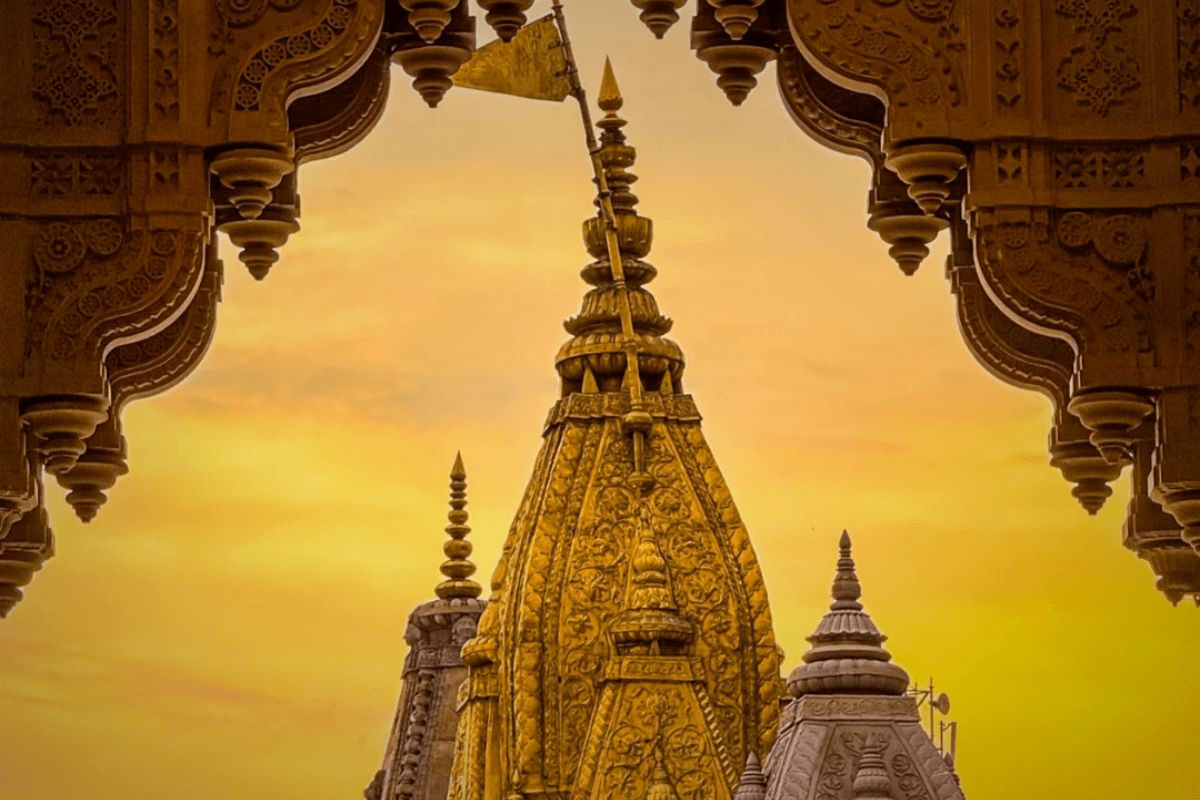
Three temples stand on the terraces of the compound, dedicated to Annapurna, Lakshminarayana and Shiva. The four shrines raised by Amrit Rao, with four smaller ones beside them, complete the ghat's upper edge. The main sacred area of the ghat and temple complex is recorded at about 0.30 hectares — small by the measure of the show-ghats downstream, and entirely sufficient for what is asked of it.
Rituals & Practices
The practice here is the ordinary practice of the Kashi riverfront, kept without ceremony. Snan begins before sunrise; arghya is offered to the rising sun from the lower steps; some devotees sit afterwards in the shade of the upper terrace for sandhya-vandan or japa. Tarpan for ancestors is offered here as at any Ganga ghat, most of all during Pitru Paksha.
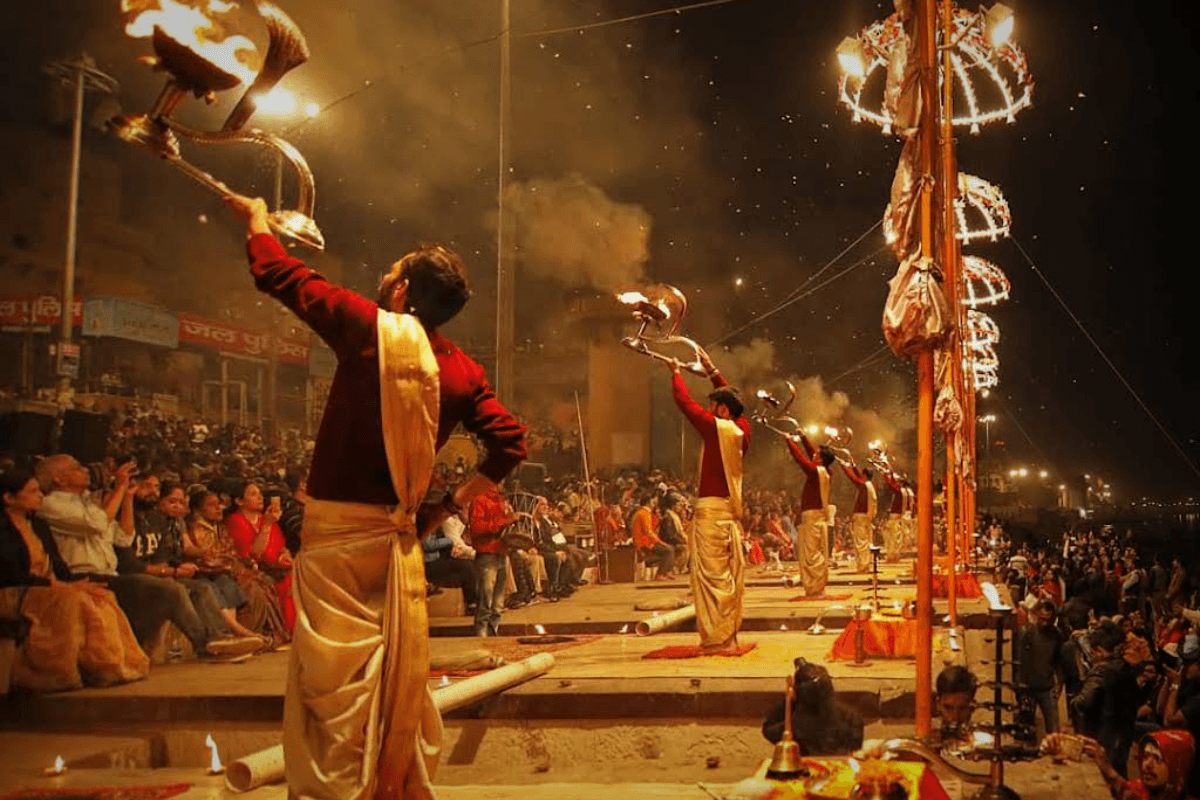
Darshan at the shrines above the steps — Amriteshvara, Gangeshvara, Vinayakeshvara and Narayaneshvara, and the Annapurna, Lakshminarayana and Shiva temples on the terraces — is usually brief and unhurried. The offerings are the simple ones: Ganga-jal, bilva patra, flowers, a lamp. There is no fixed public aarti here of the kind Dashashwamedh keeps, and no scheduled ceremony for which a visitor must arrive at a particular hour.
The small shrines open according to the habits of their trusts rather than a published timetable. Pilgrims who wish to perform a specific puja should speak to the temple trust or a local acharya a day in advance, and should verify any timings locally before travelling for them.
Festivals & Celebrations
| Festival | When | Crowd |
|---|---|---|
| Dev Deepawali | — | High, though far lighter than at Dashashwamedh and the central ghats |
| Kartik Purnima Snan | — | High through the early morning |
| Ganga Dussehra | — | Moderate to high |
| Makar Sankranti | — | Moderate to high in the morning |
| Daily Ganga snan | — | Low to moderate |
Dev Deepawali: Tradition holds that Dev Deepawali marks the descent of the devas to bathe in the Ganga at Kashi, and the lighting of lamps on the ghats is offered in their welcome.
Kartik Purnima Snan: The Puranas praise snana in the month of Kartik, and its final full-moon day above all, as bearing great devotional fruit.
Ganga Dussehra: Devotees hold that bathing in the Ganga on this day carries the removal of the ten kinds of fault, from which the name Dashahara is drawn.
Makar Sankranti: Marks the sun's passage into Makara and the beginning of Uttarayana; snana and daan on this day are held to bear particular merit.
Daily Ganga snan: The unbroken daily practice by which an ordinary ghat of Kashi remains a living tirtha.
Prepare for Your Visit
Practical guidance to help you plan your pilgrimage
| Pilgrim Guidance | How to reachRaja Ghat is most easily reached on foot along the riverfront from Dashashwamedh, walking upstream past Pande and Khori ghats — roughly fifteen to twenty minutes at an unhurried pace. From the city side, the approach is through the lanes below the Dashashwamedh–Sonarpura road; if the name Raja Ghat is not recognised, ask for Narad Ghat or Pande Ghat and walk the short distance. A shared or private boat from Dashashwamedh or Assi will also set you down at the steps when the river is not in spate. Preparation for pilgrims
Best time to visitEarly morning, between first light and about nine, is when the ghat is most alive with snan and quiet practice. October to March is the most comfortable season in Banaras. During the monsoon the lower steps go under water and the working life of the ghat moves up the stairway; boats may not be able to land. Kartik Purnima and Dev Deepawali bring lamps to these steps as to every ghat in Kashi, with far less crowding than at the ghats downstream. |
Location
Varanasi, UP
Pilgrim photos
No pilgrim photos yet.
Community corrections
No corrections yet.
Edit history
No revisions yet.
Plan Your Visit to Raja Ghat
Get a custom itinerary and pricing for your trip.
Recommended
Packages for this destination
Pilgrim Notes
On-ground observations from fellow pilgrims
No pilgrim notes yet. Be the first to share on-ground observations!
Sign in to share a note.
Pilgrim Reviews
Be the first to share your experience at Raja Ghat.
Sign in to write a review.
Nearby sacred places
Discover other sacred places near Raja Ghat
Explore temples, tirthas, and pilgrimage sites in UP
Explore nearbyPart of these circuits
Walk the traditional pilgrimage routes this destination belongs to.