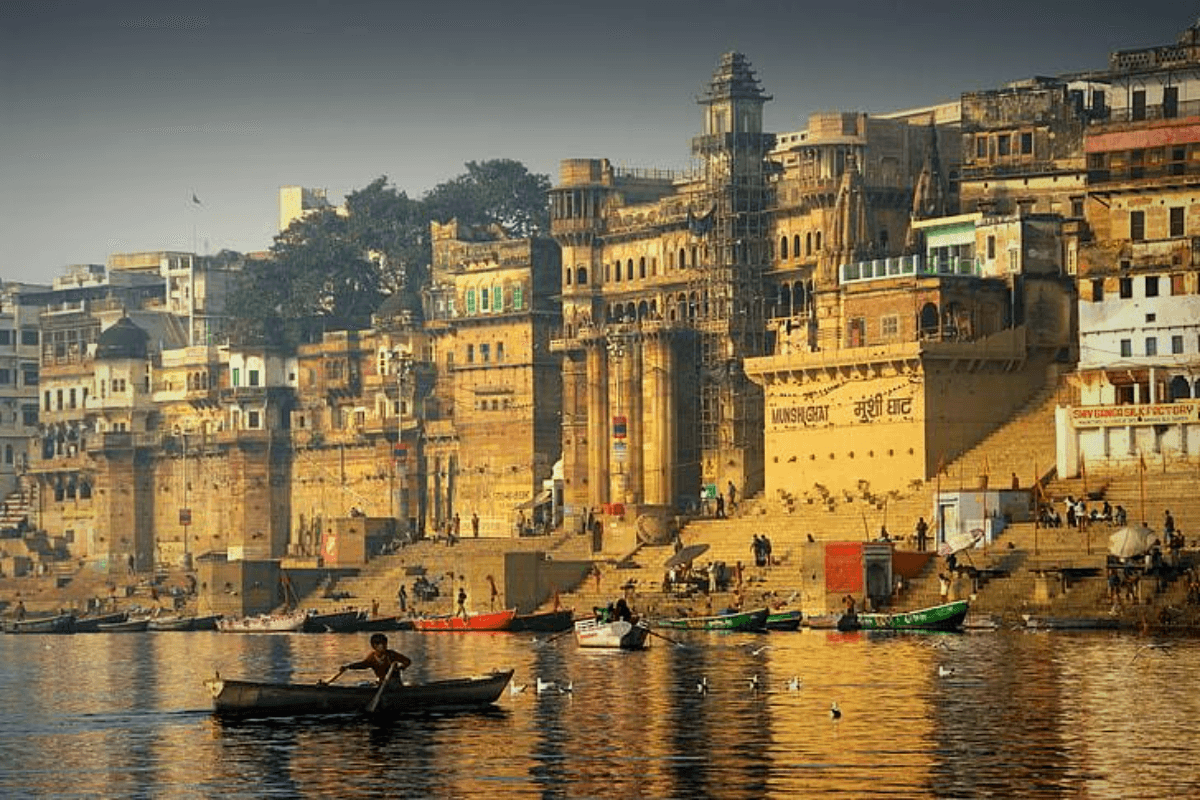
Rana Mahal Ghat stands on the central crescent of the Kashi riverfront, joined to the northern end of Chausatthi Ghat and running up to Darbhanga Ghat. It carries the name of the Rana Mahal, the palace that rises directly above its steps. The heritage dossier compiled for the Varanasi ghats records that the palace was raised by Maharana Jagat Singh of Udaipur and that the Maharana took shelter here on pilgrimage to Kashi. It gives the year as about 1670; that date does not agree with the reign of the Jagat Singh of Mewar it names, so the seventeenth century is safer ground than the year. That the palace is Udaipur's is confirmed independently: writing of the riverfront in 1905, E. B. Havell recorded that at this ghat “the Rana of Udaipur has built a palace”.
What the ghat offers a pilgrim is not ceremony but the steady, unbroken work of the river. The steps are built with a platform set at every fifth stair, so that as the Ganga rises through the monsoon and falls again through the winter, there is always a landing at the water's edge for bathers, for washermen, for boats tying up. In the upper reach of the steps, to the north and to the south, small niches hold Shiva lingas that receive Ganga-jal and bilva patra from passers-by through the day. In the lane immediately above the ghat stands a shrine of Vakratunda Vinayaka, one of the Ganesha shrines that thread the gullies behind the riverfront.
Its place in the sequence of ghats is part of what it is. Walking north along the river a pilgrim passes Chausatthi Ghat, then Rana Mahal, then Darbhanga and Munshi, then Ahilyabai and Shitala, and arrives at Dashashwamedh. Most pilgrims therefore meet Rana Mahal in passing rather than by design. It is quieter than the ghats on either side of it, and for many that quiet is its use — a place to sit with the Ganga for a few minutes before the crowd gathers at Dashashwamedh, or after the evening aarti has ended and the lamps have been carried away.
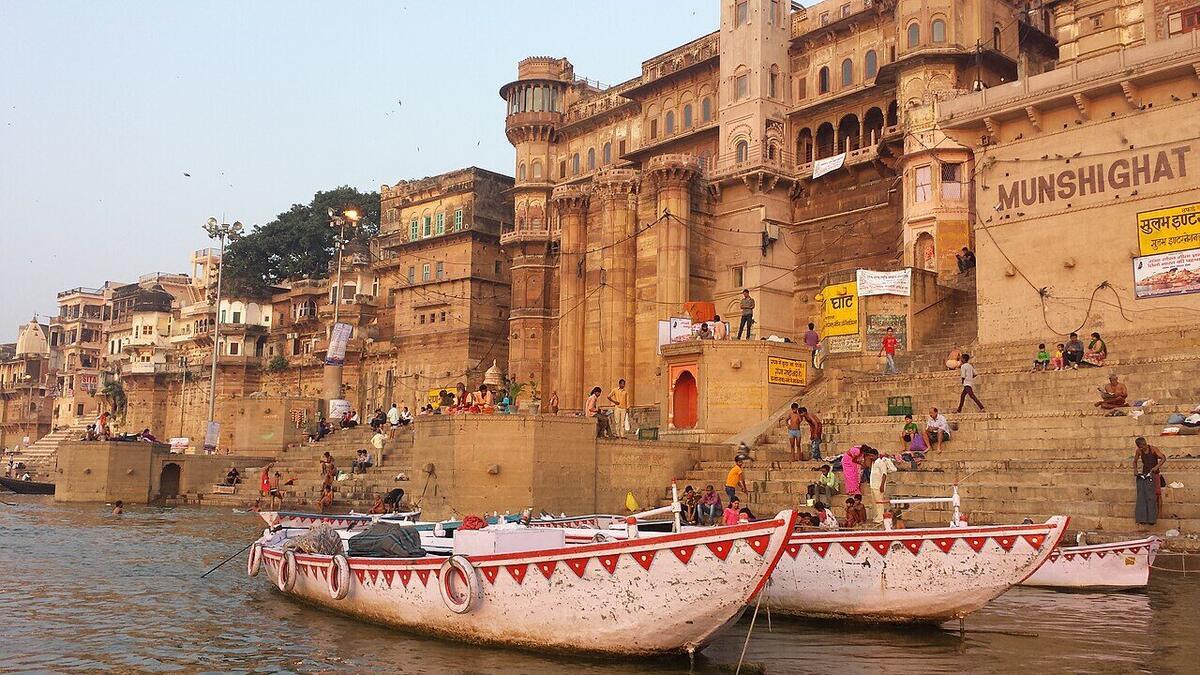
Rana Mahal is not a ghat with a mahatmya of its own. No Puranic katha is attached to these particular steps. Its sanctity is the sanctity that belongs to the whole riverfront of Kashi: the Ganga here is Uttaravahini, turning north against her own course, and tradition holds that snan taken anywhere along this crescent is snan taken in a tirtha. A devotee who bathes at Rana Mahal is not doing something lesser than one who bathes at a famed ghat; the river is one river.
What the ghat does hold is the small, daily devotion of a Banarasi neighbourhood. The Shiva lingas set into the niches of the upper steps are not grand installations — they are the kind of linga a bather greets with a palmful of Ganga-jal on the way up from the water, with a bilva patra if one is at hand. Sankalp, tarpan for ancestors and the simple offering of water to the sun can all be performed here as at any ghat, and pandas of the neighbouring ghats will guide a family that asks.
Vakratunda Vinayaka above the steps
The shrine of Vakratunda Vinayaka in the lane above the ghat belongs to a wider pattern of Kashi's sacred geography. Ganesha is honoured in this city not in one temple but in a set of shrines traditionally counted as fifty-six Vinayakas, arranged around Kashi in a spiralling order of circuits and directions — a mandala mapped onto the streets themselves. Devotees hold that Vinayaka is greeted first, before any undertaking, and pilgrims setting out on a day of darshan often touch the Ganesha of their own lane before turning towards the river.
Why princely houses built on the river
The palace above the ghat is a devotional fact as much as an architectural one. Rajput, Maratha, Bengali and Bihari houses built riverfront residences at Kashi so that their families could keep Kashivas — residence in the city — could bathe daily in the Ganga, and could hope, in old age, for the death that tradition holds to bring moksha in this kshetra. Mewar's house built here for the same reason as the others: to have a doorstep on the Ganga at Kashi.
History
The heritage dossier compiled for the Varanasi ghats records the palace above this ghat as the work of Maharana Jagat Singh of Udaipur, the ruler of Mewar, and notes that the Maharana lodged here during his own pilgrimage to Kashi. It is from this patronage that the ghat takes the name it still carries. The dossier dates the Udaipur work here to about 1670, and its entry for the adjoining Chausatthi Ghat says the same — that in about 1670 the king of Udaipur renovated and extended that ghat. The Mewar connection and the date are therefore attested twice. The name is the weaker part: no Maharana Jagat Singh of Mewar was reigning in 1670, so the person should be read as uncertain even where the century is not.
More than two centuries later the connection was still plain to visitors. Writing of the riverfront in 1905, E. B. Havell moved south from Munshi Ghat and recorded simply that “farther on is Rana Ghat, where the Rana of Udaipur has built a palace”. He also noted that many of the buildings along this stretch of the ghats housed Brahmin sannyasins living on allowances granted by Hindu princes and noblemen — a reminder that these riverfront houses were not only lodgings for visiting rulers but endowments that supported a resident devotional life.
In the modern period the property has divided. Heritage documentation records that the Udaipur Estate trust continues to look after the temple properties attached to the palace, while much of the palace building itself has passed into private hands and part of it is now let as hotel accommodation. The ghat steps below — the part that matters to a pilgrim — are municipal, maintained by the Varanasi Municipal Corporation. Through every one of these changes the ordinary use of the ghat has continued: people still come down these steps in the morning to bathe in the Ganga, which is what the steps were laid for.
Architecture
The Rana Mahal is a Rajput building on a Banarasi riverfront, and it does not disguise the fact. The heritage dossier for the ghat describes three porches facing the Ganga and windows worked in pierced stone — the pierced stone screen-work of Rajasthan, carried across the country and set down over the river at Kashi. Standing beside the sandstone frontage and Greek pillars of the Darbhanga palace just to the north, the Rana Mahal reads as unmistakably of Mewar.
The ghat below is modest in extent — the documented area is only about 0.06 hectare — and its design is entirely practical. A platform is set at every fifth step from the water's edge to the top, so that whatever the level of the river there is a usable landing. Along the upper reach of the steps, on the northern and southern sides, niches are cut to hold Shiva lingas.
Seen from a boat at first light, the ghat is best read as one panel in a long facade: Chausatthi's steps to the south, the Rana Mahal's porches and jali, then Darbhanga and Munshi rising beside it. This continuity of frontage — palace after palace, each built by a different house from a different part of India, all facing the same river — is what the heritage dossier, compiled to press the case for the Ghats of Varanasi on the World Heritage list, sets out to record and protect.
Rituals & Practices
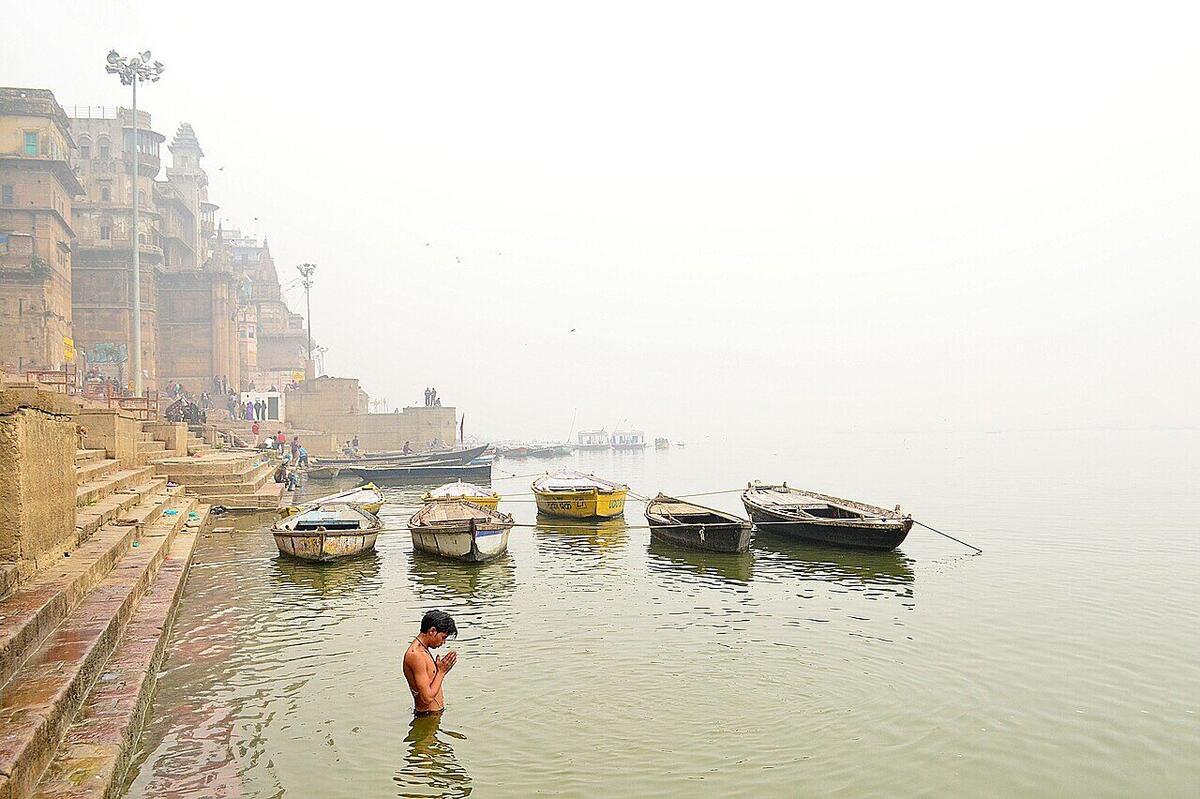
Rana Mahal is a bathing ghat rather than a ceremonial one, and its rhythm is domestic. From well before sunrise, residents of the surrounding lanes come down for snan, take a palmful of water to the lingas in the niches on the way up, and go on with the day. Families visiting Kashi perform sankalp and tarpan for their ancestors here as they would at any ghat; a panda from the neighbouring ghats will sit with a family that asks and guide the rites.
Through the day the steps carry the ordinary life of the river — washing spread out to dry on the stone, boats tied at the lower platforms, children on the middle terraces. In the month of Kartik the whole of this stretch fills before dawn as devotees keeping Kartik-vrata come for their daily bath.
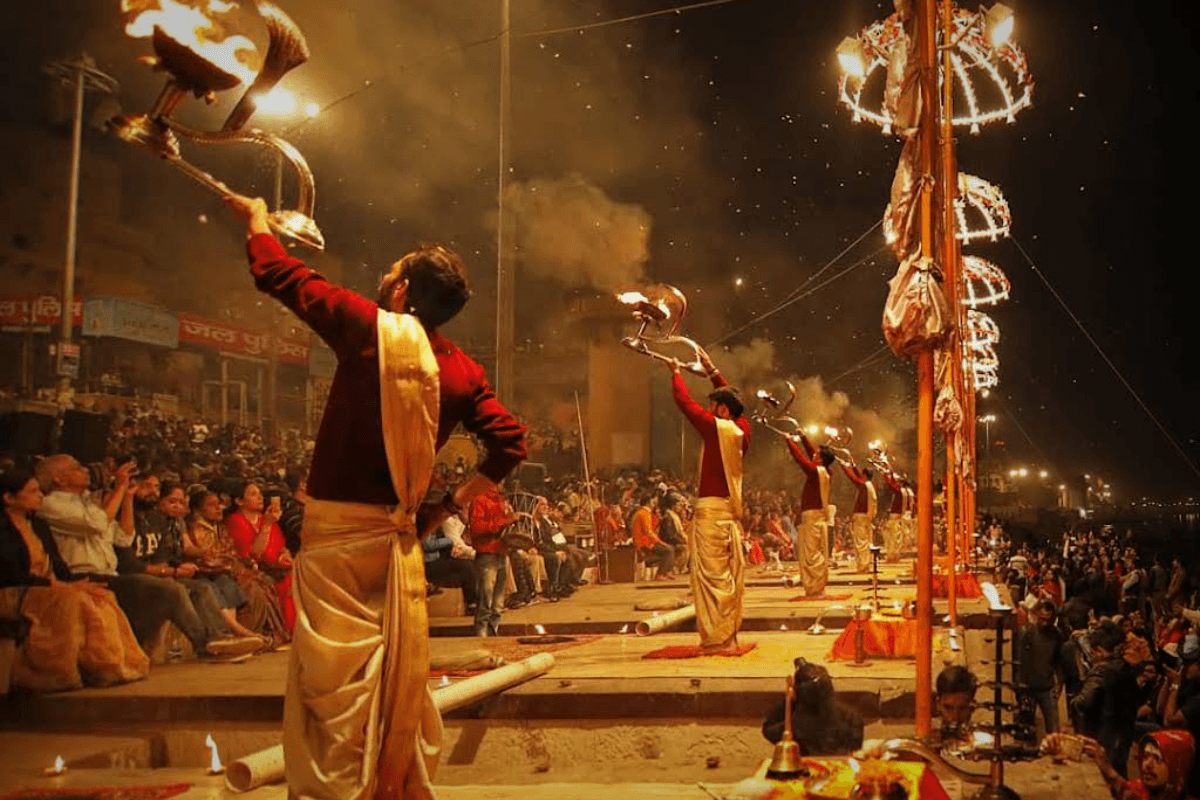
Pilgrims should know that there is no formal evening Ganga Aarti at Rana Mahal. The great aarti of the central riverfront is offered at Dashashwamedh, a few minutes' walk to the north, and a smaller one at Assi to the south. What Rana Mahal offers instead is an unhurried place to light a diya at the water's edge and let it go.
Festivals & Celebrations
| Festival | When | Crowd |
|---|---|---|
| Dev Deepawali | — | Very high â the whole central riverfront fills from the afternoon onward |
| Kartik Purnima snan | — | Very high before dawn |
| Kartik-vrata snan | — | Moderate to high each morning |
| Ganga Dussehra | — | High along the whole riverfront |
| Ganesh Chaturthi | — | Moderate in the lanes above the ghat |
| Daily Ganga snan | — | Steady from before dawn to mid-morning |
Dev Deepawali: Tradition holds that on this night the devas descend to Kashi to bathe in the Ganga, and the lamps set on every step are lit in greeting.
Kartik Purnima snan: The Puranas praise snan in the Ganga on Kartik Purnima as bearing great devotional fruit; at Kashi the whole riverfront is treated as one tirtha for the purpose.
Kartik-vrata snan: Kartik is held in Banaras to be the most meritorious month for daily Ganga snan and for the offering of lamps to the river.
Ganga Dussehra: Devotees hold that snan on this day, offered with the ten-fold sankalp, carries particular grace from the river goddess.
Ganesh Chaturthi: Kashi honours Ganesha through a set of shrines traditionally counted as fifty-six Vinayakas set around the city; Chaturthi is the day devotees make a point of visiting the Vinayaka of their own quarter.
Daily Ganga snan: In Banaras the daily bath is itself the observance; a ghat is judged by whether it is still used, and this one is.
Prepare for Your Visit
Practical guidance to help you plan your pilgrimage
| Pilgrim Guidance | How to reachRana Mahal lies between Chausatthi Ghat and Darbhanga Ghat on the central stretch of the riverfront. Most pilgrims arrive on foot along the ghats themselves — it is a short walk south from Dashashwamedh, past Shitala, Ahilyabai and Munshi. From the city side, the approach is through the gullies behind Dashashwamedh and Sonarpura; the lanes are narrow, and the last stretch must be walked. By river, any shared or hired boat working the central ghats will pass in front of it, and the palace facade is easiest to see from the water. The ghat walk this belongs toRana Mahal is best taken as part of the classical riverfront walk rather than as a destination in itself. A common morning sequence is:
Best time to visitOctober to March is the most comfortable season for walking the ghats. Early morning, between first light and about eight, is when the ghat is at its most alive and its most peaceful at once. Late afternoon light falls directly on the palace facade and is the best hour to see the porches and jali work from a boat. During the monsoon the lower platforms go under water and the steps become slippery; move slowly and keep to the upper terraces if you are walking with elders or children. |
Location
Varanasi, UP
Pilgrim photos
No pilgrim photos yet.
Community corrections
No corrections yet.
Edit history
No revisions yet.
Plan Your Visit to Rana Mahal Ghat
Get a custom itinerary and pricing for your trip.
Recommended
Packages for this destination
Pilgrim Notes
On-ground observations from fellow pilgrims
No pilgrim notes yet. Be the first to share on-ground observations!
Sign in to share a note.
Pilgrim Reviews
Be the first to share your experience at Rana Mahal Ghat.
Sign in to write a review.
Nearby sacred places
Discover other sacred places near Rana Mahal Ghat
Explore temples, tirthas, and pilgrimage sites in UP
Explore nearbyPart of these circuits
Walk the traditional pilgrimage routes this destination belongs to.