Adi Vishveshwar — the name means the first, or original, Vishveshvara — is the temple that stands in the Bansphatak compound on the Godowlia–Chowk road, sharing this small piece of ground with the mosque known as Razia Bibi Masjid. In Kashi's devotional understanding, Vishveshvara is Shiva as Lord of All, the deity whose worship gives the city its centre. This compound is where that name is remembered in its earliest form, and for many Banarasi families the short walk here is part of knowing Kashi properly rather than only visiting it.
The temple is small. A pilgrim who steps in finds a sanctum with the linga at its centre; the heritage record of the site notes the belief that the yoni, the base on which the linga rests, survives from the thirteenth-century shrine. Within the sanctum are images of Ekdanta Vinayaka, Ganesha with one tusk, and of the Sun-god; images of Rama and his family were added much later. In the compound stand the shrines of two of Kashi's Gauris — Shringar Gauri and Saubhagya Gauri — and under an old fig tree there is an image of Shani, with a shrine of Yaksha Bhairava close by. It is a compact devotional gathering rather than a grand one, and that is its character.
Immediately alongside, on a raised mound, stands the Razia Bibi mosque. It is not a ruin and not a monument: it is administered by the Sunni Waqf through a mutawalli, and every Friday a considerable number of worshippers gather there for namaz. A visitor to this compound is therefore standing in a place that two communities use, in a lane where ordinary Banarasi life — shops, houses, children, deliveries — continues around both. Nothing about the visit calls for spectacle.
Satmarg includes this site for pilgrims who want to understand where Vishveshvara's worship in Kashi is traditionally traced from, and who are willing to hold that understanding gently. The history of this ground is documented, and the documentation itself is careful: the earliest site of Vishveshvara, the heritage dossier states plainly, remains an issue of historical investigation. We follow that same restraint on this page. We set out what is recorded, we attribute what is held by tradition, and we leave open the questions that scholarship has not settled.
Katha and local belief
The devotional belief attached to this compound is contained in a single word: Adi. Kashi tradition holds that Vishveshvara was first enshrined and first worshipped here, and that the temple standing today carries that memory forward as a marker rather than as a claim of grandeur. Devotees who come do not come for scale; they come to bow at the place tradition calls the beginning.
A second, warmer belief belongs to the Gauri shrines in the compound. Saubhagya Gauri is worshipped for saubhagya — good fortune, and in particular the well-being of the household and of married life. Kashi's Nav Gauri yatra, the round of nine Gauri shrines that tradition traces to the Kashi Khanda, brings devotees to Saubhagya Gauri on the third day of Chaitra Navratri, and on that morning this quiet lane fills with women carrying flowers, sindur and chunari. For many Banarasi families that single morning, not the rest of the year, is when this compound is most alive.
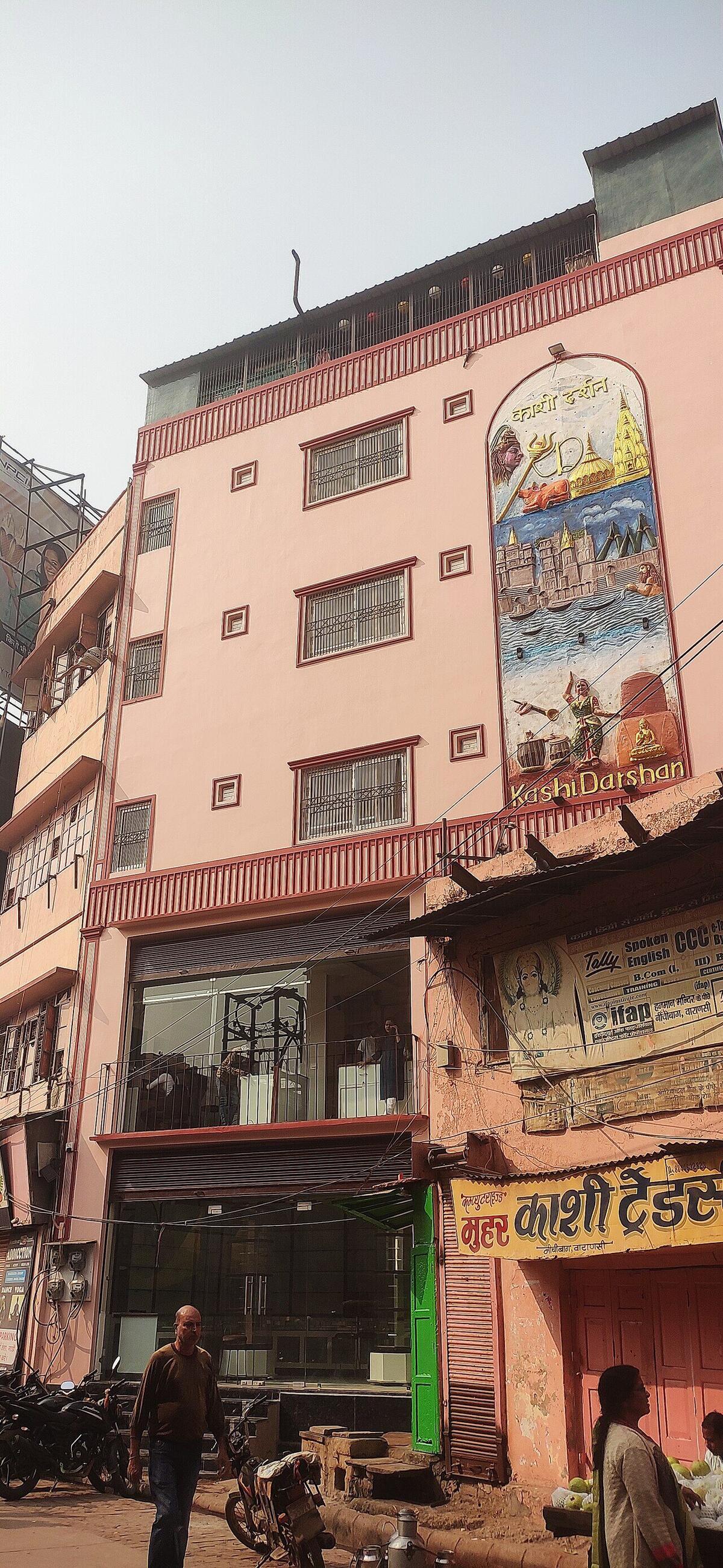
In Kashi's sacred order, Vishveshvara is not one deity among many. He is the presiding presence of the kshetra, and the whole of the city's yatra tradition is arranged in relation to him. The significance of this compound follows from the prefix in its name: devotees hold that here the worship of Vishveshvara in Kashi began. Whether or not history can finally confirm that identification, the belief itself has been carried by the city for centuries, and it is the belief that brings pilgrims to this lane.
For a Shaiva pilgrim, therefore, the darshan at Adi Vishveshwar is a darshan of continuity. The linga here is small and the sanctum is plain, and devotees often say that this is exactly the point — that Mahadev's presence in Kashi does not depend on gold or on scale, and that a very plain shrine holds it as fully as a grand one. Those who understand the site this way find that a few minutes here quietly reframes the darshan they will take later at Kashi Vishwanath.
The compound's second devotional strand is Shakti. Kashi is a city of Devi as much as of Shiva, and the classical Nav Gauri yatra threads nine Gauri shrines through the old lanes. Of that circuit it is Saubhagya Gauri who is worshipped here, on the third day of Chaitra Navratri, and that makes this compound a stop on a living pilgrimage rather than only a historical address; the heritage record also lists a shrine of Shringar Gauri standing in the compound. Devotees hold that Saubhagya Gauri's grace touches the household: the health of a marriage, the steadiness of a home, the fortune of children.
There is also the presence of Bhairava. A shrine of Yaksha Bhairava stands close by, and in Kashi's understanding Bhairava is the kotwal, the guardian who watches over the kshetra and grants permission to remain in it. His presence at the edge of this compound is consistent with how Kashi has always ordered its sacred sites — Shiva at the centre, Devi beside him, Bhairava at the boundary, and Ganesha and Surya attending.
Finally, this compound asks something of the pilgrim that is not devotional at all. Two communities keep their worship on one small piece of ground here, and have done so for a long time; Kashi's own way at such places has been to go on worshipping quietly and to leave the arguing to scholars and to the proper forums. That is the temper to carry into the visit.
History
The history of this ground is documented, but it is documented with an explicit caution, and the caution should be quoted before anything else. The Varanasi heritage dossier compiled from the survey work of scholars of the city states that the first original site of Vishveshvara, or Vishvanatha, “is an issue of historical investigation.” That is the honest position, and it is the one this page keeps.
What the dossier records as accepted is that the earliest shrine on this site was demolished in 1194, in the course of the campaign of Qutb-ud-din Aibak, and that the temple of Vishveshvara stood at what is now the Razia Mosque site. During the reign of Razia Sultana (1236–1240), a mosque was raised on the vacated ground; it is from her that the mosque takes the name by which Banaras still knows it, Razia Bibi Masjid.
Accounts of the following centuries differ, and both positions are set out here without adjudication. The heritage dossier records that in 1448 Mahmud Shah Sharqi of Jaunpur cleared the debris on the site and expanded the Razia Bibi mosque, and that the Vishvanatha worship which had been re-established by the end of the thirteenth century within the compound of Avimukteshvara continued until the middle of the fifteenth century. Other published accounts record that the rebuilt temple was damaged under the Sharqi rulers of Jaunpur and demolished later, under Sikandar Lodi at the end of the fifteenth century — published accounts give the year variously as 1490 or 1494. Historians have not settled this, and it is not settled here.
What is not in dispute is the continuity of worship in the wider area. The main Vishvanatha worship of Kashi moved, and moved again — rebuilt in the Avimukteshvara compound, rebuilt again in 1585 in the Akbar period through the effort of the scholar Narayana Bhatta with the support of Raja Todar Mal, and finally re-established in 1780 by Maharani Ahilyabai Holkar of Indore at the temple pilgrims know today as Kashi Vishwanath. Through all of it, Kashi never stopped calling Shiva by the name Vishveshvara.
On this particular compound, the temple standing today was built later, in the western part of the ground, and it carries the name Adi Vishveshwar — the first Vishveshvara. It is looked after by a temple trust, which handles management, upkeep, cleaning and whitewashing; there is no separate heritage body conserving it. The mosque beside it is administered by the Sunni Waqf, a charitable trust, and represented by a mutawalli who serves as both priest and administrator. Both institutions have functioned side by side in this lane for a long time.
Architecture
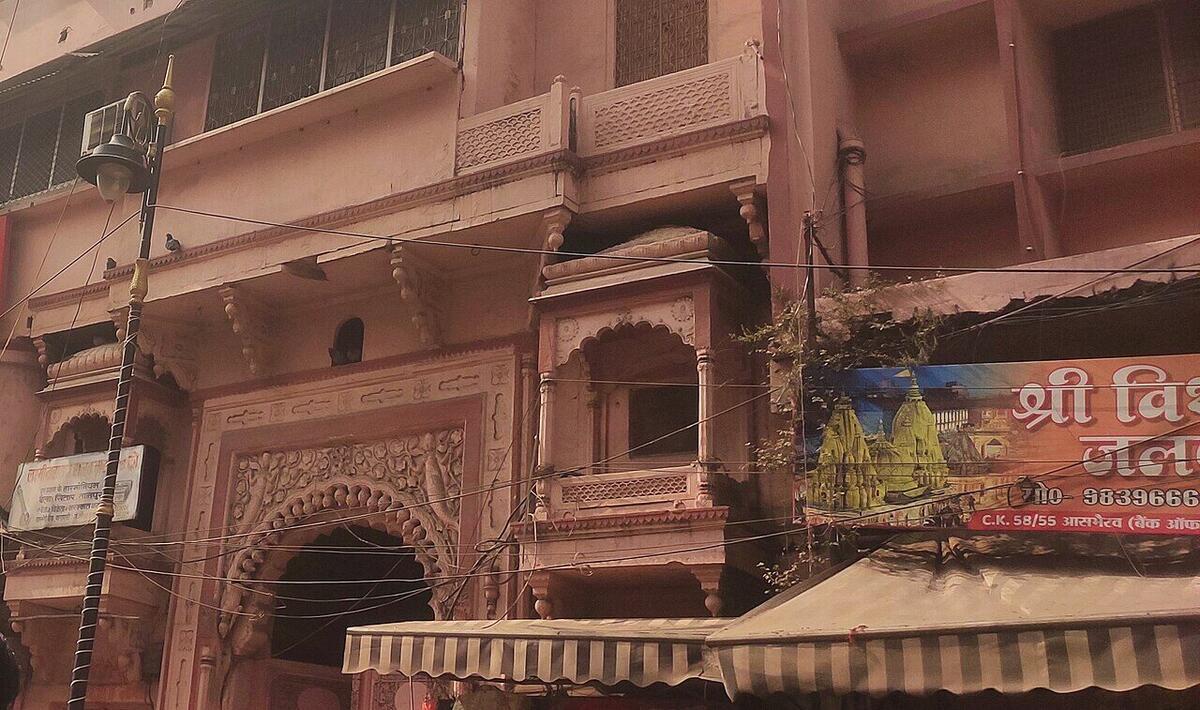
The compound is small — the heritage survey records roughly six hundred square metres for each of the two properties — and its architectural interest lies almost entirely in what the stone itself reveals.
The mosque stands on a high raised mound, so much so that its courtyard now sits at about the level of the terraces of the houses that have grown up around it. On the western side an old flanking wall with a round buttress on top is still visible. The plan of the prayer hall is unusual: the middle of the facade thrusts the central gate forward, with three arcades flanking it on either side. Inside, a thick wall divides the space into two halls, with openings through three arcades. The survey records that these halls are built of pillars, lintels and slabs of stone taken from a building that dates back beyond CE 1000 — a fact plainly visible in the carving of the members and one that scholars use to date the material rather than the mosque. The northern wall originally opened straight onto a garden through two double columns bearing lintels; that opening was walled up comparatively recently. Close study of the plan indicates the mosque was never completed, and that the southern hall was originally meant to stand at the centre. The southern hall is read as thirteenth-century work of Razia Sultana's period; the planned extension behind the qibla wall, and the niches in the north wall, are read as fifteenth-century.
The temple in the western part of the compound is modest in form and unremarkable in scale, which is characteristic of the older shrines of the Kashi lanes rather than a shortcoming. Its devotional weight is carried by its contents: the sanctum with the linga, whose yoni base is believed to survive from the thirteenth-century shrine; the images of Ekdanta Vinayaka and Surya within; the much later images of Rama and his family; the Shringar Gauri and Saubhagya Gauri shrines standing in the compound; the old fig tree with the image of Shani beneath it; and the Yaksha Bhairava shrine nearby. Whitewash, a few brass fittings, oil lamps and worn stone — this is a working neighbourhood temple, and it looks like one.
Anyone reading the compound as architecture should read it slowly. Much of what is visible here carries the mark of a different century.
Rituals & Practices
Worship at Adi Vishveshwar follows the ordinary and unhurried pattern of a small Shiva shrine in the Kashi lanes. Devotees bathe or wash before coming, offer Ganga-jal over the linga, add bilva patra, a little chandan, and flowers, light a lamp, and stand for a short while with folded hands. Many recite the Panchakshara, Om Namah Shivaya, or simply say Har Har Mahadev under their breath. There is no ticketed queue or booking system of the kind the large temples run; you come, you bow, you make room for the next person.
Timings here are not centrally published in the way that a large temple's are. The shrine keeps ordinary morning and evening darshan hours in the rhythm of the neighbourhood, and it is looked after by its temple trust rather than by a public administration. Pilgrims planning a specific darshan should confirm current hours locally on the day, and should not assume the timings of Kashi Vishwanath apply here.
The compound's most distinct observance belongs to Devi. Saubhagya Gauri, whose shrine stands in this compound, is the third station of Kashi's Nav Gauri yatra, the circuit of nine Gauri shrines that tradition traces to the Kashi Khanda and that is completed during Chaitra Navratri. On the third day of Chaitra Navratri devotees — in large part women, and often in family groups — come here for Saubhagya Gauri darshan, offering flowers, chunari, bangles, sindur and sweets, and praying for the saubhagya of the household. This is the one day when the lane is genuinely crowded, and it is the day on which a pilgrim will see the compound at its most alive.
Mahashivratri and the Mondays of Shravan are observed here as they are at Shiva shrines across Kashi, with abhishek and additional offerings, though on those days most of the city's crowd goes to the main Vishwanath temple rather than to this lane.
The mosque in the compound keeps its own weekly rhythm. The heritage record notes that a considerable number of worshippers gather there for Friday prayer. Pilgrims visiting the temple on a Friday should time their darshan with that in mind, keep the lane clear around the prayer hour, and pass through without lingering to watch.
Festivals & Celebrations
| Festival | When | Crowd |
|---|---|---|
| Chaitra Navratri â Saubhagya Gauri darshan | — | High on the third day; quiet otherwise |
| Mahashivratri | — | Moderate â most of the city's crowd goes to Kashi Vishwanath |
| Shravan Mondays | — | Moderate |
| Friday jumma namaz at the mosque | — | Moderate to high around the prayer hour |
Chaitra Navratri â Saubhagya Gauri darshan: Saubhagya Gauri is worshipped for saubhagya â good fortune and the well-being of the household and of married life. The Nav Gauri circuit of nine Gauri shrines is traced by tradition to the Kashi Khanda and is completed across the days of Chaitra Navratri.
Mahashivratri: Devotees hold that offerings made to the linga on this night carry particular grace. At a shrine bearing the name Adi Vishveshwar, the observance also carries the sense of returning to the beginning.
Shravan Mondays: Shravan is held to be Shiva's own month, and the offering of Ganga-jal over the linga on its Mondays is among the most cherished acts of Shaiva devotion in Kashi.
Friday jumma namaz at the mosque: This is the mosque's own weekly prayer, noted here only so that pilgrims can plan considerately: keep the lane clear at the prayer hour, do not photograph, and take darshan at another time of day if you can.
Prepare for Your Visit
Practical guidance to help you plan your pilgrimage
| Pilgrim Guidance | How to reachThe compound is at Bansphatak, on the Godowlia–Chowk road in the old city, in the lane known locally as Adi Vishwanath Gali. It sits within the same dense old-city core as the Kashi Vishwanath area and is reached on foot; the lanes here do not take cars. Most pilgrims come down to Godowlia by auto or e-rickshaw and walk in from there, and any local shopkeeper will point out Bansphatak if you ask for it by name. Varanasi Junction is a short drive from Godowlia, and Lal Bahadur Shastri Airport at Babatpur is roughly 25–30 km by road from this part of the city; allow generously for old-city traffic in both directions. Because the compound is in a residential lane rather than on a temple campus, do not expect signage, a parking area, a cloakroom or a shoe stand of the kind large temples provide. Plan to keep your hands free and your belongings minimal. Preparation for pilgrims
Best time to visitOctober to March is the comfortable season for walking the old city, and early morning is the best hour at this compound — the lane is quiet, the shops are still opening, and darshan can be taken without haste. Chaitra Navratri, and particularly its third day, is when Saubhagya Gauri darshan draws real crowds; come early if that is your purpose, and be prepared to wait. On Fridays, plan around the midday prayer time at the mosque. Avoid coming with a large group, avoid loud arrival, and avoid days on which the old city is already under heavy festival pressure unless the festival itself is your reason for coming. |
Location
Varanasi, UP
Pilgrim photos
No pilgrim photos yet.
Community corrections
No corrections yet.
Edit history
No revisions yet.
Plan Your Visit to Razia Sultana Mosque-Temple Complex
Get a custom itinerary and pricing for your trip.
Recommended
Packages for this destination
Pilgrim Notes
On-ground observations from fellow pilgrims
No pilgrim notes yet. Be the first to share on-ground observations!
Sign in to share a note.
Pilgrim Reviews
Be the first to share your experience at Razia Sultana Mosque-Temple Complex.
Sign in to write a review.
Nearby sacred places
Discover other sacred places near Razia Sultana Mosque-Temple Complex
Explore temples, tirthas, and pilgrimage sites in UP
Explore nearbyPart of these circuits
Walk the traditional pilgrimage routes this destination belongs to.