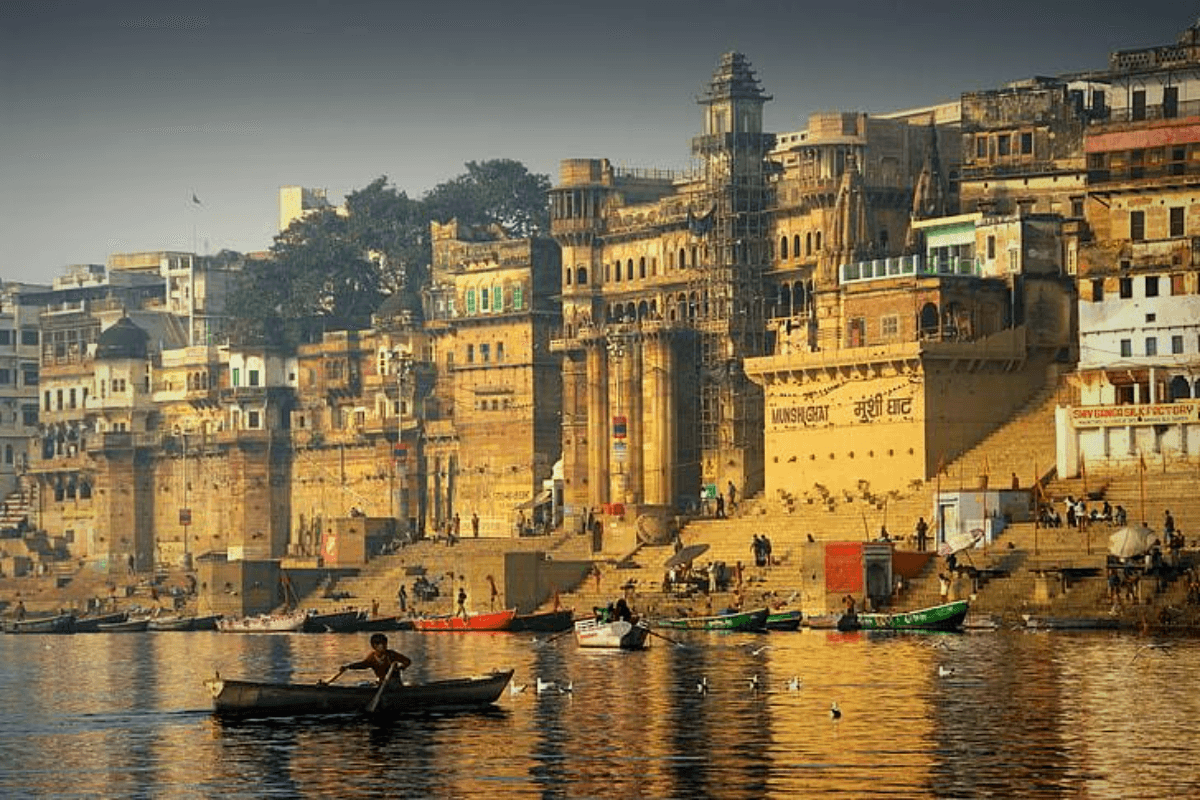
Scindia Ghat lies on the northern stretch of the Kashi riverfront, about five hundred metres downstream of Manikarnika — the mahasmashana where antim sanskar is offered day and night. Heritage accounts record that older Banaras usage knew this stretch by another name altogether: Vireshwar Ghat, after Vireshwara, worshipped in the lanes above. The name Scindia came later, with the Maratha house of Gwalior whose patronage rebuilt the steps in stone.
What gives this ghat its devotional weight is not the waterfront but the quarter behind it. The galis climbing away from the steps are known in Banaras as Siddha Kshetra, the field of fulfilment — a thick cluster of small shrines set into lanes so narrow that a pilgrim passes them almost shoulder-first. Tradition holds that Agni, the deva of fire, took birth in this quarter. Devotees come up from the water to Vireshwara, whose name is understood as the lord of the valiant, and Banarasi families have long propitiated him with the prayer for a son.
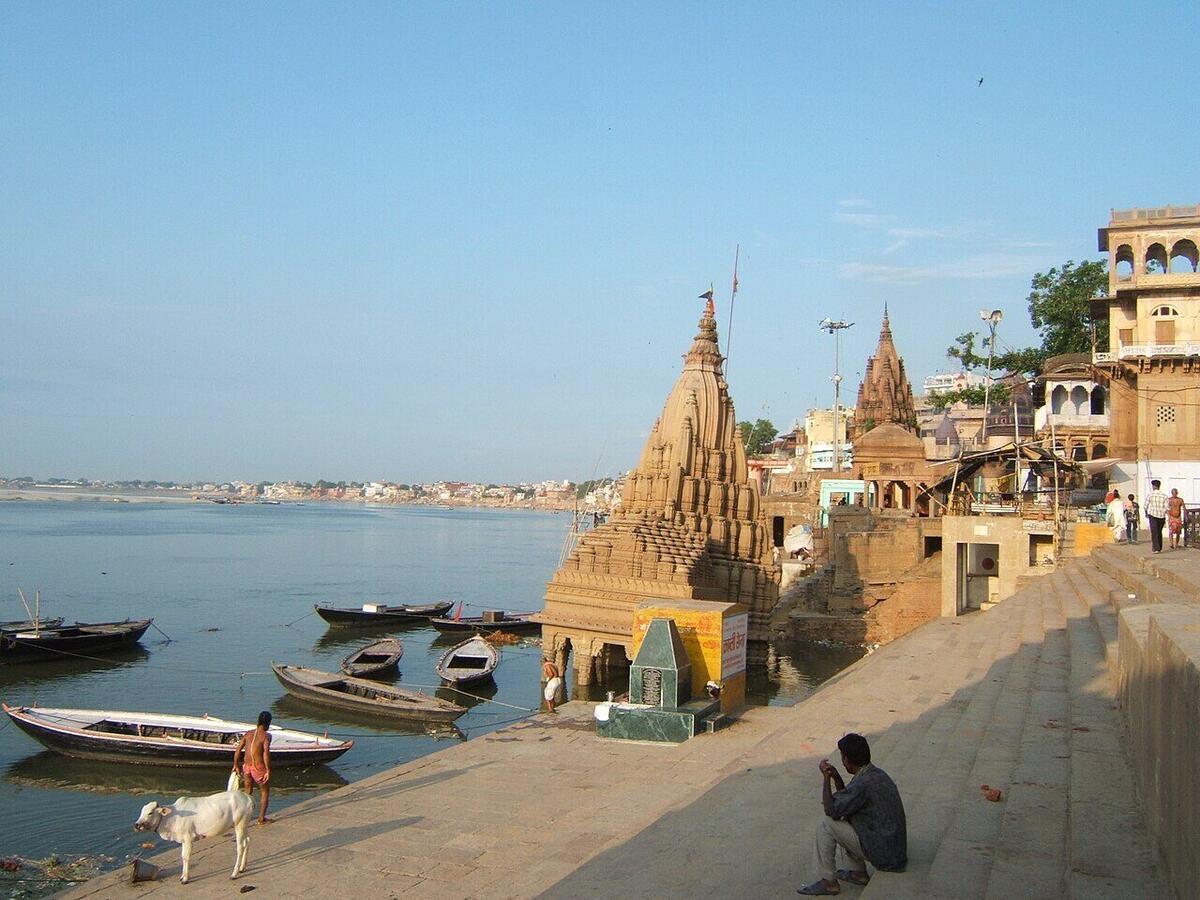
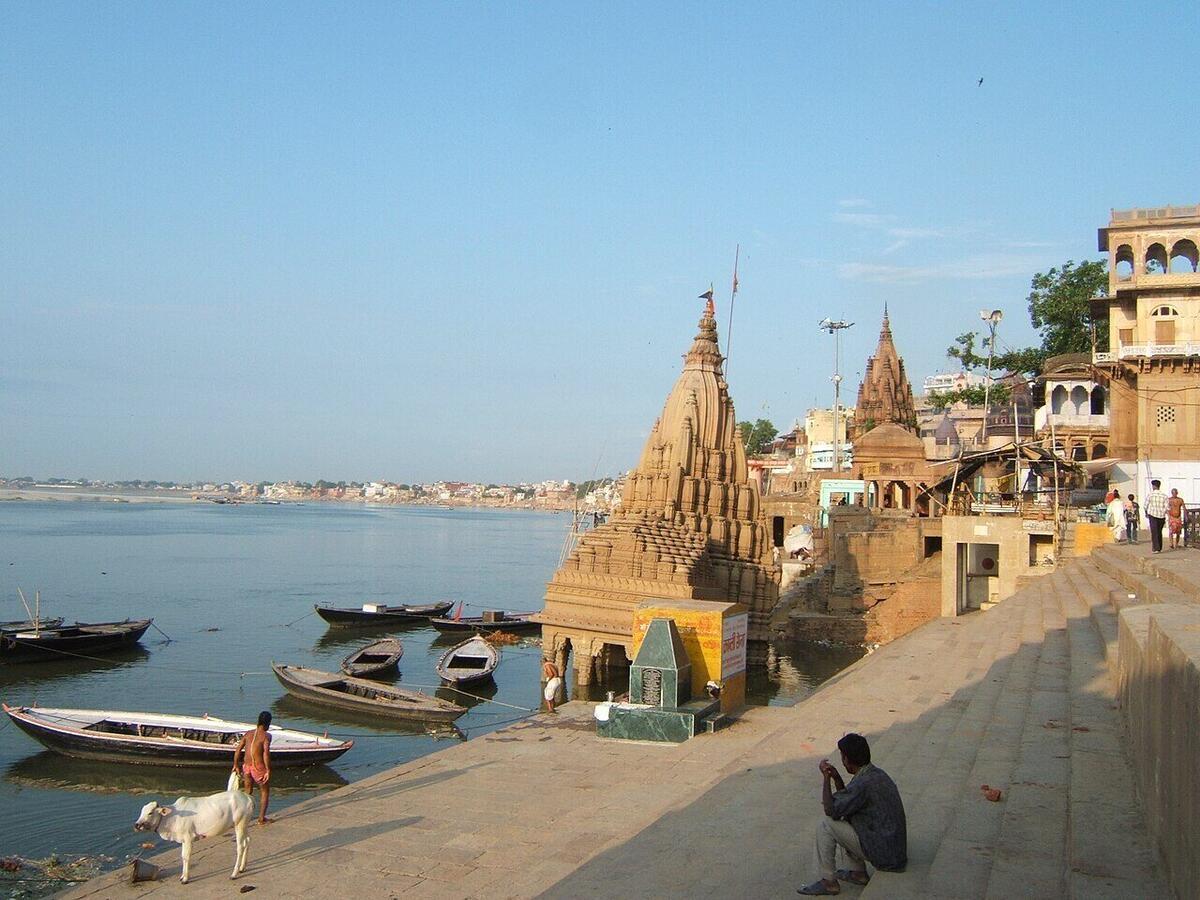
The ghat is also known for what the river has slowly done to it. The stone terraces raised in the nineteenth century proved heavier than the riverbank beneath could carry, and the masonry has been settling into the Ganga ever since. Heritage accounts record that some ten or twelve feet has gone under in all, with stair after stair vanishing continually, though slowly. A small Shiva shrine now stands tilted at the waterline, its lower courses submerged for much of the year. Pilgrims still offer to it from the steps.
For all this, Scindia remains a working bathing ghat rather than a monument. Before sunrise it is one of the quieter stretches of the central riverfront — a place Banarasis come for snan, for japa, and for the long sitting that the low stone turrets were built to allow.
Scindia is not one of the five Panchatirtha ghats of the classical Kashi yatra. Its sanctity is of a different kind: it is the water-gate to Siddha Kshetra, and it stands within sight of the mahasmashana. Pilgrims who take snan here are, in devotional understanding, bathing at the threshold of the ground where Kashi's promise of moksha is most directly enacted.
Siddha Kshetra and the birth of Agni
Banarasi tradition names the lane-quarter above these steps Siddha Kshetra — the field where sadhana bears fruit. Local belief holds that Agni, the deva of fire who carries every offering from the earthly hearth to the devas, took birth here. The tradition is preserved in devotional memory and in the shrines of the quarter rather than in any single celebrated temple, and it is best received as Banaras receives it: as a long-held belief about the ground underfoot, not as a documented event.
The shrines themselves are documented, and they are many. Heritage documentation of this stretch records, at the northern end below the high steps, the linga of Yameshvara and, in a niche in the climbing steps, the image of Yamaditya facing south, the direction of Yama — both held in tradition to have been installed by Yama himself, and both cited to the Kashi Khanda (51.108). Above them the same documentation places a Saptarshi shrine of lingas ascribed to the rishis Vashishtha, Vamadeva and Janaka, the Vinayaka called Chintamani at its gate, the Vishnu shrines of Vaikuntha Madhava and Vira Madhava, and the linga of Harishchandreshvara. Scriptural citations of this kind are made by the heritage record; the verses themselves are not reproduced here.
Vireshwara and the prayer for a child
The shrine that gave the ghat its older name is Vireshwara — Atmavireshvara in the heritage record — understood as Shiva in the form of the lord of the valiant, and eulogised there as a self-born linga. Devotees hold that worship offered here is answered with the birth of a son, and childless couples have come to this shrine for generations with that sankalp. The prayer is offered quietly, without ceremony, and the shrine remains a small one — a reminder that in Kashi the weight of a place is measured by what people have asked of it, not by its size.
Beside the mahasmashana
Manikarnika lies a short walk upstream. Through the day, shav-yatras pass along the lanes and the ghat edge on their way to the cremation ground, and mourning families use the Scindia steps for the bath that follows. Devotees hold that the soul that receives antim sanskar in Kashi is given moksha by Shiva himself. Standing beside that ground, Scindia carries something of its gravity: it is a place to bathe and to be silent, not to linger loudly.
History
The ghat's devotional life is older than its present stone. Heritage accounts cite the Sanskrit work Girvanapadamanjari as recording the older name of this stretch — Vireshwar Ghat — after the shrine above it — which is to say the stretch carried a devotional name of its own before it carried the Scindia name.
The pucca ghat as it now stands is the work of the Scindia house of Gwalior. Heritage records name Maharani Baiza Bai Scindia, widow of Daulat Rao Scindia and for several years the ruling regent of the Gwalior state, as the patron; accounts date the rebuilding variously to 1830 and 1835, so the decade is more reliable than the year. The same patron is credited with the stone colonnade raised around the Gyanvapi well near Kashi Vishwanath — a reminder of how much of the visible fabric of nineteenth-century Kashi was rebuilt by Maratha royal houses who governed elsewhere but understood Kashi as the ground of their punya.
The rebuilding was substantial, and its weight became its own problem. The terraces settled into the soft riverbank, and heritage accounts describe the ghat as having sunk some ten or twelve feet in all, with stairs continuing to disappear slowly. Nothing about this arrested worship. The ghat was repaired and re-used, the shrine at the water's edge continued to receive offerings even as it tilted, and the steps remained in daily service. The record of Scindia Ghat is not one of ruin but of a riverfront that keeps being used while the river quietly takes it back.
Architecture
The distinctive feature of Scindia Ghat is its tiered arrangement of low stone turrets — three rows of them, called marhis in Banaras, each with its own short flight of steps. They were built to be sat on and rested in, and that is what they are still used for: pilgrims wait out the heat in them, and bathers sit in them after the snan. The stone throughout is the sandstone of the Banaras riverfront, worn smooth by bare feet and river water.
The ghat's condition is part of its architecture. Because the nineteenth-century terraces outweighed their foundation, whole courses of masonry have gone under the waterline, and the small Shiva shrine at the river's edge leans visibly out of true. A further temple beside the southern turret stands in a dilapidated state. None of this is picturesque decay in the visitor's sense — it is a working riverfront in slow negotiation with a river that undercuts it every monsoon.
A word of care about the famous leaning temple: the much-photographed Ratneshwar Mahadev, whose garbhagriha lies under water for most of the year, is placed by the standard reference accounts at Manikarnika Ghat, upstream of this one — though some Banaras heritage pages describe the half-submerged temple on this stretch under that same name, so the two are not always kept apart. Its patron is disputed in every account: revenue records point to 1825-1830, the temple's own priests tell of a servant of Raja Man Singh who built it for his mother Ratna Bai, and other accounts credit Baija Bai of the Gwalior house or the Amethi family. The honest position is that the attribution is unsettled.
Rituals & Practices
Scindia is first of all a snan ghat. From well before sunrise, Banarasi households and pilgrims come down for the bath, for sankalp, and for tarpan offered to ancestors at the water's edge. The ghat is known among locals as one of the calmer stretches of the central riverfront in the early hours, and many come here specifically for japa and quiet dhyan on the turret steps after bathing.
Worship at the tilted Shiva shrine continues according to the water level; when the river is low and the plinth clears, flowers, bilva patra and Ganga-jal are offered directly, and when it is high the offering is made from the steps above. In Kartik, deep-daan — the floating of earthen lamps on the river — is offered here as along the whole riverfront.
Pilgrims seeking the Vireshwara darshan climb into the lanes of Siddha Kshetra above the steps. The shrines there are small, family-tended, and follow no fixed public schedule; it is best to ask locally for the timing of aarti rather than to assume one.
Through the day, funeral processions pass along this stretch toward Manikarnika. Bathing and worship continue around them; the accepted local practice is simply to make way, fall silent, and let them go by.
Festivals & Celebrations
| Festival | When | Crowd |
|---|---|---|
| Dev Deepawali | — | Very high â the whole riverfront fills; reach the ghat well before dusk |
| Kartik Purnima Snan | — | Very high |
| Ganga Dussehra | — | High |
| Mahashivratri | — | High |
| Makar Sankranti | — | High |
| Daily Ganga snan | — | Moderate; light before sunrise |
Dev Deepawali: Tradition holds that Shiva destroyed Tripurasura on this day, and that the devas kept it as their own festival of lights â which is why Banaras calls it the Deepawali of the gods. A diya lit on the steps is offered in that welcome.
Kartik Purnima Snan: Tradition counts a Ganga snan on Kartik Purnima among the most auspicious of the year, and holds a bath at Varanasi on this day to be especially so. Deep-daan offered on this night is held to be greatly meritorious.
Ganga Dussehra: Bathing in the Ganga on this day is held in tradition to remove the ten kinds of sin.
Mahashivratri: Observed as the night of Shiva's union with Parvati and, in Kashi, as the night the city most fully belongs to its Lord.
Makar Sankranti: Marks the sun's passage into Makar rashi. Snan and daan on this day are held to bear great devotional fruit.
Daily Ganga snan: The unbroken daily life of a Kashi bathing ghat, which is what these steps were before they carried the Scindia name.
Prepare for Your Visit
Practical guidance to help you plan your pilgrimage
| Pilgrim Guidance | How to reachScindia sits in the northern, older part of the ghat line. Most pilgrims arrive on foot from Kashi Vishwanath through the lanes past Manikarnika, or walk north along the riverfront from Dashashwamedh — a steady twenty to thirty minutes depending on the crowd. Vehicles reach only as far as the outer lanes; the last stretch is always on foot. The other approach is by boat from Dashashwamedh or Assi, which is also the clearest way to see the sunken shrine and the ghat's turret rows. Agree the boat fare clearly before stepping in. Best time to visitThe hour before and after sunrise is the ghat's own time — cool, uncrowded, and given over to snan and japa. Late afternoon light falls well on the turrets and the tilted shrine for those coming by boat. October to March is the most comfortable season overall. In the monsoon the water rises over the lower terraces, the stone becomes slippery, and the submerged shrine disappears entirely; plan accordingly if seeing it matters to you. What to expect beside ManikarnikaThis is a quiet ghat with a cremation ground as its neighbour. Expect to see funeral parties passing and mourning families bathing, and expect to be approached occasionally by people asking for donations toward cremation wood — a well-known solicitation in the lanes around Manikarnika, which pilgrims are free to decline politely. Carry small cash for genuine offerings and dakshina, keep valuables close in the lanes above, and allow extra time: the galis of Siddha Kshetra are easy to lose your bearings in, and asking a shopkeeper the way is normal and welcome. |
Location
Varanasi, UP
Pilgrim photos
No pilgrim photos yet.
Community corrections
No corrections yet.
Edit history
No revisions yet.
Plan Your Visit to Scindia Ghat
Get a custom itinerary and pricing for your trip.
Recommended
Packages for this destination
Pilgrim Notes
On-ground observations from fellow pilgrims
No pilgrim notes yet. Be the first to share on-ground observations!
Sign in to share a note.
Pilgrim Reviews
Be the first to share your experience at Scindia Ghat.
Sign in to write a review.
Nearby sacred places
Discover other sacred places near Scindia Ghat
Explore temples, tirthas, and pilgrimage sites in UP
Explore nearbyPart of these circuits
Walk the traditional pilgrimage routes this destination belongs to.