Vasudhara Falls lies deep in the Garhwal Himalaya of Chamoli district, on the high trail beyond Mana village — the last Indian habitation before the Tibetan border — and about 9 km from Badrinath Dham. The water descends nearly 400 feet down a sheer cliff face at approximately 3,658 metres above sea level, fed by snowmelt from the Chaukhamba massif. From a distance the fall appears as a thin silver ribbon hanging on the dark rock; come closer, and the wind carries its spray in scattered drifts across the valley.
For pilgrims of the Badrinath yatra, Vasudhara is not approached as a scenic site but as an extension of the dham itself. The trail begins at Mana, passes Bhim Pul and the Saraswati's sudden rising at Keshav Prayag, climbs gently through alpine meadow and moraine, and ends at the foot of the fall. Many pilgrims walk this stretch in silence. The air thins, the wind sharpens, and the only sound that travels far is the distant rush of the water itself.
The Pandava katha — Vasudhara on the svargarohan trail
The Mahabharata remembers this stretch of the Garhwal Himalaya as the path of the Pandavas' final journey. After the great war was over, after Yudhishthira had ruled and the time had come to lay down the burden of kingship, the five brothers and Draupadi set out northward with a small dog at their heels. They crossed the plains, climbed into the hills, and entered the high Himalaya seeking svargarohan — the ascent of the body itself toward the heavens. Tradition places Mana, Bhim Pul, Vasudhara, Lakshmi Van, and Satopanth along that final trail. One by one, beginning with Draupadi, the Pandavas fell — each at the place where some subtle attachment in the heart still bound them to the earth. Only Yudhishthira and the dog walked on. Vasudhara is remembered as one of the stations of that ascent — a place where the falling water itself seems to test, to weigh, to know.
From this Mahabharata memory comes the long-cherished belief of Badrinath: the waters of Vasudhara turn away from one whose heart is heavy with sin. Stand beneath the fall, raise your face, and the spray will reach you only if your inward state permits. Old pilgrims speak of this not as a magical test but as a quiet mirror — the wind decides, and the wind, here, is held to carry the breath of dharma.
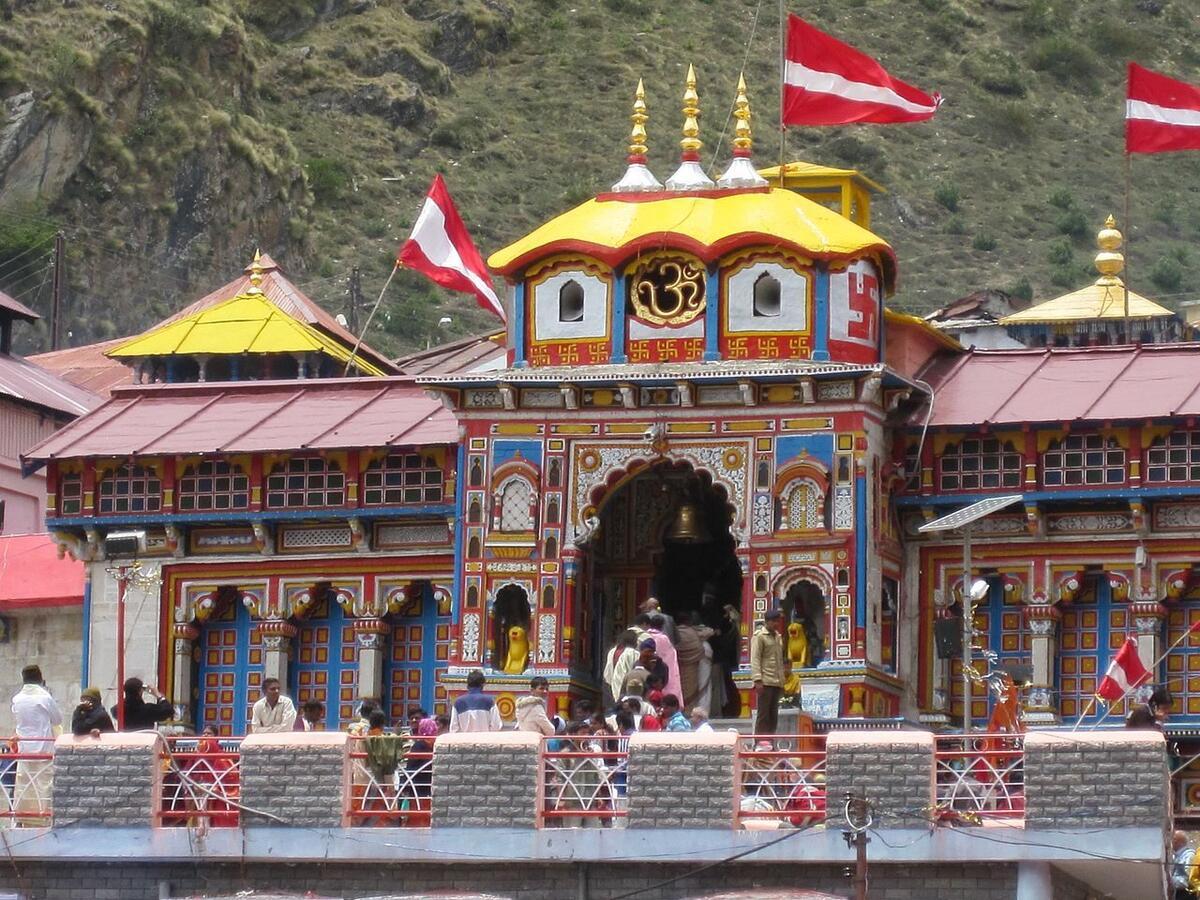
Vasudhara is one of the deepest tirthas of the Badrinath region, held in reverence not for any built shrine but for what the place itself carries. The water is taken to be living — jala-rupa, the form of grace as falling water. To touch the spray of Vasudhara is, in Badrinath devotional tradition, to receive a darshan that the dham's sanctum cannot give: the darshan of grace as it moves through the elements.
The fall sits within the larger sacred geography of Badri Kshetra. Above lies Satopanth, the triangular lake where Brahma, Vishnu, and Shiva are said to bathe; near at hand are Lakshmi Van, the forest of Devi Lakshmi, and Charanpaduka, the rock bearing Vishnu's footprint. Vasudhara belongs to this constellation as the place of water-grace — the falling stream that carries the bhav of the Pandavas' last walk, the breath of the high snows, and the old test of the heart.
For many Char Dham pilgrims, Vasudhara is the inward conclusion of the Badrinath journey. One has bowed at the dham, taken Tapt Kund snan, crossed Bhim Pul, seen the Saraswati emerge from the rock at Keshav Prayag, and now stands at the foot of a 400-foot fall in a place where the human voice is small. What returns at Vasudhara is something the temple does not always give: the simple awareness of being one small life held within the vastness of the snows. Pilgrims who reach the fall often describe a feeling not of triumph but of softening — as if the long walk itself were the prayer, and the spray on the face the answer.
History
The earliest layers of Vasudhara's memory belong to the Mahabharata, where this stretch of the upper Alaknanda valley is named as part of the Pandavas' svargarohan route. Mana, Bhim Pul, Vasudhara, Lakshmi Van, and Satopanth appear together in Garhwali oral tradition and in pilgrim accounts as the stations of that final ascent. The katha has been carried for centuries by the people of Mana — a Bhotia-Marchha community whose families have lived in the last village before Tibet for generations and who remember the Pandava trail as their own home-ground.
References to Vasudhara appear in medieval Vaishnava pilgrimage literature associated with the Badrinath Dham. Adi Shankaracharya's revival of Badrinath in the 8th-9th century brought renewed flow of pilgrims into this upper Alaknanda region, and the side-trail to Vasudhara was already known then as part of the extended Badri-kshetra. In later centuries, ascetics, Vaishnava sadhus, and small parties of Char Dham pilgrims walked this stretch as a continuation of the dham visit. The trail saw little built infrastructure — only stone cairns and pilgrim footpaths.
The 2013 Uttarakhand floods damaged parts of the Mana-Vasudhara trail, particularly the lower stretches near Bhim Pul. The trail has since been restored by local authorities and the ITBP, with stone paving in the wetter sections and footbridges across the smaller streams. The fall itself, fed by perennial snowmelt high on the Chaukhamba flank, is unchanged — the same silver thread on the same dark rock that the Pandavas are said to have walked past.
Architecture
Vasudhara has no temple, no built shrine, no shikhara. Its architecture is the rock and the falling water — a sheer cliff perhaps 400 feet high, dark grey Himalayan gneiss streaked with mineral, and a single perennial stream that breaks white against the stone as it falls. At the base, the water disperses into a wide spray-zone before gathering into a small stream that joins the Alaknanda downstream. Wind moves the spray in shifting curtains, sometimes reaching pilgrims standing at the base, sometimes lifting away in another direction altogether.
The approach trail from Mana — about 6-7 km of moderate climb — passes through alpine meadow, moraine slope, and low juniper scrub. A few stone shelters and shepherd's huts are scattered along the way; small cairns mark the path. Bhim Pul, a natural rock bridge said to have been placed by Bhima for Draupadi to cross the Saraswati, lies near the trail's beginning. Lakshmi Van, the forest of Devi Lakshmi, lies further along. The whole trail is set within a wide alpine valley with Chaukhamba (7,138 m) and Neelkanth (6,597 m) visible on clear days.
There is no roof, no compound wall, no priest at Vasudhara. The pilgrim arrives, stands at the base of the fall, raises folded hands, lets the spray decide. The architecture of the place is its own openness — the cliff, the water, the wind, and the silence that surrounds them.
Rituals & Practices
The principal observance at Vasudhara is simple: the pilgrim walks the trail from Mana, reaches the base of the fall, stands beneath the spray-zone, folds the hands, and offers a short prayer or a chosen mantra of Vishnu or Badri Narayan. Many pilgrims also softly chant Om Namo Narayanaya or Jai Badri Vishal as they approach. There is no formal puja, no archana, no fixed sequence — what is offered is the walk itself, the standing in stillness, and the inward asking.
The traditional belief — that the spray turns away from one whose heart is heavy with sin — is held by Badrinath pilgrims not as a stern test but as a gentle prompting. Many simply stand quietly, eyes closed, and wait. When the wind shifts and a soft mist passes across the face, the moment is received as blessing. When the spray does not reach, the pilgrim often turns inward rather than away, reflecting on what may need to be set down.
Some pilgrims carry small offerings — a flower, a few grains of rice, a drop of Tapt Kund water from Badrinath — and place them on a stone at the base of the fall before walking back. The water from the lower stream is sometimes collected in small lotas and carried home as tirtha-jal, mingled later with worship-water at the household shrine.
Festivals & Celebrations
| Festival | When | Crowd |
|---|---|---|
| Akshaya Tritiya (Kapat Opening) | — | high |
| Char Dham Yatra Season | — | high |
| Mata Murti Mela | — | high |
| Vijayadashami (Kapat Closing) | — | very_high |
Akshaya Tritiya (Kapat Opening): The opening day of the Badrinath yatra season and the start of the Mana-Vasudhara walking season.
Char Dham Yatra Season: The Garhwali Himalayan yatra tradition.
Mata Murti Mela: A locally cherished Badrinath observance.
Vijayadashami (Kapat Closing): The closing of the Badrinath yatra and of the upper Alaknanda pilgrim trail.
Prepare for Your Visit
Practical guidance to help you plan your pilgrimage
| Pilgrim Guidance | How to reachVasudhara is reached on foot from Mana village, 3 km from Badrinath Dham. Mana is accessible by road; private taxis and shared jeeps run between Badrinath bus stand and Mana through the yatra season. From Mana, the trail to Vasudhara is roughly 6-7 km one way, climbing gradually to about 3,658 m. The walk takes 3-4 hours up and 2-3 hours back, depending on pace and acclimatisation. Ponies are sometimes available at Mana for part of the trail. PreparationAltitude is the principal concern. Pilgrims should spend at least a night at Badrinath (3,300 m) before attempting Vasudhara to allow some acclimatisation. Dress in layered woollens; the wind near the fall is sharp even on sunny days. Carry water, a light snack, and a small rain-shell. Sturdy shoes with good grip are needed — the upper trail has loose moraine. Do not attempt the walk alone, especially in afternoon when clouds gather and visibility drops quickly. Begin early — most pilgrims start from Mana between 6 and 8 am to be back before afternoon weather. Best time to visitVasudhara is accessible only during the Badrinath yatra season — typically from late April or early May (Akshaya Tritiya, kapat opening) to mid November (kapat closing around Vijayadashami). The trail is closed in winter under deep snow. May-June and September-October offer the most settled weather. The monsoon weeks (July-August) bring landslides on the approach roads and slippery moraine on the trail. The fall is at its fullest just after the early summer snowmelt, around late May and June. |
Location
Chamoli, UK
Pilgrim photos
No pilgrim photos yet.
Community corrections
No corrections yet.
Edit history
No revisions yet.
Plan Your Visit to Vasudhara Falls
Get a custom itinerary and pricing for your trip.
Recommended
Packages for this destination
Pilgrim Notes
On-ground observations from fellow pilgrims
No pilgrim notes yet. Be the first to share on-ground observations!
Sign in to share a note.
Pilgrim Reviews
Be the first to share your experience at Vasudhara Falls.
Sign in to write a review.
Nearby sacred places
Discover other sacred places near Vasudhara Falls
Explore temples, tirthas, and pilgrimage sites in UK
Explore nearbyPart of these circuits
Walk the traditional pilgrimage routes this destination belongs to.