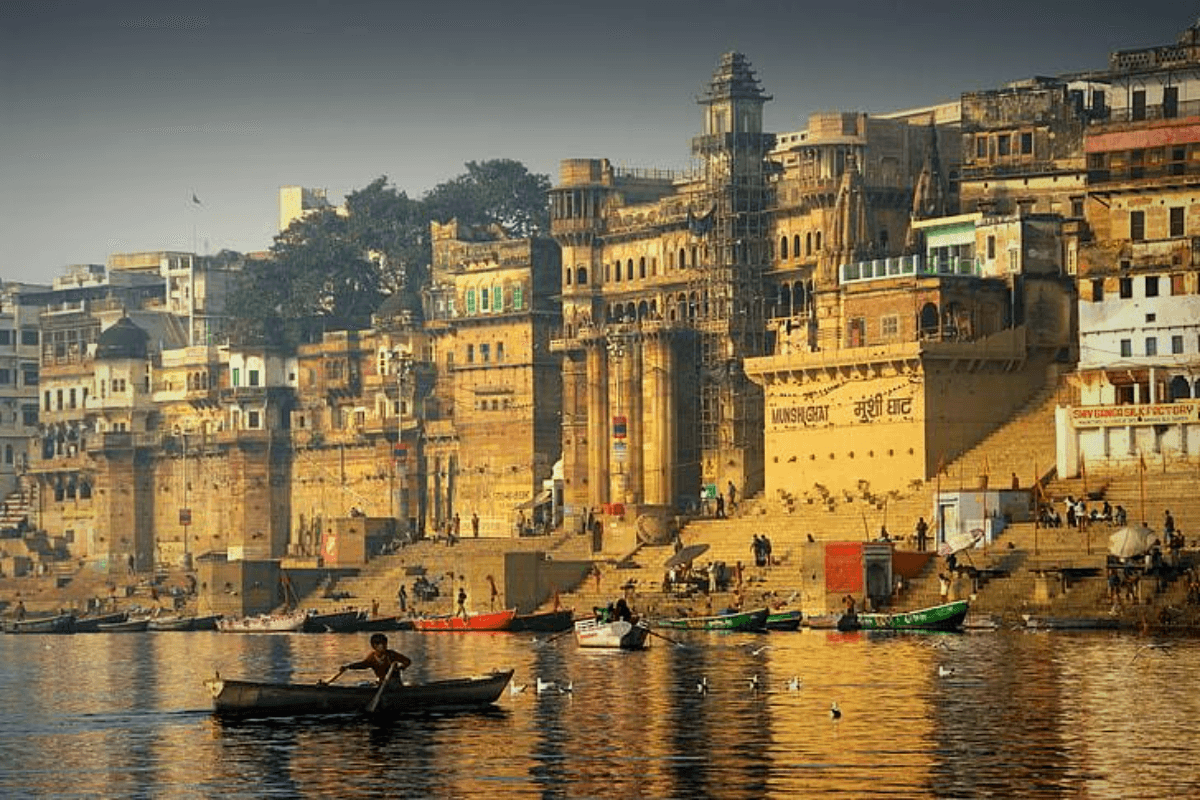
Vijayanagaram Ghat lies on the southern reach of the Kashi waterfront, between Lali Ghat and Kedar Ghat, at the foot of the quarter that tradition calls the Kedar Khanda. It began as the lower part of Kedar Ghat and was separated out and made pucca in the nineteenth century; the two still read as one long flight of stone from the water, and pilgrims habitually treat them as a single approach — snan at the water below, darshan at Kedareshvara above.
The name records a South Indian princely house. Vijayanagaram — today spelt Vizianagaram, in Andhra Pradesh — is the state of the Pusapati Gajapathi Raju family, and it is their patronage, not the medieval Vijayanagara empire of Hampi, that this ghat commemorates. That a Telugu house should build in stone on the Ganga is not an oddity but the ordinary shape of Kashi: the city's riverfront was raised by houses from every direction of Bharat, each wanting its people to have a place to bathe, to lodge, and to end their days in the kshetra of moksha. Heritage records note that the small palace raised here was built in South Indian architectural style, a Deccan grammar set into a Banarasi wall.
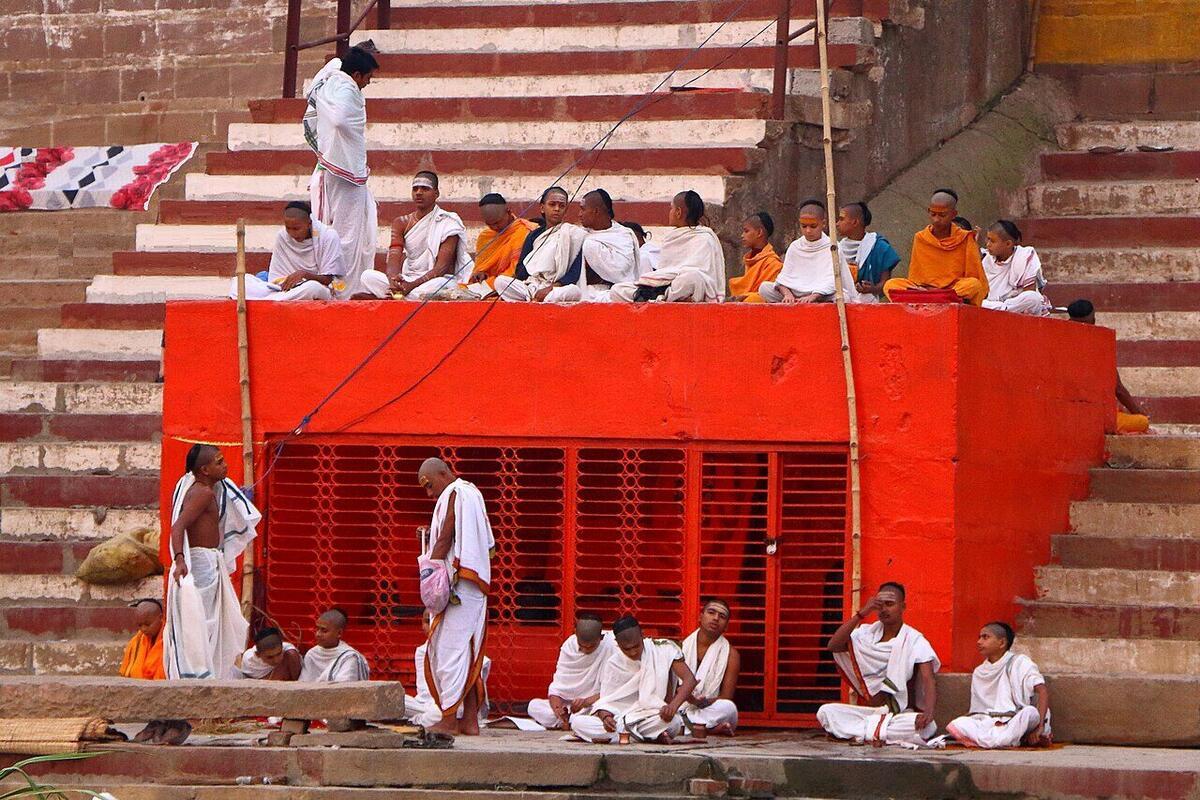
Today the ghat is quiet and used, which is its particular gift. It is a working bathing ghat, without the press of the central crescent. Devotees come down before dawn for snan and tarpan, sadhus and ashram residents sit on the upper steps, and the red-and-white stone of Kedar Ghat rises immediately to the north. Above the western edge, close to the lane, stand small Shiva shrines that heritage documentation names as Nispaneshvara and Nilakantha; behind them, the building given long ago to Swami Karpatri Ji continues as an ashram, so that the ghat carries not only a bathing line but a living seat of sannyasa.
The significance of this ghat is a matter of where it stands. Tradition divides Kashi into khandas, and the southern segment is the Kedar Khanda, whose presiding lord is Kedareshvara. Heritage documentation of the site records that the linga worshipped in the Kedareshvara temple above is honoured as a form of the linga of Kedarnath in the Himalaya, and is counted among the lingas of light of Varanasi. Devotees hold that Kedarnath darshan may be received here by those who cannot make the mountain journey.
The customary practice binds ghat and temple together. Pilgrims bathe in the Ganga at the steps, and the tradition at Kedareshvara is that one bathes in the Gauri Kund beside the temple before entering for darshan. Vijayanagaram Ghat is therefore, for many, the first act of a small and complete yatra: river first, kund next, linga last.
Beyond that, its sanctity is the sanctity of the Ganga herself. Banarasi devotional understanding holds that the river runs north at Kashi — uttaravahini — and that the whole crescent from Asi to Adi Keshava is one continuous tirtha, so that snan taken with sankalp and shraddha on a quiet step is snan in the same sacred water as at a famous one. Banaras attaches no separate katha to Vijayanagaram Ghat, and none should be invented for it; what it has is position, water, shrines and an ashram, which for a pilgrim is a great deal.
The ashram on the ghat
Heritage documentation of the ghat records that the Vijayanagaram house later gave the palace built here to Swami Karpatri Ji, who made it his residence and spent much of his life in it, and that it is known accordingly as the Swami Karpatri Ashram. Swami Karpatri (1907–1982), given the monastic name Swami Hariharananda Saraswati, was a sannyasi of the Dashanami order and a disciple of Shankaracharya Brahmananda Saraswati of Jyotir Math. He founded the Dharma Sangh in 1940, wrote extensively on Vedanta and dharma, and lived most of his life in Varanasi, where he died. For devotees in that tradition, the presence of his ashram gives these steps a weight that has nothing to do with the ghat's size.
History
The stone here is an offshoot of Kedar Ghat. Heritage documentation of the Varanasi ghats records that the lower part of Kedara Ghat was separately developed as a ghat by making it pucca and also constructing a small palatial building, in south Indian architectural style, by the king of Vijayanagaram in 1890 — and from that patronage the ghat took its name.
Sources differ on which ruler of the house and in which decade. The Vizianagaram royal family's own trust records recall Pusapati Narayana Gajapathi Raju (1786–1845), who spent much of his life in Varanasi, and state that Kedar Ghat and Vijayanagaram Ghat were constructed at Varanasi by the Maharaja of Vijayanagaram in the 1800s; the heritage dossier gives the specific year 1890, which would place the work under a later ruler of the same house. What is common to both accounts, and is not in dispute, is that the ghat is the gift of the Vizianagaram Maharajas of Andhra.
The ghat also appears in early colonial-era listing under a variant name: Greaves, writing in 1909, records it as Ijanagar Ghat, most likely a mishearing of Vijayanagaram. In 1958 the Government of Uttar Pradesh built and renovated the ghat — the same year in which the adjoining Kedar Ghat was given its present paved form — and the steps as pilgrims use them today largely date from that work.
The palace above passed out of princely hands into religious ones when it was given to Swami Karpatri Ji and became an ashram, and it is under trust care to this day. The ghat itself is in the charge of the Municipal Corporation, while the built properties along its upper edge are held by the Swami Karpatri Trust, the Swami Bhumananda Trust and private residents — a divided custody that has left conservation here uneven.
Architecture
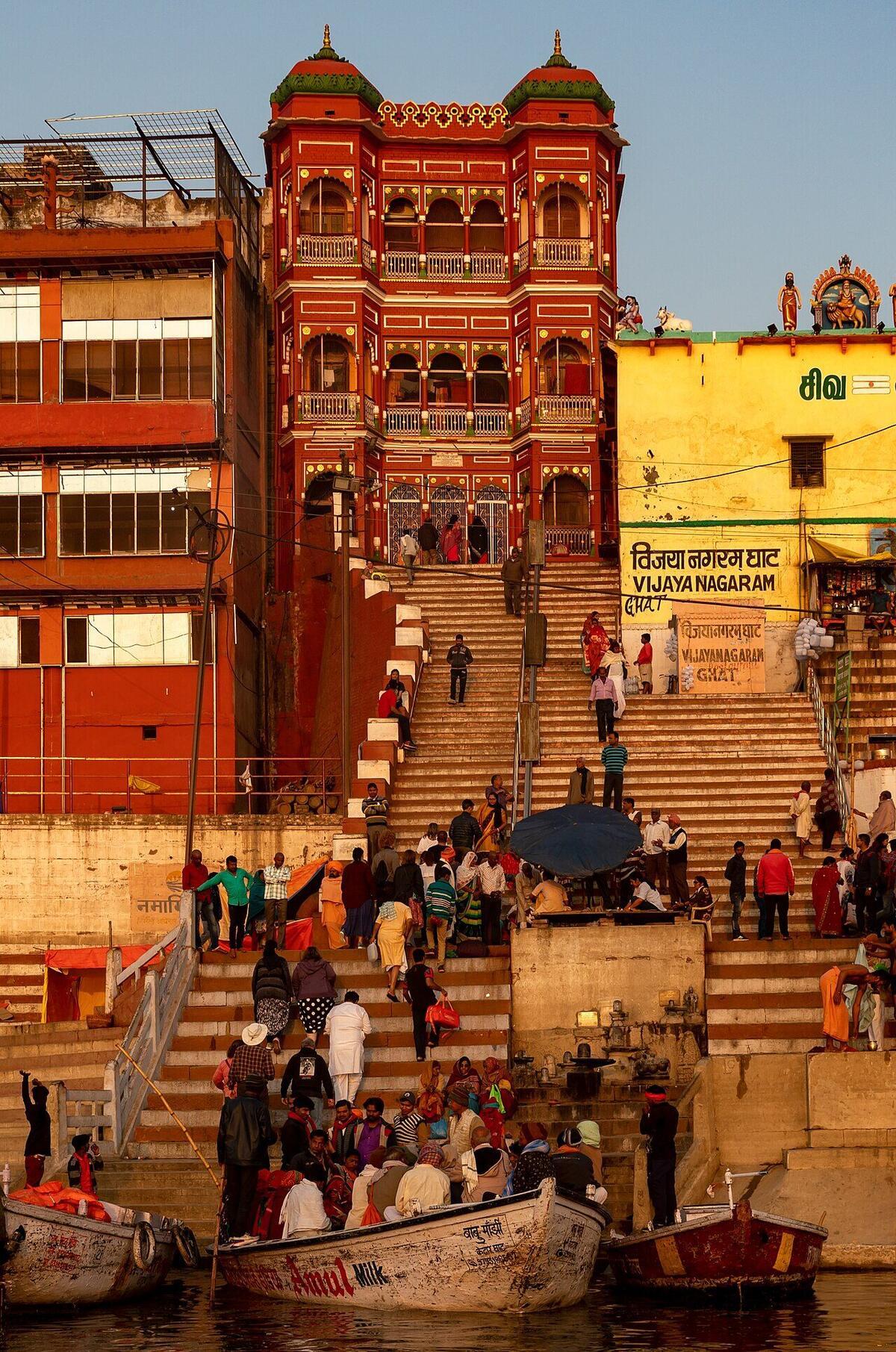
The ghat is a plain and honest flight of Banarasi stone: stepped courses running down to the water in stages, with landings where bathers leave their clothes and where sadhus sit through the day. It has none of the ornamental frontage of the palace ghats of the central crescent — the eye goes to the river and to the red-and-white banded steps of Kedar Ghat rising immediately to the north, which heritage documentation notes can be told apart from a distance by that banding.
The distinguishing built feature is the small palace above, which heritage documentation describes as raised in south Indian architectural style. That is unusual on this bank. The great riverside houses of Banaras are largely Maratha, Rajput and Bengali in their grammar, and a Deccan idiom set among them is a direct architectural record of who paid for this ghat and where they came from. The building now serves as the Swami Karpatri Ashram, and should be read as a monastic residence rather than a monument to be toured.
At the western end of the ghat, close to the lane that runs behind it, stand the two small shrines that heritage documentation names as Nispaneshvara and Nilakantha. They are modest structures of the kind that line the whole Kashi bank — a linga, a small enclosure, a lamp — and they are worshipped rather than displayed.
Rituals & Practices
This is a bathing ghat and its practice is daily rather than ceremonial. There is no aarti of its own here, and no organised evening ritual.
Before sunrise devotees come down for Ganga snan, take sankalp facing the water, and offer tarpan for the pitr with Ganga-jal and darbha grass. Many then climb to Kedareshvara, following the tradition of bathing in the Gauri Kund beside the temple before entering for darshan, and offer bilva patra and Ganga-jal to the linga. The small shrines at the western edge of the ghat receive the ordinary daily worship of the lane — water, flowers, a lamp.
Through the month of Kartik, devotees keeping the Kartik vrata bathe here every morning, and lamps are raised along the ghat line as they are across Banaras. At dusk, clay diyas are floated on the current. The ashram above keeps its own rhythm of sannyasa, and pilgrims should treat that as private observance rather than as something to watch. Timings for darshan at Kedareshvara are best confirmed at the temple on the day.
Festivals & Celebrations
| Festival | When | Crowd |
|---|---|---|
| Mahashivratri | — | Very high at the temple above; the ghat itself stays walkable |
| Shravan Somvar | — | High on Mondays through the month |
| Kartik Purnima and the Kartik snan | — | High through the month, very high on Purnima |
| Dev Deepawali | — | Very high, though calmer than the central ghats |
| Ganga Dussehra | — | High |
| Makar Sankranti | — | High |
Mahashivratri: Tradition holds Mahashivratri to be the night of Shiva's grace, and abhishek offered at a Kashi linga on this night is held to bear great merit. The Kedar Khanda keeps it with particular devotion, since Kedareshvara is the lord of this segment of the city.
Shravan Somvar: Shravan is held to be the month dearest to Shiva, and its Mondays the most auspicious days for abhishek. Water drawn from the Ganga and offered directly to the linga is the simplest and most cherished form of the offering.
Kartik Purnima and the Kartik snan: The Puranas praise snan in Kartik at a Ganga tirtha as bearing great merit, and Kartik Purnima is held to be the most auspicious bathing day of the month.
Dev Deepawali: Tradition holds that on this night the devas descend to bathe in the Ganga at Kashi and that the lamps on the ghats are lit in their welcome. Devotees also connect the day to Shiva's victory over Tripurasura.
Ganga Dussehra: Tradition holds that snan on this day at a Ganga tirtha removes the ten kinds of sin â the dasha-papa from which the festival takes its name.
Makar Sankranti: Marks the sun's entry into Makara and the start of Uttarayana. Snan and daan on this day at a Ganga tirtha are held to bear great devotional fruit.
Prepare for Your Visit
Practical guidance to help you plan your pilgrimage
| Pilgrim Guidance | How to reachThe usual approach is through the lanes from the Sonarpura or Kedar Ghat side, coming down past the Kedareshvara temple and then south along the steps; the banded red-and-white stone of Kedar Ghat is the landmark and Vijayanagaram lies immediately below and beyond it. From Assi Ghat it is a straightforward walk north along the waterfront, and from Dashashwamedh a walk south. By water, any boat will set you down at the steps. No vehicle reaches the ghat; the last stretch is always on foot. What to expectThis is a quiet, local ghat, and that is its character — bathers, ashram residents, sadhus on the upper steps, a few boats. There are no organised ceremonies and no ticketed viewing. The lower steps are slippery near the waterline and go under in the monsoon, when the bathing line shifts upward and the current runs strong. The ashram above is a religious residence, not a heritage site open for visits; do not walk in. Best time to visitOctober to March is the most comfortable season for a Kashi yatra. Early morning, from first light to about nine, is when the ghat is at its most devotional, and it is also the natural hour to pair snan here with darshan at Kedareshvara. Kartik fills these steps every morning for the month-long snan, and Mahashivratri and the Mondays of Shravan draw crowds up to Kedareshvara. If your purpose is a quiet bath and a short, complete yatra of river, kund and linga, a weekday morning outside the festival weeks is ideal. |
Location
Varanasi, UP
Pilgrim photos
No pilgrim photos yet.
Community corrections
No corrections yet.
Edit history
No revisions yet.
Plan Your Visit to Vijayanagaram Ghat
Get a custom itinerary and pricing for your trip.
Recommended
Packages for this destination
Pilgrim Notes
On-ground observations from fellow pilgrims
No pilgrim notes yet. Be the first to share on-ground observations!
Sign in to share a note.
Pilgrim Reviews
Be the first to share your experience at Vijayanagaram Ghat.
Sign in to write a review.
Nearby sacred places
Discover other sacred places near Vijayanagaram Ghat
Explore temples, tirthas, and pilgrimage sites in UP
Explore nearbyPart of these circuits
Walk the traditional pilgrimage routes this destination belongs to.