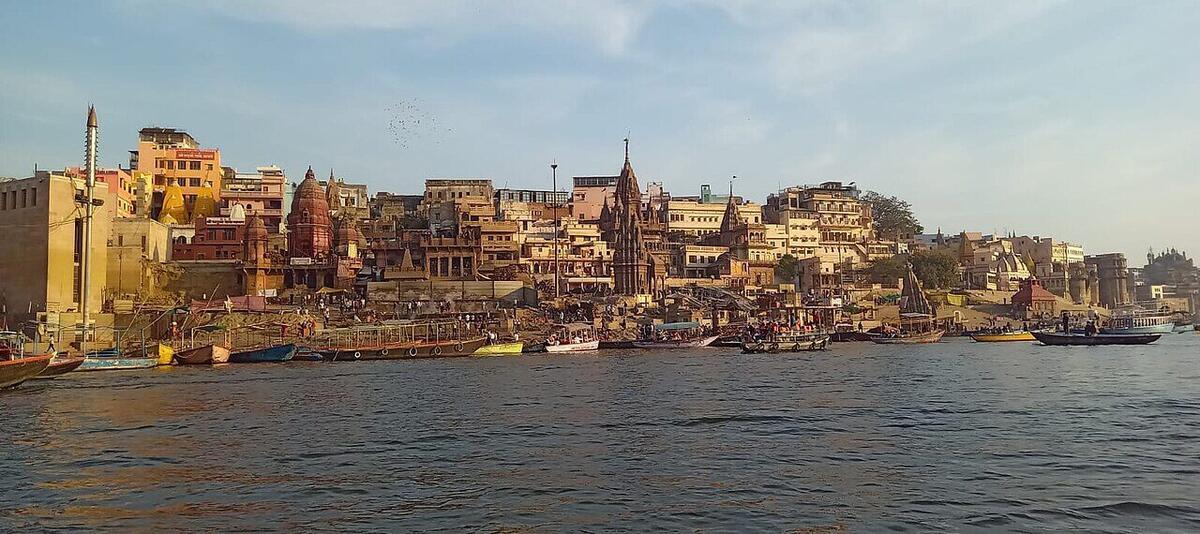
Chausatti Ghat — also written Chausatthi and Chaumsathi — takes its name from chausath, sixty-four, for the sixty-four Yoginis honoured in the Shakta tradition as the attendant shaktis who stand around the Great Goddess. Their shrine, the Chausatthi Devi temple, sits at the head of the steps, and the ghat below is its approach from the river. For the devotee the two are one place: a bath in the Ganga, then the climb up for the Mother's darshan.
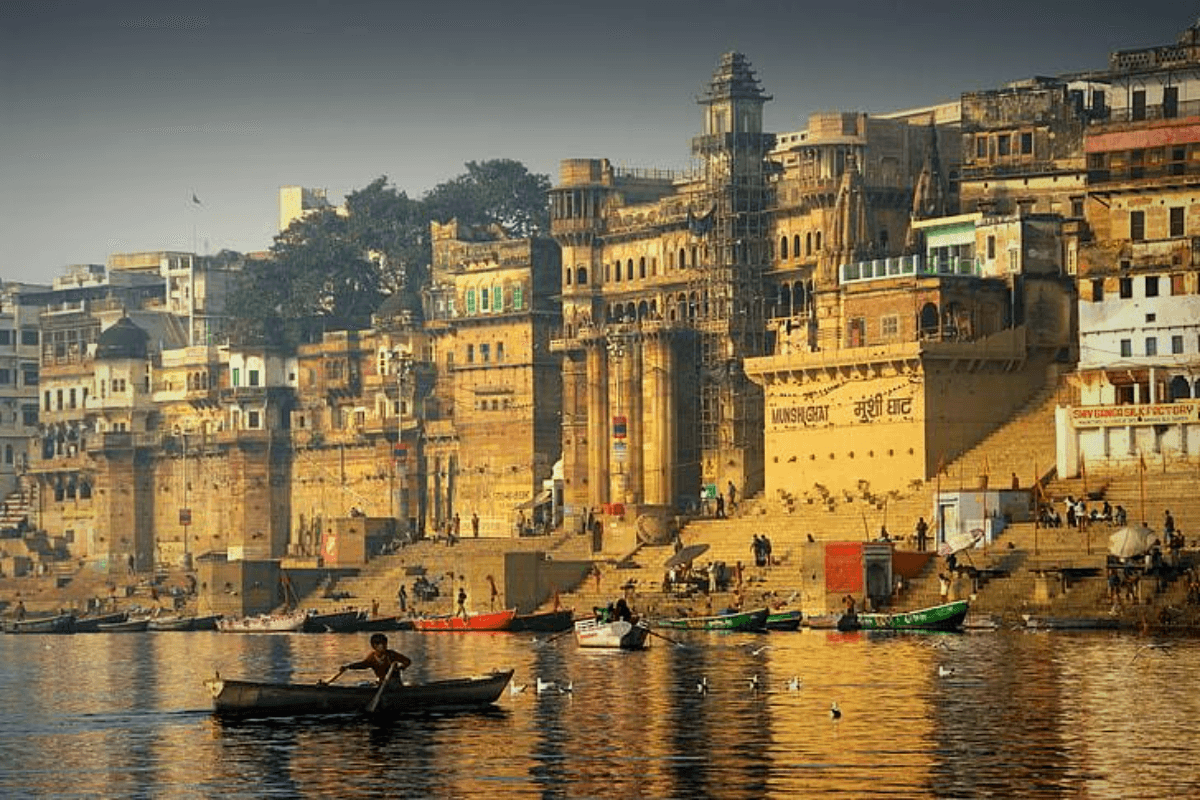
The ghat is one of the narrower and steeper flights of the central waterfront, set between Digpatiya Ghat upstream and Rana Mahal Ghat downstream, with Darbhanga, Munshi, Ahilyabai and Shitala Ghats and then Dashashwamedh following in order below it. Its neighbours give the stretch its face. Rana Mahal, attached to its northern edge, carries the Rajasthani-style palace of the Udaipur house; Digpatiya, adjoining to the south, takes its name from the king of Digapatiya of Champaran, whose Bengali-style riverside palace now serves as the Sitarama Omkara Das Kashi ashram.
Of the sixty-four Yogini images, heritage documentation records that only sixteen survive in Varanasi. Two of them stand in the immediate vicinity of the Devi here — Gajanana, the elephant-headed, and Mayuri, the peacock-headed, the latter set into the steps of the ghat itself, where bathers pass her every morning. Very old images of Kali, of Shiva, Ganesha and Kartikeya, and of folk goddesses stand in the temple compound above.
The daily life of the ghat is quiet and steady. Devotees come for snan and for a while of stillness on the stone; Bengali families of the surrounding lanes have long favoured these steps for their bathing, for meditation and for household ceremonies.
In the Shakta understanding the one Devi is worshipped in countless forms, and the sixty-four Yoginis are among the most cherished of them — the attendant shaktis who surround the Mother as her living circle of power. Chausatti is the ghat of that circle. Heritage documentation explains the number itself as a symbolism of direction and multiplication: eight mother-goddesses with eight assistants each, or the eight directions of the earth answered by eight of the celestial realm, which together give the archetype of sixty-four. To bow before the Yoginis is, in devotional understanding, to bow before the one Mother in the fullness of her powers.
Documentation of the riverfront cites the Kashi Khanda (61.176–177) as describing this ghat and the images of the Yoginis, and as naming two jala-tirthas — sacred spots associated with the water — at this place. The goddess Chausatthi and her ghat are also named in the Girvana-padamanjari, a Sanskrit work of about 1600–60. Worship here is therefore not a recent devotion but a continuity attested in the city's own textual memory.
The ghat also holds a place in Kashi's tradition of learning: heritage records note that it gave shelter to the great Sanskrit scholar Madhusudana Sarasvati (1540–1623). For pilgrims, this is part of the ghat's character — a Devi sthan where sadhana and study have long sat close together.
The Devi in Kashi's sacred order
Devotees hold Kashi to be a city of the Goddess as much as of Shiva. Vishalakshi at Meer Ghat, Annapurna who feeds the city, Durga in her temple to the south, and the Yoginis above this ghat are felt as one presence in many forms. Many pilgrims who walk the ghats include Chausatti for exactly this reason: it lets the Mother be greeted from the river, where the yatra is already taking place.
History
Worship of the Yoginis on this stretch of the riverfront is old enough to be recorded in the city's Sanskrit literature, and the ghat's stonework has been rebuilt many times around a devotion that did not change. Heritage documentation records that until the eighteenth century the principal image of Chausatthi Devi was kept in the Rana Mahal, the palace adjoining to the north, and was later moved to its present site above the steps.
The first pucca ghat here was raised in the late sixteenth century by King Pratapaditya — identified in Varanasi district heritage listings as the Bengal ruler of that name — and was in time partly destroyed. Around 1670 the king of Udaipur, Rana Jagat Singh, renovated and expanded the ghat and built the Rana Mahal at its northern edge, where he stayed during his own pilgrimage to Kashi. The present built structure of the ghat dates to 1807.
In the nineteenth century the ghat was fully renovated and repaired by the king of Digapatiya, of Champaran in Bihar, whose work on the lower portion in 1830 is why the adjoining ghat is known today as Digpatiya Ghat. The steps were made pucca in their present condition in 1965 by the Government of Uttar Pradesh. The temple and its compound are held by the Chausatthi Temple Trust; the ghat area belongs to the municipal corporation, and its upkeep rests largely with the trust and the local families who use it every day.
Architecture
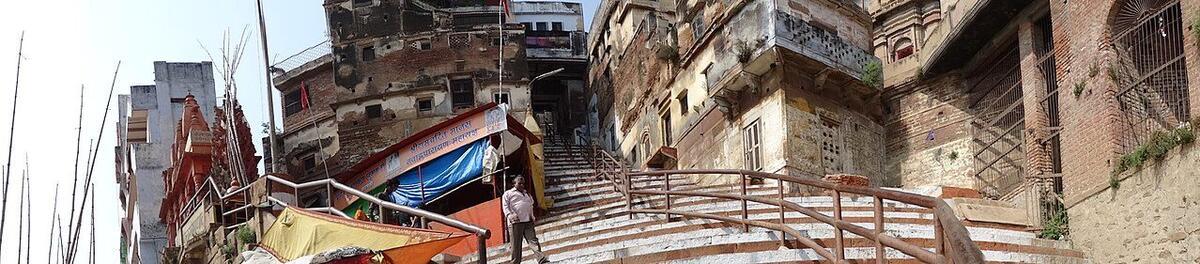
The heritage area of the ghat and temple complex together is recorded at about 0.30 hectares. Compared with the broad amphitheatre of Dashashwamedh, Chausatti is narrow and steep — a compact flight climbing directly from the water to the temple door, built up in 1807, extended below in 1830 and refaced in 1965, so that work of three different periods sits one above the other in the same short stair.
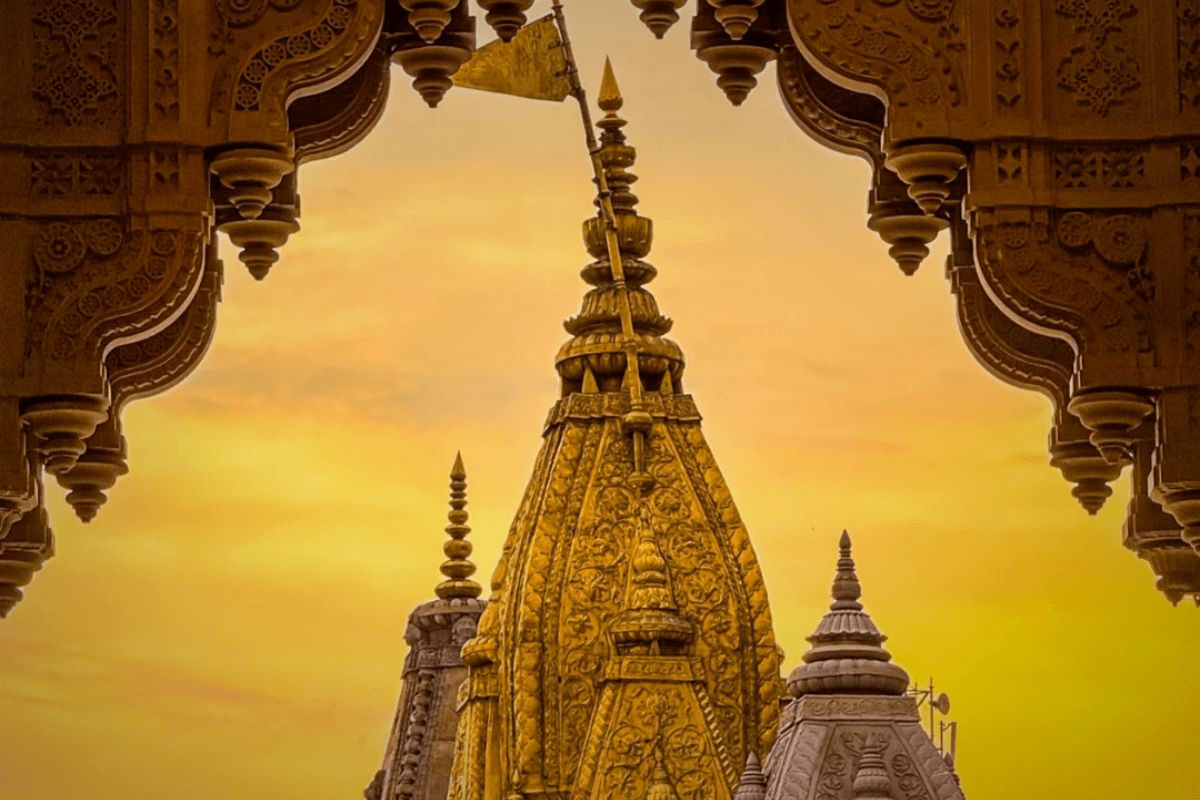
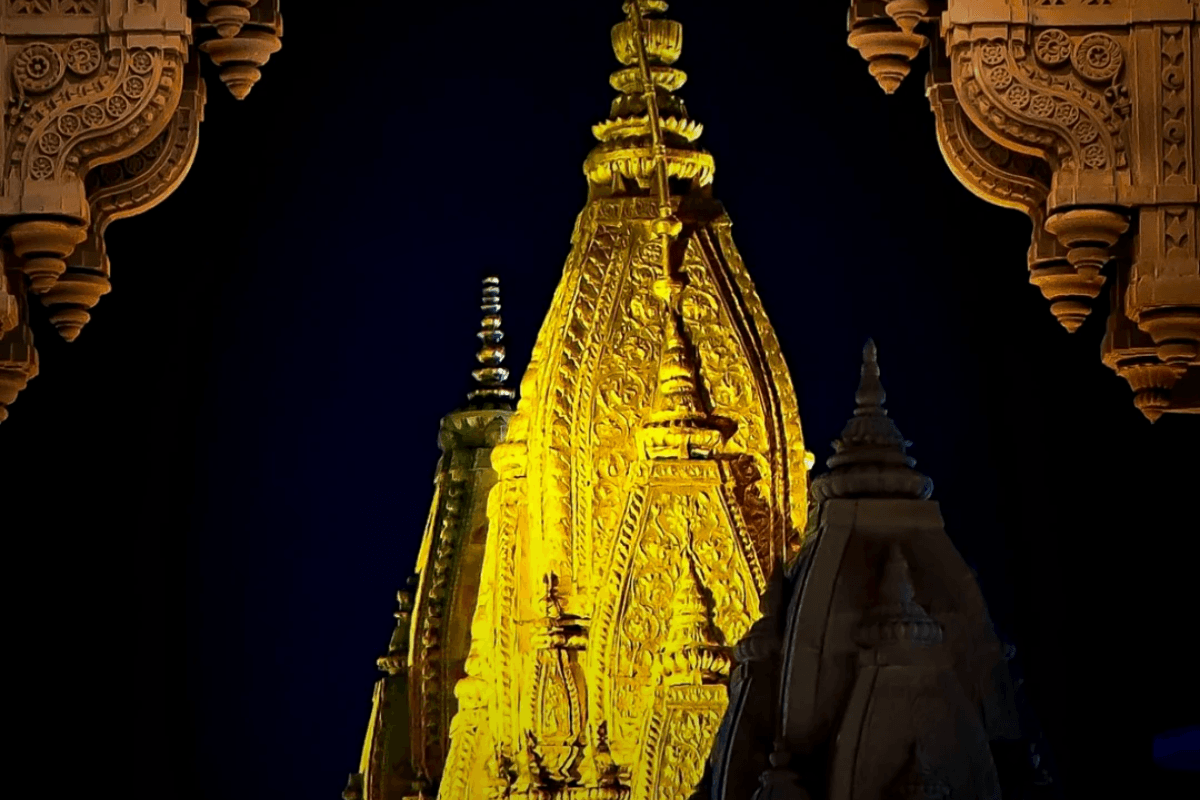
At the head stands the Chausatthi Devi temple, modest in scale, its compound holding old images of Kali, of Shiva, Ganesha and Kartikeya, and of folk goddesses whose worship in Kashi runs alongside the Puranic deities. The Yogini image called Mayuri, the peacock-headed, is set among the steps of the ghat, and Gajanana, the elephant-headed, stands close by in the immediate vicinity of the Devi — sculpture kept in worship rather than in display.
The two palaces that frame the ghat give the frontage its distinctive contrast. Rana Mahal, to the north, is a clear example of Rajasthani work: three porches facing the Ganga, windows of stone jali, a landing platform at every five steps, and niches in the upper flight to north and south holding Shiva lingas, with the shrine of Vakratunda Vinayaka in the lane above. Digpatiya's palace, to the south, is built in Bengali style with porches on both sides. Between the two, the Devi's stair runs plainly down to the river.
Rituals & Practices
The ghat's daily practice is bathing and quiet sadhana. Devotees take Ganga snan at the steps and climb to the temple for the Devi's darshan, offering a red flower, sindoor and a lamp through the priest. Families of the surrounding lanes, among them many Bengali households, use these steps for their morning snan and for the small ceremonies of family life, and the ghat is a favoured place to simply sit in meditation with the river in front of you.
Two observances are recorded as the ghat's own. Heritage documentation notes that on the twelfth of the dark fortnight of Chaitra (March–April) many pilgrims come to the Yogini temple and take ritual bath at this ghat; and that on the evening of Holi a rite of homage is performed here. Varanasi district listings additionally name Navratri, and the offerings made in the days around Rangbhari Ekadashi before Holi, as occasions when the ghat and temple are at their most active.
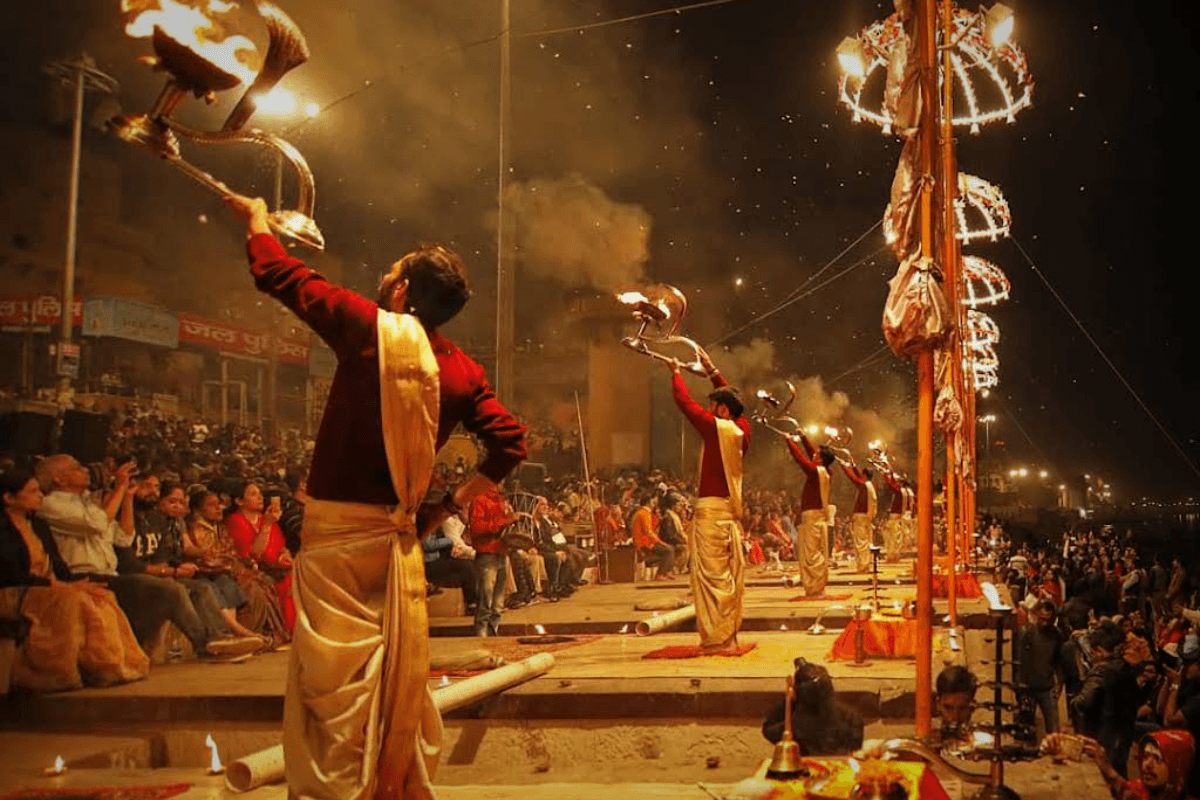
There is no formal evening Ganga Aarti of the Dashashwamedh kind at Chausatti; the great aarti is a short walk downstream, and many pilgrims take the Devi's darshan here first and go on to it. The temple keeps its own timings under its trust and priests, which shift with the seasons and with festival days; pilgrims should confirm them at the temple on the day of their visit.
Festivals & Celebrations
| Festival | When | Crowd |
|---|---|---|
| Chaitra Yogini Darshan (twelfth of the dark fortnight) | — | High for a small ghat; the stair and temple gate both fill |
| Holi | — | Moderate to high in the evening |
| Navratri | — | Very high on Ashtami and Navami |
| Dev Deepawali | — | Very high across the waterfront |
| Makar Sankranti | — | High through the morning |
Chaitra Yogini Darshan (twelfth of the dark fortnight): The day is kept as the Devi's own at this ghat, when the snan below and the darshan above are taken together as a single act of devotion.
Holi: The turn of the year at the close of Phalguna is marked here at the Devi's steps, joining the city-wide festival to the ghat's own observance.
Navratri: Navratri is the great season of the Devi across Kashi, and at a Yogini shrine it is kept as the Mother's own festival.
Dev Deepawali: Tradition holds that Dev Deepawali marks Shiva's victory over Tripurasura and the descent of the devas to bathe in the Ganga; the Puranas praise snana and daan on Kartik Purnima as bearing the fruit of great yajnas.
Makar Sankranti: The day marks the sun's turn into Makara and the beginning of Uttarayan; snana and daan on this day are held to bear great devotional fruit.
Prepare for Your Visit
Practical guidance to help you plan your pilgrimage
| Pilgrim Guidance | How to reachThe easiest approach is along the riverfront from Dashashwamedh, walking upstream past Shitala, Ahilyabai, Munshi, Darbhanga and Rana Mahal Ghats — a walk of roughly ten to fifteen unhurried minutes. From the lanes above, the ghat is reached through the Sonarpura–Bangali Tola side of the old city, where a narrow gali drops to the temple gate. A boat from Dashashwamedh or Assi will also set you down at the steps; from the river, look for the steep, narrow stair running up between the Rajasthani porches of Rana Mahal and the Bengali-style palace of Digpatiya. Darshan of the Devi and the ghat belowMost pilgrims treat the two as one visit: snan or a touch of Ganga-jal at the steps, then the climb to the Chausatthi Devi temple above. The shrine is small, and darshan is unhurried outside festival days. A red flower, sindoor, and a diya are the usual offerings, given through the priest. If you are walking the ghats as part of a Kashi yatra, Chausatti sits naturally between Kedar Ghat to the south and Dashashwamedh to the north, and can be joined to either in the same morning. Preparation and best time to visit
|
Location
Varanasi, UP
Pilgrim photos
No pilgrim photos yet.
Community corrections
No corrections yet.
Edit history
No revisions yet.
Plan Your Visit to Chausatti Ghat
Get a custom itinerary and pricing for your trip.
Recommended
Packages for this destination
Pilgrim Notes
On-ground observations from fellow pilgrims
No pilgrim notes yet. Be the first to share on-ground observations!
Sign in to share a note.
Pilgrim Reviews
Be the first to share your experience at Chausatti Ghat.
Sign in to write a review.
Nearby sacred places
Discover other sacred places near Chausatti Ghat
Explore temples, tirthas, and pilgrimage sites in UP
Explore nearbyPart of these circuits
Walk the traditional pilgrimage routes this destination belongs to.