Dwarka is the city where Shri Krishna ruled as king. After the lila of Vraja and the slaying of Kansa at Mathura, Krishna brought his Yadava kinsmen west to the Arabian Sea coast and built a magnificent capital — Dwaravati, the city of many gates. From here he ruled, went forth to serve as Arjuna's charioteer in the Mahabharata war, and returned at his lila-samapana (final lila) to the eternal Vaikuntha.
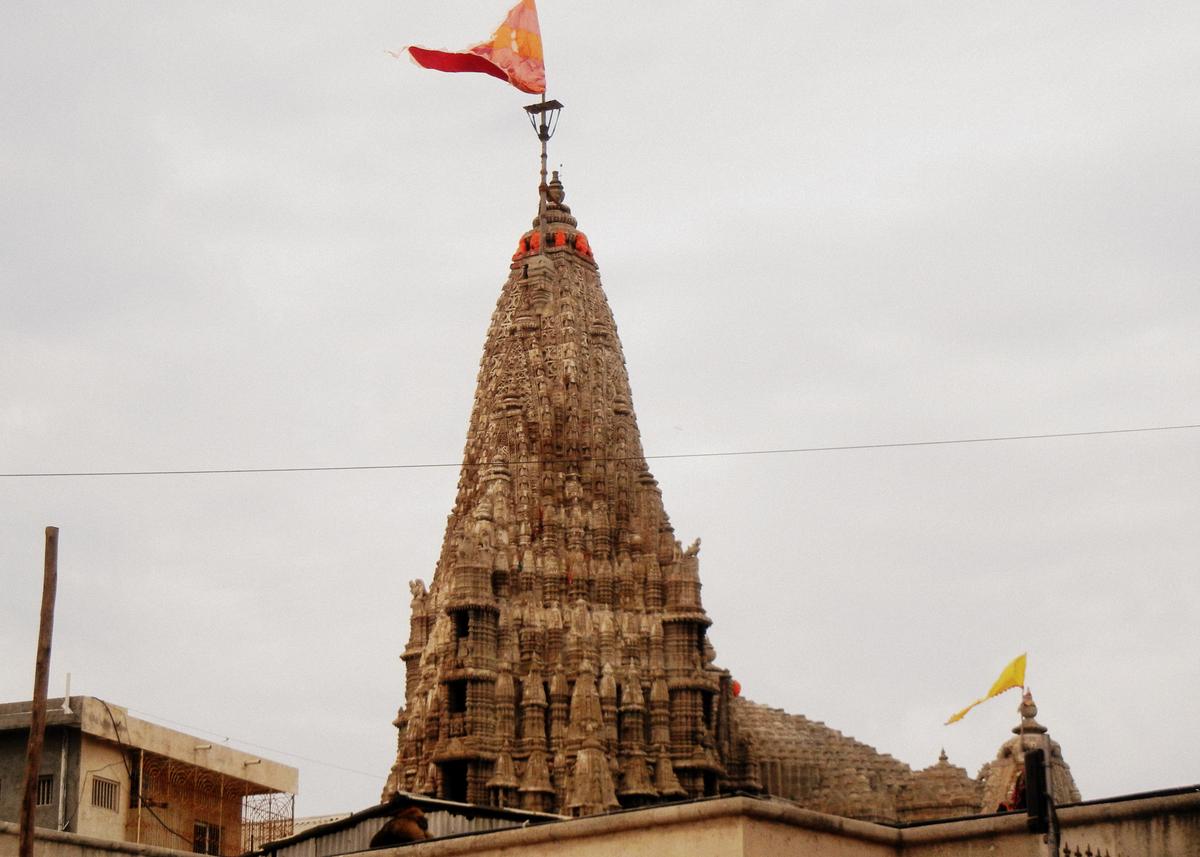
The town centres on the Dwarkadhish Mandir — the seat of Krishna as Lord of Dwarka — perched on the bank of the Gomati river where it meets the Arabian Sea. The temple is also called the Jagat Mandir; tradition holds that the original was built by Krishna's great-grandson Vajranabh, and the present structure dates from the sixteenth century. The five-storey shikhara rises 78 metres and is crowned by the great Dwarka Dhwaja — the temple's sacred flag changed five times daily.
Nearby Bet Dwarka (the original residence of Krishna, on an island reached by a 30-minute boat ride), Rukmini Devi Temple, Nageshwar Jyotirlinga (15 km away — one of the twelve Jyotirlingas), and the Gomati Ghat are visited as part of the Dwarka yatra. The wider Saurashtra pilgrimage also includes Somnath, 230 km south.
Katha and local belief
Tradition holds that Dwarka has sunk into the sea seven times across the yugas, and each time Krishna has re-established it. The Mahabharata tells of Krishna's capital with its great walls, golden palaces, gardens, and harbours. Recent underwater archaeological surveys near Bet Dwarka have found city-walls and harbour structures dated to several millennia ago, lending material support to the ancient memory.
Dwarka is among the most sacred cities of Hindu tradition. The Garuda Purana names her among the seven Mokshapuris — Ayodhya, Mathura, Kashi, Maya (Haridwar), Avantika (Ujjain), Kanchi, and Dwaravati. Adi Shankaracharya's Char Dham (8th century) places Dwarka as the western dham along with Badrinath, Puri, and Rameshwaram. Adi Shankara established his Sharada Pitha (one of the four matha-pithas) at Dwarka.
To the devotee, Dwarka is the king-form of Shri Krishna — Krishna in his maturity, as the ruler and protector, as the friend of Arjuna and the speaker of the Bhagavad Gita. The Gopis loved the cowherd of Vraja; the kshatriya tradition reveres the king of Dwarka. The Pushti Marga, the Nimbarka, and the Vaishnava sampradayas of Saurashtra all hold Dwarka in deep devotional regard.
History
Dwarka's history reaches into the Mahabharata. Underwater archaeology near Bet Dwarka by the National Institute of Oceanography has identified submerged walls and harbour structures of the ancient Dwaravati. The present Dwarkadhish temple was built in its current form in the sixteenth century, though the site has been a Vaishnava centre for many centuries. The Adi Shankara Sharada Pitha was established here in the eighth century and remains one of the four principal mathas.
The Maharaja of Baroda, the Gaikwad family, and various Saurashtra patrons supported the temple through the medieval period. Modern infrastructure dates from the twentieth century. The Dwarkadhish Trust manages the temple along with the Sharada Pitha Shankaracharya.
Architecture
The Dwarkadhish Mandir is built in the Chalukya style with a tall shikhara rising 78 metres in five storeys, supported by 72 carved pillars. The sanctum holds the deity Dwarkadhish — Krishna in his royal form with his four-armed Vishnu attributes. The temple has two main entrances — Swarga Dwara (heavenly gate, north — facing the Gomati ghat) and Moksha Dwara (liberation gate, south).
Bet Dwarka, the original residence, is on an island and includes shrines to Krishna, Rukmini, Devaki, Trivikrama, and Hanuman. Nageshwar Jyotirlinga is a separate shrine 15 km from Dwarka — one of the twelve Jyotirlingas, with a massive seated Shiva murti.
Rituals & Practices
The Dwarkadhish Mandir conducts seven daily aratis in the haveli-mandir Pushti-influenced rhythm — Mangala, Shringar, Gwal, Rajbhog, Utthapan, Sandhya, Shayan. The temple opens around 6 AM and closes after Shayan around 9:30 PM with brief midday pauses. Verify exact timings on the day of darshan.
The traditional sequence is: Gomati ghat snan, Dwarkadhish darshan, Rukmini Devi darshan (2 km away — the queen tradition is worshipped separately), Bet Dwarka by boat, and Nageshwar Jyotirlinga. The standard Dwarka yatra takes 2-3 days. Pind-daan at the Gomati ghat is auspicious; Dwarka is a recognized ancestor-rite tirtha.
Festivals & Celebrations
| Festival | When | Crowd |
|---|---|---|
| Janmashtami | — | very_high |
| Holi | — | very_high |
| Tulsi Vivah | — | high |
| Geeta Jayanti | — | high |
Janmashtami: The most spiritually charged night of the year at Dwarka.
Holi: Honours Krishna''s playful lila.
Tulsi Vivah: Auspicious wedding ceremony in the Vaishnava tradition.
Geeta Jayanti: Honours Krishna''s most beloved teaching.
Prepare for Your Visit
Practical guidance to help you plan your pilgrimage
| Pilgrim Guidance | How to reach DwarkaThe nearest airport is Jamnagar (130 km, 2.5 hours by road). Dwarka railway station is on the main western trunk and has direct trains from Mumbai, Ahmedabad, Delhi, and other major cities. Many pilgrims combine Dwarka with Somnath (230 km south, 4-5 hours) and Rajkot or Ahmedabad as part of the Saurashtra circuit. Preparation for pilgrimsModest dress at the Dwarkadhish Mandir; mobile phones, cameras, leather items, and large bags are not permitted inside the sanctum. Cloakroom at the temple entrance. For Bet Dwarka, the 30-minute boat ride can be choppy in monsoon; carry seasickness medication if you are prone. The town is hot and humid in summer (April-June, 35-40°C); winter (November-February) is cool and pleasant. Best time to visitOctober to March is the most pleasant weather. Janmashtami in Bhadrapada (August-September) is the spiritual peak — Krishna's birthday in his own capital, with all-night celebrations. Holi in Phalguna (March) and Tulsi Vivah in Kartik (November) are also major. Avoid May-June (very hot) and the deep monsoon if the boat to Bet Dwarka is on your plan. |
Location
Devbhumi Dwarka, GJ
Pilgrim photos
No pilgrim photos yet.
Community corrections
No corrections yet.
Edit history
No revisions yet.
Plan Your Visit to Dwarka
Get a custom itinerary and pricing for your trip.
Recommended
Packages for this destination
Pilgrim Notes
On-ground observations from fellow pilgrims
No pilgrim notes yet. Be the first to share on-ground observations!
Sign in to share a note.
Pilgrim Reviews
Be the first to share your experience at Dwarka.
Sign in to write a review.
Nearby sacred places
Discover other sacred places near Dwarka
Explore temples, tirthas, and pilgrimage sites in GJ
Explore nearbyPart of these circuits
Walk the traditional pilgrimage routes this destination belongs to.