Gangotri stands at the head of the Bhagirathi valley, at 3,100 metres above the sea, where the young Bhagirathi flows past a temple of white granite dressed in turmeric and vermilion. In the traditional Chota Char Dham yatra — Yamunotri, Gangotri, Kedarnath, Badrinath — Gangotri is the second dham, the place where the pilgrim moves from the goddess of mercy to the river of liberation.
Unlike the other three dhams, Gangotri can be reached almost to its threshold by road. The Bhagirathi flows alongside the path; deodar and bhojpatra forests rise above; small ashrams and dharamshalas line the riverbank. For many pilgrims this is the first dham where they can fully sit by the water — to do sankalpa, to perform tarpan for ancestors, to take Gangajal in copper vessels for the long journey home.
Katha and local belief
The katha of Bhagiratha is told and retold here. Tradition holds that King Bhagiratha of the Ikshvaku line did tapas for many years to bring Ganga down from the heavens, so that the ashes of his sixty thousand ancestors, burnt by the curse of Sage Kapila, could be redeemed. Brahma granted Ganga's descent, but her fall would have shattered the earth. Shiva, full of compassion, received her in the locks of his matted hair, and let her flow out from his head, gentle enough for the world to receive.
Devotees hold that the Bhagirath Shila, a flat rock by the temple, is the very place where Bhagiratha sat in tapas. A short walk downstream, at low water in winter, the Jalmagna Shivling — the submerged Shivalinga — is sometimes visible: the very place, tradition says, where Shiva first received Ganga upon his head.
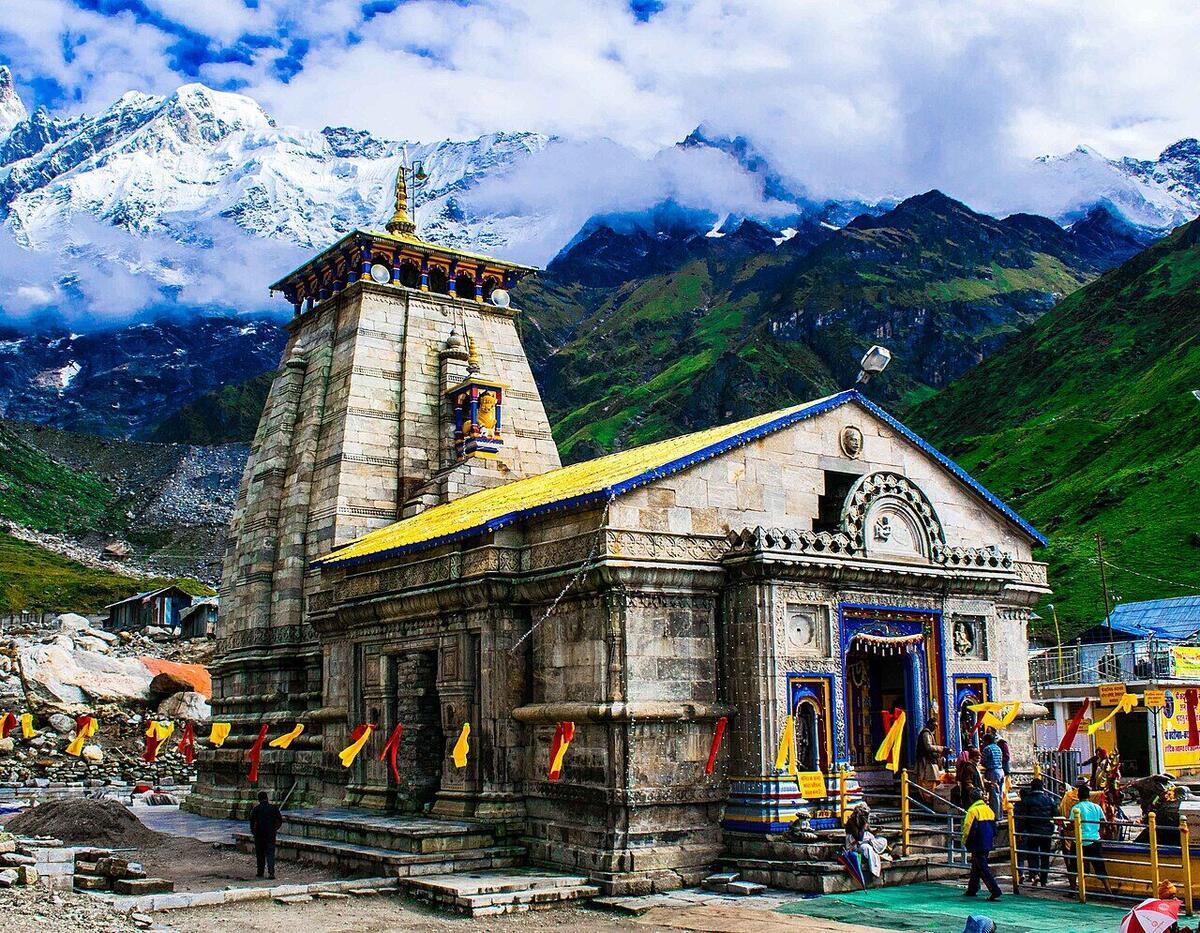
In Hindu sacred tradition, Gangotri is the spiritual source of Ganga, even though the glacial source at Gaumukh lies eighteen kilometres further up, where the Bhagirathi emerges from beneath the snout of the Gangotri glacier. Gangotri marks the place where the goddess first becomes approachable as a flowing river, and where her grace is understood to begin descending for the welfare of the world.
Ganga is worshipped here as the river of liberation. The Puranas praise her as Tripathaga, the one who flows through three worlds — Akasha-Ganga in the heavens, Bhagirathi-Ganga on earth, and Patala-Ganga in the nether realm. Her waters are held to carry the power of purification, and tarpan offered here on her banks is believed to reach the ancestors with special force.
The Chota Char Dham pilgrim approaches Gangotri after Yamunotri because tradition orders the yatra in a clockwise embrace of the four shrines, beginning at the river of mercy and rising toward the seat of moksha at Badrinath. At Gangotri, the pilgrim begins to taste the liberating current that will widen and deepen as the river flows down to Haridwar, Prayag, and Kashi.
Bhagiratha, Shiva, and the descent of Ganga
The descent of Ganga — Ganga avataran — is among the great kathas of Hindu tradition. King Sagara's sons had been burnt to ashes by Sage Kapila's curse, and could only be redeemed by the touch of Ganga's waters. Bhagiratha, their descendant, undertook severe tapas to bring her down. When Brahma at last consented, Ganga warned that her fall would crack the earth. Shiva agreed to receive her on his head; tradition tells how she fell upon his locks and wandered there for years until Bhagiratha asked Shiva once more to release her gently, in seven streams, down to the plains.
This is why the pilgrim at Gangotri stands between two presences. Ganga is the river one bathes in and offers to. But behind her, in the local devotional understanding, stands Shiva — who held her, slowed her, and gave her safely to the world. Many pilgrims here offer prayer to both: to Ganga for purification, and to Shiva for the gentleness that lets purification be received.
History
Gangotri's sacred memory in Indian tradition reaches into the antiquity of Vedic and Puranic literature. The Bhagiratha katha is found in the Ramayana, the Mahabharata, and the Puranas, and the source of Ganga has been honoured by pilgrims, sadhus, and royal patrons for many centuries.
The present temple is traditionally attributed to the Gorkha general Amar Singh Thapa in the early nineteenth century, with later restorations by the rulers of Jaipur and Tehri-Garhwal. The shrine has been rebuilt and refurbished several times to withstand earthquakes, glacial floods, and the harsh winters of the high Bhagirathi valley.
The hereditary pujari families of Mukhwa, the winter abode of Ganga, have served the goddess for many generations. Each autumn the murti is carried in ceremonial procession to Mukhwa village, where she is worshipped through the cold months until her return to Gangotri the following spring. This continuity of priestly care, across centuries of political change, has been the living thread of Gangotri's history — empires changed and roads were re-cut, but the bond between the goddess and her pilgrims has never been broken.
Architecture
The Gangotri temple is a white granite shrine in the regional Himalayan style, with a curved shikhara, simple proportions, and a quiet dignity that suits its setting on the Bhagirathi. The structure is not large, but it is carefully kept — repainted in white, ochre, and saffron every season, and dressed afresh on festival days.
The inner sanctum holds the murti of Ganga Devi, traditionally carved of white marble and worshipped seated on a makara, the river-creature that is her sacred vehicle. With her are smaller murtis of Yamuna, Saraswati, Bhagiratha, Shankara, and Annapurna — the divine companions of the Bhagirathi valley.
Around the temple stand the Bhagirath Shila, the rock of Bhagiratha's tapas; the Brahma Kund; and a short walk downstream, the Jalmagna Shivling, the natural Shivalinga that is sometimes visible above the river at low water in winter. The temple precinct also includes small dharamshalas, the priests' quarters, and a paved riverbank where pilgrims do sankalpa, tarpan, and ritual bathing.
Rituals & Practices
The daily worship of Gangotri begins with mangala aarti shortly after sunrise, followed by abhishek and the morning darshan. Pilgrims offer flowers, vermilion, chunari, and Ganga-jal taken from the river itself; many also offer milk, ghee, and small lamps along the riverbank. Sandhya aarti at sunset, beside the rushing Bhagirathi, is the most beloved devotional moment of the day. Verify the exact aarti timings with the temple authorities on the day of darshan.
The customary sequence of worship is to first bathe at the ghat (the water is very cold even in summer — most pilgrims sprinkle Ganga-jal on the head rather than full immersion), then darshan of Bhagirath Shila, then darshan of Ganga Devi in the sanctum. Many families perform pinda-daan and tarpan for departed ancestors on the riverbank — Gangotri is one of the most venerated places in north India for ancestral rites.
Special pujas include Ganga abhishek with milk and panchamrit, recitation of the Ganga Sahasranama and Ganga Lahari, deep-daan (offering of lit oil lamps to the river), and ritual filling of copper vessels with Ganga-jal to be carried home for daily worship. On Ganga Dussehra and Akshaya Tritiya the rites are especially elaborate.
Festivals & Celebrations
| Festival | When | Crowd |
|---|---|---|
| Akshaya Tritiya â Kapat Opening | — | very_high |
| Ganga Dussehra | — | very_high |
| Ganga Saptami | — | high |
| Diwali â Kapat Closing | — | very_high |
Akshaya Tritiya â Kapat Opening: Marks the beginning of the Chota Char Dham yatra season for Gangotri.
Ganga Dussehra: The most beloved festival of Gangotri â the day Ganga touched the world.
Ganga Saptami: Remembers Shiva's role in the safe descent of Ganga.
Diwali â Kapat Closing: Marks the end of the yatra season and the goddess's return to her winter home.
Temple Details
| Darshan Types | General darshan Char Dham registration (compulsory, free) must be shown at the verification point; the Uttarakhand Tourist Care portal lists Hina (Gangotri) as the registration check point on the Gangotri route and asks pilgrims to verify again on reaching the shrine. Collect the Dham darshan slot token for hassle-free darshan; the portal lists Gangotri Temple among its Queue Token Slot Counter locations. Official daily temple opening/closing and aarti/bhog times for 2026 were still marked 'will be announced soon' on the portal when checked (3 Sep 2026). |
| Management | Shri Gangotri Temple Committee, the local temple committee; ritual duties are held by the Semwal family of priests from Mukhba village (near Harsil), which is the goddess's winter seat. Gangotri is NOT administered by the Shri Badarinath Kedarnath Temple Committee (BKTC): BKTC's own list of Badrinath, Kedarnath and its 45 other affiliated temples does not include Gangotri. The committee announces the kapat opening date and muhurat each spring (2025: at Mukhwa on Sunday 30 March, Chaitra Shukla Pratipada; 2026: at Uttarkashi on 19 March, Chaitra Navratri). |
Prepare for Your Visit
Practical guidance to help you plan your pilgrimage
| Rules & Restrictions |
|
| Best Time to Visit | Only during the yatra season, when the kapat are open: from Akshaya Tritiya (April / early May) until Annakut / Govardhan Puja around Diwali (late October / early November). Outside this window Goddess Ganga is worshipped at Mukhba village (winter seat), not at Gangotri. |
| How to Reach | by air: Jolly Grant Airport, Dehradun (about 200 km from Uttarkashi HQ), with taxi/bus onward. The Tourist Care portal states that helicopter charter services are available from Dehradun and that heli services can be booked only through IRCTC. by rail: Nearest railheads: Rishikesh and Dehradun (Uttarkashi district site); the Tourist Care portal also lists Haridwar. by road: From Dehradun about 240 km, 9-10 hours; from Haridwar about 290 km and from Rishikesh about 270 km, 10-12 hours (Uttarakhand Tourist Care; the district site quotes 248 km from Rishikesh). The Tourist Care portal lists the routes Dehradun - Mussoorie - Uttarkashi - Harsil - Gangotri and Haridwar/Rishikesh - Chamba - Dharasu - Uttarkashi - Harsil - Gangotri. Gangotri is about 100 km from Uttarkashi district HQ on NH 108. State transport buses run regularly between Uttarkashi and Rishikesh/Dehradun; bus/taxi onward from Rishikesh/Dehradun. altitude: Approx. 3,100 m (Uttarakhand Tourist Care); the Uttarkashi district site gives 3,140 m for the village and 3,200 m for the shrine. road head: Gangotri is the road-head itself: the temple stands in the middle of the small village of Gangotri on the right bank of the Bhagirathi, linked by a good motorable road (NH 108 via Uttarkashi). Unlike Yamunotri (6 km trek) and Kedarnath (16 km trek), no trek is needed to reach the Gangotri temple. onward trek: Gomukh, the glacier source of the Bhagirathi, is a 19 km trek from Gangotri (Uttarkashi district site) and lies inside Gangotri National Park. Entry to the park is regulated; check current permit requirements with the Uttarkashi forest authorities before setting out. |
| Pilgrim Guidance | How to reach GangotriGangotri is the only one of the four Chota Char Dhams reachable almost entirely by road. The nearest major railhead is Rishikesh (around 250 km by road) and the nearest airport is Jolly Grant at Dehradun. Pilgrims drive from Rishikesh or Dehradun via Uttarkashi, Bhatwari, Gangnani, and Harsil to Gangotri itself — about 10–12 hours of mountain driving. There is no trek to the temple; the road brings vehicles to within a short walk of the shrine. Pilgrims who wish to reach the actual glacial source continue 18 kilometres on foot to Gaumukh, the snout of the Gangotri glacier where the Bhagirathi emerges. Gaumukh trek requires a separate permit from the forest department, fixes the number of pilgrims allowed per day, and is best undertaken in May–June or September–October. Beyond Gaumukh lie Tapovan and Nandanvan, the high meadows beloved of sadhus and serious trekkers. The traditional Chota Char Dham clockwise sequence places Gangotri as the second dham after Yamunotri, before Kedarnath and Badrinath. Helicopter packages typically combine Gangotri with the other dhams; the helipad most often used is at Harsil, with road transfer to Gangotri. Preparation for pilgrimsThe Government of Uttarakhand requires online registration for every Char Dham pilgrim before darshan. Carry a printed copy of the registration along with a government photo ID. For the Gaumukh trek, additional permits from the Uttarkashi forest department are mandatory. The shrine sits above 3,100 metres. While the temple itself involves no trek, the altitude is real and most pilgrims feel it. Carry warm woollens (temperatures fall below 5°C even in summer), rain protection, sturdy walking shoes, basic medicines, and personal toiletries. ATM and mobile network coverage is unreliable above Uttarkashi — carry sufficient cash and download offline maps. Hotel and dharamshala options exist in Gangotri town itself, but rooms book out quickly during peak yatra months; reserve in advance. Best time to visitThe Gangotri shrine traditionally opens on Akshaya Tritiya, in late April or early May, and closes around Diwali — usually a day or two before the Yamunotri kapat — when the murti is taken to Mukhwa for the winter. The most settled weather windows are May to mid-June and mid-September to October. Avoid July and August where possible — the Bhagirathi valley is prone to landslides during the Garhwal monsoon and the road from Uttarkashi closes frequently. The opening and closing days are crowded and high in devotional feeling; for darshan with more space, the second half of June and the first half of October are gentler. |
| Facilities | dham darshan slot tokentourist care helpline 1364helicopter charter from dehradunmotorable road to the temple no trekashram accommodation across the riverregistration verification point at hina |
| Pilgrim Tips |
|
Location
Uttarkashi, UK
Pilgrim photos
No pilgrim photos yet.
Official Links
Community corrections
No corrections yet.
Edit history
No revisions yet.
Plan Your Visit to Gangotri
Get a custom itinerary and pricing for your trip.
Recommended
Packages for this destination
Pilgrim Notes
On-ground observations from fellow pilgrims
No pilgrim notes yet. Be the first to share on-ground observations!
Sign in to share a note.
Pilgrim Reviews
Be the first to share your experience at Gangotri.
Sign in to write a review.
Nearby sacred places
Discover other sacred places near Gangotri
Explore temples, tirthas, and pilgrimage sites in UK
Explore nearbyPart of these circuits
Walk the traditional pilgrimage routes this destination belongs to.