Hanuman Dhara sits atop a steep hill above the Mandakini valley at Chitrakoot, the forest-tirtha where Shri Ram, Sita-mata, and Lakshman spent eleven of their fourteen years of vanavasa. The shrine is reached by climbing 360 stone steps from the Ram Ghat area below; from the summit one looks out over the panorama of Chitrakoot — Kamadgiri to the west, the Mandakini bend, and the forested hills of Bundelkhand stretching to the horizon. The shrine itself is small but the setting is one of the most beloved in the Chitrakoot parikrama: a hilltop niche in the rock where a perennial cliff-stream — the dhara — falls directly over the seated Hanuman murti, sometimes covering him entirely, the water then flowing on down the slope.
The dhara is the heart of the shrine. The water emerges from the cliff above and has flowed, tradition holds, continuously since the events of the Ramayana. Pilgrims climb the steps reciting Hanuman Chalisa, take darshan of the murti through the falling water, and (where permitted) sit for a moment beneath the dhara — a cooling-bhakti gesture that places the devotee briefly inside the same stream that has cooled Bhagavan Hanuman for ages.
The katha of the dhara
The Sundara Kanda of Shri Ramacharitamanas and the Valmiki Ramayana tell that when Hanuman went to Lanka in search of Sita-mata, Ravana's court tried to humiliate him by setting fire to his tail. Hanuman, undaunted, leapt from rooftop to rooftop and burned the city of Lanka itself with the very fire meant to shame him. After Sita-mata's blessing extinguished the burning of the tail itself, tradition holds that the heat of that fire still remained in Hanuman's body — a tail-fire that would not fully extinguish.
Hanuman, in his Bhakta-bhav, came back to Chitrakoot — to the hills where his Bhagavan Shri Ram had walked during vanavasa — and prayed for relief. Tradition holds that Shri Ram, seeing his beloved Bhakta's distress, directed a natural waterfall to begin flowing from the cliff above so that it would cascade perpetually over Hanuman's body and cool the remaining heat. The stream has flowed ever since. The shrine commemorates this exchange of grace between Bhagavan and Bhakta — the supreme moment where Shri Ram serves Hanuman as Hanuman has served him.
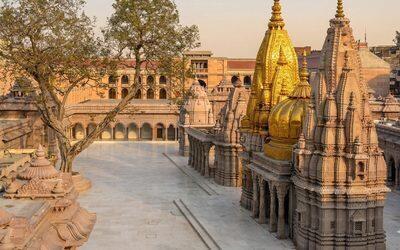
Hanuman Dhara holds a unique place in Rama-bhakti tradition: it is the site of Shri Ram's tenderness toward his greatest Bhakta. Across India, Hanuman temples celebrate Bhakta's service to Bhagavan — at Hanuman Dhara, the bhav is reversed: Bhagavan serves the Bhakta. The natural dhara that cools Hanuman is held to be Shri Ram's own kripa made visible in water. Devotees come to this shrine specifically for that bhav — to ask that the same Bhagavan who arranged perpetual cooling for his Bhakta also arrange the cooling of the fires that burn in their own lives: the fires of anger, of restlessness, of unfulfilled longing, of suffering.
The cooling-bhakti of Hanuman Dhara is also a meditation on the role of natural water in Hindu worship. Across the dharmic tradition, perennial natural springs and waterfalls are held to be physical manifestations of divine kripa — water that flows without human effort, from a source that does not exhaust. The Hanuman Dhara stream is one such manifestation: pilgrims who place themselves under it, even briefly, hold that they receive a direct touch of the same kripa that has cooled Bhagavan Hanuman through the ages.
History
Hanuman Dhara is woven into the Chitrakoot tradition that places these hills as the principal vanavasa-region of the Ramayana. The shrine is mentioned in medieval Ramayana commentaries and the parikrama-paddhati of Chitrakoot. The present stone steps were laid by successive Bundelkhand patrons over the past several centuries; the murti has been re-installed and re-consecrated multiple times as the shrine's niche has been improved. The shrine is part of the standard Chitrakoot parikrama circuit alongside Ram Ghat, Kamadgiri, Bharat Milap, Sphatik Shila, and Gupt Godavari.
Architecture
Hanuman Dhara is a hilltop rock-shrine rather than a built temple. The site consists of a natural niche carved out of the cliff face, in which the murti of Hanuman sits in his Sankat-Mochan posture. Directly above the niche, the perennial stream emerges from the cliff and falls — through a stone channel arrangement that focuses the flow — directly onto the murti. The water then flows on down the slope to feed a small pool below. The 360-step climb up to the shrine is built of dressed stone with intermediate platforms for resting; small subsidiary shrines to Shri Ram, Sita-mata, Lakshman, and Ganesha are placed along the route. From the top, a small open platform allows panoramic viewing of Chitrakoot, Kamadgiri, and the Mandakini.
Rituals & Practices
The shrine is open from sunrise to sunset; there are no formal aarti times of the institutional kind, but the resident pujari conducts brief morning and evening rituals. Pilgrims climb the 360 steps reciting Hanuman Chalisa, take darshan of the murti through the falling dhara, offer sindoor and oil to the murti at the niche, and (where the pujari permits) briefly stand or sit under the dhara as a cooling-bhakti gesture. On Sundays many groups gather at the top for a complete Sundara Kanda paath. Tuesdays and Saturdays — the principal Hanuman-days — see heavy flow throughout the year. Devotees often combine Hanuman Dhara with the wider Chitrakoot parikrama: Ram Ghat, Kamadgiri, Bharat Milap, Sphatik Shila, Gupt Godavari, and finally the climb to Hanuman Dhara as the culminating darshan.
Festivals & Celebrations
| Festival | When | Crowd |
|---|---|---|
| Hanuman Jayanti | — | very_high |
| Tuesdays | — | high |
| Saturdays | — | high |
| Sundara Kanda Sundays | — | moderate |
Hanuman Jayanti: The supreme festival at Hanuman Dhara â the birthday of Bhagavan Hanuman.
Tuesdays: The traditional weekday of Hanuman-bhakti.
Saturdays: Combined Hanuman and Shani-relief observance.
Sundara Kanda Sundays: Recitation of the Lanka-journey katha at the very site of the cooling-rite.
Prepare for Your Visit
Practical guidance to help you plan your pilgrimage
| Pilgrim Guidance | How to reachChitrakoot is reached by train to Karwi (Chitrakoot Dham) station, 8 km from Ram Ghat; from Ram Ghat the base of the Hanuman Dhara climb is 5 km by road (auto-rickshaw or shared taxi). The climb up is 360 stone steps. Ponies and palki-bearers are available at the base for elders or those who cannot manage the climb. PreparationWear comfortable shoes for the climb; carry water (small bottle). Modest dress. The climb takes 30-45 minutes at a moderate pace with rest-breaks; come early in the morning to avoid the midday sun. Carry sindoor and a small bottle of mustard oil as the traditional Hanuman-offering. A printed Hanuman Chalisa or Sundara Kanda is helpful for recitation on the way up. Best time to visitOctober to March most pleasant. Hanuman Jayanti (Chaitra Purnima, March-April) is the supreme spiritual peak with all-night bhajan and continuous Hanuman Chalisa recitation. Tuesdays and Saturdays draw heavy weekly flow. Sundays see Sundara Kanda paath groups gathered at the summit. The dhara flows year-round; the cooling effect is especially welcome from April through June. |
Location
Chitrakoot, UP
Pilgrim photos
No pilgrim photos yet.
Community corrections
No corrections yet.
Edit history
No revisions yet.
Plan Your Visit to Hanuman Dhara, Chitrakoot
Get a custom itinerary and pricing for your trip.
Recommended
Packages for this destination
Pilgrim Notes
On-ground observations from fellow pilgrims
No pilgrim notes yet. Be the first to share on-ground observations!
Sign in to share a note.
Pilgrim Reviews
Be the first to share your experience at Hanuman Dhara, Chitrakoot.
Sign in to write a review.
Nearby sacred places
Discover other sacred places near Hanuman Dhara, Chitrakoot
Explore temples, tirthas, and pilgrimage sites in UP
Explore nearbyPart of these circuits
Walk the traditional pilgrimage routes this destination belongs to.