Nand Bhawan stands on the crest of Nandishwar Hill in Nandgaon, looking out over the wide green country of Braj. Braj tradition holds that when Nanda Baba moved his household from Gokul to keep Krishna and Balarama safe, this hilltop became their new home. The years of Krishna's boyhood — his cowherd play, his butter-stealing pranks, his first flute notes, his early Govardhan-lila — are all held to have unfolded from this very palace and the lanes that descend its slope.
The climb to Nand Bhawan is itself part of the darshan. From the village square at the foot of Nandishwar Hill, a long flight of stone steps rises through cowherd homes and old peepal shade to the temple at the top. Pilgrims pause on the climb, often catching breath at small shrines along the way. When the door of the sanctum finally opens, what one sees is not a single deity but a household: Nand Baba and Yashoda Maiya seated at the centre, Krishna and Balarama as boys at their side, Rohini Maiya beside Yashoda, and the Ashta Sakhas — Krishna's eight childhood friends — ranged around them.
This family-darshan is the unique gift of Nand Bhawan. Elsewhere in Braj, Krishna is worshipped as the divine cowherd, the flute-player, the consort of Radharani. Here he is worshipped as Lala — the beloved son of Nand and Yashoda, the elder brother, the friend. The temple does not ask the pilgrim for grand philosophy. It asks only for the simplicity of one who has come home.
Katha — Nand Baba's household on the hill
The Bhagavata Purana tells that after the demoness Putana, Trinavarta, and the cart-demon Sakatasura attacked the infant Krishna at Gokul, the elders of the cowherd community gathered in council. They could no longer feel safe in the open meadows of Gokul. Upananda — Nanda Baba's elder brother — proposed that they move to a hilly settlement where the trees were thicker and the approaches narrower. Braj tradition identifies this settlement with present-day Nandgaon, and the hill of Krishna's new home with Nandishwar.
A beloved second katha holds that Nandishwar Hill is itself Shiva — that Mahadev, longing to be near the lila of Krishna's childhood, took the form of this hill so that the boyhood pastimes of the Lord would play out upon his very form. Bhakti tradition therefore holds that to climb the steps of Nand Bhawan is to climb upon Shiva himself, who carries Krishna with eternal devotion.
Yet another cherished katha tells of Nand Maharaj's daily life. Every morning he would rise before dawn, see to the cows, take counsel with the elder cowherds, and then return to the household for the bathing and feeding of his two boys. Yashoda Maiya churned butter in the inner courtyard, and Krishna — already famous for his butter-thefts — would creep up behind her or hide butter-pots from her reach. The very stones of Nand Bhawan are held in Braj memory to have witnessed these scenes.
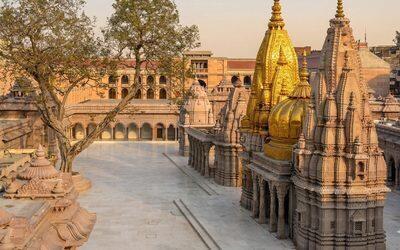
Nand Bhawan is the supreme seat of vatsalya bhava in Braj. While Yashoda Kund at the foot of the hill is the kund of vatsalya, Nand Bhawan on the crest is its principal mandir. Among the moods of pure devotion that Gaudiya tradition recognises — shanta, dasya, sakhya, vatsalya, and madhurya — vatsalya is the love of the parent for the child. Nand Baba and Yashoda Maiya are its supreme exemplars, and Nand Bhawan is the household where their love was given each day to the infinite Lord in his form as their son.
The darshan at Nand Bhawan is uniquely a family-darshan. Pilgrims who come here are invited not into a grand cosmic vision of the Lord, but into the intimate household of cowherd parents and their two beloved boys. To stand before this murti-group is to remember that the Lord of all worlds chose to live, for many years, as a son under a mother's care and a father's protection. Gaudiya, Pushtimarga, and Nimbark tradition all hold this hidden choice as the deepest sweetness of Krishna-lila.
The temple holds a special place in Sri Sanatan Goswami's Braj-yatra. Sanatan Goswami — the eldest of the Six Goswamis of Vrindavan — spent long periods in Nandgaon recovering its lila-sthals, and his Brihad-bhagavatamrita honours Nand Baba's household as one of the central scenes of pure devotion. The Pushtimarga sampradaya of Sri Vallabhacharya, which holds vatsalya as the heart of its seva, gives Nand Bhawan a similarly central place. Nimbarkacharya's lineage and the Radhavallabh tradition also pause here in deep reverence.
Devotees come to Nand Bhawan to ask not for liberation, not for siddhi, not for boons, but for entry into the household — for the chance to remember themselves as servants of Nand Baba, helpers in Yashoda Maiya's kitchen, friends of the Ashta Sakhas. This longing to be a small part of the family at Nand Bhawan is among the most tender prayers in all of Braj.
History
The history of Nand Bhawan as a worshipped site is rooted in the oldest layers of Braj devotional memory. The Bhagavata Purana describes Nanda Baba's move from Gokul to a hilly settlement, and Braj tradition has continuously identified this with Nandgaon and the hill of Nandishwar. Pilgrimage to the hilltop is referenced in early medieval Braj-mahatmya texts, and the site was already an established Vaishnava tirtha by the time of the sixteenth-century Braj revival.
The temple in its present form is traditionally attributed to the great Braj-yatra acharya Sri Narayan Bhatt Goswami and to Sri Sanatan Goswami, who together in the sixteenth century identified, marked, and re-established the lost lila-sthals of Braj. Sanatan Goswami spent extended bhajan periods in Nandgaon, and the household-darshan of Nand Bhawan — with Nand Baba, Yashoda Maiya, Krishna, Balarama, Rohini and the Ashta Sakhas worshipped together — reflects the theological vision he gave to the Gaudiya tradition through his Brihad-bhagavatamrita.
Later patronage came from the rulers of Orchha and from the Jat rulers of Bharatpur, who built ghats and pilgrim shelters along the climb, supported the daily seva, and helped maintain the long stone stairway from the village square to the hilltop. The Sanadhya Brahmin families of Nandgaon have served as the gosain-sevaks of Nand Bhawan for generations, and their lineage of seva continues to this day.
Like many Braj temples, Nand Bhawan has been restored more than once over the centuries. The Archaeological Survey marks the hilltop temple as a protected heritage site; daily worship and pilgrimage continue under the local seva tradition. The temple has weathered the changes of empires, the comings and goings of yatra-fashions, and remains today what it has always been — the home of Nand Baba on the hill.
Architecture
Nand Bhawan is built in the simple hilltop-temple style of medieval Braj. The structure is modest in plan — a stone-walled jagamohan leading into a deeper sanctum — with a low shikhara rising above the deity-chamber. The construction is in local Braj sandstone, with restrained carving on the doorways and pillars. The outer walls are washed in the warm yellow that one sees across the older temples of Nandgaon.
The sanctum opens onto a family-darshan unique in all of Braj. At the centre sit Nand Maharaj and Yashoda Maiya, dressed in the silks of a cowherd household. Beside them stand Krishna and Balarama as boys, with peacock-feather crowns and small flutes. Rohini Maiya, Balarama's mother, sits beside Yashoda. Around them are the Ashta Sakhas — Krishna's eight closest childhood friends — and small images of the cows that filled Nand Baba's stable.
The jagamohan, where pilgrims gather, is a stone-pillared hall whose walls carry old paintings and prints of Krishna's boyhood lilas. From the open courtyard outside the temple, the view stretches across the wide country of Braj — the kunds and groves of Nandgaon below, Barsana on its hill in the distance, and the long flat green of the Yamuna plains. This view itself is held as part of the darshan, since the Braj that the pilgrim sees from the courtyard is the very land of Krishna's childhood play.
A side shrine within the precinct honours Sri Sanatan Goswami, whose bhajan-sthal is held to have been on this hill. The architectural simplicity of Nand Bhawan — its modest scale, its unadorned walls, its commanding view — is held by Braj-vasis to mirror the simplicity of Nand Baba's own household.
Rituals & Practices
The daily seva at Nand Bhawan follows the household-rhythm appropriate to a cowherd home. Exact timings vary with the season and should be verified on arrival; the broad sequence is as follows. Mangala Aarti is offered before dawn, when Nand Baba and Yashoda Maiya are awakened and Lala is roused gently by his mother. Sringar Darshan follows, with the family dressed in the silks of the day. Rajbhog at midday is the principal offering — butter, milk-sweets, and the foods that a cowherd household would have prepared for its boys. Utthapan, Sandhya Aarti, and Shayan close the day, with Lala finally returned to his mother's lap for rest.
The principal practices of pilgrims at Nand Bhawan are these:
- The slow climb up the stone steps from the village square, with the inner remembrance that one is climbing upon Nandishwar — Mahadev who became the hill
- Darshan of the family-murti group at the sanctum
- Parikrama of the temple within its courtyard
- A pause at the courtyard's edge for the wide Braj-darshan from the hilltop
- Offering of butter, sweet, or a small cloth at the sanctum (through the sevaks)
- Sit-down in the jagamohan with soft japa — Hare Krishna mahamantra, or the names of Nand and Yashoda
- Hearing of Nand-baba katha from the resident gosain-sevaks, where available
Many pilgrims combine the darshan with the descent to Yashoda Kund at the foot of the hill, the visit to Pavan Sarovar, and the parikrama of the principal kunds of Nandgaon. Pushtimarga and Gaudiya yatris often perform this sequence within the wider forty-eight kos Braj parikrama.
Festivals & Celebrations
| Festival | When | Crowd |
|---|---|---|
| Janmashtami | — | very_high |
| Nandotsav | — | very_high |
| Kartik Damodara-vrata | — | high |
| Holi | — | very_high |
| Annakoot | — | high |
Janmashtami: The most important festival of Nandgaon. Janmashtami at the very hilltop where Nand Baba and Yashoda Maiya are held to have lived with their newborn Lala is a once-in-a-lifetime darshan for many Braj-yatris.
Nandotsav: Nandgaon's own festival â held with greater intensity here than anywhere else in Braj, since Nand Baba's home is identified with this very hill. The Nand-baba katha is the heart of the day.
Kartik Damodara-vrata: Honours the Damodara-lila â Yashoda Maiya binding the infant Krishna to the mortar within Nand Baba's household. Nand Bhawan is held to be the principal mandir of the Damodara-vrata in all of Braj.
Holi: One of the most beloved festivals of Braj, rooted in the playful lila between Krishna of Nandgaon and Radharani of Barsana.
Annakoot: Nand Bhawan is the household from which Krishna's first Govardhan-lila is said to have begun; Annakoot here carries a special intimacy.
Prepare for Your Visit
Practical guidance to help you plan your pilgrimage
| Pilgrim Guidance | How to reachNand Bhawan is in Nandgaon, about 50 km north-west of Mathura. From Mathura Junction, shared autos and taxis run via Govardhan and Barsana to Nandgaon; the drive is among the most beautiful in Braj. From the Nandgaon village square at the foot of Nandishwar Hill, a long stone stairway rises to the temple — roughly 10-15 minutes of steady climb, with rest-points along the way. Mathura is the railhead; Delhi (150 km) the nearest airport. Traditional pilgrim sequenceThe classical order followed by Braj-yatris in Nandgaon is: first the climb to Nand Bhawan on the hilltop, then a quiet descent to Yashoda Kund at the foot, then Pavan Sarovar, and finally the smaller kunds and groves around the village. Sri Sanatan Goswami's bhajan-sthal at the hilltop is visited along with the temple. Pushtimarga and Gaudiya pilgrims often perform this sequence within the wider Braj-yatra. PreparationModest dress is essential; full-sleeved kurtas and full-length lower garments for both men and women. The climb is long but not steep — wear comfortable footwear that is easy to remove at the temple. Carry water, especially in summer; the hilltop is exposed and can be hot from late morning. The stone steps can be slippery in the monsoon — walk slowly. Small offerings (butter, sweet, a length of cloth) can be made through the sevaks; carry only what you intend to offer. Best time to visitOctober to March for pleasant weather. Janmashtami, Nandotsav, Kartik Damodara-vrata, and Holi are the major occasions of Nandgaon. The early morning darshan — when the mist still lies on the kunds below and the first light reaches the temple courtyard — is held by Braj-vasis to be the closest one can come to the hour when Nand Baba's household itself was waking on the hill. |
Location
Mathura, UP
Pilgrim photos
No pilgrim photos yet.
Community corrections
No corrections yet.
Edit history
No revisions yet.
Plan Your Visit to Nand Bhawan, Nandgaon
Get a custom itinerary and pricing for your trip.
Recommended
Packages for this destination
Pilgrim Notes
On-ground observations from fellow pilgrims
No pilgrim notes yet. Be the first to share on-ground observations!
Sign in to share a note.
Pilgrim Reviews
Be the first to share your experience at Nand Bhawan, Nandgaon.
Sign in to write a review.
Nearby sacred places
Discover other sacred places near Nand Bhawan, Nandgaon
Explore temples, tirthas, and pilgrimage sites in UP
Explore nearbyPart of these circuits
Walk the traditional pilgrimage routes this destination belongs to.