Nishadraj Ghat carries the name of Nishadraj Guha, the king of the Nishadas of Shringverpur, who in the Ramayana gave Ram, Sita and Lakshman shelter on the first night of their exile and arranged the boat and the helmsmen who took them across the Ganga. In Banaras the name is not decorative. It is the name the boatmen of this stretch have chosen for themselves, and the ghat stands as the community's own place on the river.
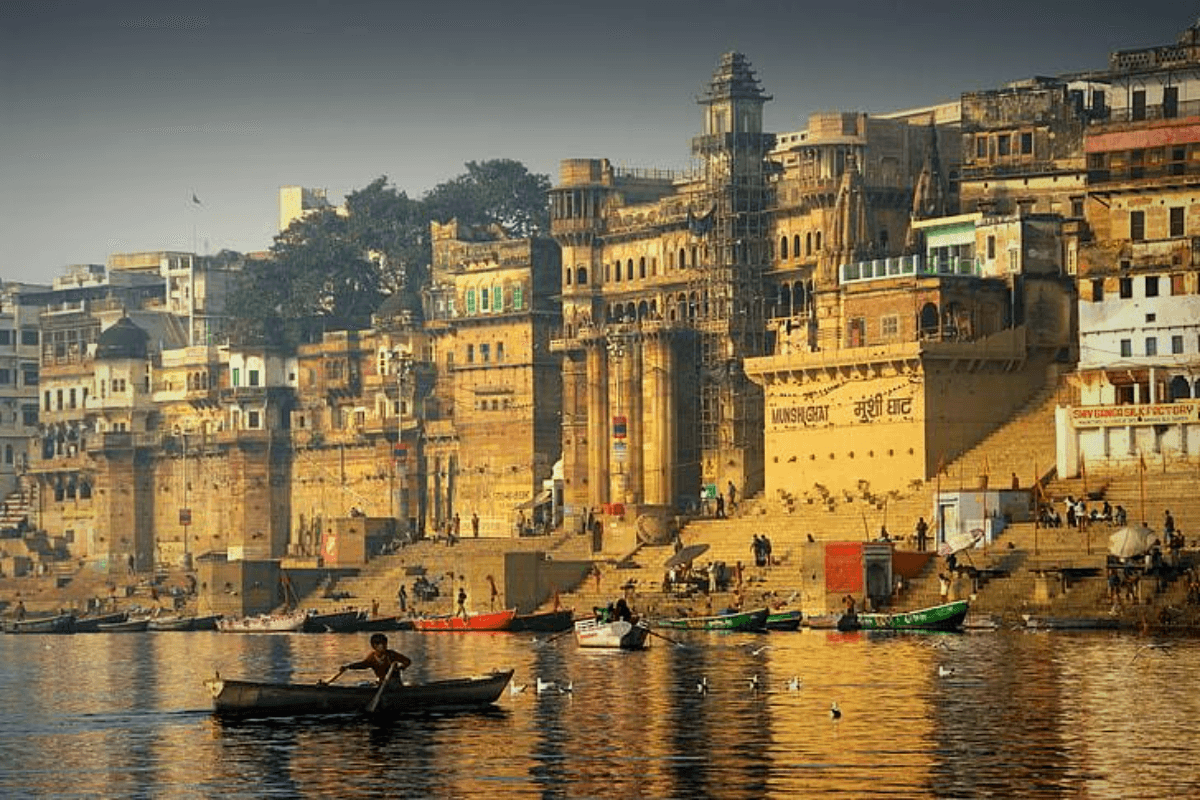
This is the tenth ghat in the traditional sequence that begins at Assi and runs north toward Adi Keshava, set between Jain Ghat to the south and Prabhu Ghat to the north. It belongs to the quieter southern crescent of the riverfront, well away from the crowds of Dashashwamedh. There is no palace facade here and no evening aarti of the grand kind. What the pilgrim sees instead is a plain flight of stone steps, a line of wooden boats moored close together, nets and oars laid out to dry, and families whose whole working life is arranged around the water.
The Nishad settlement behind the ghat is large: the Kashi district portal describes around ten thousand boatmen living in the neighbourhood, and heritage documentation of the ghat puts the figure nearer twelve thousand. Boats from these steps join the traffic that works the length of the riverfront, and the families here keep that practical rhythm going. A small temple to the boatmen-king stands in the lane above the steps, so that the household deity of the community and its livelihood sit within a few paces of each other.
Pilgrims who come here come for the Ganga herself — for snan, for arghya to the rising sun, for a quiet stretch of water where the river can be approached without haste. The ghat asks to be received as it is: a working ghat, honestly plain, held by a community that has served Kashi's pilgrims for generations.
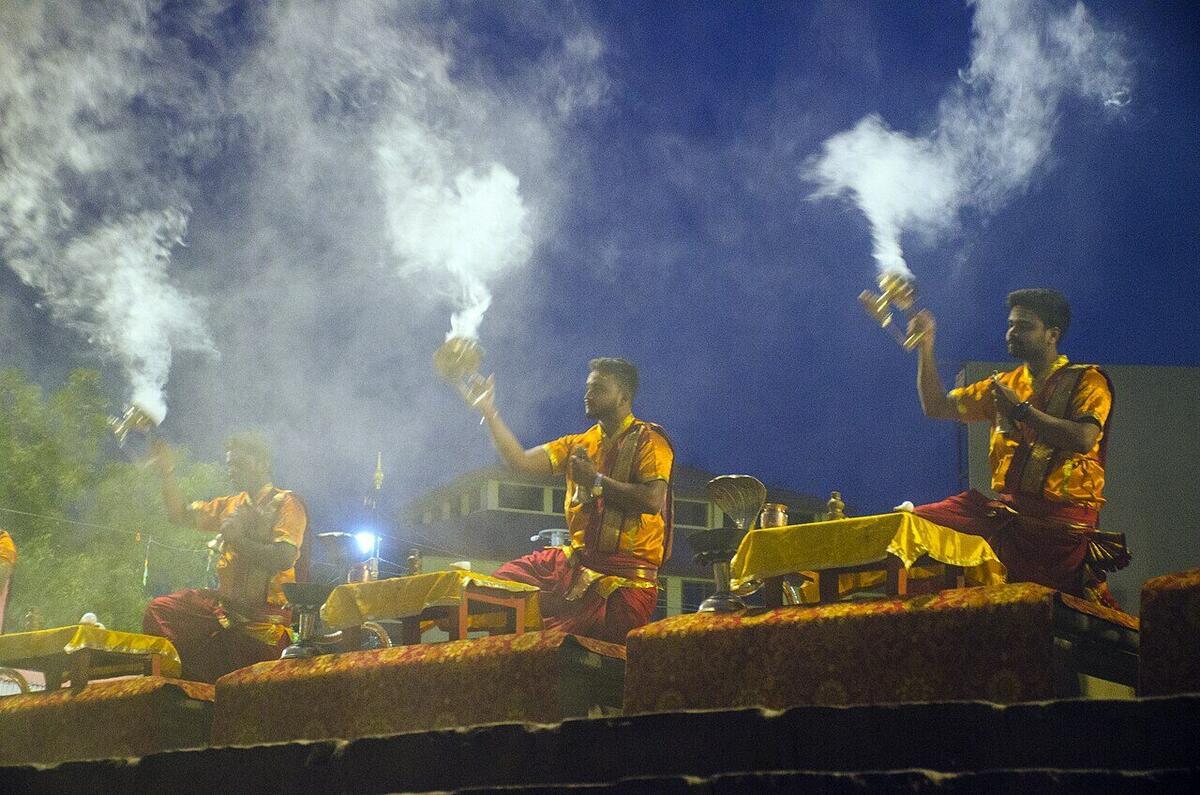
The devotional weight of this ghat rests on a single episode of the Ramayana and on what the Nishad community has made of it. In the Ayodhya Kanda of Valmiki's telling, Ram in exile reaches the Ganga at Shringverpur, and Guha — chief of the Nishadas, a forest and river people — comes out to meet him. Guha is Ram's first ally of the exile. He offers what he has, and he arranges the boat and the helmsmen for the crossing. In the Tamil Kamba Ramayanam he keeps watch through the night while the princes sleep, and Ram praises him there as his own brother. Tradition holds that Ram received him not as a subject but as a friend.
For the boatmen of Kashi this is understood as the sanctification of their own work. To row a pilgrim across sacred water is not a trade only; in devotional understanding it is the same seva that Guha offered, repeated every day. The Nishadas are described as a river people in the older literature as well — the Manusmriti and the Anushasana Parva of the Mahabharata name fishing as their livelihood, and Kalidasa's Raghuvamsha presents them as boatmen. The name Nishadraj therefore joins a very old occupational identity to a moment of grace in the Ram-katha.
What this ghat is, and is not
It is worth saying plainly: Nishadraj Ghat does not carry a tirtha-mahatmya of its own in the classical Kashi Khanda literature, and it is not counted among the panchatirtha ghats. Its sanctity is the sanctity of the Ganga at Kashi, which the tradition holds to be undivided along the whole crescent — every step of the riverfront is held to be tirtha. What is distinctive here is not a separate katha but a living community whose devotional self-understanding is bound to Ram's boatman. A pilgrim who stands here a while sees something of how Kashi actually works as a tirtha-nagari — the labour on which the darshan of thousands quietly rests.
History
For most of its recorded life this stretch of the riverfront was not a separate ghat at all. It formed the southern part of Prabhu Ghat — built in the mid-nineteenth century by a Bengali merchant named Nirmal Kumar and later renamed for Raja Prabhu Narayan Singh of Banaras — and was separated out only in the twentieth century, when the boatmen's settlement here had grown large enough to give the stretch its own identity.
Heritage documentation of the Varanasi ghats records that the steps were made pucca, that is faced in permanent masonry, in 1946, with the support of the boatmen's organisation. This is the ghat's foundational fact, and an unusual one along this riverfront: most Varanasi ghats were paved by kings, queens, Maratha sardars or wealthy merchants, while this one was made pucca with the support of the working community that uses it.
Sources differ on when the present name was settled. The Kashi district portal places the naming in the 1940s, following the establishment of a temple to the boatmen-king and the clear predominance of Nishad households in the neighbourhood; the same heritage survey dates that temple's opening to the 1970s. The substance, however, is not in dispute — that the stretch separated from Prabhu Ghat, that it took the name of Nishadraj, and that the impulse came from the community itself rather than from a patron. Something similar had happened a little to the south not long before, when Jain Ghat was set apart from Vachharaj Ghat in 1931; along this quieter southern reach of the riverfront, a community claiming its own length of steps is not unusual. The ghat area today is held by the Municipal Corporation, while the buildings above it belong to resident families and trusts.
Architecture
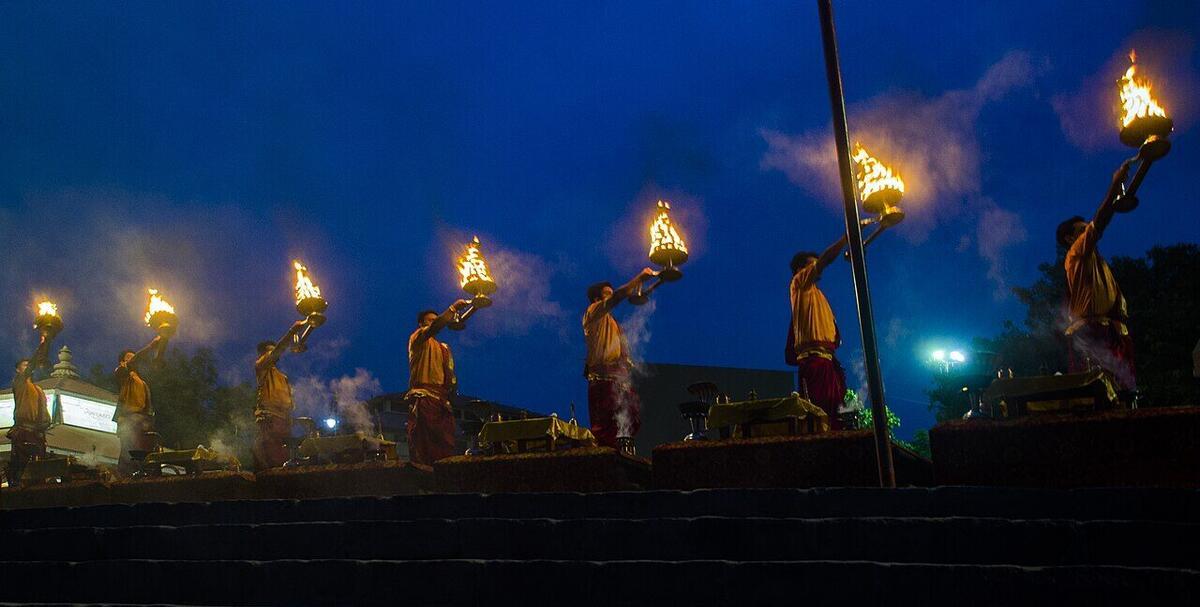
Nishadraj Ghat is a small ghat — heritage survey records give it an area of roughly a quarter of a hectare — and its architecture is plain. There is no riverside palace, no tiered pavilion, no ornamented gateway. What stands here is a plain flight of masonry steps running down to the water, the 1946 pucca work that the boatmen's organisation supported, patched and repaired many times since against the annual rise of the river.
The features that matter here are working ones. The lower steps are shaped by use rather than design: mooring points where boats are tied in ranks, flat stretches where hulls are drawn up for caulking and repainting before the season, ledges where nets and oars dry. The masonry darkens to a waterline that shifts between the winter low and the monsoon flood. Reporting from this ghat records that in the low-water months after the flood has receded, boatmen here cross to the kachhar — the wide sandbanks on the far side of the Ganga — and raise vegetables there.
Above the steps, in the lane behind, stands the modest temple to Nishadraj that gives the ghat its focus — a small shrine rather than a monument, recorded in the heritage survey at house number B 3/78. The whole effect is of a ghat that was built to be used and not to be admired, which is itself worth seeing in a city where so much of the riverfront was raised by patrons as acts of public piety.
Rituals & Practices
The practices here are those of an ordinary bathing ghat, kept by a community for whom the river is also a workplace. Before first light the steps fill with people taking snan; water is lifted in cupped hands and offered as arghya to the rising sun; a few flowers and a lamp go out onto the current. Boats are untied and pushed off through the morning as the day's ferrying begins.
Darshan at the small Nishadraj shrine in the lane above is a household observance more than a formal temple rite: the shrine was raised by the community in commemoration of the boatmen-king, and it is the community that keeps it. There is no scheduled grand aarti at this ghat; pilgrims who wish to attend the Ganga Aarti go north to Dashashwamedh, very often in a boat rowed from these steps.
One living practice here is musical rather than ritual. Boatmen of this ghat sing chaiti — the seasonal songs of the month of Chaitra — and thumri, the classical light form long associated with Banaras. Reporting from these steps records a boatman in his sixties who rows and sings both, and who says of his music that whatever he learned, he learned here from Ganga Maiya. A pilgrim who takes a boat from here in spring may hear it.
Festivals & Celebrations
| Festival | When | Crowd |
|---|---|---|
| Nishadraj Jayanti | — | Moderate â a community observance rather than a public gathering |
| Chaiti season | — | Low |
| Ram Navami | — | Moderate |
| Ganga Dussehra | — | High along the riverfront |
| Dev Deepawali | — | Very high across the city |
| Daily Ganga snan | — | Low to moderate |
Nishadraj Jayanti: Guha is remembered as the friend who sheltered Ram in exile and arranged his crossing of the Ganga. For boatmen's families the day honours the dignity of seva offered from a modest station.
Chaiti season: A living folk-classical inheritance of the river communities of Kashi, learned by ear and passed from one generation of boatmen to the next.
Ram Navami: The ghat's name keeps the Ayodhya Kanda episode of Guha's seva close to the community's devotional life through the Chaitra festivals.
Ganga Dussehra: For a community whose whole livelihood rests on the river, the descent of the Ganga is a household festival as much as a pilgrimage day.
Dev Deepawali: A city-wide observance kept at every ghat of Kashi, and one in which the river itself becomes the place from which the city is seen.
Daily Ganga snan: The unbroken daily worship of the Ganga by the families who live on her banks.
Prepare for Your Visit
Practical guidance to help you plan your pilgrimage
| Pilgrim Guidance | How to reachNishadraj Ghat sits in the southern stretch of the riverfront, north of Assi Ghat and well short of Kedar Ghat. Most pilgrims reach it on foot along the ghat walkway — from Assi it is a walk of about fifteen to twenty minutes north past Tulsi, Bhadaini, Janaki, Vachharaj and Jain Ghats. By road, an auto or e-rickshaw to the Sonarpura or Bhadaini area brings you to the head of the lanes, and a short walk through the galis brings you down to the steps. The ghat can also simply be approached from the water, since boats from Assi and Dashashwamedh pass it constantly. Hiring a boat and what to expect
Best time to visitEarly morning is the ghat's own hour — snan, the launching of the boats, and the clearest light on the water. October to March is the most comfortable season for pilgrims, with settled weather and a low, wide river. Chaitra (March–April) brings the chaiti songs, and the tithi of Nishadraj Jayanti falls in the same month. During the monsoon the lower steps go under water and boating is restricted on official advice; check locally before planning any crossing between July and September. |
Location
Varanasi, UP
Pilgrim photos
No pilgrim photos yet.
Community corrections
No corrections yet.
Edit history
No revisions yet.
Plan Your Visit to Nishad Raj Ghat
Get a custom itinerary and pricing for your trip.
Recommended
Packages for this destination
Pilgrim Notes
On-ground observations from fellow pilgrims
No pilgrim notes yet. Be the first to share on-ground observations!
Sign in to share a note.
Pilgrim Reviews
Be the first to share your experience at Nishad Raj Ghat.
Sign in to write a review.
Nearby sacred places
Discover other sacred places near Nishad Raj Ghat
Explore temples, tirthas, and pilgrimage sites in UP
Explore nearbyPart of these circuits
Walk the traditional pilgrimage routes this destination belongs to.