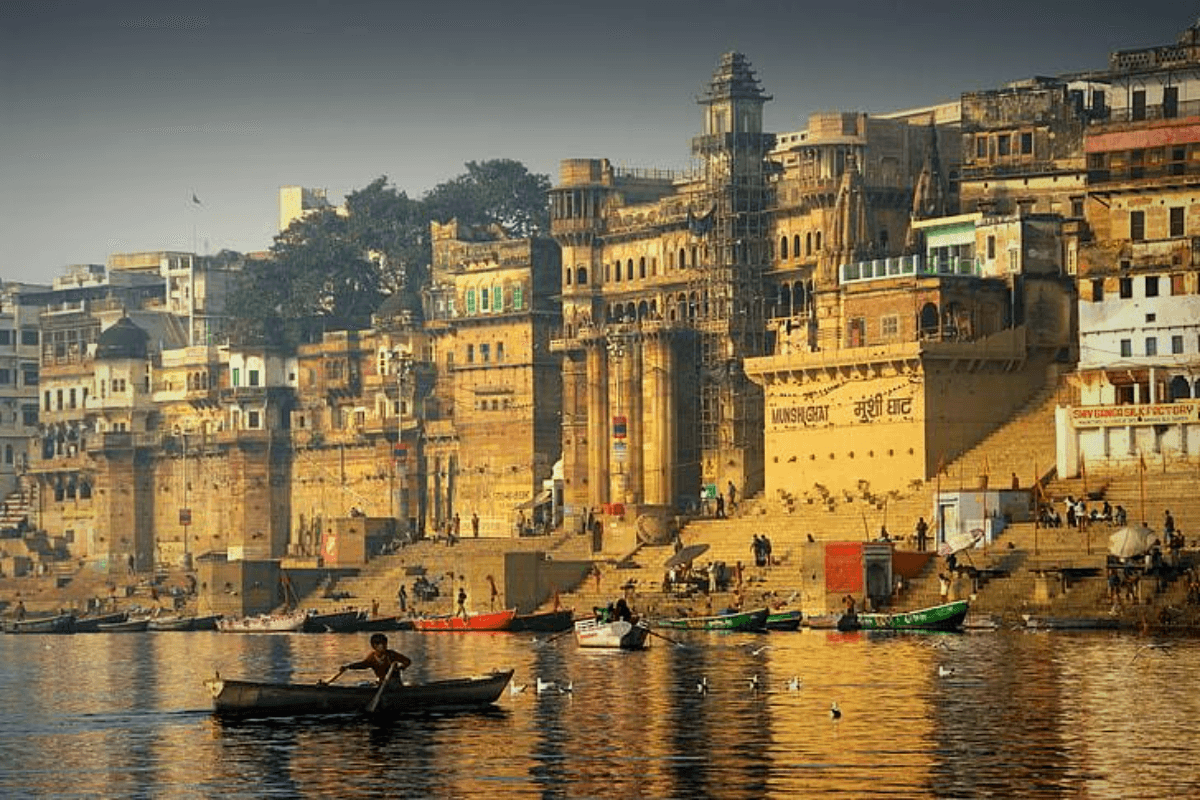
Ramnagar Fort is not approached in Banaras merely as a royal residence or a heritage monument. It is the seat of the Kashi Naresh, the Maharaja of Banaras, whom Kashi tradition holds in deep reverence as the earthly representative of Shiva and the ceremonial protector of the sacred city. Built around 1750 by Raja Balwant Singh, founder of the Banaras royal house, the fort rises on the eastern (Ramnagar) bank of the Ganga, directly facing the great sweep of Kashi's ghats.
The fort has been the principal residence of the royal family continuously since its founding, and remains so under the present head of the house. Yet its deepest identity in the devotional life of Banaras flows from the ceremonial and spiritual role the Kashi Naresh has long carried — as host of the city's most sacred public observances. The two most cherished of these are the Ramnagar Ramlila, a month-long enactment of the entire Ramayana staged across the fort and the town from Anant Chaturdashi to Sharad Purnima (late September to mid-October), and the Dusshera Darbar, the royal audience held at Vijayadashami.
Within the fort stand the kuladevata shrines of the royal family — to Durga, to Chhinnamastika Devi, and to Ved Vyasa — alongside the Saraswati Bhawan museum, which preserves the cultural memory of Kashi: royal palanquins, vintage cars, hand-copied manuscripts, ceremonial arms, and the famous astronomical clock that tracks the lunar and solar cycles. To the visitor it offers heritage; to the Banarasi devotee it remains, above all, the home of the Ramlila and the seat of the city's protector.
Katha and local belief
The Ramnagar Ramlila is held in Banaras to be the most sacred and the most complete of all Ramlilas in India. Initiated by Maharaja Udit Narayan Singh in 1830, it has run without break for nearly two hundred years. It is not a stage play in the ordinary sense — it is the Ramayana relived across the very ground of Ramnagar. The fort and its surrounding fields are understood, for thirty-one nights, as Ayodhya, Chitrakoot, Panchavati, and Lanka, and the assembled devotees move with the divine characters from place to place across the unfolding katha. The text is the Awadhi Ramcharitmanas of Goswami Tulsidas, and the Maharaja attends each night in his ceremonial role, his presence binding the lila to the continuity of dharmic kingship that Ram himself embodied.
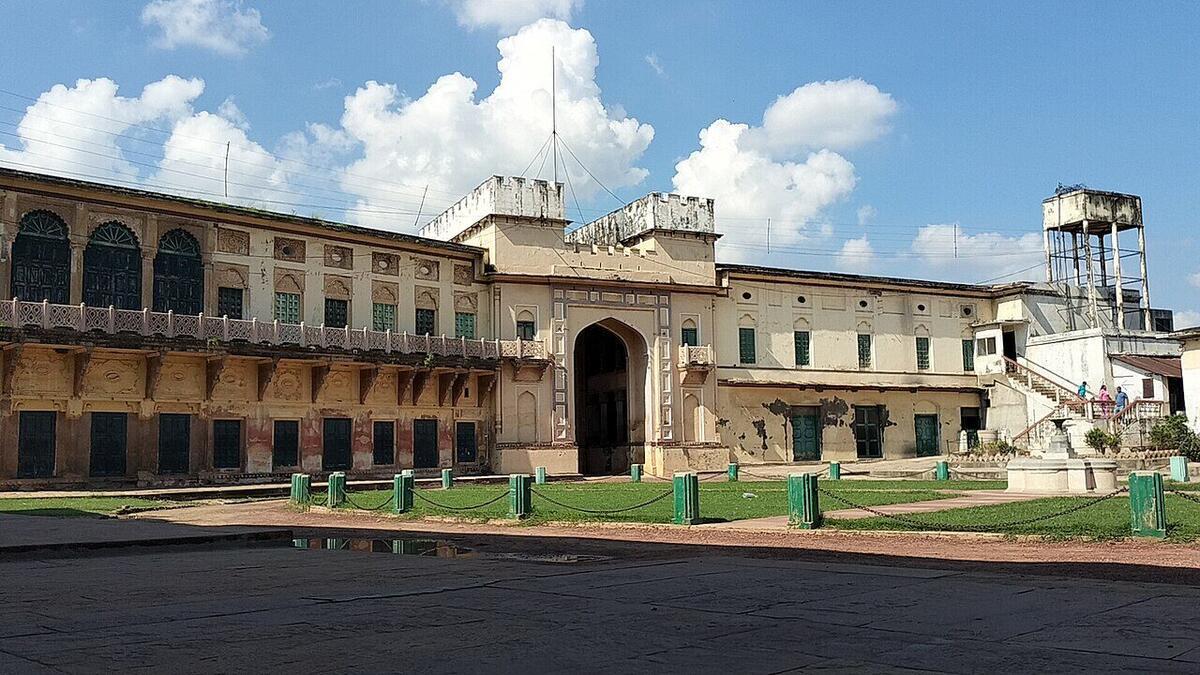
The spiritual weight of Ramnagar Fort rests on two living traditions: the devotional role of the Kashi Naresh, and the Ramnagar Ramlila that has flowered from it.
In the sacred imagination of Banaras, the Kashi Naresh is not an ordinary sovereign. He is honoured as the earthly representative of Shiva, the Lord of Kashi, and as the ceremonial protector under whose patronage the city's great public devotions are sustained. This is why the Maharaja's presence at the Ramlila, at the Dusshera Darbar, and at the river festivals is felt not as royal display but as a continuation of dharma — the king standing in service of the deity and the devotees.
The Ramnagar Ramlila itself is the fort's deepest spiritual expression. For Banarasi devotees the thirty-one nights are not entertainment but a sustained reliving of the Ramayana, a darshan of Ram, Sita, Lakshman, and Hanuman as they move through exile, the search for Sita, the battle at Lanka, and at last the coronation at Ayodhya on the final night. The boy-actors who take the divine roles — the svarup — are treated for the season not as performers but as living embodiments of the deities, and devotees bow to them. To witness the lila is held to be a pilgrimage in itself.
The Dusshera Darbar
Each Vijayadashami the Maharaja holds an open darbar at the fort — a ceremonial audience in which traditional honours are exchanged, offerings of tribute are made, and the Maharaja appears in the full ceremonial dress of his position. It is among the most visible survivals in modern India of Dasara as the day of royal audience, and Banaras keeps the tradition more faithfully than most former princely houses. The internal Durga and Chhinnamastika shrines, as the kuladevata of the royal family, are honoured in this cycle; they are approached chiefly in that devotional capacity rather than as public pilgrimage sites.
History
Ramnagar Fort was built around 1750 by Raja Balwant Singh (r. 1739–1770), the founder of the Banaras royal house as a regional power. Balwant Singh consolidated the region's zamindaris into a principality, and the fort with the town of Ramnagar around it became the administrative and residential centre from which the Banaras raj was governed.
The fort's most culturally significant moment came under Maharaja Udit Narayan Singh (r. 1795–1835), who initiated the Ramnagar Ramlila in 1830. The lila draws on Goswami Tulsidas's Ramcharitmanas — the same text composed two centuries earlier across the river at Tulsi Ghat — and is performed in Awadhi following the Manas. The founding of the Ramlila bound the fort permanently into the devotional life of Kashi, and it has been sustained by the patronage of the Kashi Naresh ever since.
Through the colonial period the Kashi Naresh retained his ceremonial standing and the fort remained the royal residence. After Independence the princely states were dissolved, but the Maharaja's revered role in the religious life of the city continued unbroken. The fort today is partly open to visitors — through the Saraswati Bhawan museum, with its royal memorabilia, arms, palanquins, vintage cars, and the celebrated astronomical clock — while the residential portion remains the private home of the royal family.
Architecture
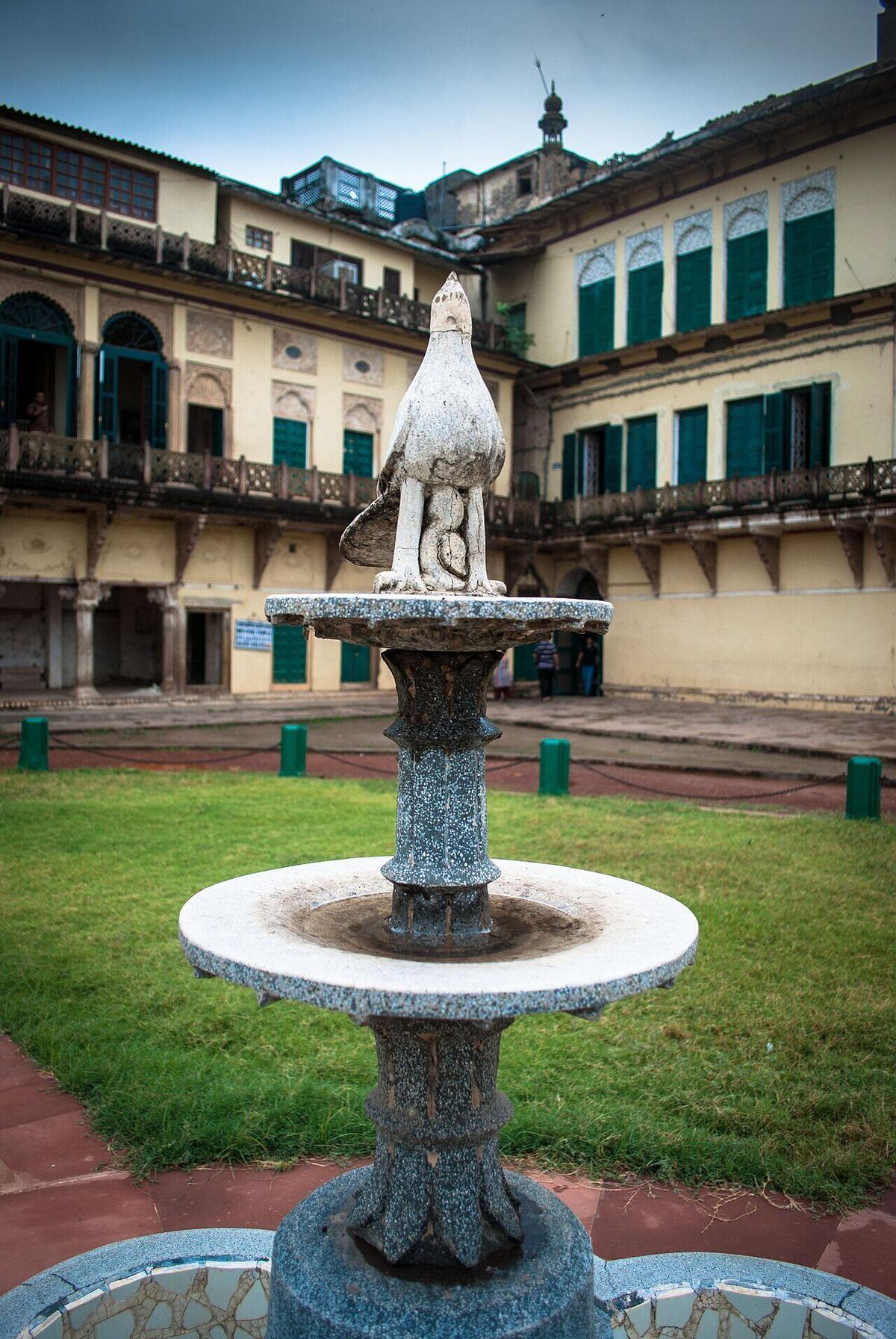
Ramnagar Fort is built in the combined Mughal–Rajput idiom characteristic of the eighteenth-century principalities — walls of Chunar sandstone, arched gateways, pavilions overlooking the Ganga, and a sequence of inner courtyards linking the residential, ceremonial, and temple portions of the complex.
Its most distinctive features are:
- The river-facing pavilions — open sandstone halls looking directly across to the Kashi ghats, commanding one of the finest single views of the Banaras waterfront.
- The astronomical clock — a remarkable eighteenth-century device that records the month, day, week, and astrological signs alongside conventional time, and is still in working order.
- The Durga and Chhinnamastika temples — the kuladevata shrines of the royal family, architecturally woven into the residence itself.
- The Saraswati Bhawan museum — holding royal memorabilia, arms from the Mughal period, ceremonial palanquins, hand-copied manuscripts, vintage cars, and royal dress.
The fort is substantial in scale but never overwhelming. It was raised as a working residential and administrative seat rather than as a monument, and this gives it a more intimate, lived-in character than the great imperial forts of Delhi, Agra, or Jaipur.
Rituals & Practices
The observances of Ramnagar Fort are not those of a temple but of a royal house carrying the ceremonial and devotional duties of the Kashi Naresh. They follow the Dussehra–Ramlila cycle of the year.
- The Ramnagar Ramlila — thirty-one nights from Anant Chaturdashi to Sharad Purnima (September–October). The enactment moves across Ramnagar and the fort grounds, and the Maharaja attends as ceremonial patron.
- The Dusshera Darbar — Vijayadashami (late September or October), when the Maharaja holds a formal darbar at the fort.
- Budhwa Mangal — an older Banarasi observance associated with the Hanuman Jayanti period, which historically included boat-processions and the royal presence.
- Dev Deepawali — the fort and the river before it are lit with lamps, facing the illuminated ghats across the water.
For the visitor, the accessible portions of the fort include the Saraswati Bhawan museum (opening hours vary), the astronomical clock and several ceremonial halls, the outer walls and pavilions overlooking the Ganga, and — with limited access — the Durga and Chhinnamastika shrines. The residential portions remain closed to the public. During the Ramlila the whole complex becomes the ground of the lila, and those who come are received as devotees of the enactment rather than as sightseers of the fort. Timings and access for the museum, the temples, and the Ramlila should be verified in advance, as they vary by season.
Festivals & Celebrations
| Festival | When | Crowd |
|---|---|---|
| Ramnagar Ramlila | — | Extremely high (selected nights) |
| Dusshera Darbar | — | High (limited access) |
| Dev Deepawali | — | Very high |
| Holi | — | Moderate (heritage context) |
Ramnagar Ramlila: Held in Banaras to be the most sacred and complete Ramlila in India. Its unbroken observance for nearly two centuries, and its integration with the devotional life of the Kashi Naresh, make it one of the great surviving devotional performance traditions of the Hindu world.
Dusshera Darbar: Continues the old pattern of Dasara as the day of royal audience â a tradition kept more faithfully at Ramnagar than at most former princely houses, sustained as part of the Kashi Naresh's ceremonial role.
Dev Deepawali: Dev Deepawali is held to be the night the devas descend to the Ganga. The fort's part in the river-wide illumination extends the festival's sacred geography to the eastern bank.
Holi: Represents the older royal-ceremonial tradition of Holi as a seasonal transition marked with dignity, distinct from the exuberant street-level observance.
Prepare for Your Visit
Practical guidance to help you plan your pilgrimage
| Pilgrim Guidance | How to reachRamnagar stands on the eastern bank of the Ganga, facing the great Kashi waterfront. It is reached by:
Preparation for Visitors
Best Time to VisitThe cooler months from October to March are the most comfortable for a general visit. The Ramnagar Ramlila (late September to mid-October) and the Dusshera Darbar are the devotional and cultural high points of the year. Dev Deepawali (Kartik Purnima, November) sets the illuminated fort against the illuminated ghats — a moving sight from the river. Summer afternoons are best avoided, as the Chunar sandstone holds the heat. |
Location
Varanasi, UP
Gallery
Pilgrim photos
No pilgrim photos yet.
Community corrections
No corrections yet.
Edit history
No revisions yet.
Plan Your Visit to Ramnagar Fort
Get a custom itinerary and pricing for your trip.
Recommended
Packages for this destination
Pilgrim Notes
On-ground observations from fellow pilgrims
No pilgrim notes yet. Be the first to share on-ground observations!
Sign in to share a note.
Pilgrim Reviews
Be the first to share your experience at Ramnagar Fort.
Sign in to write a review.
Nearby sacred places
Discover other sacred places near Ramnagar Fort
Explore temples, tirthas, and pilgrimage sites in UP
Explore nearbyPart of these circuits
Walk the traditional pilgrimage routes this destination belongs to.