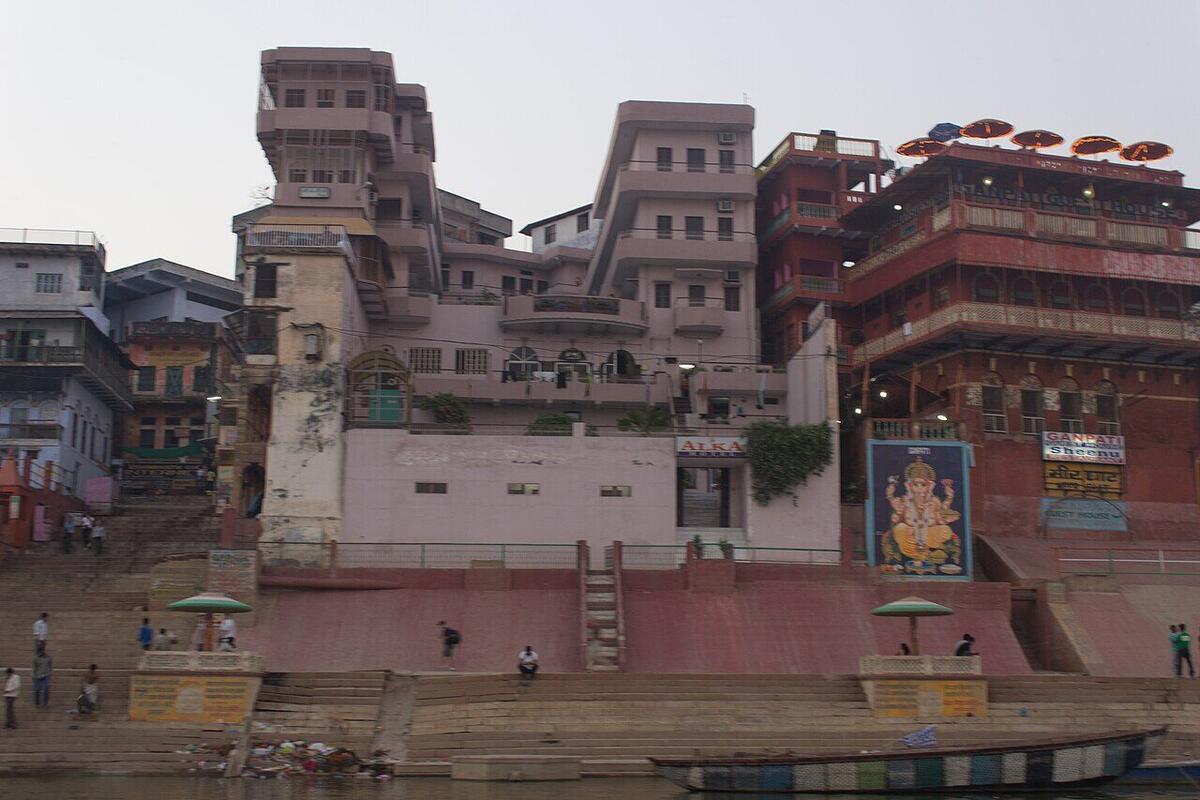
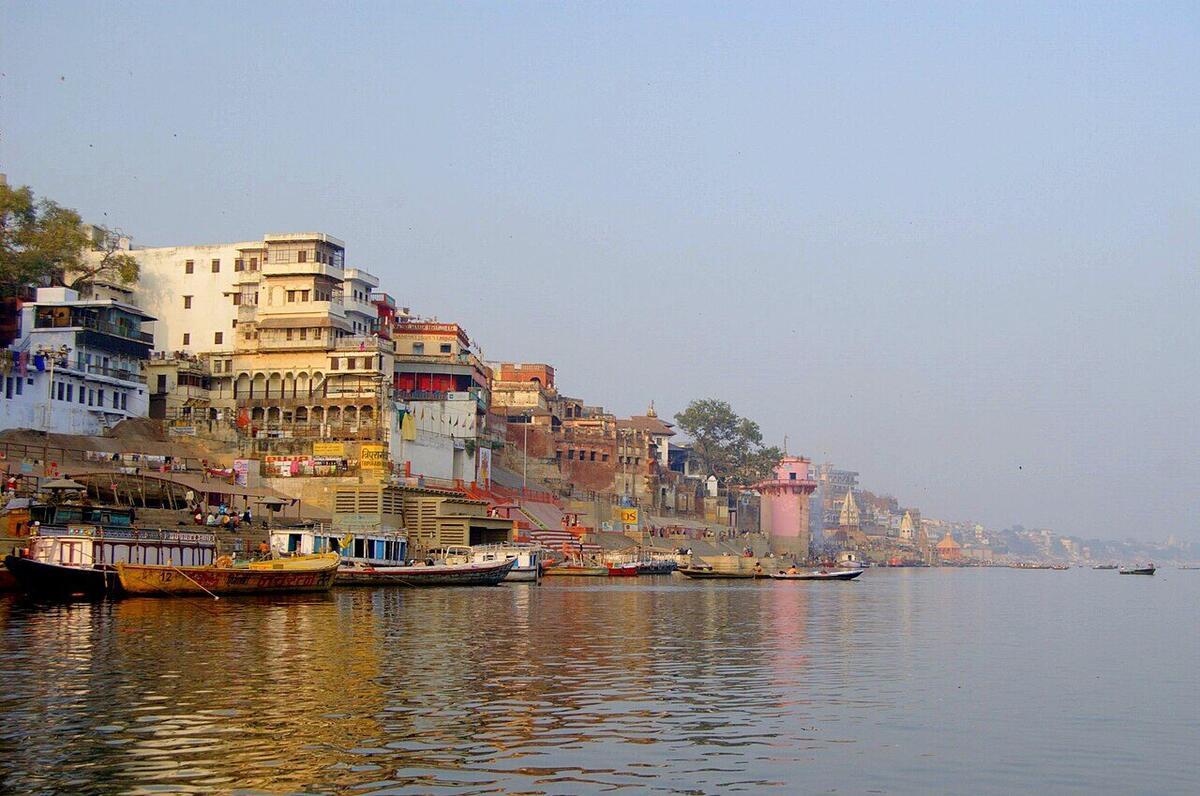
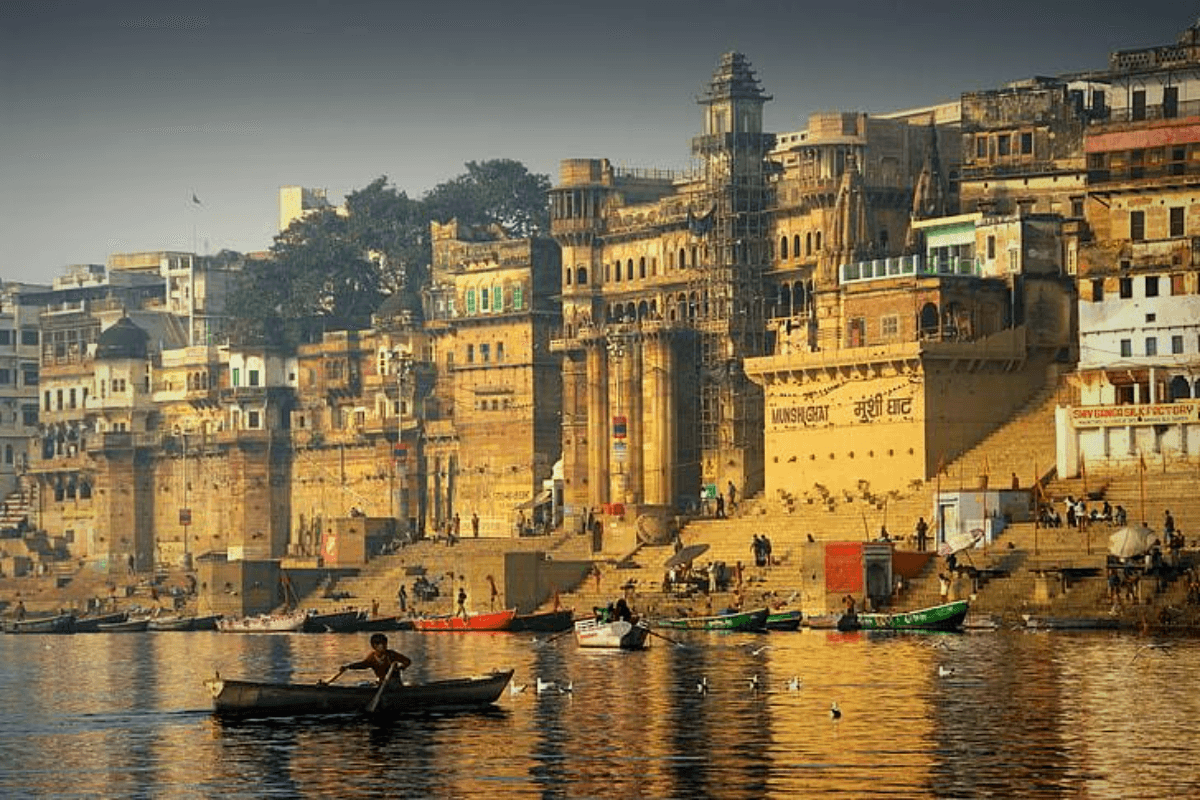
Tripura Bhairavi Ghat is a bathing ghat on the central crescent of the Kashi riverfront, counted forty-fifth in the traditional sequence of eighty-four ghats. Above it stands Man Mandir Ghat with Raja Man Singh's palace and the observatory raised there by his descendant Sawai Jai Singh; below it lies Mir Ghat, from whose lanes one climbs to Vishalakshi. It is a small ghat, and the Uttar Pradesh tourism record describes it plainly — clean, well established, used by local people for their bath.
The ghat takes its name from the Devi Tripura Bhairavi, whose temple stands on the way down to the water. The Uttar Pradesh tourism department's ghat record describes it as an ancient Tripura Bhairavi (Durga) temple that was rebuilt in the eighteenth century, after which the ghat came to be called by her name; heritage documentation of the riverfront likewise places the building of the temple in the late eighteenth century and says plainly that nearness to the shrine of Tripura Bhairavi gave the ghat its name. In the Shakta tradition Bhairavi — invoked also as Tripura Bhairavi — is counted among the ten Mahavidyas, the great wisdom-forms of the Devi, and is understood as the feminine counterpart of Bhairava.
What happens on these steps is the ordinary sacred work of a Kashi ghat. Pilgrims come down at first light for snan, take sankalp, offer tarpan for their ancestors and perform Ganga pujan at the waterline. Families come here for mundan, the first tonsure of a child, and for wedding rites by the river. Heritage documentation of the riverfront notes that the ghat is preferred by Tamil pilgrims, and that its rest house is used mostly by Tamil and Telugu visitors — one of the threads that bind Kashi to the southern country.
The name this ghat carried before
Heritage documentation and the state tourism record agree that the seventeenth-century Sanskrit work Girvanapadamanjari knew these steps as Vriddhaditya Ghat, after an old image of the Sun god here. Vriddhaditya is one of the twelve forms in which, in Kashi's tradition, Surya established himself in the city — the Dwadash Aditya, whose darshan-yatra pilgrims still undertake. The Devi's name replaced the Sun's after her temple was rebuilt, but the older devotion did not vanish: under the great pipal at the head of the ghat, an image of Surya still stands among the old stones.
The sanctity of these steps is, first, the sanctity of the Ganga at Kashi — the same river, the same kshetra, the same merit that tradition attaches to snan anywhere along the crescent between Asi and Adi Keshava. No separate Puranic mahatmya is recorded for the ghat under its present name, and honest guidance should say so rather than supply one.
What this ghat does carry is a Devi identity. Tripura Bhairavi is worshipped in the Shakta tradition as one of the ten Mahavidyas, the great wisdom-forms through which the Devi is approached — Kali, Tara, Tripura Sundari, Bhuvaneshvari, Bhairavi, Chhinnamasta, Dhumavati, Bagalamukhi, Matangi and Kamalatmika. Devotees hold that each Mahavidya opens a different door to the same Shakti. Bhairavi is the fierce form, named in the Puranas and Tantras as the consort of Bhairava.
The ghat also sits inside Kashi's wider Devi geography. Just downstream at Mir Ghat is Vishalakshi, counted in the Nau Gauri yatra that the Kashi Khanda prescribes; in the neighbourhood behind the ghat stands the old shrine of Adi Varahi. Heritage documentation records the local practice plainly: pilgrims take their bath here at Tripura Bhairavi and then go for darshan of Varahi Devi, the Varahi steps themselves being the less clean of the two.
The Sun's memory on the same steps
There is an older layer here that devotees still honour. The ghat's earlier name, Vriddhaditya, belongs to the Dwadash Aditya tradition of Kashi — the twelve Sun forms which, tradition holds, Surya took when he chose to remain in the city. At the head of the ghat, beneath a large pipal, old images are arranged in the panchayatana manner, a Shiva linga at the centre with Shakti, Vishnu, Ganesha and Surya around it. Heritage surveys date several of these fragments to the twelfth and thirteenth centuries. That arrangement is the ordinary Kashi pattern: not one deity displacing another, but the five approached together.
History
These steps are older than the name they now bear. The seventeenth-century Girvanapadamanjari records them as Vriddhaditya Ghat, after an old image of the Sun god here. In the later eighteenth century the temple of Tripura Bhairavi was built — the state tourism record describes it as an ancient shrine rebuilt in that century — and the ghat came to be known by the Devi's name instead.
For a long time the ghat remained only partly built in stone. Heritage documentation, citing Motichand (1962), records that until 1931 the steps were laid with stone slabs only in part. It was in the early twentieth century that a Giri sannyasi made the ghat fully pucca and raised a math above it; heritage records name him Mahananda Giri and give the math as D 5/100, while the Uttar Pradesh tourism record names Dayanand Giri and gives the house number as D 51/100. The two accounts differ over the name; they agree on the work and the period.
In 1958 the Government of Uttar Pradesh repaired and restructured the ghat. In the same work the southern portion, beside the ancient Adi Varahi shrine, was made pucca and separated, which is why Varahi Ghat is sometimes counted independently in lists of the eighty-four. That southern end is marked by the house of the late Kailash Nath Chaudhuri, a Dom Raja — heritage documentation glosses the title as "king of the funeral priests", the hereditary lineage whose service belongs to the antim sanskar of Kashi — a house given to the family by one of the kings of Banaras.
Stewardship today is divided. Temple properties along the ghat are held by the temple trusts and the monasteries; the houses belong to their residents; the ghat itself is maintained by the Municipal Corporation. Heritage surveys note that apart from what the trusts do for their own properties, there is no dedicated conservation plan for these steps.
Architecture
Tripura Bhairavi is a small ghat — heritage survey records give it an area of about 0.167 hectare on the central bank — and it is pucca throughout; the state tourism record calls it clean and well established, used by local people for their bath. The buildings that matter stand at the head of the steps and in the lane behind.
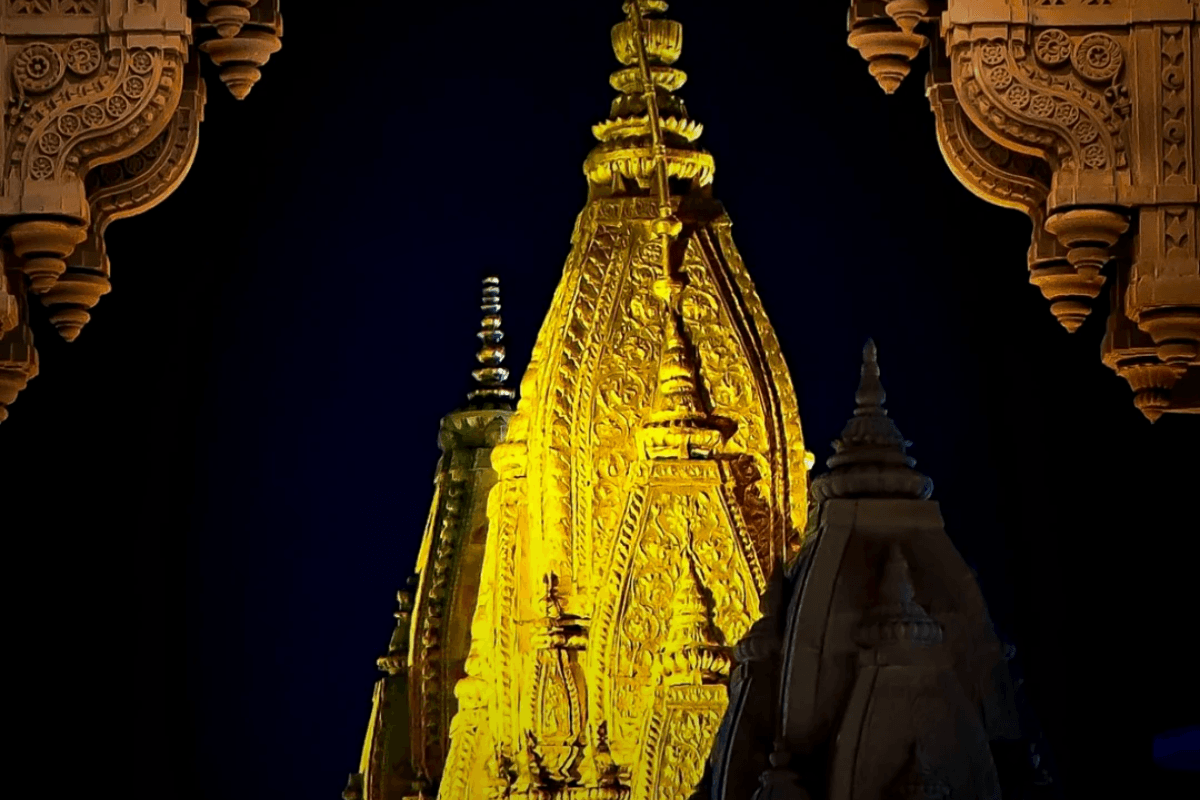
The math raised by the Giri sannyasi who completed the ghat in the early twentieth century stands above it. The Uttar Pradesh tourism record notes the Shiva temples of Tripureshwar and Rudreshwar on the ghat itself, and the temple of the Devi Tripura Bhairavi on the way down to the water.
The oldest work on the ghat is also its plainest. Under a large holy fig at the upper part of the ghat, old images are set out in the panchayatana arrangement — a Shiva linga in the centre with Shakti, Vishnu, Ganesha and Surya around it — and beside them a small temple housing an image of Surya. Heritage documentation identifies several of these fragments as work of the twelfth and thirteenth centuries, and records a nearby shrine holding images of Hanuman and a goddess. These are broken stones kept in worship rather than in a museum.
Rituals & Practices
This is a bathing ghat, and its practice is the practice of the river. Devotees come at first light for snan, take sankalp before entering the water, offer tarpan for their ancestors, and perform Ganga pujan at the waterline with a clay diya, flowers and a little milk. Pandas seated on the upper steps assist those who want the rites done in proper form.
Government records of the ghat note that mundan — the first tonsure of a child — and wedding rites are regularly performed here, along with Ganga pujan. These are family samskaras rather than public ceremonies, and a visitor who comes upon one should simply give the family room.
After the bath many climb to the Devi's temple for darshan, and to the Shiva shrines of Tripureshwar and Rudreshwar on the ghat. Some go on to the old Varahi shrine in the neighbourhood behind; heritage documentation records that pilgrims bathe here first and go for that darshan after. Offerings brought to the Devi are the usual ones of a Kashi Devi shrine — red flowers, a chunari, sindoor, a lamp.
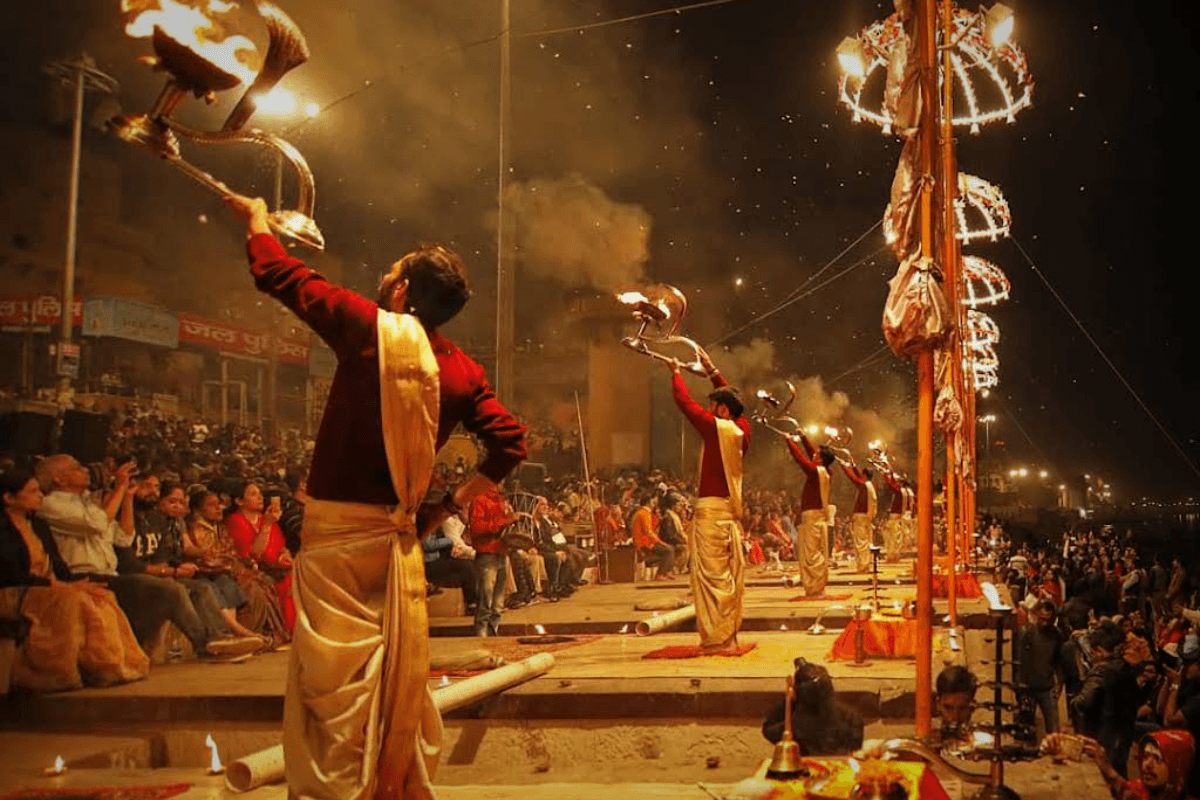
There is no formal ceremonial Ganga Aarti on these steps; the great evening aarti is a short walk upstream at Dashashwamedh. The shrines here keep informal hours, so ask on the ghat rather than relying on any printed schedule.
Festivals & Celebrations
| Festival | When | Crowd |
|---|---|---|
| Navratri | — | Busier at the Devi's temple |
| Dev Deepawali | — | Extreme across the riverfront |
| Kartik Purnima snan | — | Very high |
| Ganga Dussehra | — | High |
| Makar Sankranti | — | High |
| Daily Ganga snan | — | Steady from first light |
Navratri: Navratri is the principal season of Devi worship across Kashi. For those who approach the Devi through the Mahavidya forms, Bhairavi's shrine is a natural place to keep these days.
Dev Deepawali: Tradition holds that on this night the devas descend to bathe in the Ganga at Kashi, and the lamps on the ghats are lit to welcome them.
Kartik Purnima snan: The Puranas praise snan in the month of Kartik, and Kartik Purnima above all, as bearing great devotional fruit. Many families keep the whole month as a Kartik vrat of daily Ganga snan.
Ganga Dussehra: Devotees hold that a bath in the Ganga on this day carries particular purifying merit; it is one of the year's principal days of Ganga worship in Kashi.
Makar Sankranti: Marks the sun's turn into Makara and the beginning of Uttarayan; snan and daan on this day are held to be especially meritorious.
Daily Ganga snan: This daily use, rather than any single festival, is what the ghat was rebuilt for and what has kept it in worship.
Prepare for Your Visit
Practical guidance to help you plan your pilgrimage
| Pilgrim Guidance | How to reachThe ghat lies between Man Mandir Ghat and Mir Ghat on the central riverfront. On foot the easiest approach is along the riverside from Dashashwamedh — walk downstream past Prayag, Rajendra Prasad and Man Mandir ghats, which takes a few minutes. From above, the lanes from Bansphatak and Vishwanath Gali come down towards Mir Ghat and this stretch; the nearest vehicle drop is Godowlia, and the last part must be walked. By water, any shared or hired boat working the central ghats will set you down here on request. Preparation for pilgrims
Best time to visitEarly morning, from first light to about nine, is when the ghat is most devotional and least crowded. October to March is the most comfortable season. Navratri, in Chaitra and again in Ashwin, is when the Devi's temple sees its largest gathering; Kartik, and above all Kartik Purnima and Dev Deepawali, brings the whole riverfront alive with lamps and very large crowds. During the monsoon the river rises over the lower steps and the usable ghat shrinks considerably; take local advice before entering the water then. |
Location
Varanasi, UP
Pilgrim photos
No pilgrim photos yet.
Community corrections
No corrections yet.
Edit history
No revisions yet.
Plan Your Visit to Tripura Bhairavi Ghat
Get a custom itinerary and pricing for your trip.
Recommended
Packages for this destination
Pilgrim Notes
On-ground observations from fellow pilgrims
No pilgrim notes yet. Be the first to share on-ground observations!
Sign in to share a note.
Pilgrim Reviews
Be the first to share your experience at Tripura Bhairavi Ghat.
Sign in to write a review.
Nearby sacred places
Discover other sacred places near Tripura Bhairavi Ghat
Explore temples, tirthas, and pilgrimage sites in UP
Explore nearbyPart of these circuits
Walk the traditional pilgrimage routes this destination belongs to.