Tulsi Ghat, known in older records as Lolarka Ghat, is among the most beloved of the southern ghats of Kashi, lying just north of Assi. For devotees it is not approached merely as a bathing ghat, but as the riverside hearth of Ram-bhakti in Banaras — the ground most intimately bound to Goswami Tulsidas, the sixteenth-century saint-poet whose Ramcharitmanas carried the story of Sri Ram into the speech, song, and daily prayer of millions across North India.
Tradition holds that Tulsidas lived the final decades of his life in a modest dwelling on the bluff above this ghat. Here he is said to have composed large portions of the Ramcharitmanas and the Vinaya Patrika; here, devotional memory places his deepening bond with Hanuman; and here, in 1623, he is held to have left his body. The site is preserved today as the Akhara Goswami Tulsidas — his residence, the chamber where he wrote, his kharaun (wooden sandals), and the rooms that Banaras reveres as the cradle of Hindi bhakti.
The older name Lolarka recalls the nearby Lolarka Kund, an ancient sun-shrine tirtha whose Lolark Shashthi observance still draws great gatherings to this southern reach of the riverfront. Thus the ghat carries two streams of sanctity — the deep antiquity of solar worship below, and the living Ram-bhakti of Tulsidas above — meeting at the same stretch of the Ganga.
Katha and local belief
Banaras holds the Tulsidas residence above this ghat to be one of the sacred places of the city's bhakti geography — not a temple in the formal sense, but a sansthan of devotion whose sanctity arises from the presence of the poet and the writing of the Manas on this very ground. It is said in Banaras that every chaupai of the Ramcharitmanas carries something of the river's flow, that Tulsidas wrote with the Ganga before his eyes, and that this is why his verses have kept Ram-bhakti moving across the centuries as ceaselessly as the river herself.
The ghat's continuing character is shaped by this bond. The akhara's daily recitation of the Ramcharitmanas has not broken since the sixteenth century, and many pilgrims come as much to sit within the sound of that recitation as for snana at the ghat below.
Tulsi Ghat and the Akhara Goswami Tulsidas above it are the living memorial to the work that shaped North Indian devotion more widely than any other in the last five hundred years — the Ramcharitmanas. Before Tulsidas, the Ramayana lived chiefly in Sanskrit, accessible mainly to the learned. Tulsidas rendered the story of Sri Ram in the Awadhi of ordinary people, in chaupai and doha that could be sung and held in the heart, and with such devotional warmth that the epic became, for countless households, a personal prayer.
The continuing Manas-patha at the akhara — morning and evening, through festival and fast — is the form the ghat's devotion takes. Devotees who arrive with their own copy of the Ramcharitmanas, or who carry its chaupais in memory, find themselves drawn into the living tradition that Tulsidas set flowing here. To sit at this ghat is, for a Ram-bhakta, to sit close to the source of the prayer one already knows.
Katha — Tulsidas and Hanuman
Banaras places upon this stretch of the river the cherished story of Tulsidas's growing nearness to Hanuman — the spirit in the peepal tree, the seemingly ordinary devotee who would not leave the daily Katha, and the grace that followed. The tale is told together at Sankat Mochan, where tradition sets the darshan, and at Tulsi Ghat, where the poet lived in the years that led to it. The two shrines stand as the twin poles of Tulsidas's Banarasi presence, and devotees often hold their darshan together.
Devotees also remember the older sanctity of Lolarka. Tradition praises the nearby Lolarka Kund as a tirtha of the Sun, and the Lolark Shashthi observance — held especially by those who pray for the wellbeing of children — keeps this ancient layer of devotion alive at the same southern reach of Kashi.
History
The ghat and the akhara take their present form from the long Banarasi tradition of preserving the places of saints. Goswami Tulsidas is held to have lived here from roughly 1574 — the year tradition assigns to the beginning of the Ramcharitmanas composition — until his passing in 1623. The residence was kept by his disciples after his death and has descended through successive generations of Banarasi mahants (principal custodians), who have sustained both the akhara and the daily Manas-patha.
The present buildings reflect modifications gathered over four centuries, with the core rooms — the writing chamber, the courtyard, and the niche where Tulsidas's kharaun are kept — preserved in their oldest form. The stone embankment of the ghat below, like much of the Banaras waterfront, took its modern shape during the eighteenth-century Maratha rebuildings, when the riverfront was given its enduring lines of step and platform.
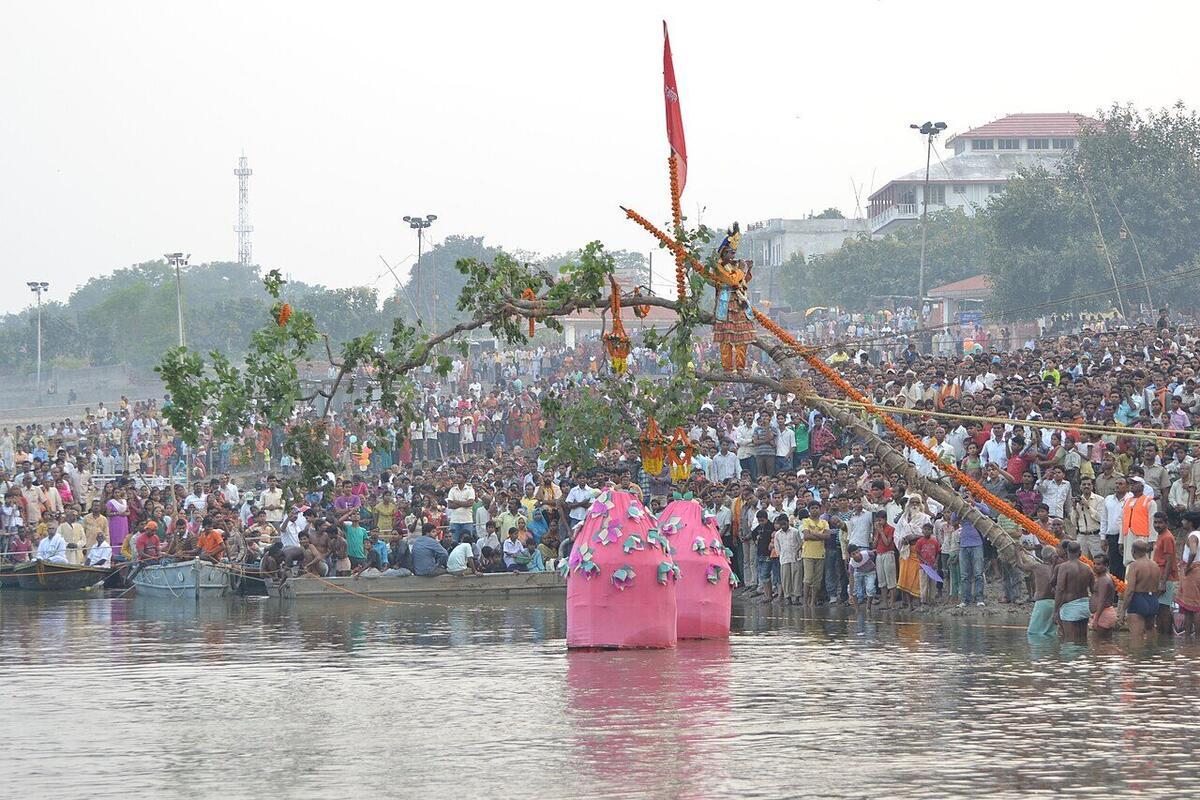
The older identity of the ghat as Lolarka reaches back further still, to the antiquity of the adjacent Lolarka Kund, counted among the oldest tirthas of the city. The annual Tulsi Jayanti — the poet's birth anniversary, in Shravan (July–August) — is the principal yearly observance at the akhara, while the traditional Nag Nathaiya, a Banarasi staging of Sri Krishna's subduing of the serpent Kaliya, is enacted at the river here during Kartik, inherited from the city's older traditions of riverside lila.
Architecture
The Akhara Goswami Tulsidas above Tulsi Ghat is not a temple in the conventional sense but a sansthan — a preserved residence become a devotional institution. The structure is modest by design: a cluster of rooms gathered around a central courtyard, holding the poet's writing chamber, his personal shrine with a small murti of Sri Ram, and the niches that have guarded his relics — the kharaun and the writing implements — across the centuries.
A small temple of Hanuman stands within the compound — Tulsidas's own Hanuman, to whom he ascribed the grace of all his compositions. A peepal tree in the courtyard is regarded with devotional respect, for the tradition that links Tulsidas to the peepal-dwelling presence which drew him toward Hanuman is remembered upon this ground.
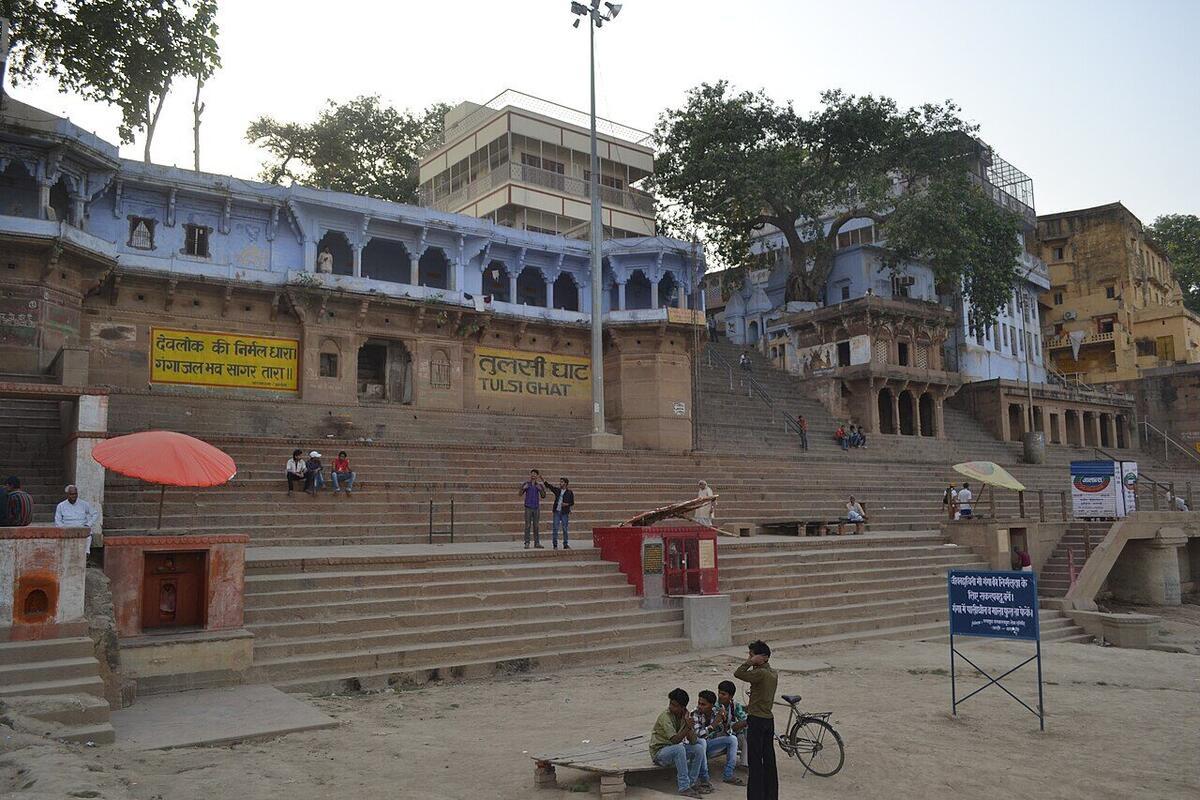
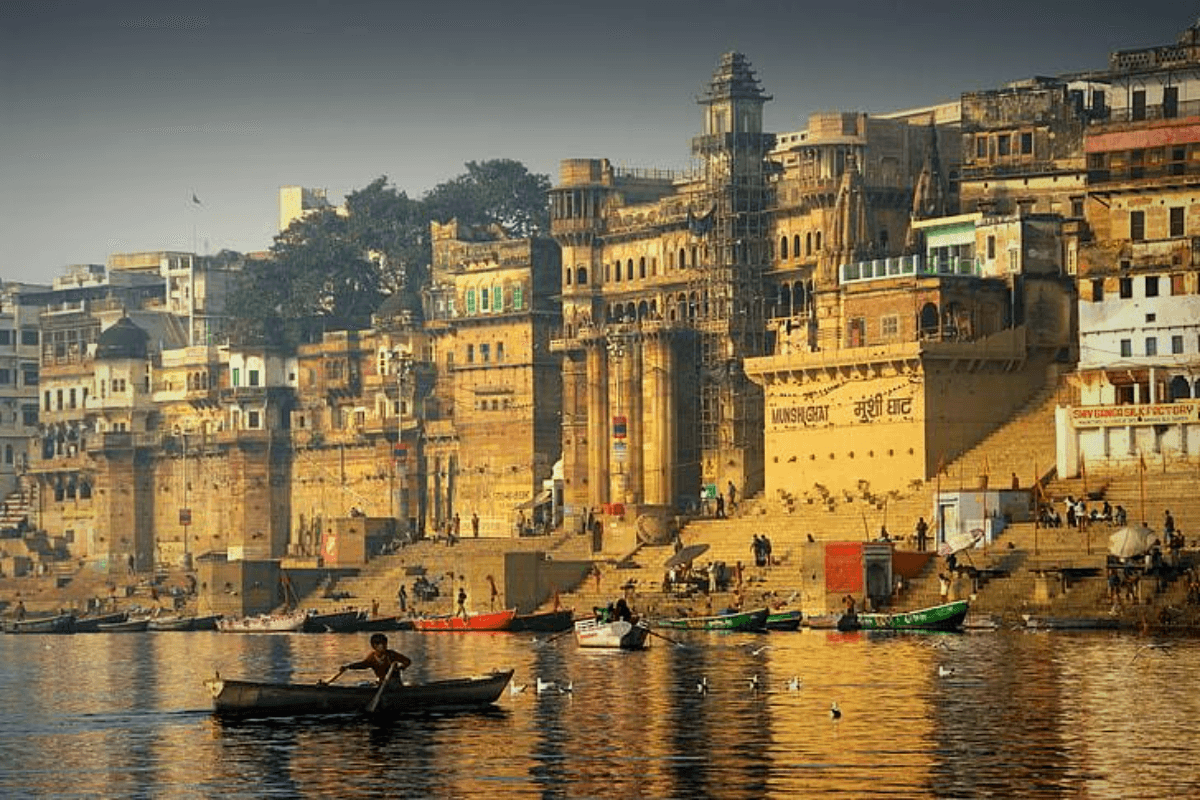
The ghat itself follows the familiar Banarasi pattern of stone steps descending to the Ganga. This southern stretch is quieter than the crowded central ghats, and the akhara's setting — raised above the river, shaded by old trees — still holds something of the contemplative stillness that must have drawn Tulsidas to this place four centuries ago. Here the power of the site lies not in scale but in nearness: the river, the recitation, and the preserved hearth of a saint, gathered in one quiet place.
Rituals & Practices
The defining practice at the Akhara Goswami Tulsidas is the Manas-patha — the continuous recitation of the Ramcharitmanas. The akhara maintains its daily morning and evening recitations, a rhythm held unbroken since the sixteenth century.
Pilgrims who come to the akhara may:
- Sit within the recitation — following with their own copy of the Ramcharitmanas, or simply listening.
- Take darshan of Tulsidas's kharaun and personal effects, preserved with reverence in the akhara.
- Offer a small dakshina toward the upkeep of the akhara and the continuation of the Manas-patha.
- Take Ganga-jal from the ghat below and receive vibhuti at the Hanuman shrine within.
The ghat below carries the ordinary rhythm of Banarasi snana — morning pilgrims, those who bathe by tradition, the quiet offerings made to the river. The akhara and the ghat are two linked but distinct places: the ghat is for snana and river-offering, the akhara above for Manas-patha and the personal darshan of Tulsidas's preserved presence.
Timings may vary; pilgrims are encouraged to verify the current schedule with the akhara before a visit.
Festivals & Celebrations
| Festival | When | Crowd |
|---|---|---|
| Tulsi Jayanti | — | Very high |
| Nag Nathaiya | — | Extremely high |
| Rama Navami | — | Very high |
| Lolark Shashthi | — | Very high |
| Kartik Purnima | — | Very high |
Tulsi Jayanti: Tulsi Jayanti at the akhara is the most direct way to honour the poet at the very site of the Ramcharitmanas composition. It draws Manas-lovers from across the Hindi-speaking regions.
Nag Nathaiya: Nag Nathaiya is among the oldest continuously observed ghat lilas of Kashi, preserved at Tulsi Ghat as part of the wider Ramlila and Krishnalila tradition that shapes the city's devotional calendar.
Rama Navami: Rama Navami at Tulsi Ghat is the natural fullness of the akhara's defining devotion. The Ramcharitmanas that Tulsidas composed here is sung in its completeness on this day.
Lolark Shashthi: Lolark Shashthi preserves the deep antiquity of solar worship at this southern reach of Kashi, an older layer of sanctity that the ghat carries alongside its Ram-bhakti.
Kartik Purnima: Kartik Purnima is held to be the night the devas descend to the Ganga. Dev Deepawali at Tulsi Ghat keeps a quieter, more devotional character than the great gathering at Dashashwamedh.
Prepare for Your Visit
Practical guidance to help you plan your pilgrimage
| Pilgrim Guidance | How to reachTulsi Ghat lies in the Bhadaini area of Varanasi, very close to Assi Ghat — Assi is the southern boundary of the old Kashi waterfront, and Tulsi Ghat is the one just to its north. Auto-rickshaws set down pilgrims at the Assi Ghat crossing, from where the akhara is about a five-minute walk. By boat from Dashashwamedh the journey downstream takes roughly 15–20 minutes. Many pilgrims combine this ghat with Assi and with Sankat Mochan in the same half-day, following the thread of Tulsidas's Banarasi presence. Preparation for Pilgrims
Best Time to VisitEarly morning, between roughly 5:30 and 8:00 AM, is the most fitting time — the recitation is underway, the ghat is still, and the river light is at its gentlest. Tulsi Jayanti (Shravan Shukla Saptami, July–August) is the akhara's principal annual observance, and Nag Nathaiya in Kartik (October–November) is among the most memorable of the Banaras ghat ceremonies. October to March is the most comfortable window for general pilgrimage. |
Location
Varanasi, UP
Gallery
Pilgrim photos
No pilgrim photos yet.
Community corrections
No corrections yet.
Edit history
No revisions yet.
Plan Your Visit to Tulsi Ghat
Get a custom itinerary and pricing for your trip.
Recommended
Packages for this destination
Pilgrim Notes
On-ground observations from fellow pilgrims
No pilgrim notes yet. Be the first to share on-ground observations!
Sign in to share a note.
Pilgrim Reviews
Be the first to share your experience at Tulsi Ghat.
Sign in to write a review.
Nearby sacred places
Discover other sacred places near Tulsi Ghat
Explore temples, tirthas, and pilgrimage sites in UP
Explore nearbyPart of these circuits
Walk the traditional pilgrimage routes this destination belongs to.