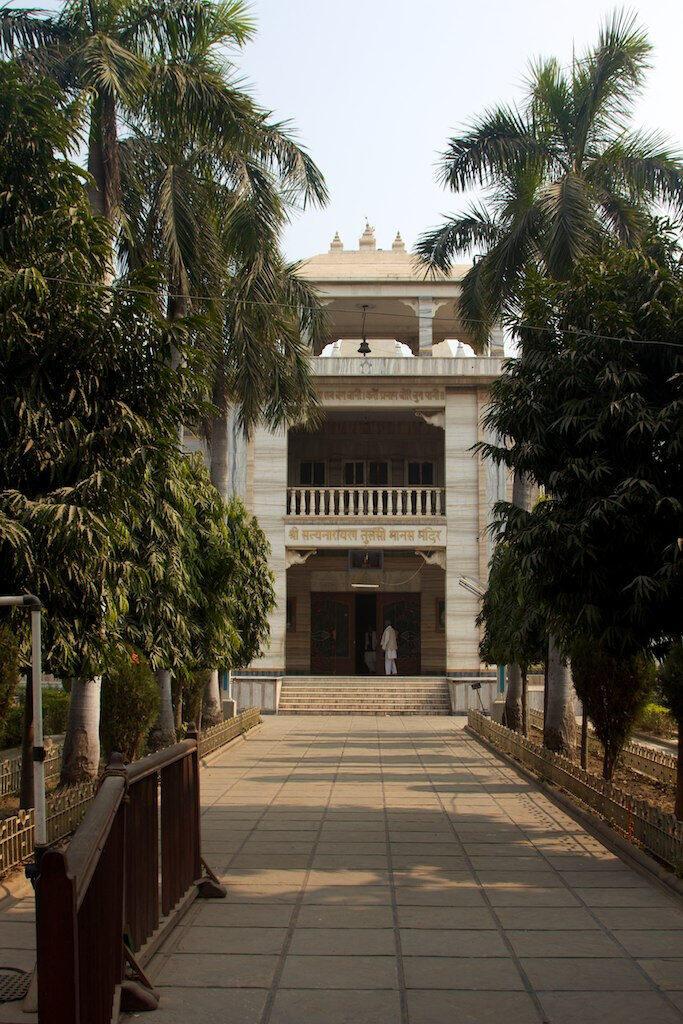
Tulsi Manas Temple is dedicated to Sri Ram and stands on the ground that devotional tradition associates with the composition of the Ramcharitmanas — the Awadhi retelling of the Ramayana by Goswami Tulsidas. Ayodhya tradition holds that Tulsidas began the work there on Ram Navami in 1574; Kashi's own tradition cherishes this ground, remembering him at work seated in the mango grove where the temple now stands.
The walls of the temple carry the complete text of the Ramcharitmanas inscribed in marble — every doha and chaupai, visible to the devotee in sequence. Pilgrims walk through the temple reading couplet after couplet, and many linger at verses that hold particular meaning for their families. The quality of the temple is therefore unusual among Kashi shrines — part devalaya, part enduring text.
The temple is close to Durga Kund and Sankat Mochan; the three together form a convenient devotional circuit of the southern part of old Kashi. For pilgrims on the Ram bhakti path — and for those who simply wish to sit within the verses of Tulsidas — Tulsi Manas holds a particular quietness.
The Ramcharitmanas is the devotional text that shaped North Indian Ram bhakti into its modern form. Tulsidas composed it in Awadhi — the language spoken by ordinary people of his region — so that the story of Sri Ram could be heard, sung, and recited in homes as well as in Sanskrit schools. The seven kandas of the work, from Bal to Uttar, have been memorised, recited, dramatised in Ramlila, and sung in every village of the North for over four centuries.
The temple is not merely a commemoration of this achievement. It is a place where the text itself is present — where the verses continue to be read, recited, and honoured daily. Pilgrims often pause before a particular line — the childhood of Ram, the meeting with Sita, the return to Ayodhya, the hymn of Hanuman — and carry its memory with them.
Katha and local belief
A devotional tradition of Banaras holds that Goswami Tulsidas was guided in his composition by Hanuman himself, who appeared to the poet during his Kashi years and blessed the work that would give Sri Ram to every Hindu household. This closeness between Tulsidas, Hanuman, and Sri Ram shapes the feeling of the temple: the images of Ram, Sita, and Lakshmana in the sanctum are approached in the warmth of a household devotion, not the distance of a royal court.
Tulsidas is said to have completed the Ramcharitmanas over two years, seven months, and twenty-six days. The tradition of reciting the full work (Akhand Ramayan Path) over the course of a day and night carries forward in this temple and in many homes of Banaras on important occasions.
History
Goswami Tulsidas spent much of his life in Kashi, and the city is marked by places associated with his memory — Tulsi Ghat, where he lived; Sankat Mochan, the Hanuman temple he founded; and the ground that Tulsi Manas Temple now occupies, held by Kashi tradition to be a site of his work on the Ramcharitmanas — though Ayodhya tradition places the commencement of the epic at Ayodhya.
Tradition holds that on Ram Navami, 1574 CE, Tulsidas began composing the first kanda — a beginning that Ayodhya tradition places at Ayodhya, and that Kashi tradition remembers beneath a tree at this site. The work continued over a period of two years, seven months, and twenty-six days, parts composed in Ayodhya and other places across the north as well. The Ramcharitmanas emerged at a time when devotional Hinduism was gathering strength across the subcontinent, and it quickly became the central devotional text of the Awadhi-speaking world.
The present temple — white marble, modern in form, designed as much for the inscribed text as for the sanctum — was built in 1964 by the Dalmia family. Its character reflects the dual nature of the site: a devotional temple, and a preserved text. The surrounding compound includes a Shiva shrine, a Hanuman shrine, smaller Ramayana-scene tableaux, and the gardens through which the inscribed walls can be walked in sequence.
Architecture
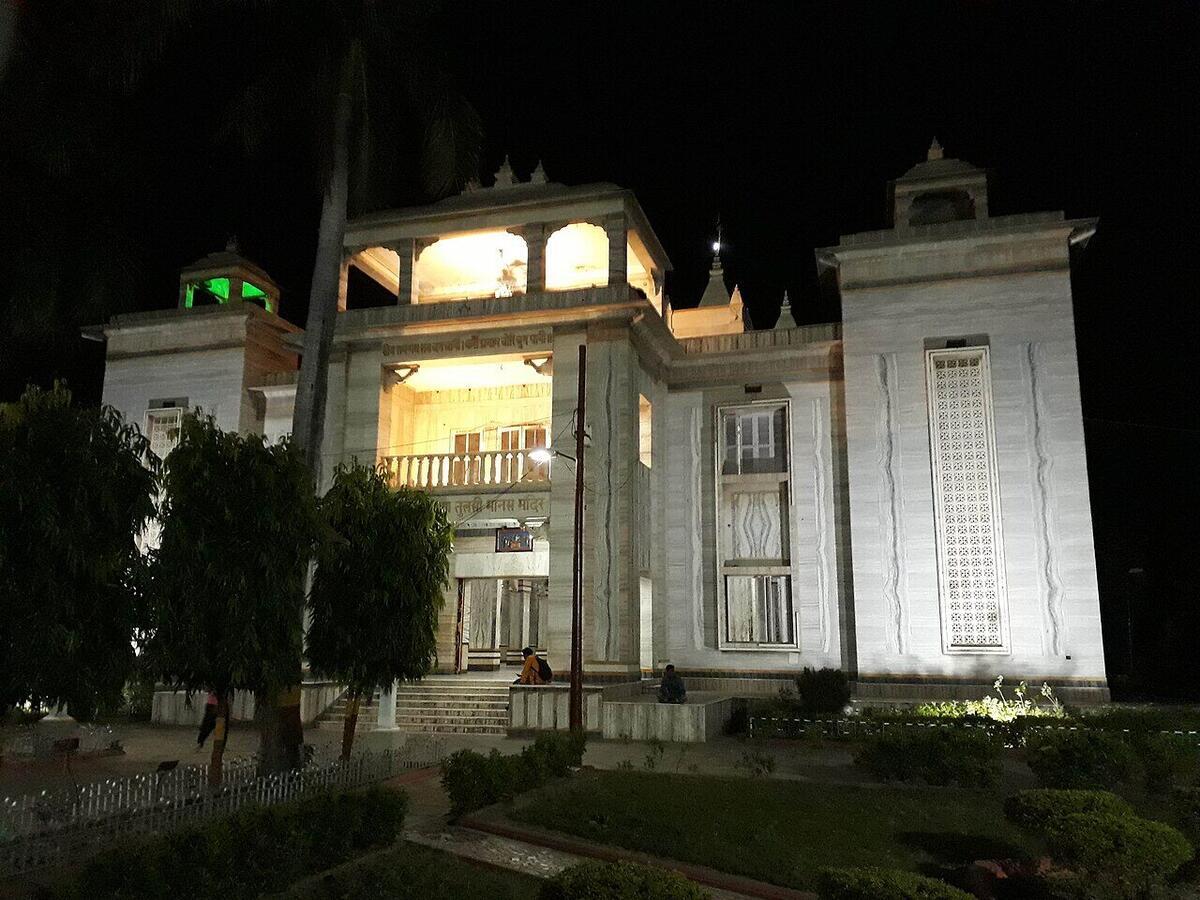
Tulsi Manas Temple is an entirely modern shrine, built in 1964 in white marble, with a form that reflects its dual purpose — darshan of Sri Ram, and the preservation of the inscribed text of the Ramcharitmanas.
The main sanctum holds the murti-s of Sri Ram, Sita, Lakshmana, and Hanuman, set within a marble enclosure. The walls of the mandapa and the surrounding corridors carry the complete text of the Ramcharitmanas inscribed on marble panels — a pilgrim walking through the temple can read the epic in sequence, from Bal Kanda to Uttar Kanda. Additional panels display key scenes from the text in relief sculpture and painted tableaux.
The compound around the main temple holds a Shiva shrine, a Hanuman shrine, smaller mandapas, and gardens. The atmosphere is calm — lighter and airier than the older lane-bound temples of Kashi — and the combination of open space, white marble, and inscribed text gives the temple a quality that is at once a shrine and a preserved library.
Rituals & Practices
The daily worship at Tulsi Manas revolves around Sri Ram as the ishta-devata, with a rhythm suited to a Vaishnava-Ram bhakti shrine.
- Morning aarti. The murtis of Ram, Sita, and Lakshmana are ritually awakened, bathed, and adorned with fresh clothes and flowers. The aarti is offered with recitation from the Bal Kanda of the Ramcharitmanas.
- Ramcharitmanas recitation. Pilgrims walk through the temple reading the inscribed verses. Small groups often sit and recite a particular kanda aloud — Sundar Kanda is especially popular on Saturdays.
- Offerings. Tulsi patra (the leaf of the holy basil, dear to Vishnu and Ram), a small sum for dakshina, and flowers. Laddoo prasad is distributed.
- Akhand Ramayan Path. The continuous recitation of the full work over 24 hours is organised on important days — Ram Navami, Tulsi Jayanti, Hanuman Jayanti — and by devotee families on request.
Evening aarti is offered before the temple closes for the night. Specific timings may shift with season; pilgrims are encouraged to verify on the day of visit.
Festivals & Celebrations
| Festival | When | Crowd |
|---|---|---|
| Ram Navami | — | Very high â the temple's most important day of the year |
| Vivah Panchami | — | High |
| Tulsi Jayanti | — | Moderate to high |
| Hanuman Jayanti | — | High |
| Rama Ekadashi | — | Moderate |
Ram Navami: Commemorates both the birth of Sri Ram and the beginning of the Ramcharitmanas. Darshan here on Ram Navami is considered particularly meaningful by devotees of the tradition.
Vivah Panchami: The wedding of Ram and Sita as described in the <em>Bal Kanda</em> of the Ramcharitmanas is held to be among the most beautiful passages in the text, and the day is celebrated at Tulsi Manas with particular vividness.
Tulsi Jayanti: Honours the poet-saint whose work the temple preserves. Regarded as the most meaningful day for those who hold Tulsidas in particular reverence.
Hanuman Jayanti: Celebrates the foremost bhakta of Sri Ram. Tradition also holds that Hanuman guided Tulsidas during the composition of the Ramcharitmanas.
Rama Ekadashi: Combines Vaishnava Ekadashi observance with the temple's Ram bhakti tradition. Fasting and recitation on this day are held to deepen one's connection to Sri Ram.
Temple Details
| Timings | note: The temple stays closed in the early afternoon; timings can change on festival days â confirm locally aarti: 6:00 AM and 4:00 PM (per Incredible India) evening: 3:30 PM â 9:00 PM (per Incredible India, Govt. of India) morning: 5:30 AM â 12:00 PM (per Incredible India, Govt. of India) |
| Management | Privately built temple — construction (completed 1964) was funded by the Thakur Das Sureka family of Howrah, West Bengal; inaugurated by President Dr. Sarvepalli Radhakrishnan |
Prepare for Your Visit
Practical guidance to help you plan your pilgrimage
| Best Time to Visit | During the Sawan months (July–August) the temple hosts a special exhibition of handcrafted puppets and puppet shows. Ram Navami and other festivals of Lord Rama bring special prayers, bhajans and discourses. |
| How to Reach | by air: Lal Bahadur Shastri International Airport (VNS) is the nearest airport by train: Varanasi Junction (BSB) is the nearest major railway station; autos and taxis connect to Durgakund location: On Sankat Mochan Road in the Durgakund neighbourhood, about 250 m south of Durga Kund and roughly 1.3 km north of the Banaras Hindu University campus |
| Pilgrim Guidance | How to reachTulsi Manas is in the Durga Kund area, close to Sankat Mochan and the Durga Temple. From Godowlia it is about 3 km — around 15 minutes by auto-rickshaw. Many pilgrims visit Durga Temple, Tulsi Manas, and Sankat Mochan together in the same half-day. Suggested sequence in this area
Preparation for Pilgrims
Best Time to VisitRam Navami (March–April) is the temple's most important day, with extended pujas and a full Ramcharitmanas recitation. Tulsi Jayanti (Shravan Shukla Saptami, July–August), Hanuman Jayanti (April), and Vivah Panchami (November–December) all carry a particular devotional atmosphere here. For a quiet reading of the inscribed walls, early mornings on ordinary weekdays are the best time. October to March is the most comfortable season for an extended visit. |
| Facilities | museum |
| Pilgrim Tips |
|
Location
Varanasi, UP
Gallery
Pilgrim photos
No pilgrim photos yet.
Community corrections
No corrections yet.
Edit history
No revisions yet.
Plan Your Visit to Tulsi Manas Temple
Get a custom itinerary and pricing for your trip.
Recommended
Packages for this destination
Pilgrim Notes
On-ground observations from fellow pilgrims
No pilgrim notes yet. Be the first to share on-ground observations!
Sign in to share a note.
Pilgrim Reviews
760 reviews
Be the first to share your experience at Tulsi Manas Temple.
Sign in to write a review.
Nearby sacred places
Discover other sacred places near Tulsi Manas Temple
Explore temples, tirthas, and pilgrimage sites in UP
Explore nearbyPart of these circuits
Walk the traditional pilgrimage routes this destination belongs to.