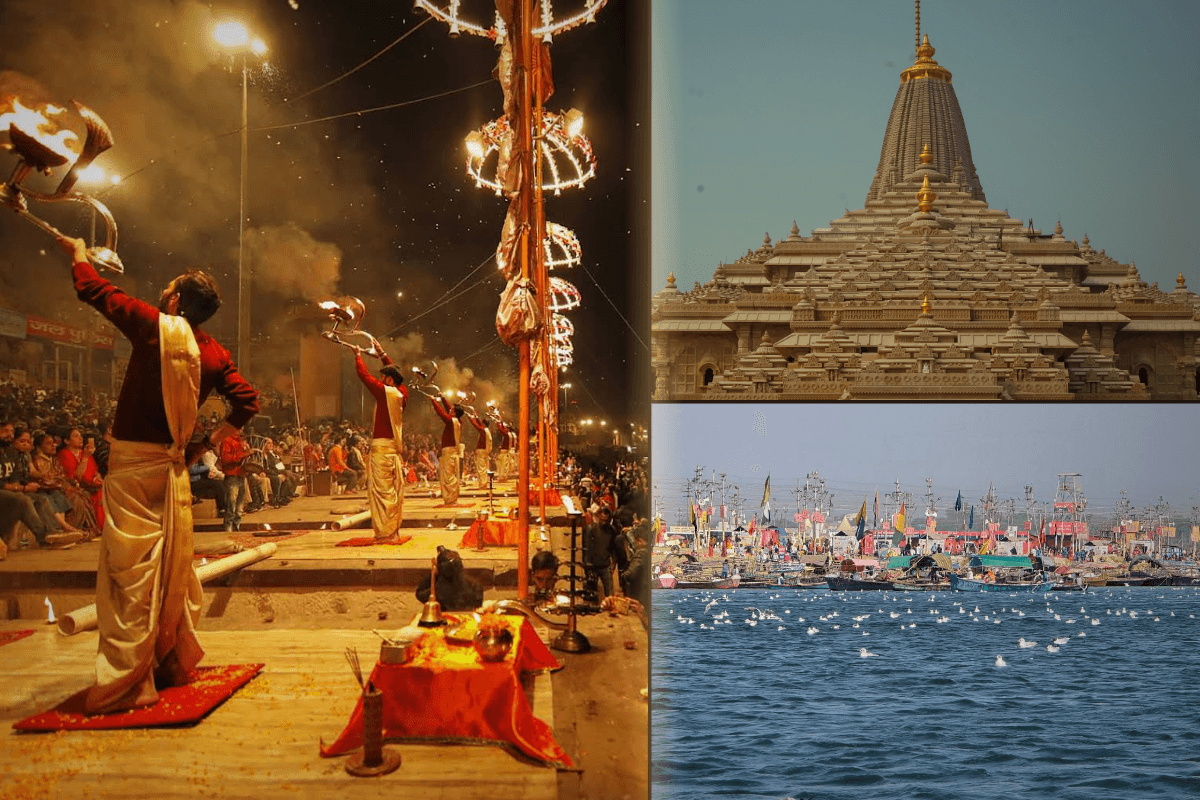
Pilgrimage Package
Varanasi + Ayodhya + Prayagraj — 5 Days Golden Triangle
Five unhurried days across three holy cities — Kashi, Ayodhya and the Triveni Sangam at Prayagraj. The classical north-Indian dharma circuit in its proper rhythm.
Traditional order
Priority bookings
Gentle pacing
Briefing included
The classical north-Indian pilgrimage triangle, spread across five unhurried days. Two days in Varanasi for the Kashi Yatra and a Sarnath afternoon, an AC cab transfer to Ayodhya for the Ram Janmabhoomi, Hanuman Garhi and Kanak Bhawan, and a day in Prayagraj for a sunrise boat to the Triveni Sangam where the Ganga, Yamuna and Saraswati meet — with tarpan available on request. Pre-booked Vande Bharat where the dates allow, walking-distance hotels in all three cities, and a single combined briefing for the trip.
Day-by-day
Itinerary
5 days · click to expand
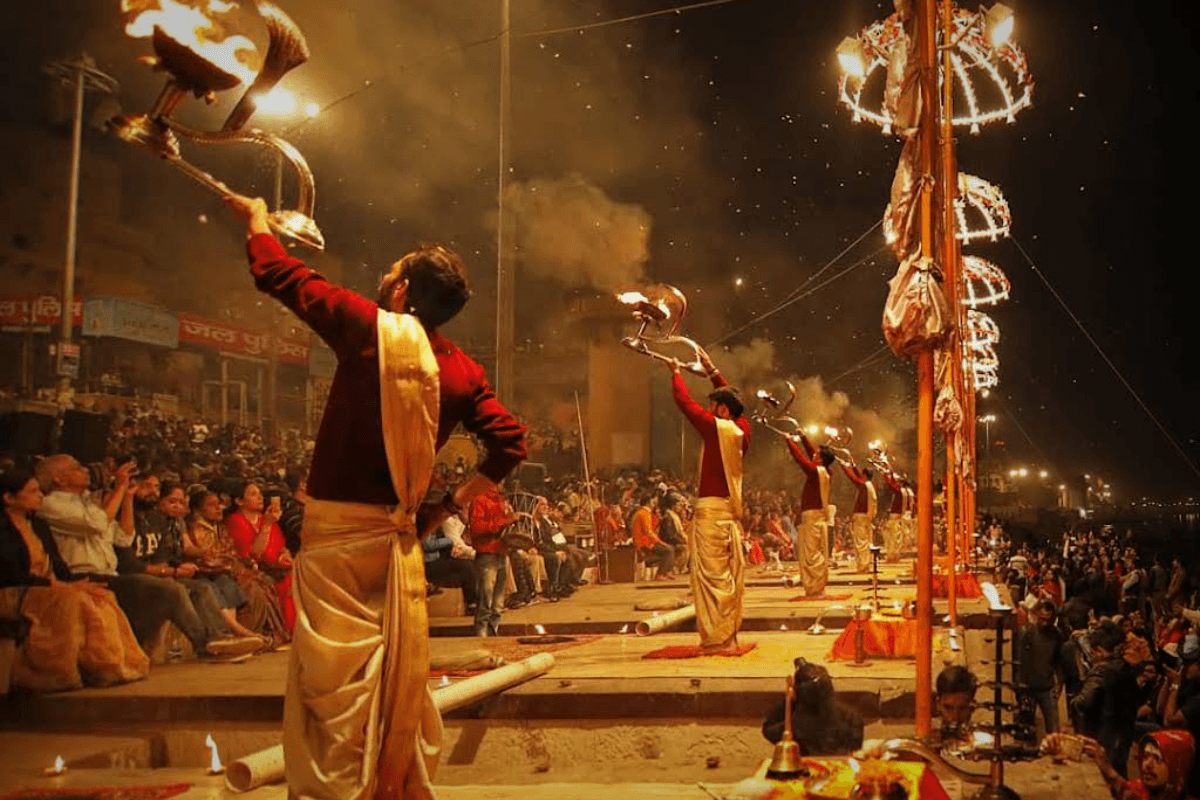
Day 1 grounds you in Varanasi. You arrive, settle in, walk a stretch of the ghats in the late afternoon, and end the day with reserved seating at the evening Aarti at Dashashwamedh — your first slow meeting with the Ganga before the days ahead unfold. The aarti begins around sunset — about 6:00–6:30 PM in winter, 6:45–7:00 PM in summer; we confirm the day's time.
Pickup + hotel check-in
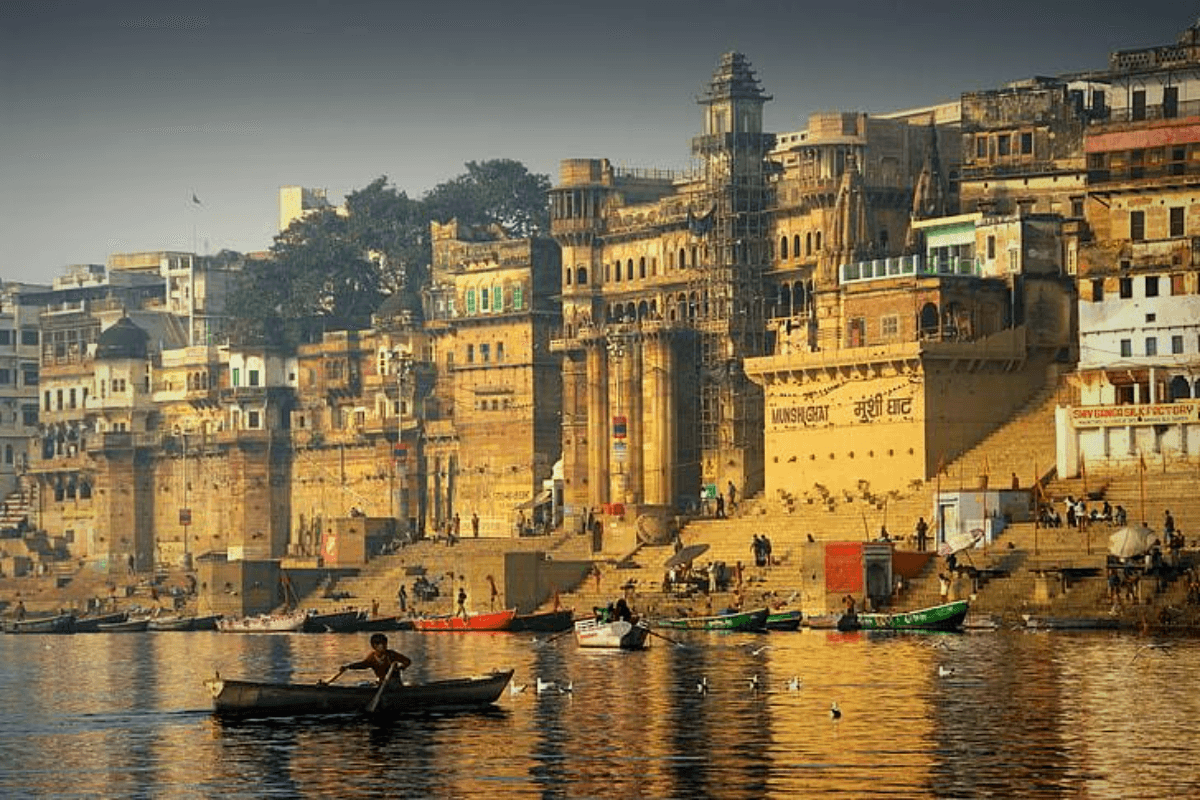
Ghat walk — Assi to Dashashwamedh
Ganga Aarti — reserved seating
Dinner
Day 2 is the central Kashi day. A dawn boat from Assi towards Panchganga before the city is fully awake, then the temple sequence in its traditional order — Sakshi Vinayak, Kal Bhairav, Annapurna, Vishwanath. The afternoon takes you 13 km north to Sarnath — the Dhamek Stupa, the Mulagandha Kuti Vihara, and the deer park where the Buddha gave his first sermon.
Dawn boat ride
Breakfast
Kashi Vishwanath + Annapurna + Kal Bhairav
Lunch
Sarnath excursion
Dinner
Day 3 takes you to Ayodhya. Morning AC cab transfer (about 5 hours) on good roads. Afternoon at the Ram Janmabhoomi for the darshan, scheduled for the calmest queue window your day allows. Evening at Hanuman Garhi up the steps for the hilltop Hanuman temple — a fitting close to the day Ayodhya speaks of.
Breakfast
Transfer to Ayodhya
Lunch in Ayodhya
Ram Janmabhoomi darshan
Hanuman Garhi + Kanak Bhawan
Dinner
Day 4 is the Prayagraj day. Morning AC cab to Prayagraj (about 165 km, about 4 hours). The afternoon takes you by boat to the Triveni Sangam — the visible line where the Ganga meets the Yamuna, and the unseen Saraswati is said to join them. Time at the confluence to sit, take a dip if you wish, or perform tarpan for ancestors. A priest can be arranged on request.
Breakfast
Ayodhya → Prayagraj transfer
Lunch near Sangam
Sangam boat ride + optional dip
Akshaya Vat + Allahabad Fort viewing
Dinner
Note Sangam water level varies seasonally.
Day 5 closes the circuit gently. Morning at the Bharadwaj Ashram — the rishi who hosted Ram, Sita and Lakshman in exile — and at the Lete Hanumanji temple, where Hanuman is in a reclining posture rare in Hindu iconography. Afternoon departure: by flight from Prayagraj airport (Delhi, Mumbai), or by train back to Varanasi for international onward connections.
Breakfast
Bharadwaj Ashram + Lete Hanumanji
Anand Bhawan (Nehru-Gandhi heritage home)
Lunch at hotel
Drop to station or airport
Note Flight option: direct from Prayagraj airport to Delhi/Mumbai.
Through the lens
Photos
6 photos
The story
About this package
In the Hindu tradition, Kashi and Prayagraj are spiritual companions. Kashi is the city where Shiva is said to live; Prayagraj is the place where the Ganga, the Yamuna and the unseen Saraswati meet at the Triveni Sangam. Together they form a yatra so old that the Mahabharata speaks of it. Add Ayodhya — the birthplace of Ram, and the city of the new Ram Mandir consecrated in 2024 — and you have the most complete dharma circuit possible in north India.
This journey takes you through all three at a calm pace, in a sensible loop. Two days in Varanasi — the essentials, then a day with the Kashi Yatra in its traditional sequence with a Sarnath afternoon. Day 3 is the AC cab transfer to Ayodhya, with the Ram Janmabhoomi darshan and Hanuman Garhi the same evening. Day 4 is the morning train to Prayagraj, the Sangam boat in the afternoon, and tarpan for ancestors if you wish. Day 5 closes with the Bharadwaj Ashram, Lete Hanumanji, and the departure — by flight from Prayagraj or back via Varanasi for international onward.
How we look after this journey for you
- The temple sequences are honoured. Kashi in its traditional order on Day 2; Ayodhya in the order most pilgrims follow — Ram Janmabhoomi, Hanuman Garhi, Kanak Bhawan; Sangam approached at the calm of late afternoon when the river is at its most beautiful.
- The bookings are made early. Reserved seating at the Dashashwamedh Aarti, dawn boats at Varanasi reserved the previous evening, Vande Bharat tickets booked the moment they open, the Ram Janmabhoomi darshan timed to avoid the longest weekend queues, hotels secured close to the temples in all three cities, and the Sangam boat held in advance.
- The pacing is gentle. Five days, three cities, with afternoon rest built in at every stop. The pace is planned so the journey feels full, not rushed.
- You arrive prepared. A single printed briefing reaches you before Day 1 — covering all three cities. Temple etiquette for each, queue strategies for the Ram Janmabhoomi, the meaning of tarpan, the small customs of each city, and a map for the Varanasi ghats.
Who this is for
- Pilgrims completing the classical north-Indian dharma circuit
- Pilgrims drawn to Ayodhya since the new Ram Mandir, who also want depth in Kashi and a quiet morning at the Sangam
- Families taking a once-in-a-decade multi-city yatra together
- NRIs returning for a consolidated spiritual journey on a single trip
What you will carry home
The quiet of standing before the Jyotirlinga at Vishwanath on a slow morning. The first sight of the new Ram Mandir's stone shikhara above the trees of Ayodhya. The thousand-year sound of the Hanuman Chalisa carried down the steps of Hanuman Garhi. The exact moment the boat reaches the Sangam point, where the green Yamuna and the brown Ganga meet and the unseen Saraswati is said to join them. The clay pot of Sangam water carried home for tarpan. And the small, clear sense of having taken all three cities in at the rhythm they ask for.
When to go
| Window | Weather | Notes |
|---|---|---|
| Oct 15 – Mar 15 | 10–28°C | The most comfortable window. Kartik Purnima at Sangam (November) and Ram Navami at Ayodhya (March or April) are very busy — book 2–3 months ahead. |
| Apr – Jun | 26–42°C | Warm. The schedule leans on early mornings and evenings, with AC rest in between. |
| Jul – Sep | Monsoon | Atmospheric. Sangam water levels rise — boats stay close to the bank rather than going out to mid-river. We adjust the route accordingly. |
A note on Kumbh years
Prayagraj hosts the Maha Kumbh every twelve years and the Ardh Kumbh every six. During Kumbh Mela weeks the Sangam, the city's traffic, hotel rates and crowd patterns all change very significantly. We can still run this circuit during Kumbh — but the route, hotels and timing all shift to handle it well, and the quote is different. Mention your dates in your enquiry and we will draft accordingly.
About the Triveni Sangam at Prayagraj
The Sangam is the meeting point of the Ganga, the Yamuna and the unseen Saraswati. A boat takes you out to the actual confluence point — the visible line where the lighter Ganga meets the darker Yamuna — and waits while you sit, dip if you wish, or perform tarpan. We can arrange a priest at the Sangam ghat for tarpan, or for a sankalpa for ancestors, if you would like to do this — please mention in your enquiry.
A few things to know before you arrive
- Wear cotton. Even in winter the afternoons can feel warm in temple courtyards, and synthetics are uncomfortable inside crowded temples.
- Carry ₹3,000 in small notes across the trip — ₹10s and ₹50s for dakshina, small offerings, the boatman at Sangam, and chai at roadside stalls.
- No leather inside Kashi Vishwanath or Ram Janmabhoomi. Belts, wallets, leather watch straps and handbags are all restricted. Lockers are available at both temples; it is easier to leave such items at the hotel on temple days.
- Phones at Ram Janmabhoomi. Mobile phones are not permitted inside the inner darshan path; secure cloakrooms are provided at the entry. The same now applies inside Kashi Vishwanath.
- Shoes with grip. Ghat steps in all three cities are stone, often wet, sometimes slippery from flower offerings.
- For the Sangam boat. A change of clothes if you plan to take a dip; a small ziplock for your phone; a clay or copper pot if you would like to carry Sangam water home (also sold at the ghat).
- Modest dress at all temples. Shoulders and knees covered. A dupatta or light scarf is useful.
- Photography. Allowed at most ghats. Restricted or not permitted inside Kashi Vishwanath, Ram Janmabhoomi sanctum, Hanuman Garhi sanctum and Kanak Bhawan. Your briefing lists what is allowed where.
Add-ons available on request
The core package is complete on its own. These additions are available if you would like them, priced separately in your quote:
- Priest for tarpan at the Sangam — a sankalpa for ancestors, performed at the Sangam ghat or on the boat
- Sugam (priority) darshan arrangement at the Ram Janmabhoomi — subject to temple trust availability
- Priest-led abhishek at Kashi Vishwanath — milk, gangajal and bilva leaves with the Mahamrityunjaya mantra
- Heritage walk through the old galis of Varanasi on Day 1 evening
- Akshayavat darshan at the Allahabad Fort in Prayagraj — the undying banyan — open through the public Akshayavat corridor since 2025, no separate permit needed on regular days
- Luxury hotel upgrade in all three cities at supplemental rates
Mention what interests you in your enquiry and we will include it in the quote.
Frequently asked
Why this order — Varanasi → Ayodhya → Prayagraj → Varanasi?
The classical sequence in the shastras runs Prayagraj first (Sangam snan), then Kashi, then Ram-related sites. For modern travel — most international and domestic flights land at Varanasi — we run it as a loop starting and ending in Varanasi. The merit of the yatra is the same; the travelling is much easier.
Can we skip Ayodhya?
Yes. We run a shorter Varanasi + Prayagraj itinerary on request, and a Varanasi-only 3 or 4-day option. Mention in your enquiry and we will draft a quote.
What about the Sangam dip and tarpan?
Both are part of Day 4. The boat takes you to the actual Sangam point, where you can sit, take a dip if you wish, or perform tarpan. A priest at the Sangam ghat for tarpan or a sankalpa for ancestors is available on request — please mention in your enquiry.
How long is the queue at the Ram Janmabhoomi?
It varies. A weekday afternoon is usually 2 to 3 hours; Saturdays, Sundays and festival days run 4 to 6 hours; Ram Navami and Diwali week are exceptional. We schedule your darshan for the calmest window your dates allow. A sugam (priority) darshan can be arranged as a paid add-on.
How do we travel between cities?
Varanasi → Ayodhya: AC cab (about 5 to 6 hours), or train when timings align. Ayodhya → Prayagraj: AC cab (about 165 km, about 4 hours — usually the better option), or a regular train (about 4 to 5.5 hours; no Vande Bharat runs this route). Prayagraj → Varanasi at the close: train (about 2 to 3 hours) or AC cab (about 3 to 4). We book the option that fits your dates best.
Is a guide included?
The core package includes a single printed briefing covering all three cities — temple etiquette, queue strategies, the meaning of tarpan, and cultural protocol. A temple interpreter, a priest for abhishek or tarpan, or an academic host for a heritage walk are available as paid options. Mention in your enquiry.
Do I need to be Hindu to do this trip?
Not at all. This package is for anyone drawn to Kashi, Ayodhya and the Sangam — of any faith, or of none. The briefing explains the meaning of every ceremony in plain language. We ask only for respect for the rituals and the people performing them.
How quickly do you reply to enquiries?
Within 6 working hours on weekdays (Mon–Sat, 9 AM – 7 PM IST). Within 24 hours on Sundays and public holidays. Every enquiry receives a named reply from a member of our team.
Related packages
- Shorter version? See Varanasi + Ayodhya — 3 Days.
- Just Kashi? See Varanasi 3-Day Spiritual Immersion.
- Buddhist circuit instead? See Varanasi + Bodh Gaya Buddhist — 5 Days.
What you get
Highlights
Logistics
What's included
Inclusions
- 4 nights hotel (2 Varanasi, 1 Ayodhya, 1 Prayagraj)
- All meals — pure-veg
- All inter-city transport (trains pre-booked, Vande Bharat where available)
- Kashi Yatra sequence + Ganga Aarti + Sarnath
- Ram Janmabhoomi + Ayodhya essential temples
- Prayagraj Sangam boat ride
- Printed combined briefing document
- All station transfers
- Bottled water throughout
Not included
- Travel to Varanasi (arrival) and from Prayagraj (return) — flight/train
- Tarpan priest fee
- Personal shopping
- Travel insurance
Send an Enquiry
Leave your name and number — our team will call you.
Starting price
₹12,999
per person
Replies in minutes on WhatsApp · 7 AM–10 PM
Trusted by Pilgrims
“We came for my mother's 75th birthday darshan. Satmarg arranged wheelchair access, a pandit who spoke her dialect, and a private boat for her Ganga aarti.”
“Third time using Satmarg. The cab service is top-notch — AC Innova, polite driver, no surprise charges.”
Udyam-registered MSME · UDYAM-UP-75-0177698
Varanasi-based operator · local guides & pandits
Hindi & English support · 7 AM–10 PM
The fine print
Cancellation policy
The fine print
Cancellation policy
Booking: 30% advance (multi-city inventory lock); balance 21 days before arrival. Cancellation: Free up to 21 days before — full refund. 14–21 days — 50%. Within 14 days — no refund but reschedule within 6 months for medical/weather emergencies. Circuit-specific: Ayodhya/Prayagraj hotels require early lock-in. Changes to route allowed up to 7 days before arrival. Substitutions: train/cab class equivalent, hotel equivalent with approval.