Annapurna Devi is worshipped in Kashi as the Mother who nourishes all creation. Her temple rises within the old Vishwanath precinct, a few steps from the Jyotirlinga, and tradition holds that the city itself continues to be fed by her grace. For the pilgrim, Annapurna and Vishwanath are rarely approached separately: the yatra that seeks Shiva also seeks the Shakti who sustains him.
The sanctum holds two murtis of the Goddess — a brass form worshipped daily and a gold-plated form kept within. The gold rupa is revealed only four days each year, from Dhanteras to Annakoot (Govardhan Puja) around Deepawali, when a mountain of offered food rises before the Devi and is distributed as prasad to all who come.
Approached through the narrow galis of the old city, the temple does not announce itself with scale. It reveals itself to the pilgrim at close quarters — an ornate doorway, a carved facade, a sanctum filled with the warmth of long daily worship. This nearness is part of how Annapurna is known in Kashi: as a presence close at hand, not distant.
Annapurna stands at the centre of Kashi's devotional household. Alongside Vishwanath, Kal Bhairav, and Vishalakshi, she completes the inner family whose darshan the traditional pilgrim seeks together. Where Vishwanath bestows liberation, Annapurna sustains the living — and in the tradition of Kashi, the two are held to be inseparable.
The worship of Annapurna carries a particular teaching: that anna-daan, the giving of food, is counted among the highest forms of dharma. Feeding the hungry is not considered a separate act of charity here; it is the central ritual. The Bhog offered to the Devi each day is a complete meal — rice, dal, vegetables, rotis, sweets, fruits — cooked with attention to purity and distributed without distinction to whoever arrives.
Katha and local belief
A beloved Puranic katha of Annapurna tells that Parvati once questioned whether the material world held any meaning. Shiva, the great ascetic, replied that all was illusion. Parvati, hearing this, withdrew from the world — and with her, all food withdrew too. The earth grew barren, beings fell hungry, the devas themselves weakened. Shiva searched every realm for her and at last found her in Kashi, seated with a cooking vessel, feeding a line of the hungry that stretched beyond sight. With folded hands he took up a bhiksha-patra and received her prasad.
From this story, Kashi holds Annapurna in a special relation: the Goddess who sustains Shiva himself, and therefore the Goddess without whom the sacred city cannot exist. A local belief of Banaras, often repeated, is that no pilgrim who arrives at her door in Kashi goes unfed — in the temple's kitchen or the city's many bhandaras that continue this tradition in her name.
History
The tradition of worshipping Annapurna at this site is ancient, recorded in the Kashi Khanda and long maintained in the devotional life of Banaras. The present temple was built in 1729 CE by Peshwa Baji Rao I of the Maratha empire, whose family, along with other Maratha patrons, contributed significantly to the sacred architecture of Kashi in the 18th century. The shrine was raised in the Nagara style of North Indian temple building, about fifteen metres north-west of Kashi Vishwanath.
A more recent chapter in the temple's story is the return in 2021 of a silver murti of Annapurna to Kashi from Canada, after many years of diplomatic effort. The murti now rests within the temple, restored to the site it left a century ago — a return pilgrims speak of with quiet pride.
Through the centuries, the devotional life of the temple has remained unbroken. Daily puja, the cooking and offering of bhog, and the distribution of prasad continue as they have for generations.
Architecture
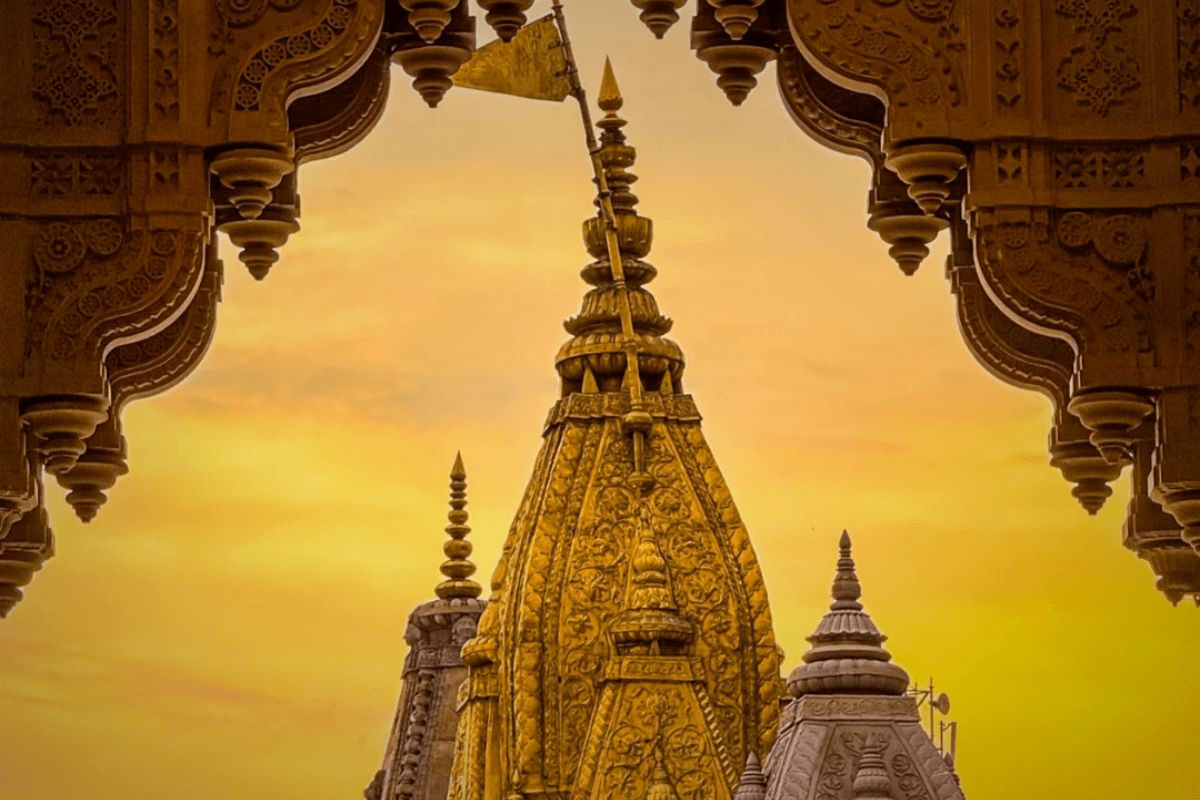
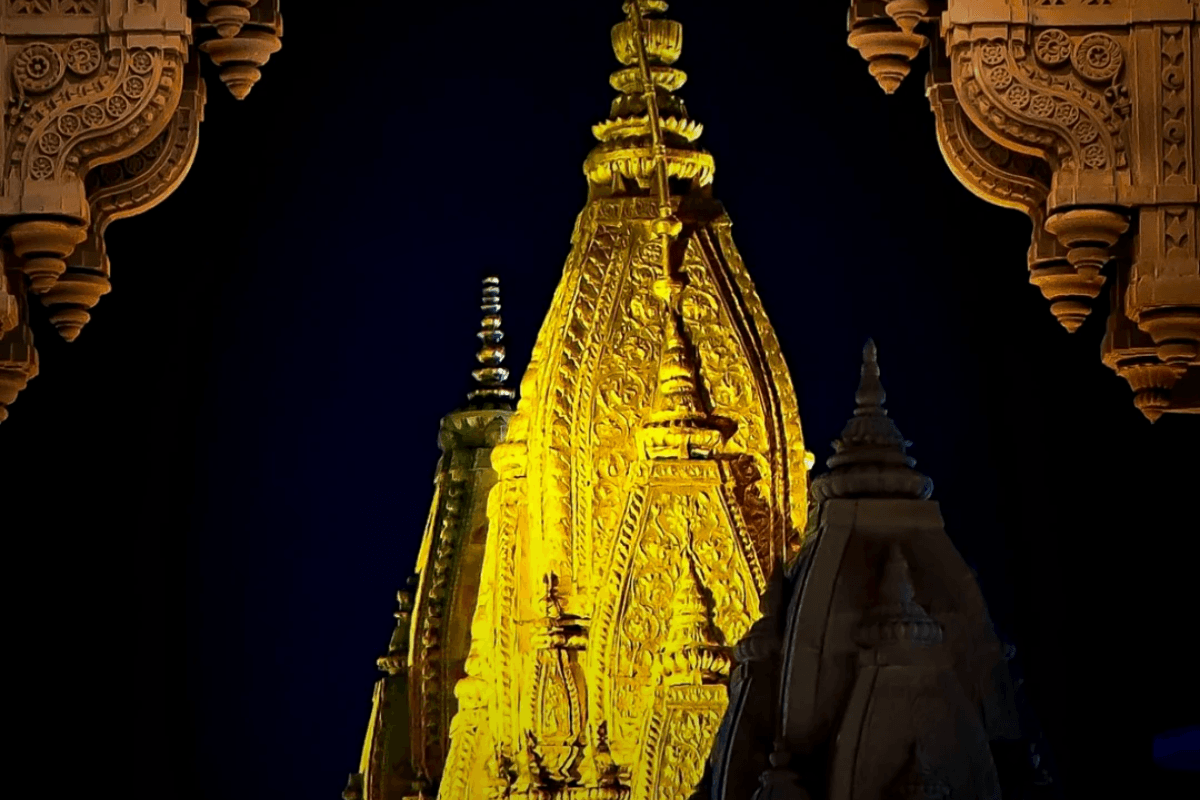
Annapurna Devi Temple is built in the Nagara style of North Indian temple architecture. It is modest in footprint, embedded within the dense urban fabric of the old Vishwanath precinct, and does not announce itself with towering gateways or expansive courtyards. The temple reveals itself to the pilgrim at close quarters — the ornate doorway and carved facade appear in the final turn of a gali, almost suddenly, with the warmth of long worship already present within.
The garbhagriha holds two murtis of the Goddess — a brass form in daily darshan, and a gold-plated form revealed only during the Annakoot window. The silver murti returned from Canada in 2021 now rests within the temple as well. Surrounding the sanctum, smaller shrines and devotional spaces carry the rhythm of the temple's kitchen, which remains central to its life.
This quality of hidden revelation is itself part of how Annapurna is understood in Kashi: a Mother close at hand, not far, known through nearness and through sustenance rather than through scale.
Rituals & Practices
The ritual life of Annapurna Devi Temple revolves around the central act of feeding. The daily Bhog — a complete meal of rice, dal, vegetables, rotis, sweets, and fruits, cooked in pure ghee with Vedic chanting in the temple kitchen — is first offered to the Goddess and then distributed as prasad to every pilgrim present.
The morning darshan begins with the awakening and bathing of the Devi, followed by the arpana of fresh flowers, sindoor, and offerings of rice and grains brought by devotees. Through the day the aartis continue in their order, each accompanied by the sound of the conch and the ringing of bells. Devotees commonly bring small quantities of rice, dal, or other grains to place before the Goddess — an act of symbolic participation in her central work of anna-daan.
The most awaited window is the Annakoot period each year, between Diwali and Navratri, when the gold-plated murti is revealed and a mountain of cooked food rises before the Goddess. Pilgrims often plan a yatra to Kashi specifically for this darshan.
Specific puja timings may vary; pilgrims are encouraged to verify current schedules with the temple trust before planning a visit.
Festivals & Celebrations
| Festival | When | Crowd |
|---|---|---|
| Annakoot | — | Very high â one of the temple's most awaited darshans |
| Sharad Navaratri | — | Very high |
| Chaitra Navaratri | — | High |
| Dev Deepawali | — | High |
| Akshaya Tritiya | — | High |
Annakoot: Celebrates Annapurna's central grace â that no one who comes to her door goes unfed. The mountain of food is a devotional enactment of the katha itself: the Devi feeding every hungry being that arrives.
Sharad Navaratri: Navaratri is the foremost festival of the Divine Feminine. At Annapurna's shrine, the Devi is honoured in her twin role â the Mother who feeds all creation and the Shakti who sustains the city.
Chaitra Navaratri: Marks the beginning of the Hindu new year with Devi worship. Devotees often begin new ventures after receiving Annapurna's blessing at this time, seeking prosperity and continuity in the year ahead.
Dev Deepawali: Celebrates the wider festival of lights in which the devas are said to participate. The illuminated temple set against the glowing ghats gives the night a particular quality pilgrims remember.
Akshaya Tritiya: The word 'Akshaya' means that which does not perish. Tradition holds that worship or daan performed on this day carries undiminishing fruit, and Annapurna's grace is sought so that the household never lacks sustenance.
Temple Details
| Timings | note: Incredible India (Govt. of India) lists 5:00 AMâ1:30 PM & 3:30 PMâ10:00 PM; timings can change on festival days â confirm locally aarti: Early morning, 12:00 noon, 8:30 PM and 10:00 PM (per temple trust) daily: 4:00 AM â 10:00 PM (per Sri Annapurna Mandir Charitable Trust) |
| Darshan Types | Daily darshan â brass icon of Maa Annapurna The brass icon is available for daily darshan; a typical visit takes 30 minutes to one hour depending on crowd levels Golden icon darshan â Annakut day only The gold icon of the goddess can be seen only once a year, on Annakut day (just after Deepavali) |
| Management | Sri Annapurna Mandir Charitable Trust (D 9/1, Vishwanath Galli, Varanasi) |
Prepare for Your Visit
Practical guidance to help you plan your pilgrimage
| Best Time to Visit | The temple sees special worship during Navratri (the goddess is venerated as Mahagauri on the eighth day), Dhanteras, and the Annakut festival held just after Deepavali. |
| How to Reach | by air: Lal Bahadur Shastri International Airport (VNS) serves the city; taxis and cabs are available on foot: The temple sits in Varanasi's old city where narrow lanes are best navigated on foot location: Inside Vishwanath Gali in the old city, about 15 m north-west of Shri Kashi Vishwanath Mandir; roughly 200 m from Vishalakshi Temple and 350 m from Manikarnika Ghat from varanasi junction: About 5 km south-east of Varanasi Junction (BSB) railway station; take an auto or taxi towards the old city, then continue on foot through the lanes |
| Pilgrim Guidance | Approach and the Kashi Yatra sequenceAnnapurna Devi Temple is approached within the traditional Kashi Yatra — she is visited before Vishwanath, because the pilgrim seeks sustenance before seeking liberation. A commonly followed sequence is:
The temple stands in the Vishwanath Gali precinct, a few steps from Kashi Vishwanath. Whether you enter through the Dham Corridor or through the older Godowlia-side gali route, any temple volunteer or security personnel can direct you; the two temples share the same precinct. Preparation for Pilgrims
Best Time to VisitOctober to March offers the most comfortable weather for pilgrimage. The Annakoot window each autumn (between Diwali and Navratri) draws the largest crowds — the gold murti darshan and the mountain of food are rare events, and many pilgrims plan their Kashi yatra around this time. The two Navratris (Sharad in September–October, Chaitra in March–April) are also highly regarded for Annapurna darshan. |
| Facilities | daily free annadanam |
| Pilgrim Tips |
|
Location
Varanasi, UP
Pilgrim photos
No pilgrim photos yet.
Official Links
Community corrections
No corrections yet.
Edit history
No revisions yet.
Plan Your Visit to Annapurna Devi Temple
Get a custom itinerary and pricing for your trip.
Recommended
Packages for this destination
Pilgrim Notes
On-ground observations from fellow pilgrims
No pilgrim notes yet. Be the first to share on-ground observations!
Sign in to share a note.
Pilgrim Reviews
520 reviews
Be the first to share your experience at Annapurna Devi Temple.
Sign in to write a review.
Nearby sacred places
Discover other sacred places near Annapurna Devi Temple
Explore temples, tirthas, and pilgrimage sites in UP
Explore nearbyPart of these circuits
Walk the traditional pilgrimage routes this destination belongs to.