Banke Bihari is for many the heart of Vrindavan. The murti — manifest to Swami Haridas around 1535 from his bhajan at Nidhivan — stands in the tribhanga pose, slightly bent at three places, and is so charged with bhav that the curtain is drawn and reopened every minute or two during darshan. The devotee and the deity, tradition holds, cannot bear too long an exchange of gaze.
The temple sits in the old quarter of Vrindavan, reached through narrow lanes lined with stalls selling chunari, prasad, pedha, and bhajan-CDs. The courtyard fills with the soft chant of Radhe Radhe as pilgrims wait for the next jhanki. There are no temple bells at Banke Bihari — tradition holds that loud bells would startle the playful child-Krishna; only soft chimes and the priests' gentle clap mark each darshan window.
Katha and local belief
Swami Haridas (1480-1573) was a great Vaishnava saint of the Nimbarka tradition and a teacher of the legendary musician Tansen. Tradition holds that as Swami Haridas sang his bhajans at Nidhivan, Radha and Krishna emerged together in his presence; on his request that they remain in a form devotees could worship, the two divine beings merged into the single murti of Banke Bihari — Krishna in his tribhanga, with the slight asymmetry of the bend marking where Radha stood beside him.
The deity is also called Banke (bent at three places) and Bihari (the lover, the enjoyer). The closed eyes and faint smile of the murti are held to be Krishna in his most intimate bhav. Many devotees say a darshan at Banke Bihari is the deepest darshan of Vrindavan; some bring their family chunari, offer it at the feet, and carry it home as the supreme blessing of Braj.
Banke Bihari is the principal shrine of the Haridasi Sampradaya and is held in the deepest devotional regard by the Gaudiya, Pushti Marga, Radha Vallabha, and Nimbarka traditions. The Vaishnava saints have praised this murti above all others in Vrindavan; the bhajans of Surdas, Mirabai, and the later goswamis turn again and again to Banke Bihari Ji.
Tradition holds that the bhajan of Swami Haridas is still alive in the rhythm of the temple. There are no bells, no loud aratis, no continuous mantra recitation in the main sanctum — only the gentle music of the curtain and the chant of Radhe Radhe from the pilgrims. The deity is held to be in his nikunja-lila bhav at all times; the priests serve him as a child, with sweetness rather than ceremony.
History
The present Banke Bihari Mandir was built in 1864 by Goswami Jagannath Goswami and the descendants of Swami Haridas. Before the temple, the murti was kept and worshipped in a small shrine at Nidhivan — the place where Swami Haridas had originally received the darshan. The bhajan-tradition of the Haridasi Sampradaya has continued unbroken from the sixteenth century to the present day.
The temple was renovated in the late twentieth century. The Banke Bihari Goswami Sevayat Trust manages the daily rituals. Despite the immense crowds of the modern era, the Goswami families have preserved the unique darshan rhythm and the absence of bells that mark Banke Bihari out from every other Krishna temple in Braj.
Architecture
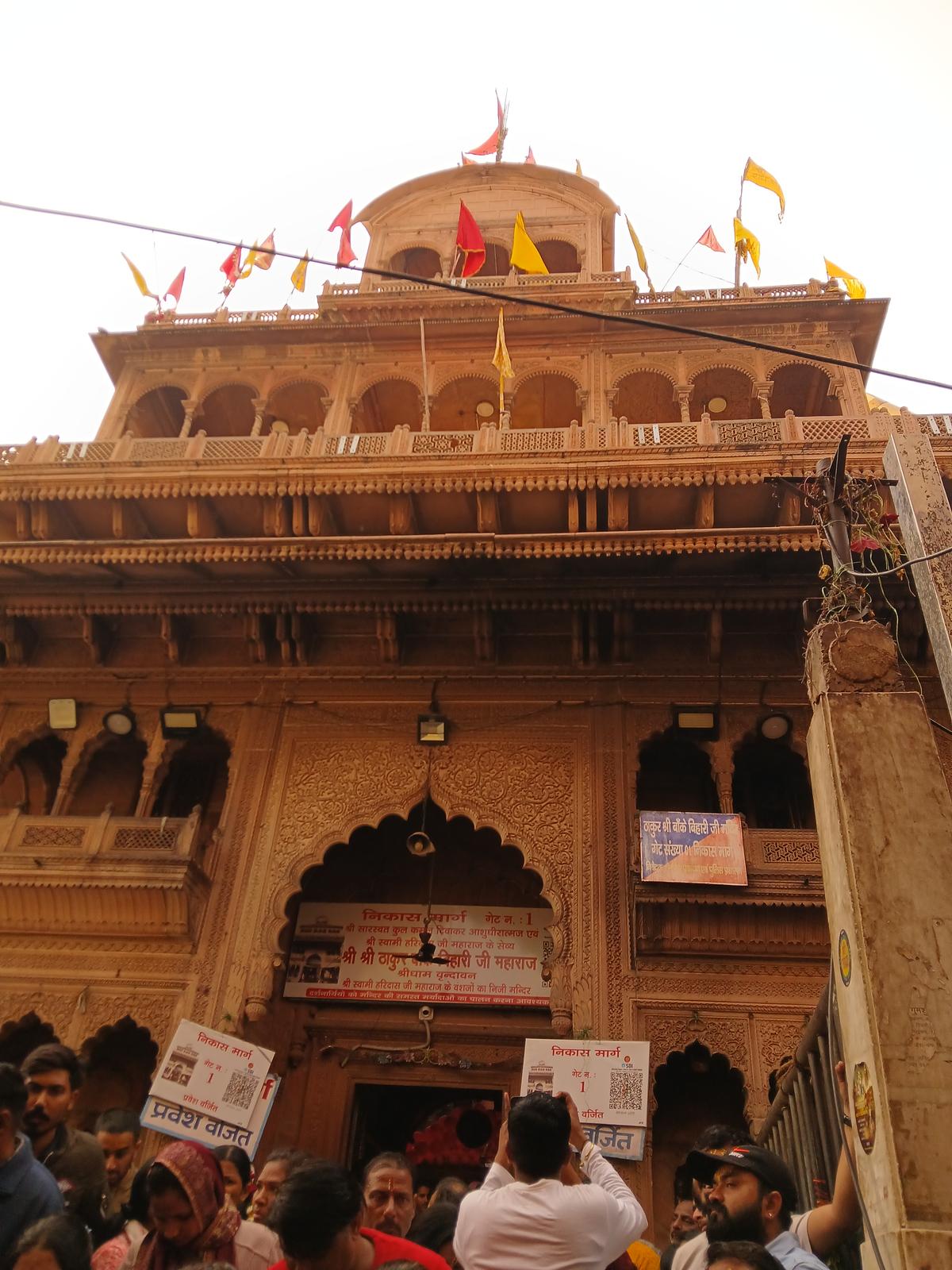
Banke Bihari Mandir is a Rajasthani-style courtyard temple with a high arched entrance, ornamental stone work, and a large open courtyard before the sanctum. The garbha-griha is at one end of the courtyard; the murti of Banke Bihari Ji stands within, dressed in seasonal silks, garlanded with fresh flowers, and crowned with a peacock-feather mukut.
The architecture has no bell-tower, no shikhara of the kind found at Govind Dev. Instead, the courtyard itself is the worship-space — pilgrims gather, chant Radhe Radhe, and watch the curtain. Side rooms house the Acharyas of the Haridasi lineage and a smaller shrine to Swami Haridas himself.
Rituals & Practices
The temple opens with Mangala Arati only once a year — on Janmashtami. On every other day the morning darshan begins with Shringar Arati (around 8:45 AM in summer, 9:00 AM in winter) and continues through five darshan windows ending with Shayan Arati at night. Verify exact timings on the day of darshan; they shift with the seasons.
The famous jhanki darshan rhythm — curtain drawn for darshan, then closed, then drawn again — runs continuously through the day. The tradition is held by the Goswamis to honour the bhav between Bihari Ji and his devotees. Bells are not rung; loud mantras are not chanted. Instead the air carries only soft music, the chant of Radhe Radhe, and the priests' gentle hand-claps.
On Phool Holi in Phalguna, instead of colours, flowers are showered on Bihari Ji and the devotees. On Janmashtami, the Mangala Arati at midnight is the most awaited darshan of the year — the only morning aarti the temple holds. Offerings of chunari, fresh flowers, and pedha are traditional.
Festivals & Celebrations
| Festival | When | Crowd |
|---|---|---|
| Janmashtami | — | very_high |
| Phool Holi | — | very_high |
| Radhashtami | — | very_high |
| Kartik (full month) | — | high |
Janmashtami: The most sacred darshan of the year at Banke Bihari.
Phool Holi: The most photographed Holi tradition in India.
Radhashtami: Honours Radha, whose presence is held to be merged into the Banke Bihari murti itself.
Kartik (full month): The month dear to Damodar Krishna.
Prepare for Your Visit
Practical guidance to help you plan your pilgrimage
| Pilgrim Guidance | How to reach Banke BihariThe temple is in old Vrindavan, reached through narrow lanes. From the main Vrindavan parikrama-marg, e-rickshaws and cycle-rickshaws drop pilgrims at the gali entrance; from there the temple is a 5-7 minute walk. Mathura Junction (12 km away) is the nearest railhead; Delhi (150 km) is the nearest international airport. Preparation for pilgrimsThe temple is extremely crowded on weekends, festivals, and the kapat-opening/closing days. Mobile phones, cameras, leather wallets, and large bags are not permitted inside — cloakroom available at the temple entrance. Wear modest clothes; remove footwear at the chappal stand outside. Carry a small cloth bag for prasad. The lane to the temple is narrow; expect slow movement and keep elders close. Best time to visitOctober to March is the most pleasant weather. The spiritual peaks are Janmashtami (August-September) — when the Mangala Arati at midnight is the only morning aarti of the year — and Phool Holi in Phalguna (March), when flowers are showered in place of colours. Radhashtami and the Kartik month are also high-bhav seasons. For lighter darshan, weekday mornings in November or early December are gentler. |
Location
Mathura, UP
Pilgrim photos
No pilgrim photos yet.
Community corrections
No corrections yet.
Edit history
No revisions yet.
Plan Your Visit to Banke Bihari Temple
Get a custom itinerary and pricing for your trip.
Recommended
Packages for this destination
Pilgrim Notes
On-ground observations from fellow pilgrims
No pilgrim notes yet. Be the first to share on-ground observations!
Sign in to share a note.
Pilgrim Reviews
Be the first to share your experience at Banke Bihari Temple.
Sign in to write a review.
Nearby sacred places
Discover other sacred places near Banke Bihari Temple
Explore temples, tirthas, and pilgrimage sites in UP
Explore nearbyPart of these circuits
Walk the traditional pilgrimage routes this destination belongs to.