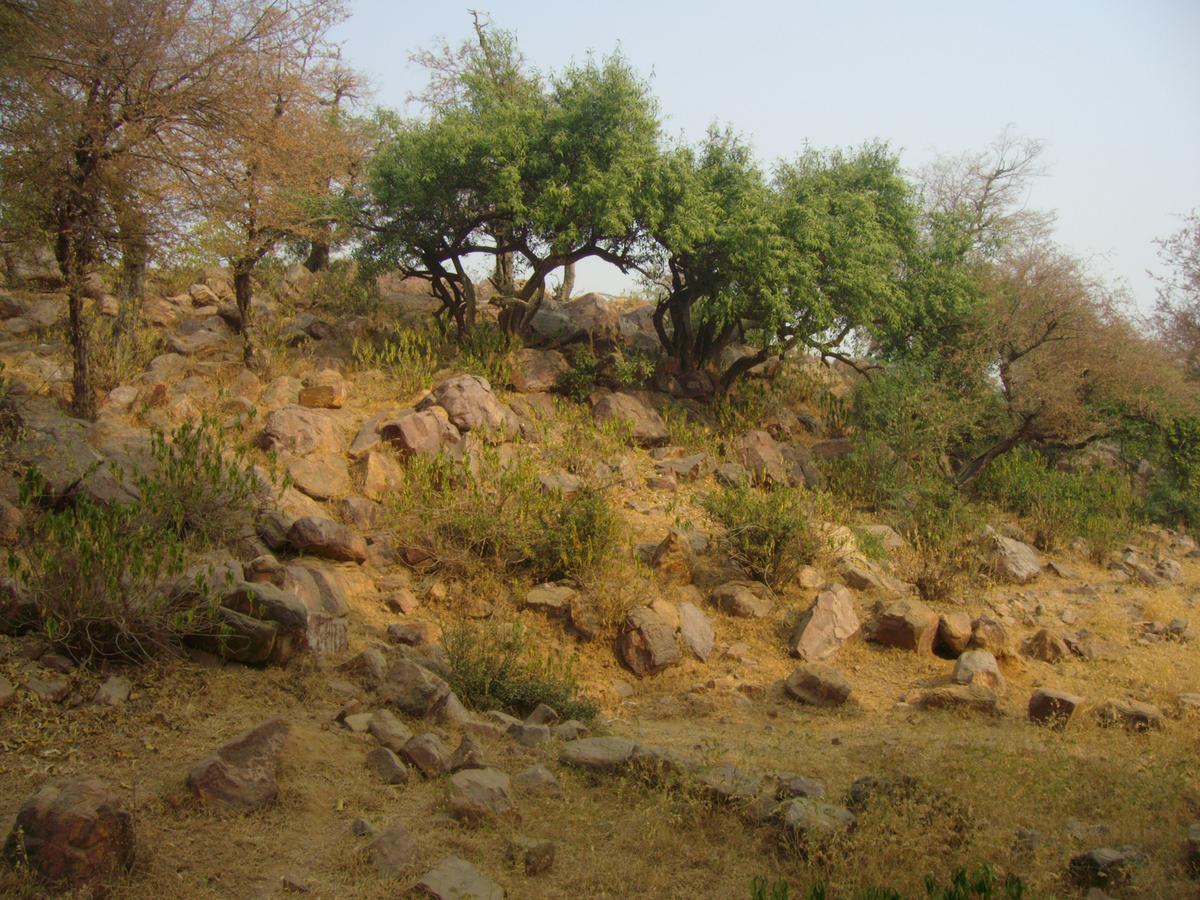
Barsana is the birthplace of Shrimati Radharani, the beloved of Shri Krishna and the soul of Vaishnava devotion. The town sits on the four hills of Brahmagiri, fifty kilometres from Mathura and ten kilometres from Nandgaon. Tradition holds the four hills to be the four faces of Brahma himself, who descended in this form to witness the eternal lila of Radha and Krishna.
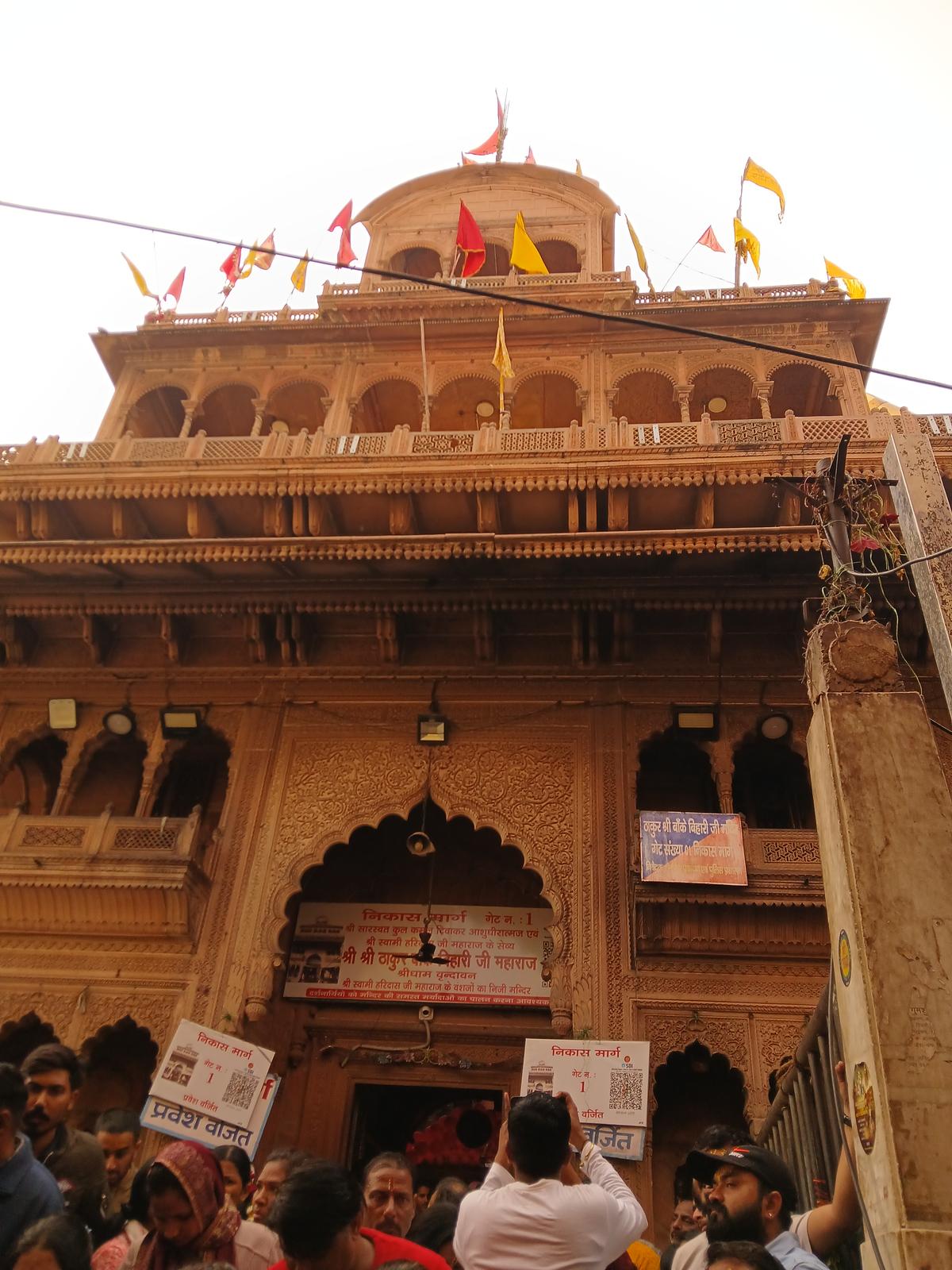
The town centres on the Shriji Temple of Radharani, perched at the top of the highest hill — about 250 feet (roughly 75 metres) above the plain — reached by a long flight of stone steps. Within the sanctum, Radha and Krishna are worshipped together; Radha holds the place of honour, Krishna stands at her side. To the Vaishnava devotee, this is the supreme darshan of Radha in her own home.
Katha and local belief
The Padma Purana, the Brahma-Vaivarta Purana, and the long oral tradition of Braj place Radha's birth at Barsana to Vrishabhanu and Kirti, in the home that became the present Shriji Temple. From an early age Radha and Krishna would meet in the groves of Vrindavan, at Sankhi Vat, and on the slopes of Brahmagiri. Barsana is the place where the love that became the soul of Vaishnava bhakti first flowered.
Barsana holds a unique place in Vaishnava tradition as the birthplace and home of Radha. The Gaudiya, Pushti Marga, Radha Vallabha, Nimbarka, and Madhva sampradayas all turn here in their devotional life. Tradition holds that a darshan at Barsana, especially on Radhashtami in Bhadrapada, confers a depth of devotional rasa unavailable elsewhere in Braj.
The town is the spiritual sister of Nandgaon, ten kilometres away, where Krishna was raised by Yashoda and Nanda. The two towns share the playful rivalry of Radha and Krishna — most beloved expressed in the famous Lathmar Holi, where women of Barsana playfully drive the men of Nandgaon (who come to play Holi) with long bamboo sticks, re-enacting the bantering love-quarrels of Radha and Krishna.
The four hills of Brahmagiri
The four hills of Brahmagiri are themselves part of the parikrama. The four hills represent the four faces of Brahma, who in tradition descended to Braj to witness the lila that Brahma alone could not understand. Each hill carries its own small shrine. The parikrama of Barsana, taking in all four hills and the Shriji Temple, is undertaken by devoted pilgrims especially on Radhashtami.
History
Barsana's sacred memory reaches into the Padma Purana and the Brahma-Vaivarta Purana. The town as the present pilgrim centre grew from the sixteenth century rediscovery by the Gaudiya saints. The Shriji Temple of Radha was rebuilt in its current form in 1675 by Raja Veer Singh of Orchha; the present structure stands above an earlier shrine on the same site. The town has been continuously held by the families of the Acharyas of the Radha Vallabha and the Nimbarka traditions, who have served Radha for many generations.
Nineteenth and twentieth century renovations by the Maharajas of Bharatpur and the Birla family have added new dharamshalas, ghats, and the steps to the Shriji Temple. Yet through all the additions, the heart of Barsana — the small sanctum where Radha is worshipped as Lardily Lal (the playfully beloved) — has remained unchanged.
Architecture
The Shriji Temple is built in the regional Rajputana style — red sandstone walls, jharokha windows, and a series of courtyards rising on the steep hill. The garbha-griha holds the murtis of Radha and Krishna, served by priests of the Vrishabhanu lineage.
The four hills carry smaller stone shrines — Brahma Pahari in the centre, Vishnu Pahari to the east, Mahadev Pahari to the west, and Sankhari Khor, the narrow ravine where Radha and Krishna would meet. Each is visited by pilgrims as part of the Barsana parikrama.
Rituals & Practices
The Shriji Temple opens with Mangala Arati shortly after sunrise and closes after Shayan Arati at night. There are five aratis through the day in the Pushti-influenced rhythm of Braj — Mangala, Shringar, Rajbhog, Sandhya, Shayan. Devotees climb the stone steps to the temple, offer flowers, sweets, and chunari to Radharani, and circumambulate the sanctum.
The traditional sequence on a Barsana pilgrimage is to first climb to the Shriji Temple, then visit Sankhari Khor (the meeting ravine), Mor Kuti, Rangeeli Mahal, and Vrishbhanu Kund (the kund of Radha's father). The full Barsana parikrama of about 10 km takes in the four hills and these connecting sites.
Special pujas include Radha abhishek on Radhashtami, recitation of the Radha Sahasranama, and the famous Phool Holi at the temple — when flowers are showered in place of colours.
Festivals & Celebrations
| Festival | When | Crowd |
|---|---|---|
| Lathmar Holi | — | very_high |
| Radhashtami | — | very_high |
| Phool Holi | — | very_high |
| Bhai Dooj | — | high |
Lathmar Holi: The most internationally famous of all Holi traditions in India.
Radhashtami: The most spiritually charged day of the Barsana year. Pilgrims come from across India and abroad.
Phool Holi: The most beautiful of the Holi traditions of Barsana.
Bhai Dooj: Honours the bond of brothers and sisters.
Prepare for Your Visit
Practical guidance to help you plan your pilgrimage
| Pilgrim Guidance | How to reach BarsanaBarsana is 50 km from Mathura and 60 km from Vrindavan, reached by road. The nearest airport is Delhi (IGIA, 175 km, 4 hours). Mathura Junction is the nearest railhead. Most pilgrims combine Barsana with Nandgaon (10 km away) and the wider Braj parikrama. Direct buses and taxis are available from Mathura, Vrindavan, and Govardhan. Preparation for pilgrimsThe climb to the Shriji Temple is about 250 metres of stone steps — approximately 200 steps. The climb is manageable for most pilgrims but tiring in summer heat. Carry water, sun protection (May-June), and warm woollens (December-February nights). Wear comfortable shoes; the steps can be uneven. Hotels in Barsana are limited and basic; most pilgrims stay in Vrindavan or Mathura and day-trip to Barsana. For Lathmar Holi (a week before main Holi), book accommodations and viewing arrangements months in advance. The Lathmar Holi is held on the morning of Phag Ekadashi in Phalguna — Barsana welcomes lakhs of pilgrims, photographers, and visitors that day. Best time to visitOctober to March is the most pleasant weather. The spiritual peaks are Radhashtami in Bhadrapada (August-September — Radharani's birthday) and Lathmar Holi in Phalguna (March — a week before main Holi). Janmashtami (August-September) and Kartik month (October-November) are also high seasons. May-June is hot and best avoided for the temple climb. |
Location
Mathura, UP
Pilgrim photos
No pilgrim photos yet.
Community corrections
No corrections yet.
Edit history
No revisions yet.
Plan Your Visit to Barsana
Get a custom itinerary and pricing for your trip.
Recommended
Packages for this destination
Pilgrim Notes
On-ground observations from fellow pilgrims
No pilgrim notes yet. Be the first to share on-ground observations!
Sign in to share a note.
Pilgrim Reviews
Be the first to share your experience at Barsana.
Sign in to write a review.
Nearby sacred places
Discover other sacred places near Barsana
Explore temples, tirthas, and pilgrimage sites in UP
Explore nearbyPart of these circuits
Walk the traditional pilgrimage routes this destination belongs to.