Bharat Kund — the sacred pond and the temple complex at Nandigram, about 20 kilometres south of Ayodhya — is the place where Bharat lived for the fourteen years of Shri Ram's vanvas. The Ramayana tells the deeply moving katha: when Bharat returned to Ayodhya from his maternal uncle's home and learned that his mother Kaikeyi's vara had sent Ram to vanvas, he refused to accept the throne. He went to Chitrakoot, fell at Ram's feet, begged him to return; when Ram declined, Bharat asked for his padukas instead. He placed those sandals on the throne at Nandigram, lived as an ascetic himself, and ruled Ayodhya only as the trustee of his elder brother.
The complex centres on the Bharat Kund — the pond where Bharat bathed daily — and the principal Bharat Mandir at its bank. The temple holds murtis of Bharat in tapasvi-form (with matted hair and ascetic dress), the symbolic padukas of Shri Ram on a small throne, and subsidiary shrines to Hanuman and Shatrughna. The atmosphere is the most contemplative of any Ayodhya-area site — the bhav is of deep humility, brotherly love, and rule-as-service.
The padukas on the throne
The image of Bharat ruling Ayodhya only by holding Shri Ram's padukas on the throne is one of the most beloved scenes of the Ramayana. The Padukas-rajya is the supreme symbol of nyas (trusteeship) — power held in trust, not for oneself. Tradition holds that Bharat slept on the bare ground, wore valkala (bark-cloth), ate only sattvik food, and bowed daily before the padukas. His self-denial through the fourteen years matches Ram's vanvas in austerity; many devotees consider Bharat the deepest bhakta of the Ramayana, the one who served without leaving home.
Bharat Kund is the temple of bhakti-without-self — the devotion that asks nothing for itself and serves through obedience. Tradition holds Bharat to be the partial-avatar of the conch-shell of Vishnu (the Panchajanya), as Lakshman is of Sheshanaga; the four brothers together represent the four aspects of Vishnu's presence. For the bhakta, the lesson of Bharat Kund is that the throne can be a place of tapas, that rule can be a form of bhakti, and that selflessness is the truest form of devotion.
History
Bharat Kund and the Nandigram complex have been pilgrim sites since ancient times. The Padma Purana and the Skanda Purana's Ayodhya Mahatmya both mention Nandigram as Bharat's tapasthala. The present temple structure was rebuilt in the late nineteenth century in the Bundeli style. The complex is managed today by the Bharat Mandir Trust.
Architecture
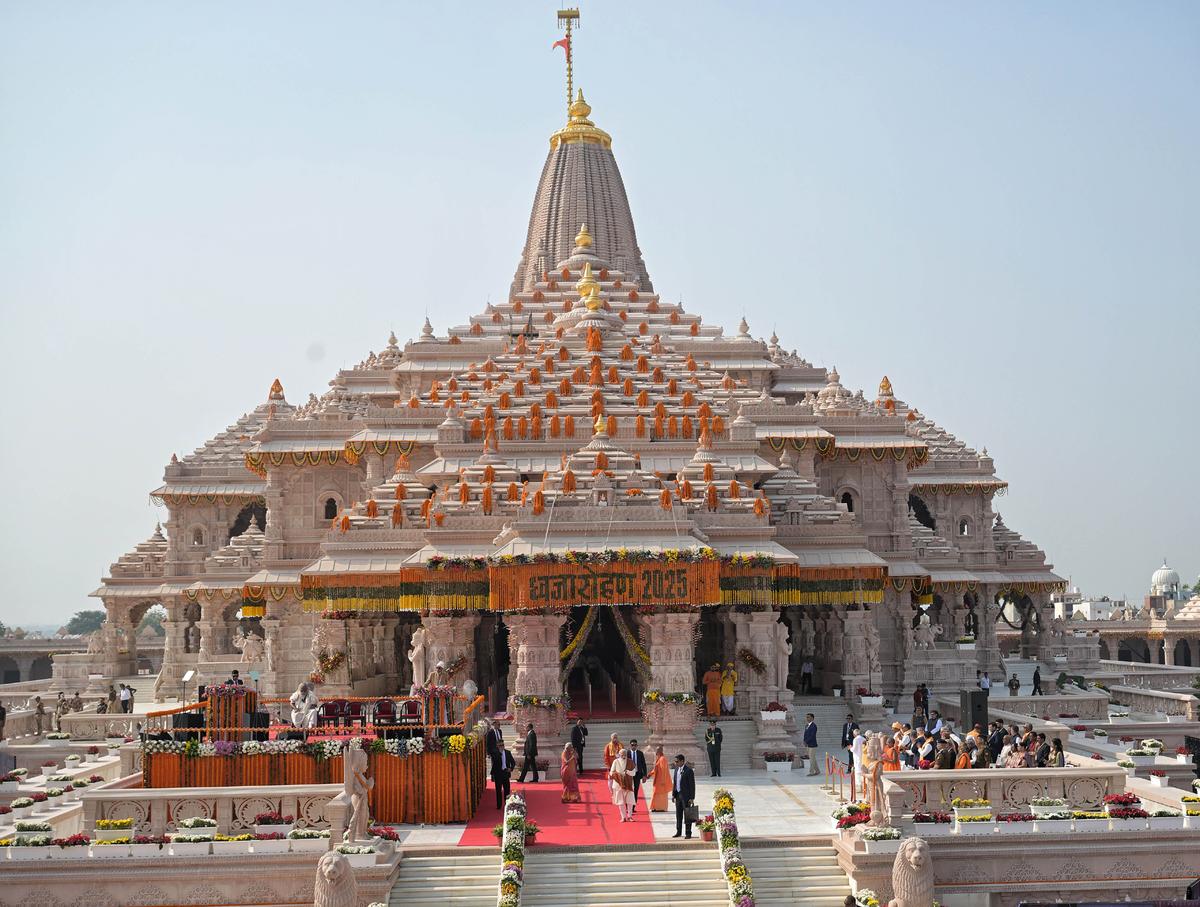
The complex is set across about 5 acres around the sacred pond. The principal Bharat Mandir is built in the Bundeli haveli-mandir style — courtyard temple, painted in cream and ochre, with carved jharokha windows. The sanctum holds the seated tapasvi-Bharat with the symbolic padukas on a small throne before him. The pond has stone-paved steps, and small subsidiary shrines surround it — to Hanuman, Shatrughna, and to ascetic-sages from the Ramayana.
Rituals & Practices
The temple opens around 6 AM and closes around 8:30 PM with three daily aartis. The principal devotional moment is the early-morning paduka-puja, when devotees offer flowers and chandan to the symbolic sandals on the throne. Pilgrims bathe in the Kund, recite the Bharat-stotra from the Padma Purana, and pause for silent reflection by the pond. The traditional sequence on an Ayodhya yatra is to visit Bharat Kund last — after the central Ayodhya darshans — as the closing reflection on selfless bhakti.
Festivals & Celebrations
| Festival | When | Crowd |
|---|---|---|
| Bharat Milap | — | very_high |
| Ram Navami | — | high |
| Akshaya Navami | — | high |
| Bharat-shata | — | moderate |
Bharat Milap: The supreme day of brotherly bhakti.
Ram Navami: Shri Ram''s birthday observed by Bharat-bhaktas.
Akshaya Navami: The day of full Ayodhya merit.
Bharat-shata: The lifestyle-bhakti tradition of Bharat.
Prepare for Your Visit
Practical guidance to help you plan your pilgrimage
| Pilgrim Guidance | How to reachBharat Kund at Nandigram is about 20 km south of central Ayodhya, about 30 minutes by road. Taxis and shared autos run from the main Ayodhya area; the road is well-paved. Pilgrim families on a 2-day Ayodhya yatra often do Bharat Kund as a half-day excursion on the second day. Ayodhya Dham railway station is 18 km from Bharat Kund. PreparationModest dress. The complex is quieter than central Ayodhya — fewer stalls, less commercial activity. Carry water and light snacks; vegetarian food is available at the temple's pilgrim canteen. The bathing pond is shallow and safe. Best time to visitOctober to March for pleasant weather. Bharat Milap (the anniversary of Ram-Bharat reunion at Chitrakoot, celebrated 4 days after Diwali in Kartik) is the spiritual peak — a procession from Bharat Kund to Ayodhya re-enacts the reunion. Ram Navami sees special abhishek of the padukas. |
Location
Ayodhya, UP
Pilgrim photos
No pilgrim photos yet.
Community corrections
No corrections yet.
Edit history
No revisions yet.
Plan Your Visit to Bharat Kund
Get a custom itinerary and pricing for your trip.
Recommended
Packages for this destination
Pilgrim Notes
On-ground observations from fellow pilgrims
No pilgrim notes yet. Be the first to share on-ground observations!
Sign in to share a note.
Pilgrim Reviews
Be the first to share your experience at Bharat Kund.
Sign in to write a review.
Nearby sacred places
Discover other sacred places near Bharat Kund
Explore temples, tirthas, and pilgrimage sites in UP
Explore nearbyPart of these circuits
Walk the traditional pilgrimage routes this destination belongs to.