Chaurasi Khambha, the temple of eighty-four pillars, stands in Mahavan — the old Gokul that Braj tradition holds to be the first home of Krishna after Vasudev carried him across the Yamuna from the prison of Kamsa. For the first months of his life, before the family moved to the Nandgaon hills and later to Vrindavan, the infant Krishna is believed to have lived here in the courtyard of Nanda Maharaj. The mandapa as it stands today rises on the spot tradition remembers as that very courtyard.
To the casual visitor, Mahavan can feel quiet — older, dustier, and less visited than Vrindavan or Mathura. To the Braj pilgrim, that quietness is part of its character. This is the village where Krishna was first laid in a cradle, where Yashoda Maiya first held him, where Putana came in the disguise of a wet-nurse, where the bullock-cart of Shakatasura was overturned by a tiny kick, and where Yashoda tied her child to the wooden mortar — the lila that gave him the name Damodara. Almost every devotee comes to Chaurasi Khambha with these kathas already living in the heart.
The mandapa itself is the central feature: eighty-four sandstone pillars arranged in rows, carrying a flat stone roof, holding within them the sanctum where the cradle (oklhi) and the wooden mortar (ukhal) of bal-Krishna are preserved. Pilgrims walk between the pillars softly, often pausing in silence, sometimes touching a pillar in pranam, before approaching the inner shrine.
Katha — Mahavan and the lilas of bal-Krishna
Tradition recounts that on the rainy night of Janmashtami, when Vasudev carried the newborn Krishna across the flooded Yamuna to Gokul, it was here in Mahavan that he laid the child beside Yashoda and returned with her newborn daughter to the Mathura prison. From that night onward, Nanda Baba and Yashoda Maiya raised the Lord of all worlds as their own son in this very courtyard.
The first great lila of this house is the slaying of Putana. The demoness, sent by Kamsa with poison smeared on her breast, came in the form of a beautiful wet-nurse asking to feed the newborn. Yashoda, untouched by suspicion, allowed her near the child. Krishna drew the poison and her life-breath together; Putana fell in her true demonic form, and tradition holds that her body covered many yojanas. The cowherd women purified the infant by passing him through the holy smoke of cow-dung — a ritual that Braj mothers still observe symbolically for newborns.
The second lila is the breaking of Shakatasura. The infant Krishna lay beneath a heavily laden bullock-cart while Yashoda went to the Yamuna. A demon had entered the cart; when Krishna stretched his small foot in play, the cart shattered into pieces. The cowherds, returning to see the wreck, could only marvel that the baby was unharmed.
The third and most beloved lila of this courtyard is ukhal-bandhan — the binding to the wooden mortar. Yashoda, exhausted by her child's mischief of stealing butter and breaking pots, finally tied him with a rope to the heavy ukhal (the household mortar for grinding grain) and went back to her work. Krishna, accepting her bond out of love, dragged the mortar through the courtyard until it caught between two arjuna trees. With a small pull he uprooted both — releasing the two sons of Kubera, Nalakuvara and Manigriva, who had been cursed to stand as those trees. From this lila came the name Damodara — the one bound at the belly by his mother's love. The very mortar of that lila is held to be preserved at Chaurasi Khambha to this day.
The Eighty-Four Pillars
The number eighty-four is sacred across Braj. The full Braj-yatra circuit is traditionally counted as chaurasi kos — the eighty-four-kos parikrama of Krishna's lila-bhumi. Eighty-four lakh species of life are said to fill the universe, and the human birth is held precious as the rare doorway among them. The eighty-four pillars of Mahavan are remembered in Braj tradition as a silent reckoning of all this — the entire created order standing in silent darshan around the courtyard where the Lord of all became a child.
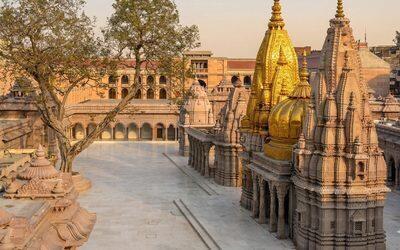
Chaurasi Khambha is the foundational shrine of bal-lila — the childhood pastimes of Krishna that lie at the heart of Braj bhakti. While Vrindavan is celebrated for the kishore lilas of Krishna with the gopis, and Govardhan for the lifting of the hill, Mahavan is the first chapter — the months when Krishna was still an infant in his mother's arms. For the bhakta who follows the lila in order, the pilgrimage of Braj begins here.
The shrine holds a special place in the bhava of vatsalya rasa — the relationship of parent to child, in which the devotee approaches Krishna not as a distant Lord but as one's own infant. Vatsalya bhava is the central mood of the Pushtimarga tradition founded by Sri Vallabhacharya, and Mahavan is one of the principal seats of this sampradaya. Sri Vallabhacharya is held to have performed his Bhagavata-saptaha here, and the place where he sat is preserved as a baithak nearby.
For the Gaudiya tradition, Mahavan is part of the Antardvip and Braj-mandal parikramas. For Pushtimarga families, it is one of the most cherished sites in the chaurasi-baithak yatra. For ordinary Braj pilgrims, it is the place where one comes to remember that the Lord of all worlds once accepted a mother's rope around his belly — and to ask, in the silence of the eighty-four pillars, that one's own heart be similarly bound to him in love.
The ukhal and the oklhi preserved at the shrine are not merely relics. In the bhava of the devotee, they are living witnesses to the lilas that the Bhagavata Purana describes in its tenth canto. To touch one's forehead to the wood of the mortar, or to sit quietly before the cradle, is to enter — for a moment — the courtyard of Nanda and Yashoda.
History
Mahavan, literally the great forest, is one of the oldest inhabited sites of the Braj region. Local tradition and the Bhagavata Purana hold that it was the original Gokul — the cowherd settlement where Nanda Maharaj resided before later moving with the community to Nandgaon. The present village retains the name Mahavan, while a newer Gokul has grown a short distance away on the Yamuna bank; both are part of the chaurasi-kos parikrama.
The Chaurasi Khambha mandapa is among the older surviving stone structures of Braj. Archaeological and architectural readings place the present pillared hall in the early medieval period, with later additions and restorations under various Hindu patrons. The pillars themselves carry carvings whose style suggests an earlier substrate, and tradition holds that the mandapa was built over the original courtyard of Nanda Baba, preserving the spot through every age of rebuilding.
In the late fifteenth and early sixteenth centuries, with the great Braj-revival led by Sri Vallabhacharya, Sri Chaitanya Mahaprabhu, and the Six Goswamis of Vrindavan, Mahavan returned to active devotional life. Sri Vallabhacharya is held by Pushtimarga tradition to have established one of his eighty-four baithaks at Mahavan and to have performed Bhagavata-saptaha here. The site remained a quieter pilgrimage centre through later centuries — never as crowded as Vrindavan or Mathura, but never forgotten by the Braj parikrama tradition.
Through the Mughal period and afterwards, daily worship continued. The cradle and the mortar associated with bal-Krishna have been preserved through every generation of seva. The Archaeological Survey of India today recognises the structure as a protected monument; the sanctum continues to be a living shrine, with daily darshan offered to the cradle and the ukhal.
Architecture
The mandapa of Chaurasi Khambha is a flat-roofed pillared hall, rectangular in plan, with eighty-four stone pillars arranged in regular rows. Unlike the soaring shikhara temples of later medieval Braj, the architecture here is horizontal, intimate, and trabeated — stone beams resting on stone pillars, in a style that traces back to early temple building before the rise of the tall Nagara spire.
The pillars themselves are the most striking feature. Each is carved from sandstone, with bases, shafts, and capitals that show simple but distinct ornamentation — lotus medallions, kalasha forms, restrained foliate scrolls. The carving style varies subtly across the rows, suggesting different periods of work; some scholars read in the older pillars an architectural memory that may reach back well before the present mandapa.
At the heart of the mandapa is the sanctum, which preserves the cradle (oklhi) and the wooden mortar (ukhal) of bal-Krishna. The cradle is small and worn, draped in cloth and flowers; the mortar is short and heavy, its surface darkened by centuries of touch. Pilgrims circle the sanctum from within the forest of pillars; the experience is unlike any other Braj shrine — a long, low, dignified hall whose silence is held by the columns themselves.
An adjoining shrine houses murtis of Nanda Baba, Yashoda Maiya, Krishna, and Balarama, often shown in the bhava of the courtyard — the parents standing in vatsalya, the infants in lila. The whole complex sits within the older lanes of Mahavan, accessible by a short walk from the main parking area.
Rituals & Practices
Daily worship at Chaurasi Khambha follows a quiet rhythm shaped by the bhava of bal-lila. The shrine opens in the early morning for Mangala darshan; the cradle is uncovered, the mortar shown, and a simple arati offered to bal-Krishna. Through the day, darshan continues with breaks at midday and in the early afternoon for the deity's rest — the seva-crama of an infant Lord, not a royal one. Evening arati is offered as the lamps come up across Mahavan. Pilgrims should verify exact timings at the shrine, as they shift with the season.
The traditional sequence at Chaurasi Khambha begins with pranam at the entrance, a slow walk through the eighty-four pillars (some pilgrims count the pillars as a silent recitation), darshan of the cradle and the mortar at the sanctum, pranam to Nanda-Yashoda and the bal-murtis in the adjoining shrine, and a circumambulation of the mandapa from outside. Many pilgrims combine the visit with the nearby Yogamaya temple, the Mahavan baithak of Sri Vallabhacharya, and the kunds of old Gokul. Those undertaking the chaurasi-kos parikrama include Mahavan as a key node in the southern Braj circuit.
Offerings at the shrine are gentle and child-appropriate: a small piece of cloth for the cradle, a tulsi leaf, a flower, a simple sweet for bhog. Many devotees come with their own small children, asking for the same protection that Yashoda Maiya gave to the infant Krishna. Mothers in Braj are known to bring newborns here for a first pranam — a quiet, unhurried offering that needs no priest.
Festivals & Celebrations
| Festival | When | Crowd |
|---|---|---|
| Janmashtami | — | very_high |
| Nandotsav | — | very_high |
| Annakut | — | high |
| Ukhal-Bandhan Utsav | — | high |
Janmashtami: The night Krishna was placed in this very courtyard by his father Vasudev. The most important festival of the year at Mahavan.
Nandotsav: Honours the household of Nanda and Yashoda â the courtyard where bal-Krishna grew up.
Annakut: Connects Mahavan to the wider Braj remembrance of Krishna lifting Govardhan to feed his cowherd community.
Ukhal-Bandhan Utsav: The lila that gave Krishna the name Damodara â one of the most loved kathas of bal-lila.
Prepare for Your Visit
Practical guidance to help you plan your pilgrimage
| Pilgrim Guidance | How to reachMahavan lies about 12 km south-east of Mathura, across the Yamuna from the newer Gokul. From Mathura Junction (railhead) or from Krishna Janmasthan, autos and shared vehicles run regularly to Mahavan; the journey takes about 30-40 minutes. From Vrindavan, the road via Mathura is the most reliable route. The nearest airport is Delhi (about 180 km). The Chaurasi Khambha mandapa is at the heart of old Mahavan village; a short walk from the village square brings you to the shrine. PreparationModest dress is appropriate; cover shoulders and knees. The mandapa floor is bare stone — footwear is removed before entering, so a pair of clean socks helps in cold weather. The village is dusty and traditional; carry water, and prepare for a quieter, less commercial atmosphere than Mathura or Vrindavan. Photography is generally permitted in the outer mandapa but not at the sanctum; ask the sevaks before taking pictures. If you are travelling with children or elderly pilgrims, plan a short rest in the village afterwards — there is no rush. Best time to visitOctober to March is the most comfortable season. Janmashtami, Nandotsav (the day after Janmashtami), and Annakut are the major festivals when the shrine is at its most alive. Early mornings are quiet and contemplative; afternoons during the parikrama season (October-March) can see groups of pilgrims passing through. For a deep, unhurried darshan, plan a weekday morning visit and allow time to sit quietly within the pillars. |
Location
Mathura, UP
Pilgrim photos
No pilgrim photos yet.
Community corrections
No corrections yet.
Edit history
No revisions yet.
Plan Your Visit to Chaurasi Khambha
Get a custom itinerary and pricing for your trip.
Recommended
Packages for this destination
Pilgrim Notes
On-ground observations from fellow pilgrims
No pilgrim notes yet. Be the first to share on-ground observations!
Sign in to share a note.
Pilgrim Reviews
Be the first to share your experience at Chaurasi Khambha.
Sign in to write a review.
Nearby sacred places
Discover other sacred places near Chaurasi Khambha
Explore temples, tirthas, and pilgrimage sites in UP
Explore nearbyPart of these circuits
Walk the traditional pilgrimage routes this destination belongs to.