Gopinath is among the seven sapt-devalaya temples of Vrindavan and the principal seat of the lineage of Madhu Pandit Goswami. The deity is Krishna in his Gopinath bhav — the lord of the gopis and cowherds, the beloved who slips into kitchens at dawn to steal the freshly-churned butter, the flute-player whose call draws the maidens of Braj into the moonlit raas. The murti stands in tribhanga with a small smile, hand raised toward the lips as if tasting the stolen makhan, and is dressed in the soft silks and cowherd-shringar of the Gaudiya tradition.
The temple sits in old Vrindavan within walking distance of Banke Bihari and Radha Raman, and forms the third major stop on the saptadevalaya parikrama after Madan Mohan and Govind Dev. The original sixteenth-century mandir is built in Akbar-period Vaishnava style — smaller than Govind Dev but architecturally significant, with a red-sandstone shikhara, carved pillars, and an inner sanctum aligned to the east. The lane outside is narrow and devotional; pilgrims arriving from the parikrama-marg often catch the strains of bhajan drifting from the temple courtyard.
Katha — Madhu Pandit Goswami and the butter-stealing Krishna
Tradition tells that Madhu Pandit Goswami, a disciple of Gadadhara Pandit (one of the Pancha Tattva of Sri Chaitanya Mahaprabhu), came to Vrindavan in the sixteenth century to participate in the great recovery of the lost lila-tirthas of Krishna. He was a deeply learned scholar and an intimate of the Six Goswamis, and was entrusted with the seva of the Gopinath deity that the goswamis had received. Madhu Pandit Goswami established the deity in the small temple that became, in time, the grand Gopinath mandir of Vrindavan.
The form of Gopinath itself carries the most beloved of all Krishna katha — the makhan-chor lila of Gokul, where the boy Krishna would slip from gopi to gopi stealing butter from suspended pots, and where the gopis themselves, half-scolding and half-melting, would scoop the stolen butter back into his cupped hands. Tradition holds that this is the form the gopis love most — the Krishna who is theirs, who eats from their kitchens, who lives in their hearts. Pilgrims who come to Gopinath are said to be drawn especially into this gopi-bhav, the loving intimacy that is the secret of Vrindavan.
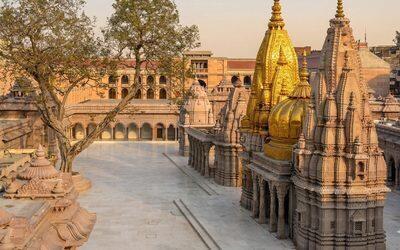
Gopinath is a principal seat of the Gaudiya Vaishnava gopis-bhakti tradition — the rasa-marga that treats Krishna not as the cosmic lord but as the cowherd-beloved of Vraja. The Gaudiya goswamis taught that the highest sweetness of Krishna is the Gopinath bhav, where the lord himself is captured by the love of his devotees; the gopis bind him with rope, scold him for stealing, and feed him from their own hands. Madhu Pandit Goswami's establishment of Gopinath placed this teaching at the heart of the Vrindavan saptadevalaya.
The Gaudiya tradition holds that Gopinath, Govind Dev, and Madan Mohan together form a trinity of bhav — Madan Mohan teaches sambandha (the relationship with Krishna), Govind Dev teaches abhidheya (the means of worship), and Gopinath teaches prayojana (the ultimate goal — pure love in the gopis' mood). Pilgrims who walk the saptadevalaya in this order are said to receive the full progression of Gaudiya teaching in a single morning. Madhu Pandit Goswami was a disciple of Gadadhara Pandit, who himself is held by the Gaudiya tradition to be Radha — and so the Gopinath seva at Vrindavan carries an unbroken line back to Radha-bhav itself.
History
Gopinath Temple was established in the mid-sixteenth century by Madhu Pandit Goswami, a disciple of Gadadhara Pandit and a contemporary of the Six Goswamis of Vrindavan. The deity itself is said to have been ancient — recovered, like the other saptadevalaya thakurs, in the great Vaishnava revival that the goswamis led under the inspiration of Sri Chaitanya Mahaprabhu. The original temple was built in Akbar-period Vaishnava architecture, with a red-sandstone shikhara and stone-carved sanctum.
In 1670, when Aurangzeb's persecution forced the deities of Vrindavan to flee, the principal Gopinath murti was carried out of Vrindavan by way of Radha Kund and eventually reached Jaipur. There the deity was installed as the family thakur of the Maharaja of Amber-Jaipur, and Gopinath remains the principal Vaishnava authority of the Royal House to this day. The Jaipur Gopinath is the original murti; a replica was installed at the Vrindavan mandir and has been worshipped there in unbroken seva by the descendants of the Madhu Pandit Goswami line. Pilgrims who can travel are encouraged to visit both — the original murti at Jaipur and the seat of the lineage at Vrindavan.
Architecture
The Gopinath temple of Vrindavan is built in the Akbar-period Vaishnava style that distinguishes the saptadevalaya group — red sandstone construction, a Nagara shikhara, carved pillars in the mandapa, and a small stone-walled sanctum oriented to the east. The structure is smaller than Govind Dev and less ornamented than Radha Raman, but architecturally significant as one of the surviving sixteenth-century Vrindavan temples. The shikhara rises in modest tiers and is topped by a kalasha; the outer walls carry low-relief carvings of Vaishnava motifs — peacocks, lotuses, conch, and the bansuri-flute.
The inner mandapa is intimate, with stone pillars carved in a hybrid Rajputana-Mughal idiom. The deity sits on a small silver throne, dressed daily by the Goswami pujaris in seasonal silks and cowherd-shringar. The temple has been carefully maintained; modern outer additions support the original sixteenth-century core.
Rituals & Practices
Gopinath opens with Mangala Arati before dawn and follows the eight-darshan Gaudiya rhythm — Mangala, Sringar, Gwala (the cowherd darshan), Rajbhog, Utthapan, Sandhya, Bhog, and Shayan. Verify exact timings on the day of visit; they shift seasonally and on festival days. The bhog is prepared daily in the temple kitchen by the Goswami family on seva-duty and distributed as prasad after each arati.
Pilgrims who walk the saptadevalaya parikrama traditionally visit Gopinath after Madan Mohan and Govind Dev — the third stop in the morning sequence. The temple is least crowded at Mangala and Gwala darshans; Sringar and Rajbhog draw larger gatherings. Silent darshan with hands folded is the temple's preferred mood; bhajan and kirtan happen in the outer courtyard rather than the sanctum.
Festivals & Celebrations
| Festival | When | Crowd |
|---|---|---|
| Janmashtami | — | very_high |
| Radhashtami | — | very_high |
| Gaura Purnima | — | high |
| Madhu Pandit Goswami Disappearance Day | — | medium |
Janmashtami: Krishna''s birthday â the makhan-chor''s appearance day, especially dear at Gopinath.
Radhashtami: Honours Radharani, the soul of the Gopinath bhav.
Gaura Purnima: Honours the founder of the Gaudiya tradition and the source-master of the saptadevalaya seva.
Madhu Pandit Goswami Disappearance Day: Honours the founder of the Vrindavan Gopinath seva and the disciple of Gadadhara Pandit.
Prepare for Your Visit
Practical guidance to help you plan your pilgrimage
| Pilgrim Guidance | How to reachGopinath Temple is in old Vrindavan, walking distance from Banke Bihari and Radha Raman. From the parikrama-marg, e-rickshaws drop pilgrims at the gali entrance; from there it is a short walk through the narrow devotional lanes. Mathura Junction (12 km) is the railhead; Delhi (150 km) the nearest airport. PreparationModest clothes; full-sleeved kurtas and full-length lower garments. The sanctum is small and the lane crowded during arati times — go early. Photography is restricted near the deity; outer courtyards are fine. Best time to visitOctober to March for pleasant weather. Janmashtami, Radhashtami, and Gaura Purnima are the major spiritual peaks. Madhu Pandit Goswami's Disappearance Day is observed quietly by the lineage. Early-morning Mangala Arati on any day is the most spiritually charged darshan. |
Location
Mathura, UP
Pilgrim photos
No pilgrim photos yet.
Community corrections
No corrections yet.
Edit history
No revisions yet.
Plan Your Visit to Gopinath Temple
Get a custom itinerary and pricing for your trip.
Recommended
Packages for this destination
Pilgrim Notes
On-ground observations from fellow pilgrims
No pilgrim notes yet. Be the first to share on-ground observations!
Sign in to share a note.
Pilgrim Reviews
Be the first to share your experience at Gopinath Temple.
Sign in to write a review.
Nearby sacred places
Discover other sacred places near Gopinath Temple
Explore temples, tirthas, and pilgrimage sites in UP
Explore nearbyPart of these circuits
Walk the traditional pilgrimage routes this destination belongs to.